Introduction
Type “perchance ai” into Google and you’ll get a flood of generic listicles that all say the same thing: it’s free, it’s unlimited, no sign-up required. All true. What almost none of them tell you is how the thing actually works under the hood, why that architecture matters for your privacy, and why regulators in the UK and EU have started paying uncomfortably close attention to platforms exactly like this one in 2026.
This guide covers both sides: the genuinely useful creative tool that hundreds of thousands of writers, game masters, and hobbyists use every week, and the parts of the story — content moderation, age verification, data handling — that a responsible write-up shouldn’t skip.
What Is Perchance AI, Exactly?
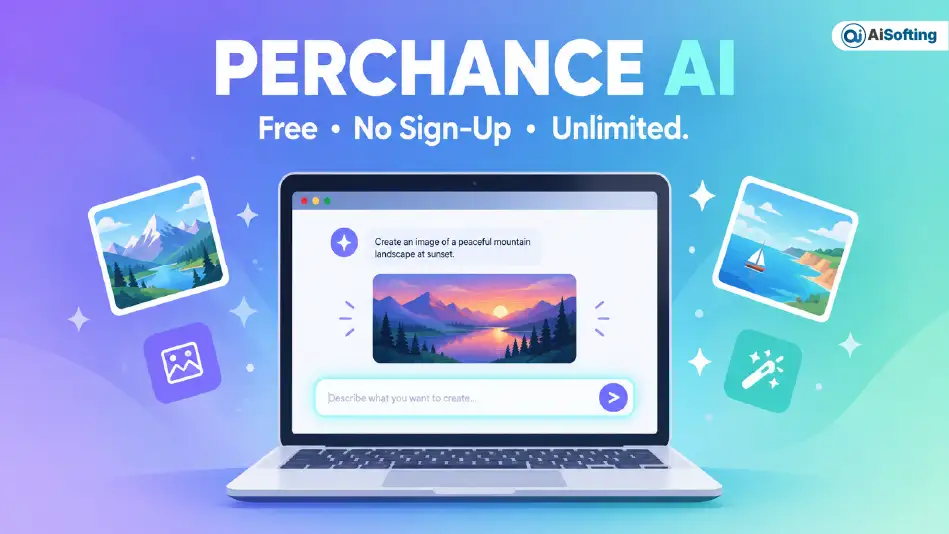
Perchance (perchance.org) isn’t a single AI product. It’s a platform for building and sharing random generators, and AI-powered tools are just the layer that got bolted onto that original idea. The site started years ago as a simple tool for making list-based random generators — think “random D&D character name” or “random writing prompt” — and has since grown into a sprawling library of community-built pages, many of which now use generative AI models for text, images, and chat.
Not One App — A Whole Ecosystem
This is the part most articles gloss over. When people say “Perchance AI,” they usually mean one of a handful of flagship pages:
- AI Text-to-Image Generator – turns a text prompt into an image
- AI Character Generator – builds detailed fictional characters and backstories
- AI Character Chat / AI Chat – a Character.AI-style chatbot experience
- AI Text Adventure (AI RPG) – an AI Dungeon-style interactive story engine
- AI Comic Generator and dozens of smaller, community-made spin-offs
Every one of these is technically a separate “generator” built on Perchance’s own scripting system, not a single unified app. That distinction matters because quality, reliability, and content policy can vary wildly from one generator to the next, even though they all live under the same perchance.org domain.
The Engine Behind It: Perchance Script
Perchance generators are written in a simplified, list-based scripting language the community just calls “Perchance syntax.” You define lists (of names, adjectives, scenarios, etc.), and the engine randomly combines them — with plugins layered in for AI image and text generation. This is why the platform describes itself as low-code: anyone can fork an existing generator and remix it without needing to write real JavaScript, though a simplified version of JS is available for advanced users.
How Perchance AI Actually Works Under the Hood
This is the genuinely underreported technical detail, and it’s the reason Perchance behaves so differently from Midjourney, DALL·E, or ChatGPT.
Client-Side Generation vs. Server-Side Generation
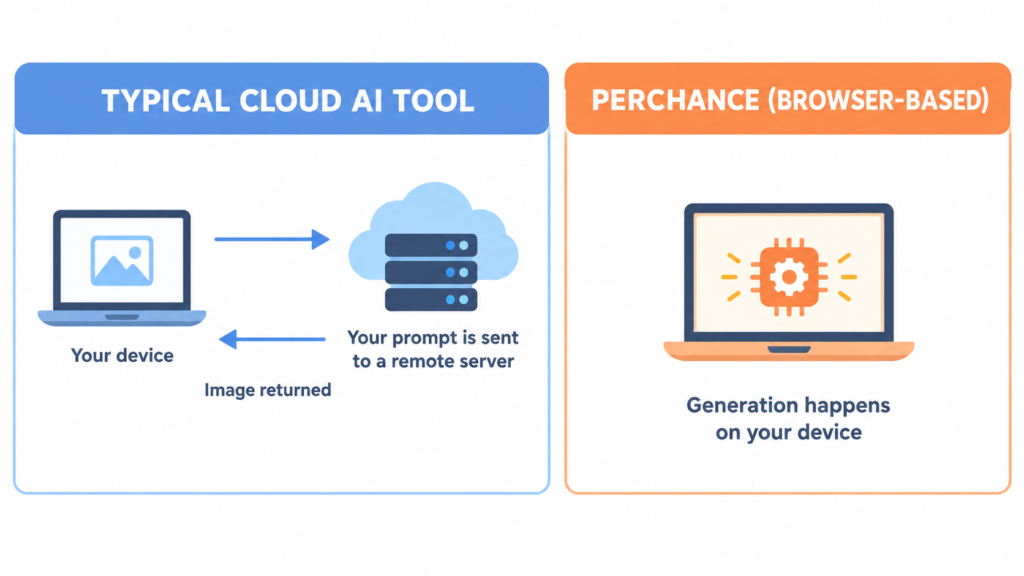
Most mainstream AI image tools send your prompt to a company’s servers, where the actual model runs, and send an image back. Perchance’s text-to-image generator largely runs inference in your own browser, using WebGL/WebGPU to execute Stable Diffusion-family models locally on your device rather than uploading your prompt to a remote server for every request.
Why this matters practically:
- Privacy trade-off, not privacy guarantee. Your prompt text may never leave your device for the actual image generation step, which is a genuine privacy advantage over cloud-only tools. But the page itself, ads, and any account activity are still tracked like a normal website.
- Performance depends on your hardware, not a data center. A weaker laptop or older phone will generate images slower and at lower resolution than a gaming PC — the opposite of how cloud tools behave.
- It explains the resolution ceiling. Community discussion consistently notes Perchance’s image outputs top out well below what a paid, server-hosted model like Midjourney can produce, because it’s constrained by consumer-grade browser compute rather than a data center GPU cluster.
This browser-based approach puts Perchance in a different technical category than most face-swap and portrait-style AI image tools, which almost universally process images server-side. If you’re specifically comparing image-generation approaches, our guide to AI face swap tools covers how those cloud-based pipelines work by contrast.
How It’s Funded
There’s no subscription tier gating the core tools. Reviewers who’ve used the site for months report it’s supported through on-site advertising and some affiliate/sponsored placements rather than a freemium paywall — which is also exactly why you’ll see ads around the generator interface.
Key Features That Make Perchance Popular
- Zero sign-up friction — no email, no password, no verification screen before you start
- Unlimited generations on most tools, with no visible daily cap the way many “free tier” competitors impose
- Remixable, open generators — you can view, fork, and modify almost any public generator’s underlying script
- Broad content range, including themes many mainstream AI platforms filter out
- A genuinely active builder community on Reddit and Lemmy where people share generator code, debug scripts, and teach beginners
Perchance’s AI Character Chat and roleplay generators occupy the same niche as dedicated apps we’ve reviewed separately — including Xoul AI, SpicyChat AI, and Nomi AI — but without any account system gating access. If you’ve used one of those and are curious how a no-login alternative compares, that’s the core trade-off: less friction, less structure.
Perchance AI vs. Other AI Tools
| Perchance AI | Midjourney / DALL·E | Character.AI | |
|---|---|---|---|
| Sign-up required | No | Yes | Yes |
| Cost | Free (ad-supported) | Paid subscription | Freemium |
| Where generation happens | Mostly in-browser | Cloud servers | Cloud servers |
| Content moderation | Minimal / community-defined | Strict | Moderate |
| Output resolution/quality ceiling | Lower | Higher | N/A (text) |
| Age verification | None | Account-based | Account-based |
If you’re weighing Perchance’s chat and roleplay tools against dedicated platforms, it’s worth reading our breakdown of Character.AI’s soft launch and how it actually works, since several of Perchance’s community-built chat generators are direct answers to that same product category. For a wider view of where these tools sit today, our full AI reviews hub compares dozens of similar platforms side by side.
Benefits of Using Perchance AI
- Genuinely useful for tabletop RPG prep — quick NPC names, backstories, and random encounter tables
- Good for brainstorming and drafting, not final production art
- Low barrier to entry for learning generator/prompt logic without touching real code
- No financial commitment to experiment with AI image or chat concepts before investing in a paid tool
The Regulatory Reality Check Most Guides Skip
Here’s the part that’s genuinely new information and rarely covered in “what is Perchance AI” content: 2026 has been a turning point for anonymous, no-login AI generators, and it’s directly relevant to how you should think about using (or letting a minor use) a platform like this.
The UK’s Online Safety Act came into force with age-verification enforcement in mid-2025, requiring platforms hosting adult or harmful material to implement “highly effective” age assurance — ID checks, facial age estimation, or similar. Major platforms like Reddit, Discord, Bluesky, and adult sites had to comply or restrict UK access. Perchance’s model — no accounts, no age gate, community-defined content rules — sits in an awkward position relative to that framework precisely because it has none of the friction the law is designed to require.
Separately, the Internet Watch Foundation has repeatedly warned throughout 2025–2026 about a surge in AI-generated child sexual abuse material appearing on open, unfiltered generation tools rather than hidden dark-web forums — a trend regulators explicitly tie to platforms with weak or no content moderation and no age verification. This isn’t a Perchance-specific finding from the IWF, but independent parental-safety reviews published in 2026 have specifically flagged Perchance by name as high-risk for younger users because of this exact combination: no registration, minimal moderation, and unrestricted NSFW toggles on some generators.
What this actually means for you:
- If you’re an adult using Perchance for writing prompts, character design, or casual image generation, the practical risk is low — but understand you’re on a platform explicitly built to avoid the friction regulators now require elsewhere.
- If there’s any chance a minor in your household could access it, treat it the same way you’d treat an unfiltered search engine, not a walled-garden app store product. Standard parental controls (device-level content filtering, DNS filtering, or router-level blocking) are currently the only real mitigation, since Perchance itself has no built-in age gate to toggle.
- Expect this space to keep shifting. Age-verification mandates are expanding beyond the UK (several US states have passed similar laws), and platforms like Perchance that rely on anonymity as a feature will likely face growing pressure to add some form of assurance.
Common Mistakes People Make With Perchance AI
- Assuming “AI Perchance” (a common misspelling) leads to the same official site — it doesn’t always; stick to perchance.org and be wary of copycat domains
- Expecting Midjourney-level image quality and getting frustrated with lower resolution and less prompt adherence
- Writing prompts like a search query instead of a descriptive scene (style, lighting, composition all help)
- Not reading the specific generator’s rules — content policy is set per-generator by whoever built it, not uniformly by Perchance
- Treating chat generators as private when conversations aren’t guaranteed confidential the way a paid, account-based service might frame it
Best Practices and Tips
- Start with an existing popular generator and study its script before building your own — it’s the fastest way to learn Perchance syntax
- For images, front-load the important subject and style keywords; the model weighs early tokens more heavily
- Use “anti-descriptions” (negative prompts) to cut out recurring artifacts, extra limbs, or unwanted style bleed
- If a generator feels slow, it’s often your device’s GPU/CPU load, not a site-wide outage — try a smaller batch size
- Cross-check anything Perchance generates as “factual” (its story and chat tools are creative generators, not research tools)
Personal Experience Section
I first stumbled onto Perchance while prepping a tabletop campaign and needing quick NPC names and one-line backstories at 11 p.m. with zero patience for creating an account somewhere. That’s genuinely where it shines: the friction is gone, and for that narrow “I need fifty variations of a fantasy tavern name right now” use case, nothing beats it.
Where my experience got more mixed was the image generator. The first few sessions were fun — fast, no login, decent results for rough concept sketches. But after switching between a few different devices, the quality gap was obvious: a five-year-old laptop produced noticeably worse, slower results than a newer machine, which took me a while to connect to the fact that the model runs locally rather than on a remote server. Once I understood that, the inconsistency made sense — it’s not that the tool got worse, it’s that the previous device was doing more of the heavy lifting than I realized.
The other lesson, learned the harder way: not every generator with “Perchance” in its name behaves the same. I forked someone’s public character generator expecting sanitized output similar to the main homepage tools, and it wasn’t — content policy is genuinely per-generator, set by whoever built and published it. That’s a useful reminder that Perchance is closer to a hosting platform for thousands of independently-run tools than a single curated product, and it’s worth reading a generator’s own notes before assuming it behaves like the flagship version.
If you’re coming from paid tools like Midjourney, temper expectations on output quality and resolution — but for rapid, no-cost ideation and RPG prep, it’s earned a permanent spot in my bookmarks bar.
Frequently Asked Questions
Is Perchance AI actually free?
Yes — the core generators (image, chat, text adventure, character creation) don’t require payment or a subscription. The site is supported by advertising rather than a paywall.
Do I need to sign up to use Perchance?
No account is required to use most generators. Creating a free account only unlocks extras like saving your own custom generators.
Is Perchance AI safe for kids?
No, and multiple 2026 parental-safety reviews explicitly warn against it for minors due to the lack of age verification and inconsistent, per-generator content moderation. Treat it like an open part of the internet, not a filtered kids’ app.
Why does the official site look different from other “Perchance AI” sites I found on Google?
Because perchance.org is the only official domain. A number of independent fan sites and SEO-optimized guides use similar names and branding but are not affiliated with or endorsed by the original developer.
Is Perchance’s image generator as good as Midjourney or DALL·E?
Not in raw output quality or resolution — those are paid, server-hosted models with far more compute behind them. Perchance’s advantage is speed, cost (free), and privacy from running locally in-browser, not top-tier image fidelity.
Can I use Perchance to build my own AI tool without coding experience?
Yes — that’s the platform’s original purpose. Its list-based scripting language is designed to be approachable for non-programmers, with an active community that helps troubleshoot on Reddit and Lemmy.
Does Perchance store or sell my prompts?
Perchance’s own account documentation states it doesn’t store data tied to how you use its generators, and you’re only emailed at your request (e.g., for password resets). That said, this is a self-reported policy, not an independently audited one — treat it accordingly for anything sensitive.
Why is Perchance sometimes described as risky or controversial?
Mainly because of the same feature that makes it popular: no sign-up and light content moderation, which regulators and child-safety organizations have flagged as a growing concern industry-wide in 2025–2026, not unique to Perchance but very much applicable to it.
Conclusion and Actionable Takeaways
Perchance AI is a genuinely useful, zero-cost entry point into AI generation — best suited for brainstorming, tabletop prep, and casual creative writing rather than professional-grade image or content production. Its browser-based, client-side architecture is the real technical story behind why it feels different from Midjourney or ChatGPT, and it’s the reason both its privacy upside and its performance inconsistency exist.
Before you dive in:
- Use the official perchance.org domain only, and verify any generator’s specific content rules before relying on it
- Don’t expect paid-tool image quality — use it for speed and iteration, not final output
- If minors have any device access in your household, add device-level filtering rather than relying on the platform itself
- Keep an eye on the regulatory landscape — age-verification requirements are expanding, and anonymity-first platforms like this one are squarely in that conversation
For a broader look at where free and freemium AI tools are heading in 2026 — including the roleplay, image, and productivity categories Perchance touches — browse our artificial intelligence section for ongoing reviews and comparisons.
Disclaimer: This article is for informational purposes only and reflects publicly available information as of September 2026. Perchance.org hosts user-generated and community-built content that is not centrally curated by a single company; content policies, features, and availability can change without notice and vary by individual generator. This is not legal advice regarding the UK Online Safety Act or any other regulation — consult official government or legal sources for compliance guidance. Parents and guardians should independently assess and supervise any AI platform’s suitability for minors.