If you’ve been poking around the AI space lately, you’ve probably noticed something a bit unsettling — most of the popular chatbots out there are quietly storing your conversations, building profiles on your behavior, or routing everything through some server farm you’ve never heard of. It’s not exactly a secret, but most people don’t think about it until something goes wrong.
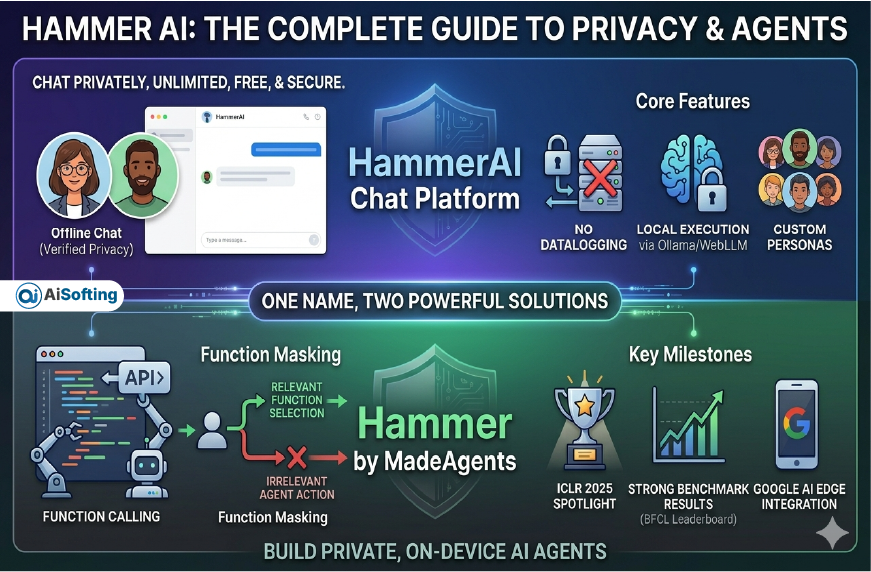
That’s where Hammer AI comes in. And actually — depending on what you’re looking for — there are two very distinct things that go by this name. One is a privacy-first AI chat platform for everyday users. The other is a series of cutting-edge, lightweight large language models built specifically for on-device function calling — and it’s been making serious waves in the developer community. Both are genuinely interesting in their own right, and this guide is going to break down both of them in detail.
Whether you’re a curious user who wants private AI interactions or a developer looking for robust, on-device agentic capabilities, there’s a version of Hammer AI that’s almost certainly relevant to you.
What Exactly Is Hammer AI?
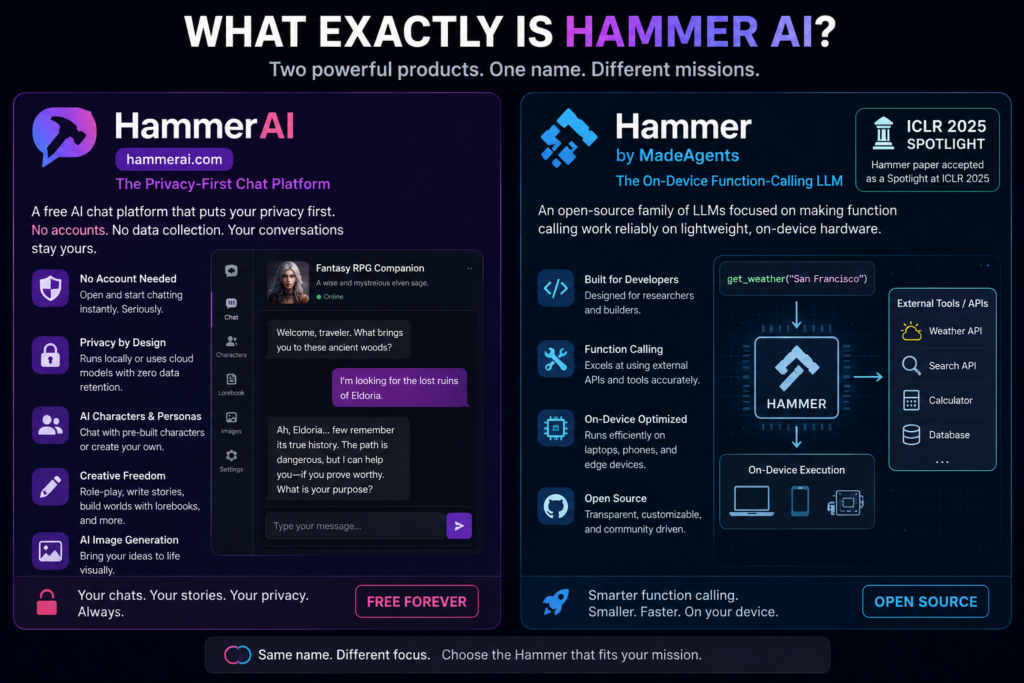
Let’s get the definitions out of the way first, because the term “Hammer AI” actually covers two overlapping but distinct products:
HammerAI (hammerai.com) — The Privacy-First Chat Platform
HammerAI is a free AI chat platform designed from the ground up around one core idea: your conversations are yours. Unlike mainstream chatbots that require you to create an account, agree to data collection policies, and trust that your chats won’t be used for training, HammerAI takes a fundamentally different approach.
The platform lets you chat with AI characters — both pre-built ones and custom personas you create yourself — without ever logging in. Seriously, no account needed. You just open the app or the website and start chatting. All core processing either runs locally on your own machine or, if you use cloud-hosted models, nothing is stored after your session ends.
It supports role-playing, creative writing, story building with lorebooks, and even AI image generation. Think of it as a creative AI sandbox that genuinely respects your privacy.
Hammer (by MadeAgents) — The On-Device Function-Calling LLM
The other “Hammer AI” is an open-source family of large language models developed by MadeAgents. This one is squarely aimed at developers and AI researchers. The Hammer model series focuses specifically on making function calling — the ability of an AI to correctly use external APIs and tools — work well on lightweight, on-device hardware.
In February 2025, the Hammer paper was accepted as a Spotlight at ICLR 2025, one of the most prestigious machine learning conferences in the world. That’s a pretty big deal for a relatively small research team.
We’ll dig into both of these in depth. Let’s start with the consumer-facing platform, since that’s what most people searching “Hammer AI” are looking for.
HammerAI Chat Platform: A Deep Dive
How It Works
HammerAI runs on two core modes:
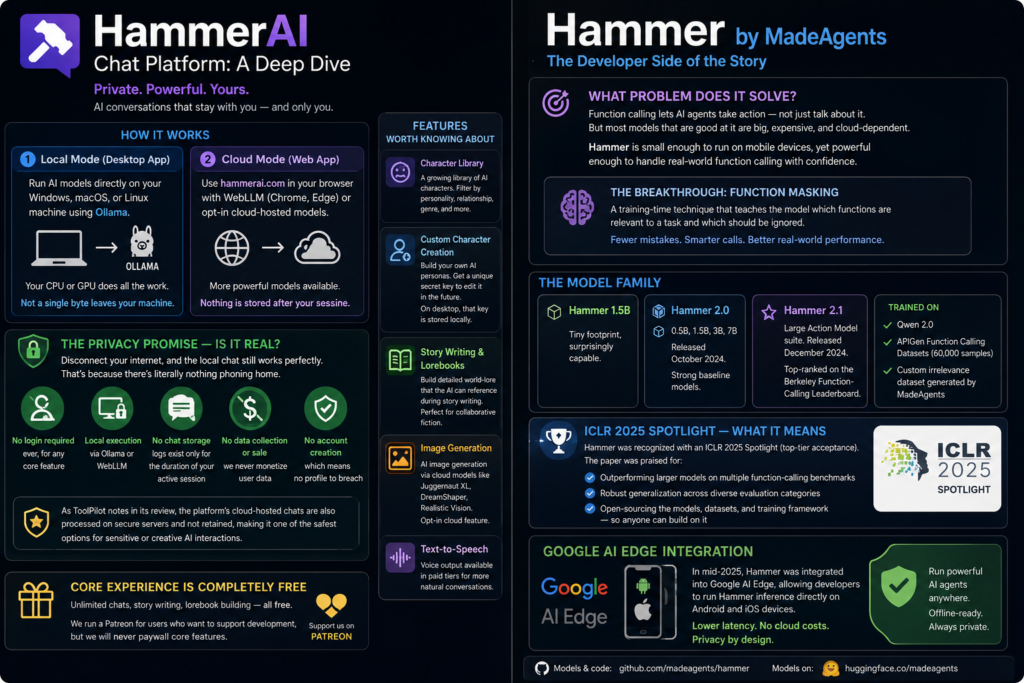
1. Local Mode (Desktop App) When you download the HammerAI desktop application for Windows, macOS, or Linux, you can run AI models directly on your own hardware using Ollama, a popular framework for running LLMs locally. In this mode, your CPU or GPU does all the work. Not a single byte of your conversation leaves your machine.
2. Cloud Mode (Web App) The web app is available at hammerai.com and works directly in your browser using a technology called WebLLM, which runs models locally in compatible browsers like Chrome and Edge. For users who want more powerful models without the desktop download, cloud-hosted options are also available — and even those aren’t stored after your session.
The Privacy Promise — Is It Real?
Here’s the thing that actually makes HammerAI stand out. A lot of apps claim to be private. HammerAI gives you a way to verify it yourself: disconnect your internet, and the local chat still works perfectly. That’s because there’s literally nothing phoning home.
Key privacy features include:
- No login required — ever, for any core feature
- Local model execution via Ollama or WebLLM, meaning data never leaves your device
- No chat storage — logs exist only for the duration of your active session
- No data collection or sale — the platform pledges never to monetize user data
- No account creation — which means there’s no profile to breach
As ToolPilot notes in its review, the platform’s cloud-hosted chats are also processed on secure servers and not retained, making it one of the safest options for sensitive or creative AI interactions.
Features Worth Knowing About
Character Library HammerAI has a growing library of AI characters across different genres, personalities, and use cases. You can filter by personality type, relationship dynamic, genre, and more. Whether you want a philosophical sparring partner or a creative writing collaborator, there’s probably something that fits.
Custom Character Creation Users can build their own AI personas. When you create a character, you get a unique secret key that lets you edit it in the future. On desktop, that key is stored locally — again, no external servers involved.
Story Writing and Lorebooks One of the more creative features is the lorebook system, which lets you build out detailed world-lore that the AI can reference during story writing. If you’re into collaborative fiction, this is genuinely useful.
Image Generation HammerAI also offers AI image generation through cloud-based models like Juggernaut XL, DreamShaper, and Realistic Vision. This is one of the features that require the cloud component, but its still opt-in.
Text-to-Speech Voice output is available in paid tiers, letting conversations feel more like real interactions.
Pricing
Here’s the good news: the core experience is completely free. Unlimited chats, story writing, lorebook building — all free. The platform runs a Patreon for users who want to support development, but the team has explicitly committed to never paywalling core features.
Hammer by MadeAgents: The Developer Side of the Story
Now let’s talk about the other Hammer AI — the one that’s getting citations at ICLR and integration into Google AI Edge.
What Problem Does It Solve?
Function calling is a critical capability for modern AI agents. It’s what allows a language model to not just talk about doing something, but actually do it — calling a weather API, booking a calendar event, fetching data from a database. The challenge? Most models that are good at function calling are big, expensive, and cloud-dependent.
MadeAgents set out to build something different: a family of models that are small enough to run on a mobile device, but capable enough to handle real-world function calling without embarrassing themselves.
As described in the official Hammer paper on arXiv, the team developed a technique called function masking — a training-time strategy that forces the model to learn which functions are relevant to a given task, and which should be ignored. This sounds simple, but its actually a core insight: most function-calling failures happen because models get confused by irrelevant API options and try to call something that doesn’t fit the situation.
The Model Family
The Hammer series (available on Hugging Face under MadeAgents) includes:
- Hammer 1.5B — tiny footprint, surprisingly capable
- Hammer 2.0 (0.5B, 1.5B, 3B, 7B) — released October 2024, strong baseline models
- Hammer 2.1 — the Large Action Model suite, released December 2024, with impressive rankings on the Berkeley Function-Calling Leaderboard
All models are fine-tuned on Qwen 2.0 and trained using the APIGen Function Calling Datasets (60,000 samples) plus a custom irrelevance dataset the MadeAgents team generated themselves.
ICLR 2025 Spotlight — What It Means
Getting a Spotlight paper at ICLR is genuinely meaningful in the academic ML community. It means the work was reviewed by multiple experts and ranked in the top tier of submissions. The Hammer paper was recognized for:
- Outperforming larger models on multiple function-calling benchmarks
- Demonstrating robust generalization across diverse evaluation categories
- Open-sourcing the models, datasets, and training framework — so anyone can build on it
As the OpenReview page confirms, Hammer’s empirical evaluations show that it doesn’t just match bigger models — it beats several of them despite being a fraction of the size.
Google AI Edge Integration
In a major validation, Hammer was integrated into Google AI Edge in mid-2025, allowing developers to run Hammer inference directly on Android and iOS devices. This is a big deal for anyone building mobile AI agents who don’t want to pay cloud API costs or deal with latency.
HammerAI vs. Competing Platforms: Quick Comparison
| Feature | HammerAI | Character.AI | JanitorAI |
|---|---|---|---|
| Login Required | ❌ No | ✅ Yes | ✅ Yes |
| Local Execution | ✅ Yes (Desktop) | ❌ No | ❌ No |
| Data Storage | ❌ None | ✅ Stored | ✅ Stored |
| Free Tier | ✅ Unlimited | Partial | Partial |
| Custom Characters | ✅ Yes | ✅ Yes | ✅ Yes |
| NSFW Content | ✅ Optional | ❌ Censored | ✅ Optional |
| Image Generation | ✅ Yes | ❌ No | ❌ No |
| Open Source Models | ✅ Yes (via Ollama) | ❌ No | ❌ No |
The table makes it pretty obvious where HammerAI’s advantages lie — privacy and control. It’s not necessarily the slickest interface out there, but for users who care about where their data goes, the trade-off is clearly worth it.
Pros and Cons of HammerAI
Pros
- Genuinely private — local execution means your data never leaves your machine
- No login friction — just open and use
- Free and unlimited for core features
- Flexible deployment — web or desktop, cloud or local
- Creative tools included — lorebooks, story writing, image gen
- Cross-platform — Windows, macOS, Linux, and browser
Cons
- Interface is functional but not flashy — some users find it basic compared to polished commercial apps
- Some docs behind Discord — getting deeper into customization sometimes requires joining the Discord community
- Cloud image generation requires internet — local-only mode loses this feature
- Community is smaller than mainstream platforms, so the character library is more limited
Pros and Cons of Hammer (MadeAgents)
Pros
- State-of-the-art function calling for its model size
- Fully open-source — models, datasets, training code
- On-device capable — runs on mobile hardware via Google AI Edge
- Strong benchmark performance — BFCL rankings back up the claims
- Active development — Hammer 2.1 released just months after 2.0
Cons
- Primarily for developers — not beginner friendly
- Requires technical setup — Ollama, vLLM, or HuggingFace familiarity needed
- Smaller context window than some cloud alternatives
- Limited to function calling — not a general-purpose LLM for all tasks
Tips for Getting the Most Out of HammerAI
If you’re planning to use HammerAI, here’s what actually makes a difference:
- Download the desktop app if privacy is your top priority. The web app is convenient but the desktop version with Ollama is where the true local-only experience lives.
- Choose your model wisely. In the desktop app, you can download different LLM weights. Larger models (7B+) give better responses but need more RAM. If you’re on a laptop with 8GB RAM, stick with 3B or smaller.
- Use lorebooks for creative writing. If you’re building a story, invest time in setting up a lorebook first. It makes a noticeable difference in how contextually consistent the AI’s responses are.
- Create your own characters. The pre-built library is fun, but custom characters tailored to your specific use case — whether that’s a study buddy, a creative writing partner, or a specific fictional persona — are where HammerAI really shines.
- Don’t worry about the lack of login. It feels weird at first if you’re used to accounts everywhere, but that’s the whole point. You’re not missing out on saved history — that’s a feature, not a bug.
Who Should Use Hammer AI?
HammerAI (chat platform) is for:
- Privacy-conscious users who don’t want their conversations stored or analyzed
- Creative writers who want an AI collaborator for fiction, worldbuilding, or roleplay
- People curious about AI who want to explore without creating accounts
- Users in regions with strict data privacy concerns
- Developers who want to experiment with local LLMs without coding their own interface
Hammer by MadeAgents is for:
- Mobile app developers building AI agents that need to call APIs
- Researchers working on function calling or on-device AI inference
- Companies that want to add agent capabilities to their products without cloud dependency
- Teams exploring edge AI and privacy-preserving inference
FAQs About Hammer AI
Is HammerAI completely free?
Yes. Core features including unlimited chat, character creation, story writing, and lorebooks are free. Cloud image generation and TTS may require optional paid tiers, but the chat experience itself costs nothing.
Does HammerAI store my conversations?
No. Local model chats never leave your device. Cloud-hosted sessions are processed securely and not retained after the session ends.
What hardware do I need to run HammerAI locally?
For most smaller models (1.5B–3B), a modern laptop with 8GB RAM works fine. Larger models benefit from more RAM and a dedicated GPU. The app automatically detects and uses your GPU if available.
Is the Hammer (MadeAgents) model available commercially?
Yes — the models are open-sourced under the Apache 2.0 license, which allows commercial use. Check the GitHub repository for exact terms.
How does Hammer AI compare to GPT-4 for function calling?
The MadeAgents Hammer 2.1 models have shown competitive results on the Berkeley Function-Calling Leaderboard relative to much larger models. For on-device use cases, there’s currently nothing comparable in its size range.
Can I use HammerAI on my phone?
The web app works on mobile browsers. A native mobile app isn’t officially available as a download yet, but the web experience is mobile-friendly.
The Bigger Picture: Why This Matters
There’s a broader trend happening in AI right now, and Hammer AI sits right at the center of it. Privacy concerns around AI are growing. Regulatory pressure — especially in the EU under the AI Act and in various US state-level privacy laws — is pushing companies toward more transparent data practices. And on the technical side, the push for on-device AI inference is accelerating because it’s cheaper, faster, and more private than routing everything through the cloud.
HammerAI is essentially a bet that users care about privacy enough to choose it over convenience. And based on the community that’s forming around the platform on Reddit and Discord, that bet seems to be paying off.
MadeAgents’ Hammer, on the other hand, is a bet that you don’t need a massive model to do useful work — that with the right training techniques and smart architectural choices, a 7B parameter model can punch well above its weight. The ICLR 2025 Spotlight acceptance and the Google AI Edge integration suggest the technical community agrees.
Conclusion: Should You Use Hammer AI?
If you’ve been looking for an AI chat experience that doesn’t come with a side of surveillance capitalism, HammerAI is genuinely worth your time. It’s free, it works, and the privacy model is one of the most robust you’ll find in consumer AI right now. The creative tools are solid, the character customization is fun, and the fact that you can run the whole thing offline — just to prove to yourself that nothing is phoning home — is a real differentiator.
For developers, the MadeAgents Hammer model family is one of the most exciting open-source developments in the on-device AI space in the last year. The function masking technique is clever, the benchmark results are strong, and the Google AI Edge integration opens up a whole category of mobile applications that weren’t really feasible before.
Here’s the actionable takeaway: privacy in AI isn’t just a nice-to-have anymore — it’s becoming a baseline expectation. Whether you’re a regular user or a developer building the next generation of AI agents, Hammer AI — in both its forms — offers a compelling path forward.
Visit: Aisofting