If you’ve ever sat staring at a blank page, trying to write a fantasy novel, build out a roleplay scenario, or just explore a fictional world you’ve had in your head for years — you’ll know the frustration. Most AI tools aren’t really built for that kind of creative work. They’re built for emails, summaries, and productivity checklists. DreamGen AI is different, and that’s precisely why it’s been getting so much attention in 2026.
DreamGen is a narrative-first AI platform designed specifically for immersive roleplay and collaborative story generation. It’s not a chatbot with a coat of paint — it’s a full creative environment where you define the world, the characters, the lore, the tone, and then let the AI bring it all to life. Whether you’re a fiction writer fighting off writer’s block, a tabletop RPG enthusiast, or someone who just loves deep, character-driven storytelling, DreamGen has carved out a pretty unique space in the AI landscape.
What you’ll find in this guide:
- What DreamGen AI actually is and how it works
- A breakdown of its core features (Scenario Codex, Steering Dial, Anchor Memory)
- How the DreamGen Story Mode vs. Roleplay Mode differs — and when to use each
- Full pricing tier breakdown for 2026
- A look at all available AI models (Lucid Base vs. Lucid Max)
- Who it’s best for — and who should look elsewhere
- Honest pros and cons, including real platform limitations
- Head-to-head comparisons with Character.AI, NovelAI, Candy AI, and SpicyChat
- Pro tips for getting better results, including how to beat context drift
- FAQs, a final verdict, and actionable takeaways
Let’s get into it.
What Is DreamGen AI?
At its core, DreamGen AI is an AI-powered roleplay and story writing platform that lets users create and interact with AI characters in dynamic, user-directed narratives. The platform has been steadily building a community of writers, gamers, and creative enthusiasts — and the V2 interface overhaul in March 2026 marked a clear signal that this isn’t just a niche hobby project anymore.
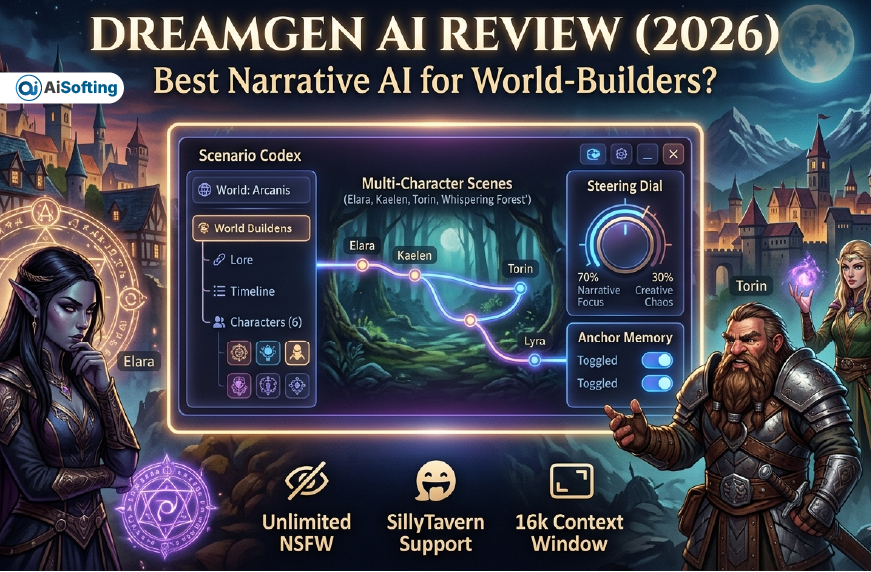
What sets DreamGen apart from tools like Character.AI or even NovelAI is something it calls the Scenario Codex — a structured pre-production layer where you set the rules of your world before you start writing. You define the plot direction, the characters’ personalities and relationships, the tone of the writing, the lore, the setting — all of it. DreamGen then carries that context forward through every scene, without you having to repeat yourself over and over.
That might sound like extra work upfront, and honestly, it is. But the payoff is significant. Users who invest time in building their Codex report far more consistent, coherent, and immersive narratives than what they’d get from other platforms. The AI actually remembers the rules you’ve set.
DreamGen Story Mode vs. Roleplay Mode: What’s the Difference?
One of DreamGen’s most genuinely useful features is the separation of its two core writing modes:
- Roleplay Mode — Dialogue-driven, first-person interaction. You’re in the scene, talking to AI characters who respond based on their defined personalities and backstories. Best for interactive, immersive sessions where you want to be inside the story.
- Story Mode — Third-person narration, more traditional creative writing. You’re the author shaping the plot, not necessarily a character inside it. Best for long-form narrative writing, plot development, and prose-heavy sessions.
Being able to switch between these depending on what kind of session you’re in makes the platform way more flexible than tools locked into one interaction style. Writing an ensemble fantasy story one day and want to play as one of the characters next session? DreamGen lets you shift gears without starting from scratch.
Key Features of DreamGen AI
The Scenario Codex — DreamGen’s World-Building Engine
This is the beating heart of the platform. Before a single line of story is generated, users build out their scenario using DreamGen’s codex tools. You can specify:
- Character names, physical descriptions, backstories, and personality traits
- Relationships between characters (friendships, rivalries, romantic tension, political alliances)
- World locations, artifacts, factions, and hidden lore
- The overall tone — dark and gritty, light-hearted adventure, mature romance, horror, sci-fi, etc.
- Plot anchors that the AI is expected to follow throughout
Here’s how the system architecture flows at a high level:
[User Input: World Rules & Lore]
            |
            v
   [Scenario Codex Engine]
            |
            v
 [Persistent Context Window]
            |
            v
[Coherent Multi-Character Outputs]
Once this is set up, DreamGen threads all of it through every generated scene. That’s the promise — and based on user feedback, it delivers more consistently than most competitors. The key insight here is that DreamGen treats storytelling like pre-production on a film, not a casual chat session.
💡 PRO TIP: Don’t rush the Codex setup. Users who spend 20–30 minutes building out character relationships, world lore, and plot anchors before writing a single scene report dramatically better output quality and fewer consistency issues. Think of it as the investment that pays dividends across every scene that follows.
Multi-Character Scene Support
This is one of those features that sounds like marketing fluff until you actually try it. DreamGen supports multiple AI characters in a single scene simultaneously. Each character maintains its own distinct voice, motivations, and backstory. You can have three or four characters interacting in one scene with genuine narrative depth — not just one AI pretending to be multiple people in a single reply.
For anyone writing ensemble fiction, group roleplay sessions, or complex tabletop-style adventures, this is probably the main reason to choose DreamGen over alternatives like SpicyChat AI. This is also what makes DreamGen one of the best AI platforms for writing ensemble fiction with multiple characters — a use case most competitors simply can’t serve well.
The Steering Dial
Context drift is a universal problem with AI storytelling platforms. You’re 25 messages into a pirate adventure and suddenly your grizzled sea captain is speaking like a corporate HR rep. It happens to everyone.
DreamGen’s Steering feature lets you actively adjust AI behavior mid-scene — pushing toward more creative chaos when outputs get flat, or snapping it back to strict adherence when things drift too far. On most other platforms you’d have to manually write several correction prompts and hope for the best. Here you’ve got a dial, and you use it proactively, not desperately.
Anchor Memory
DreamGen doesn’t rely purely on short-term chat memory. Users can set story anchors — key facts, character states, and plot points — that persist across sessions. This is what makes longer storytelling arcs actually feasible. Think of it like bookmarking the essential truths of your fictional world so the AI can reference them even deep into an extended session.
💡 PRO TIP: To completely bypass the 20–30 message context drift limit, copy your external “Story Bible” notes and paste them back into DreamGen’s Anchor Memory settings roughly every 15 prompts. This single habit dramatically improves long-term narrative consistency and prevents characters from “forgetting” who they are mid-scene.
How to Use DreamGen API in SillyTavern
For more technically-inclined users, DreamGen offers API access to its underlying language models. The platform is officially supported in SillyTavern as a text-completion API, which makes it a popular backend choice for advanced roleplay and world-building users who prefer to work inside their own custom frontends.
To connect DreamGen to SillyTavern:
- Go to your DreamGen account settings and find your API key
- In SillyTavern, navigate to API Connections → Text Completion → Custom
- Enter the DreamGen API endpoint and your key
- Select your preferred model (Lucid Base or Lucid Max) and save
This level of flexibility is a genuine differentiator — most consumer AI tools don’t offer this at all, and the SillyTavern community has built an extensive library of character cards and scenario templates specifically optimized for DreamGen’s output format.
Image Generation (Recent Addition)
Image generation was added to DreamGen’s roadmap and has since rolled out as a paid-credit feature. It’s newer and not quite at the level of dedicated image generators like Midjourney, but for users who want to pair their written scenes with visuals — character portraits, setting illustrations — it’s a useful addition that keeps you inside one platform.
⚠️ NOTE: Image generation costs extra credits on all plans, including Pro. If visuals are a core part of your workflow, factor this into your budget when comparing plans.
DreamGen AI Pricing: Breaking Down the Plans (2026)
DreamGen uses a credit-based pricing model with four tiers, ranging from free to $48.30 per month. Here’s the full breakdown:
| Plan | Monthly Price | Context Window | Monthly Credits | Daily Credits |
|---|---|---|---|---|
| Free | $0 | Limited | Basic allocation | Daily top-up |
| Starter | ~$7.83/mo | 4,000 tokens | 375 credits | 45 credits |
| Advanced | ~$19.35/mo | 8,000 tokens | 2,250 credits | 75 credits |
| Pro | ~$48.30/mo | 30,000 tokens | Large allocation | Included |
A few things worth knowing before you pick a tier:
The context window matters more than the credit count. The Starter plan’s 4,000 tokens is genuinely tight for complex multi-character scenarios. Most serious users find that the Advanced tier at 8,000 tokens is where the platform starts to feel comfortable for longer sessions. The Pro tier’s 30,000-token window is for writers who want to run very extended sessions with minimal drift.
The free plan is actually pretty generous. No credit card required, credits reset at the start of each calendar month, and you also get a small daily top-up so you’re never completely locked out mid-month. On the Lucid Base model, 100 free credits can generate roughly 300 pages worth of prose output — that’s a solid test drive by anyone’s measure.
New users get 50% off for the first month on all paid plans, which makes it easy to try a higher tier without a big financial commitment upfront.
The Pro plan also gives a 20% discount on credit pack purchases and up to 60% off certain third-party AI models — useful for heavy users who want to experiment with different backends.
Always verify current pricing directly on the DreamGen pricing page as rates can shift.
DreamGen AI Models: Lucid Base vs. Lucid Max (Chonker)
DreamGen uses several large language models tuned specifically for narrative storytelling. Here’s how the main models compare as of 2026:
🐣 Lucid Base
- Fast, efficient, optimized for simpler to moderate adventures
- Has the longest effective context window on base plans
- Best for: lighter sessions, casual stories, free-tier users testing the platform
- Credit cost: lower per output token
🦚 Lucid Max (Chonker)
- The heavyweight option — more capable on complex, multi-character, epic narratives
- Better at maintaining distinct character voices across a large cast
- Best for: serious long-form projects, ensemble roleplay, writers who need depth
- Requires Advanced or Pro plan for unlimited access
GLM 4.7 / GLM 4.7 Flash
- Third-party model options integrated into DreamGen’s ecosystem
- Available at different credit costs — Flash is faster and lighter, standard GLM 4.7 is the default for most paid users
- Pro plan subscribers get up to 60% off third-party model credits
💡 PRO TIP: Don’t default to Lucid Max just because it sounds more powerful. For shorter, action-driven scenarios, Lucid Base is snappier and more responsive. Run the same opening scene through both models and compare — the stylistic differences are immediately obvious and one will likely click better with your writing voice.
Who Is DreamGen AI Best For?
Let’s be direct here — this isn’t a tool for everyone. If you want a quick, casual AI chat companion without any setup, DreamGen’s learning curve will frustrate you. Something like Candy AI or Character.AI is a better fit for that use case.
DreamGen genuinely shines for:
- Fiction writers and authors who want to build out characters, develop plot lines, and work through writer’s block with a collaborating AI that doesn’t forget what you’ve established
- Tabletop RPG enthusiasts and dungeon masters who want to simulate multi-character worlds and test narrative scenarios before running sessions
- Fan fiction writers who work in established universes and need an AI that can hold a lot of lore simultaneously
- World-builders who geek out on the pre-production side of storytelling — defining rules, locations, artifacts, and backstories in meticulous detail
- Advanced users and developers who want API access and integration with tools like SillyTavern
- Educators and trainers using narrative simulations to build engaging scenario-based learning environments
The platform also supports adult and NSFW creative writing. Unlike many mainstream AI platforms, DreamGen doesn’t impose content filters on mature themes, which is a significant draw for a particular segment of its user base. The platform does still enforce strict rules against illegal content, so it’s better described as an “uncensored hybrid” — creative freedom with non-negotiable hard limits.
Pros and Cons of DreamGen AI
✅ Pros
- Scenario Codex is genuinely powerful — the structured world-building approach produces more consistent narratives than most competitors
- Multi-character scenes actually work — not just a marketing claim; they hold up in extended testing
- The Steering dial gives real-time narrative control that most other platforms don’t offer
- Free tier is legitimately useful — no credit card required, monthly reset, daily top-up safety net
- API access + SillyTavern support for users who want custom frontends
- Story Mode + Roleplay Mode flexibility suits both authors and interactive players
- 50% first-month discount lowers the barrier to test paid features
- V2 interface (March 2026) addressed major UX complaints with cleaner scenario management and visible anchor controls
❌ Cons
- Context drift still happens — around 20–30 messages even on paid plans; characters can start to forget inventory items, relationships, or plot threads
- Steep learning curve for new users who skip the Codex setup step and then wonder why the output feels generic
- Credit-based pricing can feel metered if you’re a heavy user on lower plans
- No character visuals or avatar rendering — purely text-first; image gen is an add-on that costs extra credits
- Weak social features — no character sharing marketplace comparable to Character.AI’s ecosystem
- Multilingual support is limited — non-English users report weaker narrative consistency and tonal nuance loss
- Corporate transparency concerns — the company’s legal entity details are not clearly disclosed in public-facing documentation, which some users flag as a legitimate trust concern
DreamGen AI vs. The Competition
DreamGen AI vs. NovelAI for Long-Form Stories
NovelAI is a strong competitor in the AI writing space, especially for long-form content. Both platforms take storytelling seriously. The key differences: DreamGen is more accessible to new users thanks to its structured Codex approach, while NovelAI is more technically demanding and caters to users who want granular model control. NovelAI also has a more mature image generation pipeline. If you’re primarily a prose writer who doesn’t need roleplay mechanics, NovelAI deserves a serious look. If you want the roleplay and multi-character depth alongside your writing tools, DreamGen wins.
DreamGen vs. Character.AI
Character.AI has a much larger community and stronger social features, but it operates with significant content guardrails that frustrate users who want creative freedom. DreamGen sits on the opposite end of that spectrum — more control, less restriction, but also more setup required. For casual chat, Character.AI wins. For serious narrative work and creative writing without restrictions, DreamGen wins.
DreamGen vs. Candy AI
Candy AI focuses on the “AI companion” experience — emotional connection, personalized characters, casual interaction. DreamGen is about story and creative writing architecture. If you want an AI companion with memory and emotional depth for everyday conversation, Candy AI’s character system is more refined. If you’re a writer who needs a collaborative narrative engine, DreamGen is the better tool. Candy AI’s basic plan starts at around $9.99/month versus DreamGen Starter at $7.83/month, making DreamGen the more affordable entry point.
DreamGen vs. SpicyChat AI
SpicyChat is primarily a character-based chat platform. DreamGen offers superior multi-character scene capabilities, which is the clearest advantage for ensemble fiction writers. If you’re writing a solo character interaction, SpicyChat is simpler. If you need a full cast working together in a single scene, DreamGen is in a different league.
Tips for Getting the Most Out of DreamGen AI
- Invest time in the Codex before you write a single scene. This is the single most impactful thing you can do. Users who skip setup get generic output. Users who build out their world first get genuinely immersive, consistent results.
- Maintain an external “Story Bible” document. Context drift is real. Keep a short, evolving summary of your core characters, key relationships, and major plot events outside the platform. Periodically feed this back into your scenario to keep the AI anchored across long sessions.
- Use the Steering dial proactively, not reactively. Don’t wait for the AI to go off-rails and then try to fix it. Nudge it regularly — after every 5–10 responses — to reinforce tone and character voice before drift becomes noticeable.
- Start on the free tier to learn the interface. The free plan is generous enough to build a full scenario and meaningfully test the workflow before spending any money. Run a complete short story arc before committing to a paid plan.
- Try multiple models before settling. Lucid Base and Lucid Max have genuinely different feels — one isn’t universally better than the other. Run the same opening scene through both and see which matches your writing style.
- Use tag-based filtering when browsing public scenarios. DreamGen’s public library has genre, character type, and tone tags. Use them — they save a lot of time versus scrolling blindly.
- For SillyTavern integration, check community resources. The SillyTavern documentation and Reddit’s r/SillyTavern community have extensive guides specifically for DreamGen API setups, custom character cards, and optimized prompt templates.
What’s on DreamGen’s Roadmap?
According to DreamGen’s public roadmap and developer communications across Discord and Reddit, the team is working on:
- Larger context windows — targeting up to 16,000+ tokens on base models for longer, more coherent sessions
- Better integrated image generation tied more closely to the written scene context
- Expanded third-party model support at flexible pricing tiers
- V2 interface refinements — the March 2026 V2 beta already addressed interface complaints with cleaner scenario management and visible anchor memory controls, but more updates are expected
The platform is bootstrapped by a small, lean team, which means updates can be slower than VC-backed competitors. But the developer is genuinely active in community spaces — Discord, Reddit, and direct support — which is reassuring for a platform that’s still scaling.
Frequently Asked Questions (FAQs)
Is DreamGen AI free to use?
Yes. DreamGen offers a free plan with no credit card required. Credits reset monthly and you get a small daily top-up, so you’re never completely locked out. On the Lucid Base model, free credits can generate roughly 300 pages of prose output per month — genuinely useful for evaluating the platform.
Is DreamGen AI safe to use?
The platform runs entirely in your web browser and requires no downloads. There is no official DreamGen AI APK — any site offering one should be treated with serious suspicion. The platform enforces strict rules against illegal content even though mature creative themes are generally permitted.
How do I use DreamGen API in SillyTavern?
DreamGen is officially supported in SillyTavern as a text-completion API. You’ll need your DreamGen API key from your account settings, then connect it in SillyTavern under API Connections → Text Completion → Custom. The SillyTavern community has detailed setup guides for DreamGen specifically.
Does DreamGen support multiple characters in one scene?
Yes, and it’s one of the platform’s most significant differentiators. You can run three or four distinct characters simultaneously with separate voices, motivations, and backstories in a single scene — this isn’t just a marketing claim, it holds up in real extended sessions.
What is context drift and how does DreamGen handle it?
Context drift is when the AI starts to “forget” established facts — character traits, inventory items, plot threads — as a session grows longer. DreamGen’s anchor memory and Steering dial help manage it, but drift still typically occurs around 20–30 messages even on paid plans. The best mitigation is an external Story Bible refreshed every ~15 prompts into the Anchor Memory settings.
What’s the difference between DreamGen Story Mode and Roleplay Mode?
Roleplay Mode is dialogue-driven and first-person — you’re interacting with characters as if you’re in the scene. Story Mode is third-person narration where you’re writing the story from an author’s perspective. Both are available on all plans and you can switch between them across sessions.
Is DreamGen AI worth paying for?
For serious writers and world-builders, the Advanced plan (~$19.35/month) at 8,000 tokens is the sweet spot. The Starter plan works well for lighter use. The Pro plan at $48.30/month is best reserved for heavy users who genuinely need the 30,000-token window for very long, continuous narrative arcs.
What long-tail queries does DreamGen rank well for?
The platform is particularly well-positioned for intent-driven searches like “best AI platforms for writing ensemble fiction with multiple characters,” “DreamGen AI vs NovelAI for long-form stories,” “how to use DreamGen API in SillyTavern,” and “uncensored narrative AI tools with world-building memory.”
Final Verdict: Is DreamGen AI Worth Your Time?
Honestly, yes — if you’re the right kind of user. DreamGen AI isn’t for everyone, and the platform doesn’t pretend to be. It’s a purpose-built tool for people who take creative storytelling seriously and want an AI collaborator that actually respects the rules of their fictional world.
The Scenario Codex approach is genuinely smart and sets DreamGen apart from everything that treats AI roleplay as glorified chat. The multi-character scene support is the best in class. The Steering dial gives narrative control that most AI writing tools don’t come close to. And the free tier is generous enough to evaluate the platform properly before spending a cent.
The limitations are real — context drift, a steep learning curve, a credit system that can feel restrictive at lower tiers, and some corporate transparency gaps that the team should address more proactively. None of these are dealbreakers for serious users, but casual users should go in with realistic expectations.
The bottom line: If you want a tool for quick, casual AI companionship, look at Candy AI or Character.AI. If you want a serious narrative engine for building fictional worlds, writing long-form stories, running multi-character roleplay sessions, or powering custom SillyTavern setups — DreamGen is, right now, one of the most capable platforms available.
Start with the free tier at dreamgen.com, invest the time in your Codex, and see if DreamGen becomes the creative partner your storytelling has been waiting for.
Visit: Aisofting