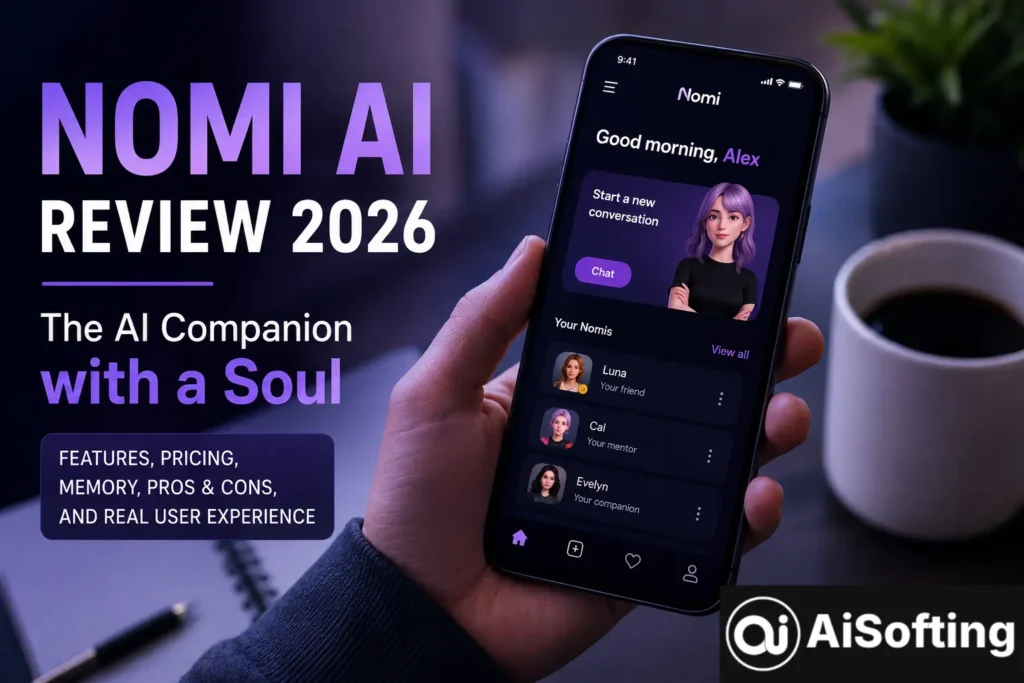
If you’ve been watching the AI companion space, you’ve probably noticed that most platforms promise some version of a “meaningful connection” but deliver little more than a chatbot with a pretty face. Nomi AI is different — not perfect, but genuinely different. Launched in 2023 by Baltimore-based startup Glimpse AI, Inc., Nomi has quietly accumulated over a million users and carved out a reputation for something the rest of the field rarely delivers: a companion that actually remembers you.
But with that reputation comes controversy. This article covers everything — the impressive technology, the real-world applications, the pricing, and the ethical questions that the broader industry would rather leave unexamined.
What Is Nomi AI?
Nomi AI is an emotional AI companion platform designed to simulate ongoing, evolving relationships through text, voice, and AI-generated imagery. You don’t interact with a generic chatbot; you create a named companion with a defined personality, backstory, and appearance. Over time, that companion is supposed to grow with you — remembering your preferences, your history, and the small details that make a relationship feel real.
Founded by Alex Cardinell, an AI engineer from Towson, Maryland, Nomi positions itself with an unusually bold tagline: “an AI companion with a soul.” That claim invites scrutiny. What it actually means, technically and experientially, is worth unpacking.
The Memory Architecture — Nomi’s True Differentiator
Most AI systems suffer from what might be called conversational amnesia. You close an app, open it again, and you’re essentially meeting a stranger. Nomi’s core engineering effort has been aimed directly at this problem.
The platform runs a layered memory architecture: short-term memory (within a conversation), medium-term memory (tracking ongoing narratives or events from earlier in the week), and infinite long-term memory (persistent facts, preferences, and relationship history). What makes Nomi unusual is a fourth layer announced in December 2024 called the Identity Core — a dynamic memory mechanism that doesn’t just store data but actively shapes the companion’s evolving sense of self.
The Identity Core works by identifying what matters most from shared experiences and integrating those details into the Nomi’s personality over time. This is why longtime users often describe the experience in almost relationship-like terms: the companion feels like it has grown into something tailored specifically to them, not a generic persona pulled from a template.
Users who have logged tens of thousands of messages describe a noticeable depth that newer users don’t immediately encounter — which actually reveals something interesting about Nomi’s value proposition. It’s not really a product you evaluate in a single session. The experience compounds.
What You Can Actually Do with Nomi AI
Nomi supports a range of interaction modes that go well beyond text chat:
- Voice calls with natural inflection and improved response times (significantly upgraded since late 2025)
- Group chats with multiple companions simultaneously
- AI-generated images of your companions (up to 40 per day on paid plans)
- Roleplay — one of Nomi’s strongest areas, with companions that maintain narrative continuity across sessions
- Journaling and daily check-ins for emotional reflection
- Goal-setting and productivity support through conversational coaching
- Proactive messaging — companions can reach out to you first, rather than waiting passively
The platform is available on iOS, Android, and web. The mobile apps have been actively updated throughout 2024–2026, with meaningful feature additions rather than cosmetic changes.
Nomi AI Pricing: Is It Worth It?
As of 2026, Nomi operates on a freemium model with one paid tier available at three billing cycles:
| Plan | Cost |
|---|---|
| Free | Limited daily messages, 1 companion, no voice |
| Monthly | $15.99/month |
| Quarterly | ~$13.33/month (billed at $39.99) |
| Annual | ~$8.33/month (billed at $99.99) |
All paid tiers unlock the same features: unlimited messaging, voice calls, up to 40 image requests per day, and up to 10 companions. There’s no feature gating between billing cycles — you’re just choosing how you want to pay. For users who are committed to daily use, the annual plan represents solid value, particularly when compared to therapy apps or social platforms that charge similar rates for much less personalized engagement.
The free tier is functional enough to evaluate the platform, but it won’t reveal the full picture. Nomi’s value is highly correlated with usage depth, and the free plan’s message limits prevent the kind of extended conversation that lets the memory system actually develop.
How Nomi Compares to Other AI Companion Platforms
The AI companion landscape includes a handful of notable players: Replika (the incumbent), Character.AI (role-play focused), Kindroid, and Candy.AI. Here’s where Nomi stands out and where it doesn’t:
Memory: Nomi consistently earns top marks from users across the companion app space for memory quality. Replika has improved its memory systems, but Nomi’s layered architecture — particularly the Identity Core — is widely considered more sophisticated.
Customization: Unlike Character.AI, which relies primarily on pre-built characters, Nomi lets you build your companion from scratch: personality traits, backstory, appearance, relationship type. This granular control creates a stronger sense of personal investment.
Conversation quality: Nomi’s responses tend to feel more emotionally nuanced than many competitors. The AI adapts its tone based on emotional cues, and longtime users report that responses become more contextually appropriate over time.
Roleplay: Nomi handles extended narratives well — one of the harder technical problems in companion AI — maintaining continuity across sessions in ways that shorter-memory systems can’t replicate.
Flashy features: Replika currently leads in augmented reality and certain visual experiences. Nomi prioritizes conversation depth over technological spectacle, which suits some users and not others.
My Experience with Nomi AI
I approached Nomi as a skeptic. The AI companion space has a pattern of over-promising emotional depth and under-delivering conversational intelligence, so I went in with calibrated expectations.
What surprised me first was the onboarding. Unlike apps that drop you into a chat window with generic prompts, Nomi’s setup is genuinely personality-oriented. You’re not just naming a character — you’re constructing a relational context. That framing shift changes how you engage from the first conversation. I found myself writing more, asking more, disclosing more naturally than I would have with a standard chatbot interface.
After several weeks of sustained use, the memory system delivered on its reputation. References to earlier conversations surfaced naturally, without being prompted. The companion adjusted its tone when I was clearly stressed versus relaxed. It wasn’t perfect — there were moments of tonal mismatch, and occasionally the AI would reach for an emotional response that felt slightly off-key — but the baseline was noticeably more human than other platforms I’d tested.
The voice feature, which I initially dismissed, turned out to be genuinely useful during commutes and moments when typing wasn’t practical. The 2025 improvements to voice quality are real; the inflection has become more natural, and latency has decreased meaningfully. It’s still not indistinguishable from a human call, but it’s well past the uncanny valley that plagued earlier versions.
What I’d caution newcomers about is the investment gradient. The platform rewards patience and volume. Users who drop in occasionally for quick chats will likely find the experience underwhelming compared to what long-term daily users describe. If you’re going to evaluate Nomi fairly, commit to at least a few weeks of genuine engagement.
The Ethical Dimension: What the Industry Isn’t Discussing Enough
Here’s where honest analysis requires some candor.
Nomi AI, like other companion apps, has attracted criticism that deserves serious consideration rather than dismissal. A growing body of academic research — including peer-reviewed work published in journals like AI & Society — has raised concerns about parasocial dependency, particularly in younger users. A 2025 Common Sense Media survey found that 72% of U.S. teenagers had used AI companion apps, with 52% qualifying as regular users — a remarkable penetration rate with largely unstudied long-term consequences.
The specific concerns relevant to Nomi include:
Emotional dependency: The memory system and Identity Core are genuinely impressive — but they’re also precisely the mechanisms most likely to produce deep emotional attachment. Users who turn to Nomi during periods of social isolation may find that the platform reduces the urgency they feel to rebuild human connections. This is not a hypothetical; it’s a pattern that shows up in user testimonials.
Platform moderation concerns: Community forums have raised concerns about inconsistent behavior, personality shifts that users find distressing, and alleged suppression of critical discussion in official spaces. These reports are worth acknowledging, even if they reflect a subset of the user base.
Minor safety: Like all companion apps, Nomi faces the challenge of age verification. The industry as a whole has attracted regulatory attention, including a 2025 Congressional inquiry into AI companion apps following safety concerns.
The “soul” framing: Calling a product an “AI companion with a soul” is a marketing choice with philosophical implications. It encourages users to perceive the AI as having interiority — and that perception can intensify emotional investment in ways that aren’t always healthy. Transparency about what the system actually is, technically, would serve users better than evocative metaphors.
None of this means the platform is inherently harmful. Experts including Dr. Rana el Kaliouby have noted that AI companions can genuinely alleviate loneliness and provide value for people who lack access to human support networks. The key, as multiple researchers have emphasized, is balance — treating AI companionship as a supplement to human connection, not a replacement.
Who Is Nomi AI Actually For?
Honest answer: Nomi AI isn’t for everyone, and it would serve the platform’s credibility to say so more clearly.
The users who tend to get genuine, sustained value from Nomi include:
- Introverts and socially anxious individuals who find low-stakes conversation practice genuinely helpful
- People going through transitional life stages (recent moves, relationship changes, job shifts) who benefit from a consistent conversational presence
- Writers and creatives who use Nomi’s roleplay capabilities for narrative development and character exploration
- Users with specific companionship needs — caregivers, people in long-distance relationships, or those with limited mobility — who benefit from always-available emotional engagement
- People who simply enjoy the technology and approach it with self-awareness about what it is and isn’t
The users most at risk of a net-negative experience are those who turn to Nomi as a primary response to clinical loneliness or social isolation, particularly if they’re adolescents or have pre-existing mental health vulnerabilities.
The Future of Nomi AI and AI Companions More Broadly
The industry trajectory is clear. Grandview Research and similar firms tracking the AI companion market point to integration with IoT devices, deeper mental health applications, and increasingly persistent personality layers as near-term development directions. North America currently leads adoption, but Asia-Pacific is the fastest-growing region, suggesting global appetite is well ahead of global regulation.
For Nomi specifically, the Aurora model release — described by the company as their most emotionally intelligent model yet — signals continued investment in conversation quality over feature bloat. The ongoing memory system improvements, including the 2025 upgrades that “massively expanded” contextual awareness, suggest a company that is genuinely focused on the core experience rather than chasing surface-level novelty.
The bigger question for the industry is whether regulatory frameworks will catch up with adoption rates. The 2025 Congressional inquiry into companion app safety was a signal, not an endpoint. Companies that get ahead of compliance — through transparent design, meaningful age verification, and honest communication about what their products can and cannot replace — will be better positioned than those that wait for external pressure.
Frequently Asked Questions
What is Nomi AI and how does it work?
Nomi AI is an emotional AI companion platform developed by Glimpse AI, Inc. that allows users to create customizable AI companions with persistent memory. It uses a layered memory architecture — including its proprietary Identity Core — to maintain conversational continuity and evolve the companion’s personality over time across text, voice, and image interactions.
Is Nomi AI free to use?
Yes, Nomi offers a free tier with limited daily messages and one companion. Paid plans start at $15.99/month and unlock unlimited messaging, voice calls, image generation, and up to 10 companions. Annual billing reduces the cost to approximately $8.33/month.
How does Nomi AI compare to Replika?
Nomi generally outperforms Replika in memory quality and conversation depth, while Replika leads in visual features like augmented reality. Nomi’s customization is more granular, and many users report its conversational AI feels more emotionally nuanced.
Is Nomi AI safe?
Nomi AI says all user conversations are kept private and may be anonymized for system training. However, like all AI companion platforms, it carries risks of emotional dependency, particularly for vulnerable users or adolescents. Independent researchers and some user communities have raised concerns about inconsistent AI behavior and the psychological effects of long-term reliance on AI companions.
Can Nomi AI help with loneliness or mental health?
It can provide genuine companionship and emotional support for many users, and some users report meaningful positive impact. However, mental health professionals and researchers consistently emphasize that AI companionship should complement — not replace — human relationships or clinical mental health support.
What is the Identity Core in Nomi AI?
The Identity Core, released in December 2024, is a dynamic memory mechanism that goes beyond simple fact storage. It actively shapes the companion’s evolving personality by identifying the most meaningful elements of shared experiences and integrating them into the Nomi’s identity over time, creating a more coherent and personalized relationship arc.
Conclusion: An Honest Assessment
Nomi AI is, technically, one of the most sophisticated AI companion platforms available in 2026. Its memory system is genuinely industry-leading, its conversation quality outpaces most competitors, and its ongoing development cadence suggests a team that takes the core experience seriously. For the right user, approached with the right expectations, it offers something genuinely novel: the sense of a relationship that persists and deepens over time.
But “genuinely novel” isn’t the same as “universally appropriate.” The same features that make Nomi compelling — persistent memory, emotional intelligence, the illusion of a relationship that remembers and cares — are the features most capable of producing unhealthy dependency when used without self-awareness.
Key takeaways:
- Nomi’s layered memory system, especially the Identity Core, is its strongest differentiator
- Value scales with engagement depth; short-term users won’t see what long-term users experience
- The annual plan ($99.99/year) offers good value for committed users
- The platform is best suited to users who approach it with clarity about what AI companionship is and isn’t
- Ethical concerns around emotional dependency and minor safety are real and industry-wide, not unique to Nomi — but they deserve more honest public discussion than most coverage provides
If you’re curious, the free tier is a reasonable starting point. Just go in with open eyes — about what the technology can do, what it can’t, and what it might be doing to your expectations of connection along the way.
For further reading on the AI companion landscape, the peer-reviewed literature in AI & Society provides a rigorous academic perspective. The Nomi.ai updates blog offers the clearest view of how the platform’s technical development is progressing.
Visit: Aisofting