
Introduction
Paste a ChatGPT draft into an AI humanizer, click a button, and watch the “AI score” drop. It feels like a cheat code. It’s also why more writers, students, and SEO teams are asking a better question: is it working, and what is it doing to my text?
Most guides on this topic are tool roundups written by companies that sell the tools. This one goes back to the primary sources: Turnitin’s own announcements and help documentation, a Stanford study, an academic audit of 19 humanizer tools, Google’s documentation, and generative engine optimization (GEO) research. It also includes a small test of my own. The picture is less flattering than the marketing and more useful than the panic.
What is an AI humanizer? An AI humanizer is a tool that rewrites machine-generated text so it reads less robotic. It usually works by swapping words, splitting or merging sentences, or re-prompting a language model. Many products also promise a lower score on AI detectors. Quality varies widely, and no tool can guarantee a result on every detector.
Key takeaways
- Humanizers differ enormously in quality, and in one audit all of them made the text worse on average.
- Turnitin now targets humanizer-modified text, in English only.
- Google’s rules focus on value and intent, not on how a page was made.
- The strongest way to “humanize” AI text is to add what a model can’t: verified facts, real experience, and a point of view.
What an AI Humanizer Actually Does
Two camps under one name
The label “AI humanizer” covers two different promises. QuillBot’s tool says it improves how your writing reads and isn’t meant for evading AI detection. Others, like Surfer’s AI humanizer, openly market bypassing detectors such as Turnitin, Copyleaks and GPTZero. Same category, opposite intent. Before you pick a tool, decide which job you actually need done.
How AI humanizer tools work under the hood
Researchers who studied 19 humanizer and paraphrasing tools found some are language models with a system prompt asking for a more human, conversational tone, while others are rule-based synonym replacers. That distinction matters. Synonym swappers stay close to your original sentence structure but produce odd word choices. LLM-based rewriters sound smoother but drift further from what you wrote.
What an Audit of 19 Humanizers Found
This is the part most tool reviews skip. In a 2025 study, Masrour, Emi and Spero sorted humanizers into three quality tiers. They used a “fluency win rate”: how often GPT-4o judged the humanized version more coherent than the original text.
| Tier | What the auditors saw | Humanized version judged better than original |
|---|---|---|
| L1 (best) | Kept tone, vocabulary level, and complexity | 26.0% |
| L2 | Lower quality, but meaning preserved | 14.67% |
| L3 (worst) | Nonsense phrases, distorted meaning | 2.67% |
The researchers concluded that every humanizer tends to degrade the original text, just to different degrees. The weaker tools added hallucinated citations, stray strings of question marks, and outright gibberish.
Two caveats. The authors work at Pangram Labs, which sells an AI detector, so they have a stake in the topic. The audit is also a snapshot from around January 2025, so individual tools may have changed. The pattern still holds up: a rewriter optimizing for “less detectable” can damage accuracy, and accuracy is what your reader pays for.
A lesson from science publishing: tortured phrases
Synonym-swapping has a track record. Researchers led by Guillaume Cabanac found published papers where paraphrasing software had mangled standard terms. “Counterfeit consciousness” stood in for artificial intelligence, and “kidney disappointment” for kidney failure. The CNRS profile of Cabanac’s work explains how these “tortured phrases” now act as a forensic signal for unreliable papers.
The same risk applies to any niche. A humanizer doesn’t know your industry’s fixed terms. In SEO, “crawl budget” is not “creep allowance.” If a tool touches your terminology, a knowledgeable reader will notice, and so will a search engine’s quality systems.
Detectors Have Adapted: Turnitin’s AI Bypasser Detection
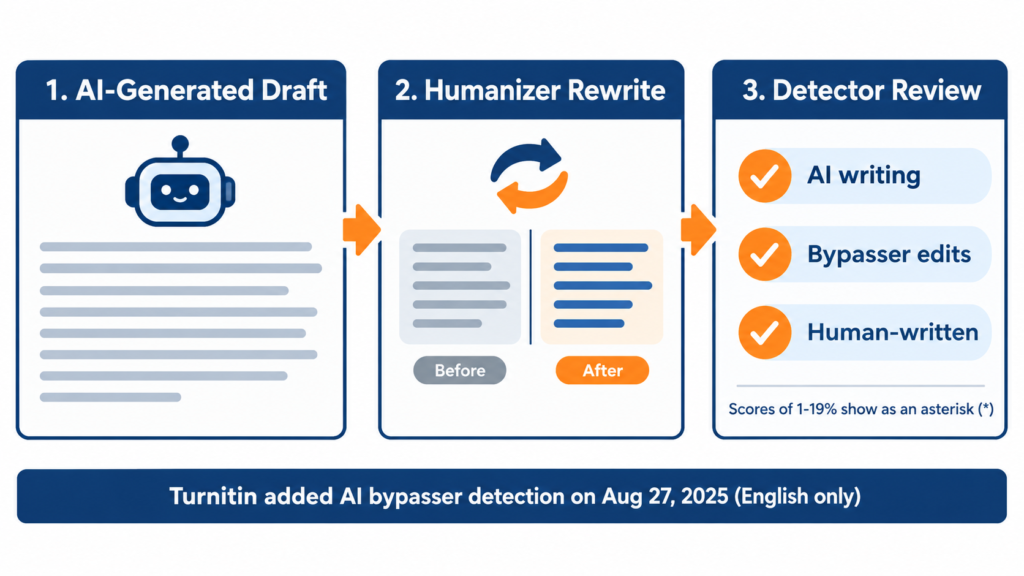
On August 27, 2025, Turnitin announced that its AI writing detection now includes AI bypasser detection, designed to help educators spot text that may have been intentionally modified by humanizer tools. Two practical details from the announcement: the feature is trained and tested for English only, and it sits within the Turnitin Originality add-on.
Turnitin’s help documentation adds context worth knowing. To limit false positives, scores between 1% and 19% show only as an asterisk, with no percentage or highlights. And the Spanish and Japanese detectors don’t include AI paraphrasing or bypasser detection.
The picture isn’t one-sided, though. In the same Pangram study, GPTZero’s detection rate on academic text fell from 99.73% to 60.04% after humanization. So humanizers can beat some detectors, and detectors are being trained against humanizers. Vendor pages advertising a “99.8% bypass rate” are self-reported and describe a moving target.
One more finding deserves attention. When the researchers tested Google’s SynthID watermark, a paraphrasing pass dropped watermark detection from 87.6% to 5.4% at a 5% false-positive rate. That was a small research model, so don’t generalize it. It does suggest that watermark-based detection is fragile against rewriting.
The Fairness Problem: Detectors and Non-Native English Writers
If you write in English as a second language, this section matters most. A Stanford study in Patterns tested seven GPT detectors. It found that over half of the non-native English writing samples were misclassified as AI-generated, while accuracy for native samples stayed near perfect. The likely cause is that non-native writers tend to show less lexical richness, syntactic diversity, and grammatical complexity, which lowers the “perplexity” many detectors read as machine-like.
Turnitin reports different numbers from its own testing: a 1.4% false-positive rate for English-language-learner writers and 1.3% for native writers on documents of 300+ words. The studies used different detectors, so they don’t contradict each other. Detector accuracy depends heavily on which tool you’re judged by.
The practical lesson is that a humanizer isn’t your only defense against a false flag. Evidence of process is stronger: keep your notes, outlines, version history, and dated drafts. If you ever have to contest a result, those files carry more weight than a “0% AI” screenshot from a third-party checker.
Does Google Penalize Humanized AI Content?
Not automatically, and humanizing doesn’t shield you either. Google’s guidance says generative AI can help with research and adding structure to original content, but generating many pages without adding value may violate its scaled content abuse policy. Its older blog post makes the same point from the other side: using automation to generate content mainly to manipulate rankings breaks the spam policies, but not all AI use is spam.
Look at what that guidance measures: value to users and intent. It says nothing about detector scores. A thin page that has been reworded until it “passes” is still a thin page. The same guidance points to Quality Rater Guidelines sections 4.6.5 and 4.6.6, covering scaled content abuse and main content made with little effort, originality, or added value.
If you publish AI-assisted content at volume, a strong SEO content strategy matters far more than any rewriting pass. Topic selection, original inputs, and editorial review are what separate helpful pages from scaled spam.
Humanizing for AI Search: ChatGPT, Gemini, Perplexity, and AI Overviews
The Princeton GEO study is the best evidence on what makes content citable by generative engines. Its winning tactics added relevant statistics, credible quotes, and citations from reliable sources. That is added information, not added polish.
Read this one carefully, because the “40% boost” headline gets repeated without its limits. A 2026 critical survey notes that the 40% figure is a relative maximum on one metric under a specific configuration. Another study found that isolated text-level modifications don’t reliably raise citation visibility and may disrupt the natural writing patterns LLMs prefer to cite.
I found no direct study of whether humanizer output gets cited more or less by ChatGPT, Gemini, Claude, or Perplexity. The reasonable inference from what exists is that surface rewriting won’t help, while sourced facts, clear definitions, and named entities will. Publishing on a technically sound site helps too, and that’s a web development job as much as a writing one.
The Human Layer Method: A Safer Way to Humanize AI Text
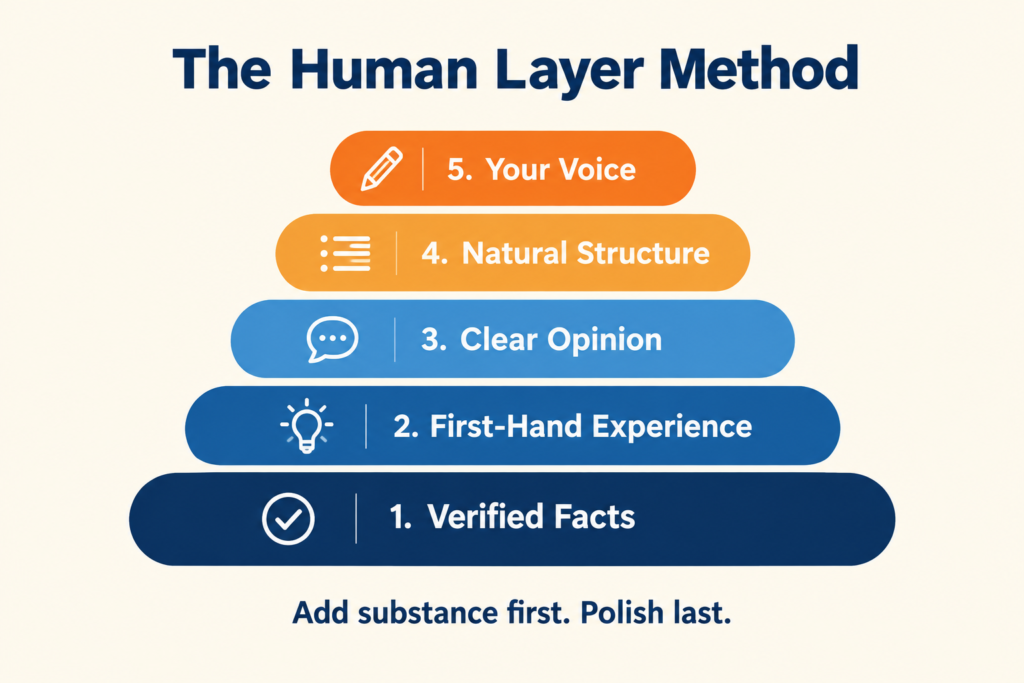
This is my working framework, not an industry standard. It treats “humanizing” as adding layers of substance, with polish last.
Layer 1: Facts
Verify every number, name, date, and citation. Delete anything you can’t source. This is where humanizers hurt most, given the invented references in that audit and the meaning drift in my own test below.
Layer 2: Experience
Add something only you have: a test you ran, a client outcome, a mistake you made, a screenshot. Google’s guidance asks whether content shows first-hand expertise and depth of knowledge. A model can’t supply that, and a humanizer can’t fake it. Aisofting’s own AI arbitrage guide makes a similar point. Editing AI drafts until they sound good takes real effort, and careless clients accept mediocre output.
Layer 3: Opinion
Take a position. Wikipedia’s editors, who have reviewed thousands of AI-written drafts, describe a recognizable pattern in their Signs of AI Writing guide: promotional tone, overblown significance, repetitive transitions, and rule-of-three phrasing. They also warn against relying solely on AI detection tools, which have non-trivial error rates. Human-sounding writing mostly comes from committing to a view.
Layer 4: Structure
Answer first, then explain. Vary paragraph length. Cut the “not just X, but Y” constructions and the tidy triplets.
Layer 5: Voice
Now, and only now, use a tool or your own ear to fix stiff phrasing. Read the piece aloud. Then re-check layer 1, because rewriting can change facts.
Before and after:
- Robotic: “In today’s digital landscape, AI humanizers play a pivotal role in ensuring content resonates with audiences.”
- With the human layer: “A humanizer can smooth stiff phrasing. It can’t add a source, a number, or a reason to trust you. That part is your job.”
For teams building repeatable pipelines, automation tools like those covered here work best when a human review step is built in, not bolted on.
Benefits of an AI Humanizer (When Used Right)
- Faster editing. It smooths stiff rhythm and repetitive transitions in a first draft.
- Language support. Non-native writers can polish phrasing while keeping their own ideas.
- Consistency. It helps when several people draft in different registers.
- A useful second opinion. Flagged phrasing shows you your own habits.
Common Mistakes
- Chasing a 0% score. Detectors disagree with each other, and the score isn’t proof of anything.
- Running text through repeatedly. In my test below, three light passes damaged more technical terms than one. Each pass compounds the drift.
- Humanizing quotes, references, code, and figures. These need to stay exact.
- Publishing at scale. Volume without added value is the pattern Google’s spam policy targets.
- Ignoring the rules where you work. Using a humanizer to hide AI use where it’s prohibited is an integrity problem, not a technical one.
- Skipping the read-aloud test. Tortured phrases get past software but not a sharp reader.
How to Choose an AI Humanizer Tool
There’s no single best AI humanizer. Judge tools on these criteria instead:
| Criterion | What to check |
|---|---|
| Meaning preservation | Compare numbers, names, and claims before and after |
| Reference handling | Does it leave citations alone or invent new ones? |
| Tone control | Can you set register, or is it stuck at one reading level? |
| Transparency | Does it say what it does, or promise guaranteed bypass? |
| Language coverage | Detector and tool support varies by language |
| Privacy | Read where your text goes and how it’s stored |
Personal Experience: I Stress-Tested a Synonym-Swap “Humanizer”
I can’t run every commercial AI humanizer through every detector, and I won’t pretend to. So I tested something narrower and fully reproducible: what a crude synonym-swap rewriter does to a text full of facts and technical terms.
The setup. I wrote a 318-word passage packed with numbers, product names, and industry phrases like “scaled content abuse” and “crawl budget.” Then I built a simple tool that replaces nouns, adjectives, and verbs with dictionary synonyms (Python and NLTK’s WordNet), with no awareness of context. This is not a commercial product, and I ran no detector scores. I ran it at two intensities, plus a three-pass version at the lower setting, with 30 random seeds each. The script is published with this article, so you can rerun it.
What I measured.
| Setting | Avg. words swapped | Domain terms intact (of 12) | Fact anchors intact (of 7) |
|---|---|---|---|
| Original text | 0 | 12 | 7 |
| Light, 1 pass | 27.8 | 8.6 | 6.8 |
| Heavy, 1 pass | 57.4 | 6.4 | 6.5 |
| Light, 3 passes | 80.5 | 6.5 | 6.6 |
What I noticed. I read all 28 swaps from one light-setting run and sorted them by hand. Thirteen broke the meaning or a technical term. Eight were odd but understandable. Seven were fine. The damage was specific:
- “Generative AI” became “productive AI.”
- “Scaled content abuse” became “scaled content maltreatment.”
- “Detectors” became “sensors,” so the sentence now said Stanford tested “seven sensors.”
- “Named sources” became “named beginnings.”
- “Pages” became “Sir Frederick Handley Pages.” That is a real quirk of context-blind lookup, and it appeared in 24 of 30 light runs and 29 of 30 heavy runs.
The three-pass run supports my earlier suspicion that repeated passes compound the damage. Domain terms intact fell from 8.6 to 6.5, even though each pass used the same light setting.
Lessons I apply now.
- A rewriter that doesn’t know your field will break your field’s vocabulary. I check every technical term and number after any rewrite.
- One or two passes are enough to see the damage, so I don’t stack them.
- A clean-looking sentence can still state something false. “Seven sensors” reads fine and is wrong.
Limits. This tests one crude class of tool on one passage. Modern LLM-based humanizers make different mistakes, and I measured nothing about detectors. What it shows is that meaning drift is real and measurable.
Frequently Asked Questions
What is an AI humanizer?
An AI humanizer rewrites machine-generated text so it sounds more natural, using synonym swaps, sentence restructuring, or an LLM rewrite. Some products aim only to improve readability. Others promise to lower AI-detector scores. Results vary by tool, text, and detector.
Do AI humanizers actually work?
Sometimes, against some detectors. In one study, GPTZero’s detection rate on humanized academic text fell from 99.73% to 60.04%. But the same audit found every humanizer degraded text quality to some degree, and detectors are being retrained against humanizer output.
Can Turnitin detect humanized text?
Turnitin says that since August 27, 2025, its AI writing detection includes AI bypasser detection, designed to flag text that may have been intentionally modified by humanizer tools, for English submissions. No detector is perfect, and low scores of 1–19% appear only as an asterisk.
Is using an AI humanizer cheating?
It depends on the rules that apply to you: a syllabus, an employer’s policy, or a client contract. Polishing your own draft is different from hiding AI use where it’s prohibited. When the rules are unclear, ask and disclose.
Does Google penalize AI-humanized content?
Not automatically. Google targets scaled content produced without adding value for users, regardless of how it was made. A reworded but thin page remains thin.
Are AI detectors accurate?
They are useful signals, not proof. A Stanford study found detectors misclassified over half of non-native English samples as AI-generated. Wikipedia’s editors advise against relying on detector scores alone.
Can humanizers remove AI watermarks?
In one research test, paraphrasing cut SynthID detection from 87.6% to 5.4% at a 5% false-positive rate. That used a small model in a lab setting, so it doesn’t prove the same result for every system.
Will an AI humanizer help me get cited in AI Overviews or ChatGPT?
I found no direct evidence that it does. GEO research points elsewhere: statistics, credible quotes, and reliable citations improved visibility in generative engine responses. Add those first.
How do I make AI text sound human without a tool?
Follow the five layers above: verify facts, add first-hand experience, take a position, restructure for clarity, then polish the voice by reading aloud.
Conclusion
An AI humanizer is a rewriting tool, not a credibility tool. It can smooth stiff phrasing. It can’t verify a claim, supply experience, or give a reader a reason to trust you. The research shows quality loss across the category, detectors adapting quickly, and Google judging value instead of origin. My own small test showed the same thing at the level of single words: a context-blind rewrite turned “detectors” into “sensors” and left the sentence looking fine.
Audiences are moving the same way in other fields. Aisofting’s look at graphic design trends for 2026 notes that as AI visuals spread, personal and imperfect work becomes more valuable. Writing is following that path.
Actionable takeaways
- Decide whether you need polish or evasion. Only the first is a sound long-term strategy.
- Never let a humanizer touch citations, quotes, numbers, or code.
- Run a quick before-and-after test on your own text before adopting any tool.
- Add facts, experience, and opinion before you polish the voice.
- Keep drafts and notes as evidence of process, especially if you write in a second language.
- Publish fewer, better pages instead of volume you have to disguise.
For more AI tool reviews and practical guides, explore Aisofting.
About this article: Written with primary sources (Turnitin, Google Search Central, Stanford, arXiv, Princeton, Wikipedia, CNRS) reviewed on September 24, 2026. Detector features change often, so recheck before relying on any figure.