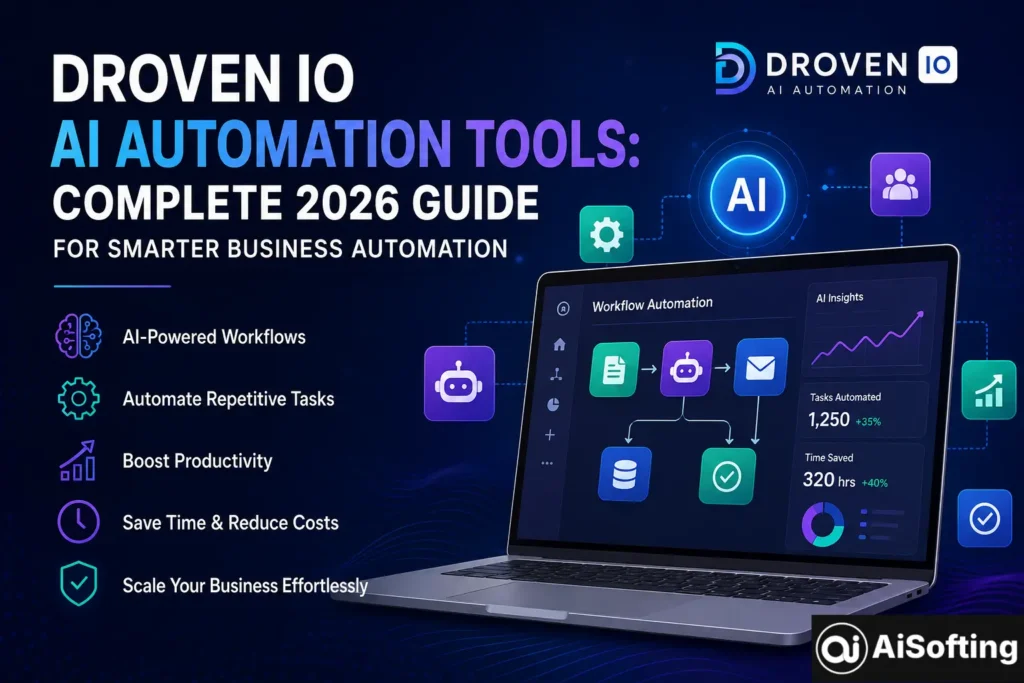
Introduction: Why AI Automation Decisions Are Harder Than They Look
There’s a moment most business owners hit — usually somewhere between reading their fifth “Top 10 AI tools” article and opening their third free trial in a week — where they realize something’s off. The internet is drowning in AI tool recommendations, but almost none of them answer the actual question: Which one is right for my specific situation, and what do I do with it once I have it?
That’s exactly the gap Droven IO was built to fill. And in 2026, with the global AI automation market projected to reach $407 billion by 2027 (MarketsandMarkets), the stakes of getting that decision right have never been higher.
This guide takes a grounded, practical look at Droven IO AI automation tools — what the platform actually is, which tools it covers and recommends, how real businesses are using them, and what you should watch out for before you spend a single dollar. Whether you’re a startup founder mapping out your first tech stack, a marketing manager drowning in repetitive tasks, or an operations lead trying to reduce process bottlenecks, there’s something here for you.
What Is Droven IO, Really?
Before diving into the tools themselves, it’s worth being precise about what Droven IO is — because a lot of people misunderstand it.
Droven IO is not a software product. It doesn’t run your automations, execute your workflows, or integrate your apps. It’s a knowledge and editorial platform — essentially a well-researched, non-promotional guide to the AI and automation landscape, aimed at business owners, developers, marketers, and operations professionals who need clear information before making technology decisions.
Think of it the way you’d think of a trusted industry analyst or a consultant you bring in before a major purchase. Droven IO explains what technologies exist, how they actually work, where they fall short, and what conditions determine whether they succeed in a given business. It covers machine learning, workflow automation, RPA, cloud computing, cybersecurity, and digital transformation — without a sales agenda attached to any of it.
That independence is rarer than it sounds. As one review put it, the AI automation space in 2026 is “crowded with sponsored reviews, affiliate-driven rankings, and vendor-funded comparison content.” Droven IO sits deliberately outside that model.
Who Droven IO Is Best Suited For
- Small business owners who want clarity before committing budget to software
- Startup teams building their first automation stack and need to move quickly without guessing
- Operations and process managers mapping workflow bottlenecks
- Beginners exploring AI adoption who need plain-language context and real examples
It’s less useful for teams that already know exactly which tools they want and need deep implementation support. For execution, you’ll still need the tools themselves — but Droven IO helps make sure you’re choosing the right ones.
The AI Automation Landscape in 2026: Why This Matters Now
The data tells a clear story. Employees using AI automation tools now report an average 40% increase in task throughput, with knowledge workers seeing the largest gains in document processing, data extraction, and communication workflows (McKinsey Global Institute, 2025). Businesses deploying AI workflow automation report 30–60% cost reductions in automated process categories including customer service, invoice processing, and lead management.
But here’s the uncomfortable flip side: 68% of failed automation projects fail due to poor integration architecture, not tool limitations (Gartner, 2025). Most companies don’t struggle because there aren’t enough AI tools. They struggle because they start without a clear use case, messy data, or a realistic understanding of what any given tool can and cannot do.
This is exactly why an orientation platform like Droven IO has become more valuable over time, not less. The more tools flood the market, the more useful it becomes to have a trusted guide that helps you slow down, cut through the noise, and make a better next decision.
Top AI Automation Tools Featured on Droven IO (2026)
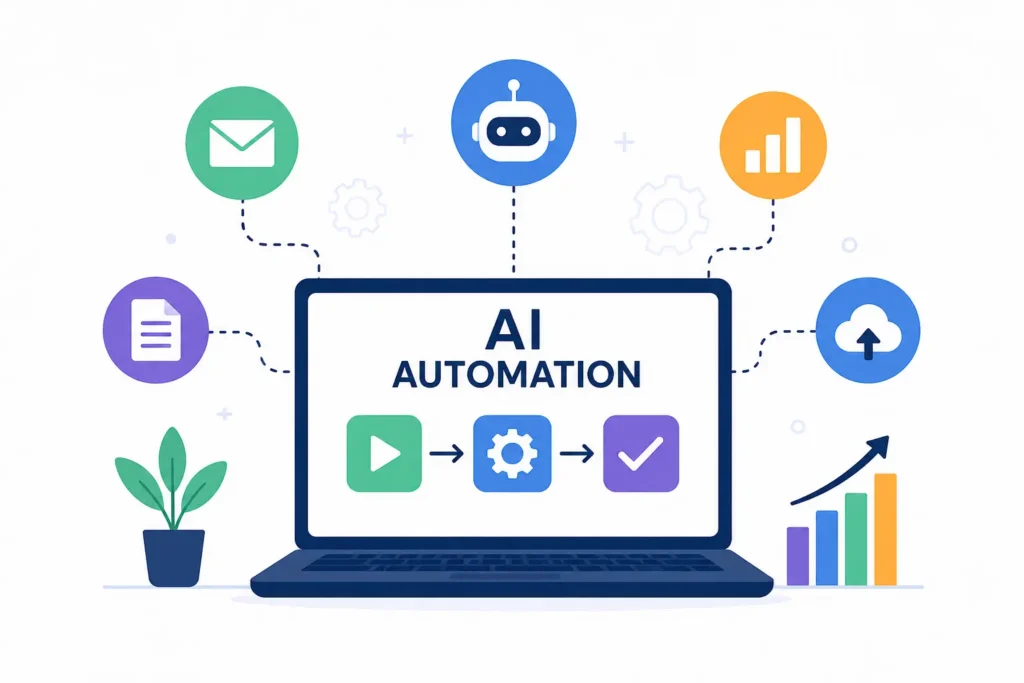
Here’s a breakdown of the leading platforms that Droven IO covers in depth — along with the honest context about who each one actually serves well.
Zapier — Best for Non-Technical Teams Getting Started Fast
Zapier remains one of the most accessible entry points into business automation in 2026. Its AI-enhanced workflows — called Zaps — connect over 6,000 apps and services without requiring a single line of code. The platform has significantly expanded its AI capabilities, allowing users to build intelligent conditional workflows, not just simple “if this, then that” triggers.
Best for: Small businesses, marketers, and non-technical teams who need quick, practical automation between popular apps.
Real-world example: A boutique e-commerce brand uses Zapier to automatically tag new Shopify customers in their CRM, send a personalized welcome email via Mailchimp, and add the customer to a Slack notification channel — all triggered the moment a purchase is completed.
Watch out for: Costs can escalate quickly as your Zap count grows. It’s also not well-suited for complex, multi-branch logic.
n8n — Best for Technical Teams Needing Custom AI-Powered Workflows
For teams that need flexibility beyond what no-code tools offer, n8n is the most powerful open-source workflow automation platform available right now. It handles complex, branching logic, supports custom code nodes, and integrates natively with AI APIs including OpenAI, Anthropic, and Hugging Face.
Best for: Developers, agencies, and technical operations teams building custom automation pipelines.
Important caveat: In February 2026, critical vulnerabilities in n8n were publicly disclosed that could enable sandbox escape on self-hosted deployments. Teams using self-hosted n8n must apply security patches promptly — open-source does not mean secure by default.
Make (formerly Integromat) — Best for Visual Workflow Builders
Make sits comfortably between Zapier’s simplicity and n8n’s technical depth. Its visual drag-and-drop interface makes it easy to build multi-step workflows with advanced logic, conditional routing, and error handling — all without deep coding knowledge.
Best for: Growing businesses and agencies that need powerful automation but want a visual, intuitive interface.
Real-world example: A marketing agency uses Make to pull client ad performance data from Google Ads, run it through a custom data transformation module, and automatically populate a Google Sheets report — saving roughly 6 hours of manual reporting per week, per client.
UiPath — Best for Enterprise RPA with Governance Requirements
UiPath leads the enterprise field in AI governance and compliance. Its AI Trust Layer includes PII masking, model selection controls, and comprehensive audit trails — making it particularly relevant as the EU AI Act continues enforcement through 2025–2026.
Best for: Large organizations in healthcare, finance, or legal sectors where explainability and compliance are non-negotiable.
Entity-based context: UiPath competes directly with Automation Anywhere and Microsoft Power Automate in the enterprise RPA space. For regulated industries, its governance architecture currently justifies the premium cost.
GoHighLevel — Best for Marketing Agencies and SMBs
GoHighLevel has become the go-to all-in-one platform for marketing agencies and small businesses in 2026. It combines CRM, email marketing, SMS automation, funnel building, and AI-powered lead management into a single interface — reducing the number of separate tools a business needs to maintain.
Best for: Marketing agencies, coaches, and service businesses that want unified automation without managing multiple subscriptions.
Lindy.ai — Rising Star for Intelligent AI Agents
Lindy.ai focuses on AI agents designed for specific business tasks — scheduling, inbox management, customer follow-up, and meeting summarization. Unlike traditional workflow tools that follow fixed rules, Lindy’s agents adapt to new inputs and make contextual decisions.
Why it matters in 2026: Gartner introduced the category “Business Orchestration and Automation Technologies” (BOAT) in late 2025, signaling that the line between workflow automation and AI agent systems is actively dissolving. Lindy.ai is positioned right at that convergence.
Benefits of Using AI Automation Tools (Beyond the Obvious)
Everyone knows automation saves time. But the less-discussed benefits are often more transformative:
Consistency at scale. A human making the same decision 200 times a day introduces variance. An automated workflow doesn’t. For customer-facing processes, that consistency directly affects satisfaction scores.
Data you can actually use. Automated workflows generate clean, structured logs. Teams that were previously flying blind on process performance suddenly have dashboards showing exactly where bottlenecks exist.
Competitive positioning. Most SMBs reach positive ROI from AI automation within 60–90 days when deployment is handled properly. Those that delay are effectively subsidizing the efficiency gains of competitors who don’t.
New role clarity. When repetitive tasks are automated, the people who were doing them can focus on judgment-intensive work. This is often better for team retention than it gets credit for.
Common Mistakes to Avoid
Automating broken processes. Automation amplifies whatever’s underneath it. If your lead qualification process is inconsistent, automating it just produces more inconsistency, faster. Fix the process first.
Choosing tools based on popularity. Zapier has the biggest brand, but it might not be the right fit for your stack. Use Droven IO’s framework: match the tool to the use case, not the other way around.
Underestimating change management. Most automation failures aren’t technical. They’re organizational — unclear ownership, inconsistent data quality, teams that weren’t brought along.
Starting too big. The businesses with the fastest ROI typically start with one high-frequency, low-complexity workflow. Lead capture and CRM automation has an average time-to-ROI of just 45 days for small businesses.
Ignoring security requirements. Any automation stack handling customer data, PII, or financial records needs data classification, encryption in transit and at rest, access control, and audit logging — regardless of which platform you use.
Personal Experience: What Working With AI Automation Tools Actually Feels Like
I want to be honest about something that most guides gloss over: the early days of building an automation stack are genuinely messy.
The first workflow I set up — a relatively simple lead capture sequence connecting a contact form to a CRM and an email sequence — took about three times as long as I expected. Not because the tools were hard to use, but because I didn’t fully understand my own process before I tried to automate it. I had to stop, map the workflow manually, identify the decision points, and then go back to the tool.
That’s the lesson I’d give anyone starting out: the automation is the easy part; the process clarity is the hard part. Droven IO’s value became clear to me during that process, because its content helped me think through what I was actually trying to accomplish, not just how to configure a particular integration.
The second thing that surprised me was how quickly the ROI became visible — and how different it felt from what I expected. I wasn’t blown away by any one workflow. The value accumulated in the background: fewer dropped leads, more consistent follow-up timing, cleaner data in the CRM. It wasn’t dramatic; it was just steadily better.
The third thing: the security considerations are not optional and they’re not theoretical. After the n8n vulnerabilities that surfaced in early 2026, I went back through our self-hosted workflows and realized we’d been running without a proper patching schedule. That’s a gap I’d encourage anyone to close before it becomes a problem.
Best Practices for AI Automation in 2026
- Start with a single, high-frequency workflow — ideally one that’s currently manual, time-consuming, and has a clear success metric
- Document the process before you automate it — if you can’t draw the workflow on a whiteboard, you’re not ready to automate it
- Work with a specialist for complex implementations — businesses using expert deployment teams reach positive ROI 3–4x faster (Forrester, 2025)
- Build review cycles into every workflow — AI automation is not set-and-forget; regular performance reviews catch drift before it becomes a problem
- Prioritize tools with audit trails if you’re in a regulated industry — this is not a nice-to-have in 2026
FAQs About Droven IO AI Automation Tools
1. What is Droven IO and is it a software tool?
Droven IO is an editorial knowledge platform covering AI, automation, cloud computing, machine learning, and cybersecurity. It is not a software product — it does not run automations or integrate apps directly. Its value is in helping users understand the automation landscape and make better decisions before selecting and implementing tools.
2. Which businesses benefit most from AI automation tools in 2026?
Businesses with high volumes of repetitive, rule-based processes — lead management, customer support routing, invoice processing, content scheduling, and reporting — typically see the fastest and clearest ROI. Both SMBs and enterprise organizations benefit, though the specific tools and implementation paths differ significantly.
3. What’s the difference between traditional automation and AI automation?
Traditional automation follows fixed, pre-defined rules. AI automation learns from data, adapts to changes, and makes contextual decisions. A traditional system sends an email at a set time; an AI automation system analyzes engagement patterns and sends the message when an individual user is most likely to respond.
4. How long does it take to see ROI from AI automation?
Most SMBs reach positive ROI within 60–90 days when deployment is handled properly. Businesses that self-deploy without prior experience typically take longer. The highest-ROI entry point, according to implementation data, is lead capture and CRM workflow automation (average 45-day time-to-ROI).
5. Is n8n safe to use in 2026?
n8n remains one of the most powerful open-source automation platforms available. However, critical vulnerabilities were publicly disclosed in February 2026 for self-hosted deployments. Safe use requires a consistent patching schedule and proper security hygiene — it is not secure by default in a self-hosted environment.
6. How does the EU AI Act affect automation tool selection?
The EU AI Act’s enforcement through 2025–2026 is already influencing enterprise decisions. Platforms with robust AI governance, explainability features, and audit trails — UiPath being the current leader — have a structural advantage in regulated industries. Businesses in healthcare, finance, and legal sectors should prioritize governance architecture in their evaluation criteria.
7. What are the most common reasons AI automation projects fail?
According to Gartner (2025), 68% of failed automation projects fail due to poor integration architecture — not tool limitations. Other common failure modes include automating broken or unclear processes, insufficient change management, unclear process ownership, and inconsistent data quality.
8. Can I use Droven IO to find and compare specific AI tools?
Yes — Droven IO’s content covers workflow automation, RPA, no-code and low-code platforms, AI agents, cloud infrastructure, and productivity tools. It functions as a research and decision-support platform, helping users narrow their options by use case and business function before committing to paid trials or implementations.
Conclusion and Actionable Takeaways
The AI automation conversation in 2026 has matured past the point of “should we automate?” Most businesses are past that question. The real question now is: which tools, in which order, deployed how, to solve which specific problems?
Droven IO exists to help answer that — not by selling you a product, but by giving you the context to make that decision well. In a market full of affiliate-motivated rankings and vendor-funded comparisons, that independence is genuinely valuable.
Here’s what to take away from this guide:
- Use Droven IO as a research foundation before you commit budget — it’s most useful early in the evaluation process, not after you’ve already chosen a tool
- Match tools to use cases, not brand familiarity — Zapier, n8n, Make, UiPath, and GoHighLevel each serve meaningfully different needs
- Fix your processes before you automate them — automation amplifies what’s underneath it
- Start small with one high-frequency workflow — lead capture and CRM automation is the highest-ROI entry point for most SMBs
- Take security seriously from day one — especially if you’re running self-hosted tools or handling customer data
- Work with an implementation partner for complex deployments — the 3–4x faster ROI timeline is real and documented
The businesses winning with AI automation in 2026 are not necessarily the ones using the most sophisticated tools. They’re the ones that understood their processes first, chose tools deliberately, and deployed them with discipline.
External Resources
- IBM — AI Automation Overview
- McKinsey Global Institute — The Economic Potential of Generative AI
- Gartner — AI Research and Insights 2025
- Zapier — Official Platform
- UiPath — Enterprise Automation Platform
For more AI tools, AI assistants, software reviews, and the latest AI innovations, visit Aisofting