Introduction
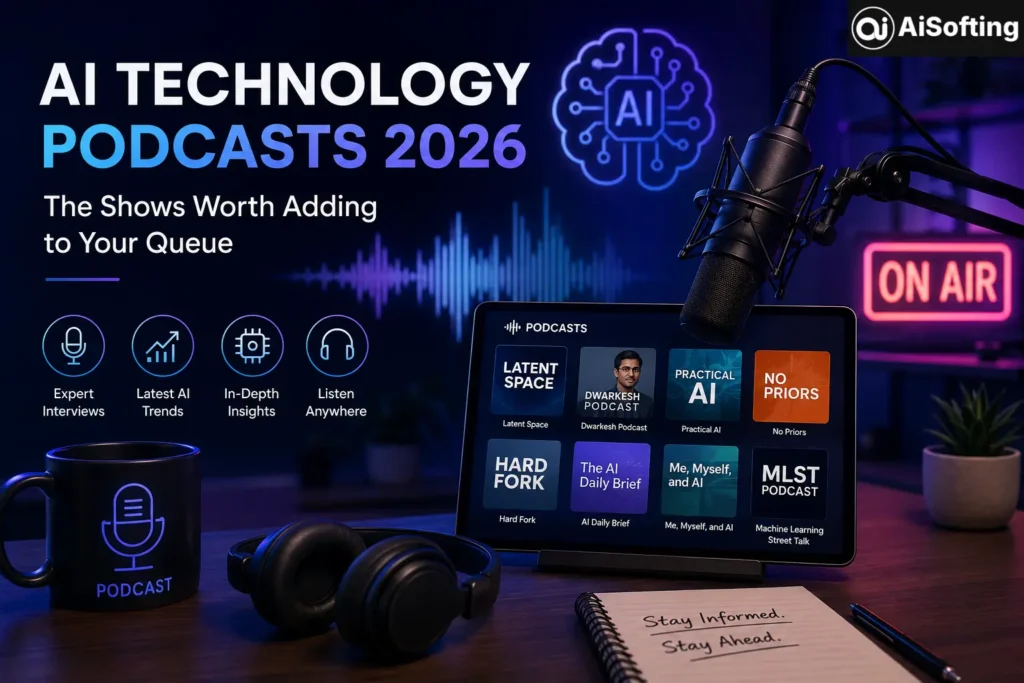
If you searched for AI technology podcasts 2026, you’re probably not looking for a generic “top 10” list recycled from 2023. You want to know which shows are still active right now, who they’re actually for, and whether they’ll be worth your commute or gym time. That’s exactly what this guide covers.
Two years ago, listening to an AI podcast was a nice-to-have for people who liked gadgets. In 2026, it’s closer to a professional habit. Frontier labs now treat long-form audio as a primary communication channel — researchers and founders explain major releases in podcast interviews before the official blog post even goes live. Hundreds of new AI shows launched between 2024 and 2026, and most of them recycled whatever was already trending that week. The ones that survived did it by offering something a text summary can’t: unscripted reasoning, real disagreement, and follow-up questions guests don’t get asked anywhere else.
Below is a working list of the AI technology podcasts worth your time in 2026, organized by who you are and what you’re trying to get out of listening, followed by real lessons from actually building a listening habit around them.
Why AI Technology Podcasts 2026 Matter More Than Before
AI capability has reportedly been compounding roughly every couple of months over the past year — a pace written coverage simply can’t track in real time. That’s a big part of why podcast listening became one of the fastest ways for engineers, founders, and operators to absorb primary-source thinking straight from the people building the systems, often months before the same ideas appear in a published paper or a mainstream article.
There’s also a trust factor. In a feed full of AI-generated summaries and recycled hot takes, a two-hour unscripted conversation is harder to fake and easier to verify. Hearing someone answer a hard, unplanned follow-up question tells you more about what they actually believe than a polished quote ever will.
Top AI Technology Podcasts 2026: The List
1. Latent Space — Best for AI Engineers
Latent Space grew out of a Discord community for AI engineers, and it still feels like eavesdropping on a sharp internal Slack channel rather than a produced show. Weekly episodes cover model releases, tooling, and agent infrastructure with real technical depth rather than headline summaries. Listen directly at latent.space/podcast.
2. Dwarkesh Podcast — Best for Frontier Research Interviews
Hosted by Dwarkesh Patel, this show has become something close to a peer-review process that frontier labs voluntarily submit to. Episodes often run three to five hours, but the question density is unusually high — Patel pre-reads internal papers and adjacent interviews before sitting down with guests, which is why leaders from labs like Anthropic and OpenAI keep showing up. Full archive at dwarkesh.com/podcast.
3. Practical AI — Best for Builders Who Ship
Hosted by Daniel Whitenack and Chris Benson, Practical AI stays grounded in what actually works at the application layer: MLOps, evaluation harnesses, and the unglamorous parts of shipping AI features. If you build with the technology rather than just talk about it, this is the weekly refresher worth keeping in rotation. Episodes are at changelog.com/practicalai.
4. No Priors — Best for Founders and Investors
Sarah Guo and Elad Gil host this show from a startup and investor lens, covering which markets are ripe for AI disruption and how founders should be thinking about the next 12 months. It’s less research-heavy and more focused on company-building. Listen at no-priors.com.
5. Hard Fork — Best for a Smart Non-Engineer
Kevin Roose and Casey Newton bring narrative journalism to AI at The New York Times. Hard Fork is the show to recommend to a smart friend or colleague who wants to follow the field without a technical background. Find it at nytimes.com/column/hard-fork.
6. The AI Daily Brief — Best for Daily News Without the Noise
If you want a daily rundown without hour-long detours, The AI Daily Brief delivers fast, digestible updates on company moves, new tools, and the biggest stories in AI, usually in 30 minutes or less. Visit aidailybrief.ai.
7. Me, Myself, and AI — Best for Enterprise Leaders
Produced by MIT Sloan Management Review and hosted by Sam Ransbotham, this show focuses on how large organizations actually deploy and govern AI, featuring leaders from companies like Hugging Face, Cisco, and ServiceNow discussing real wins and failures. Listen at sloanreview.mit.edu/audio-series/me-myself-and-ai.
8. Machine Learning Street Talk — Best for Technical Depth
MLST leans harder into research rigor than almost anything else in the space, making it a strong pairing with a lighter, more conversational show on the same playlist. Explore the archive at mlst.ai.
Common Mistakes People Make With AI Technology Podcasts
- Subscribing to everything and finishing nothing. A crowded podcast app isn’t the same as being informed. Two or three shows, actually completed, beat a dozen half-listened episodes.
- Treating news-roundup shows as a primary source. They’re useful for catching up quickly, but they mostly repackage what a good newsletter already covers.
- Skipping long technical episodes because of runtime. The three-hour interviews are usually where the real insight lives; short clips are marketing.
- Never adjusting playback speed. Most interview-format shows hold up fine at 1.5x to 2x without losing nuance, which is a genuinely underused way to reclaim time.
Best Practices for Building an AI Podcast Rotation in 2026
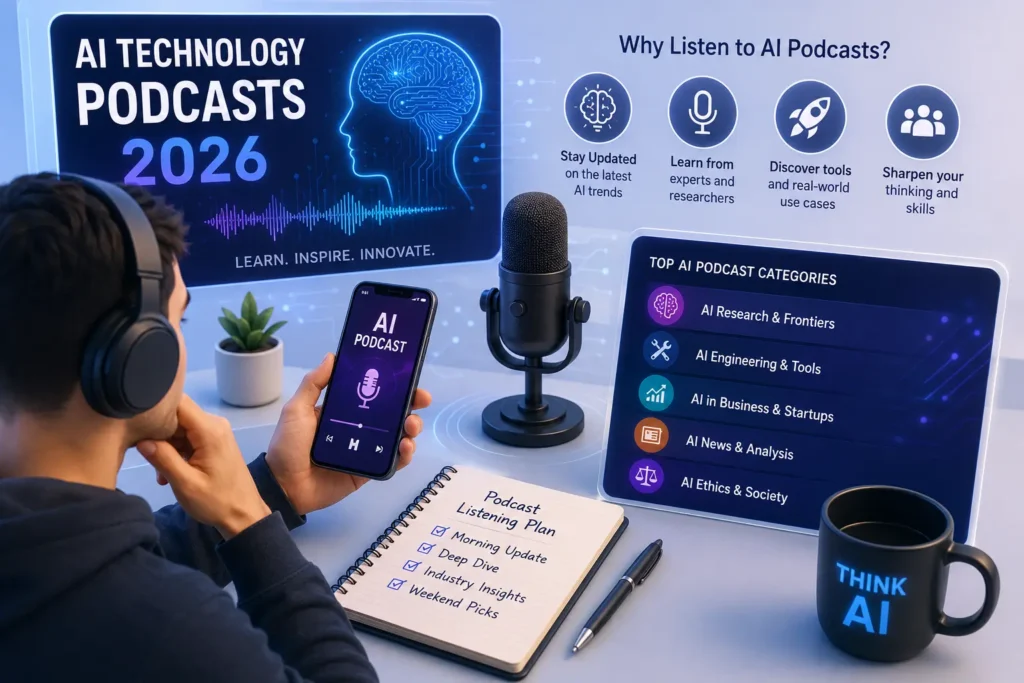
- Filter by guest, not just by show name. Follow a handful of researchers or founders you trust, then play whichever episode features them, regardless of which podcast it’s on.
- Read transcripts for technical episodes. Shows like Dwarkesh and Latent Space publish full transcripts, which are far easier to parse than audio when the discussion involves benchmarks or diagrams.
- Pair one technical show with one strategy show. That combination covers both “how is this actually built” and “why does it matter” without requiring five subscriptions.
- Revisit your rotation every few months. The AI podcast landscape moves fast enough that a great show from a year ago can go stale, and a new one can become essential within months.
Personal Experience: What Actually Changed My Listening Habits
I started building a rotation of AI technology podcasts the way a lot of people probably did in 2024 — out of low-grade anxiety that everyone else understood “agents” and I didn’t. My first instinct was to subscribe to anything with “AI” in the title. That lasted about three weeks before my podcast app turned into a graveyard of unplayed episodes.
What actually worked was narrowing down hard. I dropped every daily news show except one and started following two or three specific voices whose thinking I trusted, listening to whatever podcast they happened to appear on that week. I also started playing longer interview episodes at 1.5x speed during commutes instead of skipping them for shorter, punchier content, and found I retained more from one well-paced three-hour conversation than from five ten-minute clips.
The other change was reading transcripts for anything genuinely technical. Listening to a discussion of model architecture on a walk is fine for the general idea, but I found myself pulling up the transcript afterward almost every time something involved a diagram or a specific benchmark number. That habit alone saved me from misremembering details in conversations with colleagues more than once.
If there’s one lesson from a year and a half of doing this, it’s that the value isn’t in the number of shows you subscribe to. It’s in actually finishing the right episodes, and occasionally going back to reread them.
FAQs About AI Technology Podcasts 2026
What are the best AI technology podcasts in 2026? Latent Space, Dwarkesh Podcast, Practical AI, No Priors, and Hard Fork are among the most consistently recommended shows in 2026, each suited to a different audience — from engineers to business leaders to general listeners.
Which AI podcast is best for beginners? Hard Fork tends to be the most approachable starting point since it explains context as it goes rather than assuming technical background.
Which AI podcast is best for software engineers and AI builders? Latent Space and Practical AI both stay closest to real implementation details, evaluation, and tooling rather than market commentary.
Are long-form AI podcast episodes worth the time investment? Often, yes. Longer interview shows like Dwarkesh Podcast tend to have higher question density and more genuine follow-up than shorter, headline-driven formats, and playing at increased speed can help manage the time cost.
How do I keep up with AI news without listening every day? A weekly show plus a good newsletter usually covers the same ground as a daily podcast in far less time. Save daily listening for shows you genuinely enjoy rather than treating it as an obligation.
Do frontier AI companies actually use podcasts for real announcements? Increasingly, yes. Leaders from major labs have used long-form podcast interviews to discuss research and product direction in more depth than a typical press release allows.
Is it worth subscribing to more than five AI podcasts? Usually not. Most experienced listeners do better following a smaller number of trusted hosts and guests closely rather than spreading attention across a long subscription list.
Conclusion
The field of AI technology podcasts 2026 is loud, but the shows worth your time are the ones that consistently earn a second listen, not the ones with the flashiest guest list for one episode. Start small: pick one technical show, one strategy or business show, and one you genuinely enjoy on a personal level. Adjust playback speed, read transcripts for the dense episodes, and revisit your rotation every few months as the field moves. That’s a far more sustainable way to stay current than trying to listen to everything.
Actionable takeaways:
- Pick two to three AI technology podcasts rather than subscribing broadly, and actually finish episodes.
- Prioritize interview-format shows over pure news roundups if you already read newsletters.
- Use transcripts for technical episodes involving benchmarks, code, or diagrams.
- Reassess your rotation quarterly since this field changes fast.
Further reading: MIT Sloan Management Review’s Me, Myself, and AI series covers real enterprise AI deployment case studies, and NVIDIA’s The AI Podcast offers accessible, story-driven episodes on AI applications across industries. For ongoing frontier-lab interviews, the Dwarkesh Podcast archive is worth bookmarking directly.
Visit: Aisofting
Disclaimer: This article reflects publicly available information and general observations about AI technology podcasts 2026 as of mid-2026. Podcast rankings, hosts, formats, and episode availability can change over time, so verify current details directly with each show before relying on them. This piece is intended for general informational purposes and does not constitute professional, financial, or career advice. Mentions of specific podcasts, hosts, or companies are for illustrative purposes and do not imply endorsement.