
Introduction
If you’ve spent any time on YouTube or Twitter/X lately, you’ve probably seen someone claiming they’re making thousands of dollars a month doing “AI arbitrage.” It sounds like jargon dreamed up by a hustle-culture influencer, but the concept behind it is actually pretty simple — and it’s not new at all. It’s a modern twist on an old business model.
AI arbitrage is the practice of using artificial intelligence tools to produce a product or service cheaply and quickly, then reselling it at a higher price to a client who either doesn’t have the tool, doesn’t know how to use it, or simply doesn’t have the time to do it themselves. Think of it as the digital version of buying low and selling high, except instead of stocks or sneakers, you’re arbitraging speed, skill, and access to technology.
In this guide, we’ll break down what AI arbitrage actually means, how people are using it in the real world, the risks nobody talks about, and some lessons learned from actually trying it. If you’re exploring ways to monetize AI tools, this is the no-fluff version.
What Does “AI Arbitrage” Actually Mean?
The term borrows from traditional arbitrage, a finance concept where you profit from price differences for the same asset in different markets. AI arbitrage applies that same logic to digital labor and services.
Here’s the basic formula:
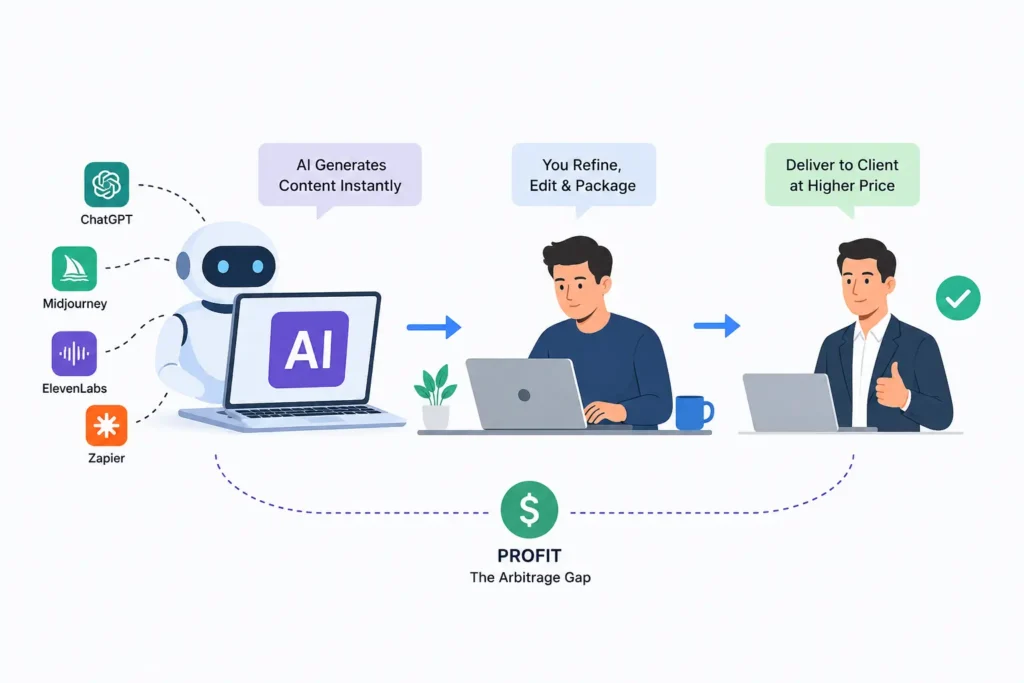
- You use an AI tool (like ChatGPT, Midjourney, Claude, or an automation platform) to produce something — content, images, code, voiceovers, video edits, customer support replies, and so on.
- You package or refine that output so it looks polished and client-ready.
- You sell it to a customer at a price that reflects human-level service, even though most of the heavy lifting was done by a machine in seconds.
The “arbitrage” is the gap between what the AI tool costs you (often just a monthly subscription) and what the client pays you for the finished product.
A Simple Example
Say a small business owner wants 30 product descriptions for their online store. They don’t know how to use AI tools, or they simply don’t have the time. You generate the descriptions using an AI writing assistant, edit them for accuracy and tone, and deliver them for $300. Your actual cost might have been your subscription fee and an hour of editing time. That spread is the arbitrage.
This same model shows up across freelance platforms like Fiverr and Upwork, where sellers offer “AI-generated logo design,” “AI voiceovers,” or “AI video editing” services without always disclosing that AI did most of the work.
Common Types of AI Arbitrage
1. Content Arbitrage
Using tools like ChatGPT or Jasper to write blog posts, social captions, or email sequences, then reselling them as a content service.
2. Design and Image Arbitrage
Generating logos, thumbnails, or marketing graphics with tools like Midjourney or Adobe Firefly and selling them as custom design work.
3. Voice and Video Arbitrage
Using AI voice cloning or text-to-video tools (like ElevenLabs or Synthesia) to produce voiceovers, dubbing, or short videos for clients who’d otherwise pay for a studio.
4. Automation Arbitrage
Building simple AI-powered chatbots or workflow automations (using tools like Zapier combined with an AI model) and selling them to small businesses as “custom AI solutions.”
5. E-commerce Arbitrage
Using AI to research trending products, write listings, and generate ad creative for dropshipping or print-on-demand stores — essentially compressing what used to take a team into a one-person operation.
If you’re curious how these tools stack up against each other, our comparison of top AI writing tools breaks down pricing and output quality in more detail.
Why People Are Drawn to AI Arbitrage
The appeal is obvious: low startup cost, fast turnaround, and the ability to scale without hiring a team. Someone with no design background can technically “offer” design services now, because the AI handles the technical execution. That’s a genuinely new shift in how digital labor markets work.
It also fits well with the broader freelance and gig economy. Reports from organizations like the World Economic Forum have repeatedly flagged how generative AI is reshaping freelance and knowledge work, lowering the barrier to entry for tasks that once required specialized training.
The Risks Nobody Talks About
This is the part most “make money with AI” videos conveniently skip.
Quality control is on you. AI output isn’t perfect. It hallucinates facts, makes design choices that look generic, and sometimes just gets things wrong. If you’re reselling without thorough review, you’re putting your reputation on the line for a tool’s mistakes.
Race to the bottom pricing. Because AI lowers the cost of production for everyone, more people enter the market, and prices drop fast. The arbitrage gap shrinks the more popular it becomes — this is true of arbitrage in any market, not just AI.
Disclosure and ethics. Some clients are fine knowing AI was used; others feel misled if they paid for “custom” work that was templated by a machine. Being upfront protects you legally and reputationally.
Platform and copyright issues. AI-generated images and text can run into copyright ambiguity, and some platforms restrict undisclosed AI content. The U.S. Copyright Office has published ongoing guidance on this, and it’s worth understanding before you build a business around reselling AI output.
Best Practices If You’re Trying This
- Always review and edit AI output before delivering it — never ship raw, unedited AI content.
- Be transparent with clients about the use of AI tools where it matters (especially for written content, since SEO and trust both depend on accuracy).
- Specialize in a niche instead of competing on generic “AI services,” since differentiation is what protects your margin.
- Track your actual time and tool costs so you know your real profit margin, not just the sticker price.
- Stay updated on the tools — the AI landscape moves fast, and the arbitrage opportunity often lies in being early to a new capability before everyone else catches on. Our guide to emerging AI tools is updated regularly if you want to stay ahead of that curve.
Common Mistakes to Avoid
- Overpromising “human-quality, 100% original” work without checking AI output for accuracy or plagiarism overlap.
- Ignoring client briefs and relying entirely on generic prompts.
- Underpricing so aggressively that the business isn’t sustainable once competition increases.
- Failing to build any actual skill — pure prompt-and-resell models tend to collapse once clients can use the tools themselves.
Personal Experience
I tried a small version of this myself a while back, mostly out of curiosity rather than as a serious business plan. I offered short-form blog intros and product descriptions to a couple of small e-commerce clients, using AI as a first draft and then editing heavily for tone and accuracy.
A few honest observations from that experiment: the time savings were real, but smaller than the hype suggests. Editing AI output to sound genuinely good — not just grammatically correct — still took real effort. Clients who didn’t review carefully were sometimes happy with mediocre output, which honestly made me uncomfortable, because mediocre content doesn’t actually help a business long-term.
The other thing I noticed is that pricing eroded quickly. Within a few months, more freelancers were offering the same “AI-powered” service, and clients started expecting lower prices because they assumed (correctly) that it took less time than traditional writing. The arbitrage window was real, but it was short, and it rewarded people who added a genuine layer of expertise on top of the AI output — strategy, brand voice, accuracy — rather than people just copy-pasting from a chatbot.
My takeaway: AI arbitrage works best as a head start, not a permanent business model. The people who succeeded long-term were the ones who used AI to work faster, then layered real expertise, taste, and client relationships on top — not the ones treating it as a copy-paste side hustle.
Frequently Asked Questions
Is AI arbitrage legal?
Yes, generally. Using AI tools to produce work and selling that work isn’t illegal. Issues can arise around copyright, plagiarism, or misrepresentation if you claim work is fully human-made when it isn’t.
Is AI arbitrage the same as dropshipping?
Not exactly, though they share a similar logic. Dropshipping arbitrages physical product sourcing and shipping, while AI arbitrage applies the same buy-low-sell-high logic to digital labor and services.
Can I really make money with AI arbitrage in 2026?
People do, but the market has gotten more competitive than it was in 2023–2024. Profit margins are tighter, and success increasingly depends on adding real skill, not just access to AI tools.
What skills do I need to start?
Basic prompt writing, an eye for quality control, and at least one area of specialization (writing, design, video, automation) where you can refine AI output to a professional standard.
Do I have to tell clients I used AI?
There’s no universal legal requirement in most cases, but transparency is generally good practice and increasingly expected, especially for written content where accuracy and originality matter.
What’s the biggest risk of AI arbitrage?
Quality control. If you resell AI output without careful review, errors or generic-sounding work can damage your reputation faster than it took to build it.
Which AI tools are most commonly used for arbitrage?
ChatGPT and Claude for writing, Midjourney and Firefly for images, ElevenLabs for voice, and Zapier-style platforms for automation are among the most common.
Conclusion
AI arbitrage isn’t a magic money machine, but it’s also not pure hype — it’s a real shift in how digital services get priced and delivered. The opportunity exists because AI tools can produce in seconds what used to take hours, and there’s still a gap between people who know how to use these tools well and people who don’t.
If you want to explore it, start small, be honest with clients, and treat the AI as a productivity multiplier rather than a replacement for actual skill. The arbitrage window rewards speed early on, but it’s expertise and reliability that keep clients coming back once the novelty wears off.
Disclaimer: This article is for informational purposes only and does not constitute financial, legal, or business advice. Always do your own research and consider consulting a professional before starting any new business venture.