Introduction
Every board deck in 2026 says the same thing: “We need to accelerate AI transformation.” Almost none of them say: “We need to decide who is accountable when an AI agent makes a bad call.”
That gap is the whole story.
Enterprises are pouring record budgets into generative AI, copilots, and increasingly autonomous agents, yet the majority of these programs never make it past the pilot stage or fail to show measurable return. The instinctive explanation is “the model wasn’t good enough” or “our data was messy.” Those things matter, but they’re not the root cause. The real reason AI transformation stalls is far less technical and far more uncomfortable: most organizations have no idea who owns an AI decision once it’s made, no threshold for what counts as an acceptable risk, and no escalation path when something goes wrong.
In other words, AI transformation is a governance problem wearing a technology costume. Fix the governance, and the technology starts behaving. Ignore it, and even the best model in the world becomes a liability sitting on your balance sheet. It’s the same pattern we broke down in the missing step most companies skip before scaling AI — the tooling was never really the hard part.
This article breaks down why that’s true, what’s changed in 2026 that makes it urgent, and — importantly — a governance approach most companies haven’t tried yet: matching oversight to an agent’s autonomy and blast radius, rather than applying one governance policy to every AI system in the building.
Why “AI Transformation” Keeps Failing
The numbers tell a consistent story across every major research body tracking enterprise AI in 2025 and 2026.
- Independent research has found AI project failure rates running well above those of typical IT projects, with a large share of initiatives never escaping the pilot phase.
- Deloitte’s State of AI in the Enterprise research, based on thousands of senior leaders, found that only a small fraction of companies describe themselves as genuinely AI-mature.
- MIT’s widely cited “GenAI Divide” research tracked tens of billions in enterprise generative AI spend and found that only a small percentage of projects produced measurable profit-and-loss impact.
- Boston Consulting Group’s analysis attributes most AI transformation failures to people and process breakdowns rather than model quality.
None of these numbers are about the models being weak. GPT-class and Claude-class models in 2026 are dramatically more capable than what enterprises were piloting even two years ago. The bottleneck moved. It used to sit in the technology. Now it sits in the organization.
The Real Failure Modes
When you dig into post-mortems of failed AI rollouts, the same patterns keep showing up:
- No owner of the outcome. A generative AI tool ships a bad customer response, and nobody can say whose job it was to catch it.
- Shadow AI. Employees paste confidential data into consumer chatbots or unapproved tools because the “official” tool doesn’t do what they need — a security and compliance blind spot hiding in plain sight.
- Policy that exists on paper but not in practice. Many companies wrote AI usage policies in 2023–2024. Static PDFs, however, don’t govern an autonomous agent making decisions at 2 a.m.
- Uniform governance applied to non-uniform risk. A chatbot that drafts marketing copy and an agent that can issue refunds or move money are treated under the same review process — which either slows the harmless one to a crawl or lets the risky one through unchecked.
- No regulatory readiness. With the EU AI Act’s enforcement powers coming into force in August 2026, and U.S. federal and state agencies issuing AI-related rules at a rapidly increasing pace, companies without a compliance posture are exposed to real legal and financial risk — not hypothetical risk.
The Governance Gap No One Talks About: Agent Autonomy vs. Blast Radius
Here’s the part of this conversation that most articles on this topic miss, and it’s worth sitting with.
Gartner has warned that applying the same governance rules to every AI agent — regardless of how much autonomy it has or how much access it’s been granted — is itself a cause of failure. Lock everything down uniformly, and your teams route around governance with shadow AI. Trust everything uniformly, and you get an incident with no clear owner.
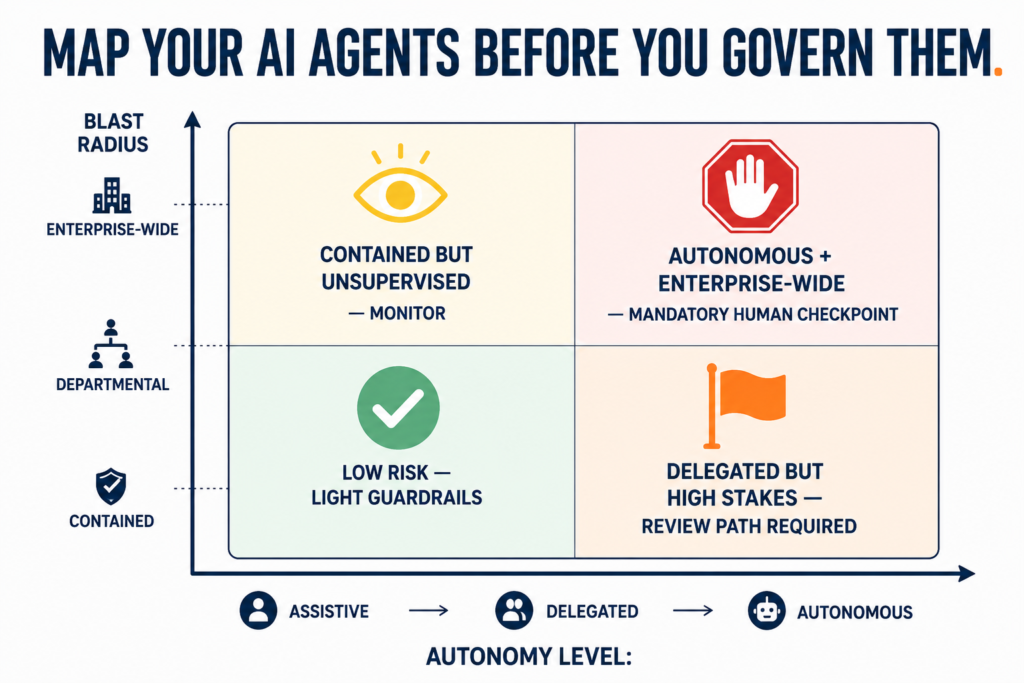
The fix isn’t “more governance” or “less governance.” It’s differentiated governance, mapped against two variables most companies never plot against each other:
1. Autonomy Level — how much can the agent decide on its own?
- Assistive: suggests, human approves every action (e.g., a drafting copilot).
- Delegated: acts within a pre-approved scope, human reviews after the fact (e.g., auto-categorizing support tickets).
- Autonomous: initiates and completes multi-step actions without real-time human sign-off (e.g., an agent that negotiates a vendor contract or issues a refund). If your team is still getting familiar with how these systems actually work day to day, our guide to agentic AI is a useful starting point before you attempt to govern one.
2. Blast Radius — how much damage can a bad decision do?
- Contained: affects one document, one conversation, easily reversible.
- Departmental: affects a workflow, a customer segment, a budget line.
- Enterprise-wide: affects regulatory standing, financial exposure, brand trust, or customer safety.
Plot any AI system on this 2×2, and you get a much more useful governance map than a single company-wide “AI policy.” A marketing copy assistant sitting in the Assistive/Contained corner needs light-touch guardrails and a fast approval lane. An autonomous agent sitting in Autonomous/Enterprise-wide needs mandatory human checkpoints, audit logging, and a named accountable owner before it ever touches production — no matter how well it performed in testing.
This is the piece most “AI governance frameworks” skip. They hand you a checklist. They don’t hand you a way to decide which items on the checklist actually apply to this system, for this level of risk.
Turning Policy Into Enforcement: Policy-as-Code
Another shift worth understanding: governance is moving from documents to code. Instead of a policy PDF telling employees what not to do, more organizations are embedding rules directly into the systems agents run on — automatically blocking a refund above a certain size, automatically flagging a data export, automatically halting an agent that starts to act outside its defined scope. This is often called policy-as-code, and it matters because a rule that only lives in a document has no way to stop an autonomous system acting in real time. A rule embedded in the workflow does.
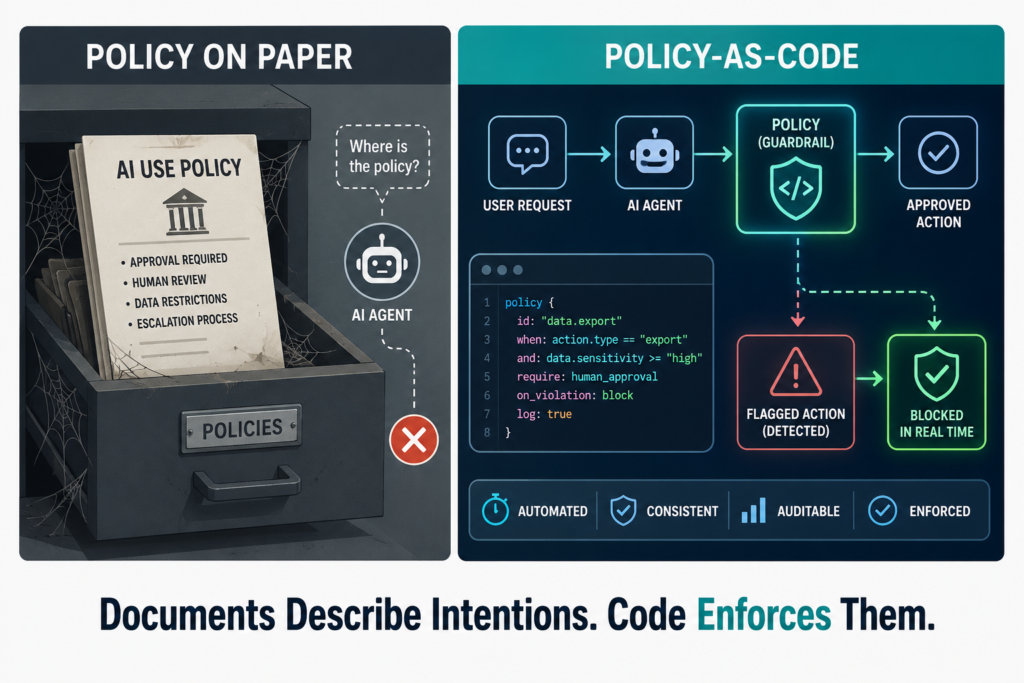
Frameworks like the NIST AI Risk Management Framework and ISO/IEC 42001 give companies a starting vocabulary for this, but the actual enforcement increasingly has to live in the tooling — observability platforms, agent orchestration layers, and access controls — not just in a governance committee’s meeting notes. This is closely tied to a problem we’ve covered from the finance side: explainable AI in finance, where “the model said so” has stopped being an acceptable answer to a regulator or a customer.
Building an AI Governance Structure That Actually Works
If you’re starting from close to zero, here’s a practical order of operations:
- Inventory what you actually have. Most companies discover they have more AI running in production — official and unofficial — than leadership realized. You cannot govern what you haven’t counted.
- Classify by autonomy and blast radius, using the model above, rather than a single flat risk tier.
- Assign a named accountable owner per system — not a committee, a person — whose job includes monitoring behavior over time, not just approving launch.
- Build the escalation path before you need it. Decide, in writing, who gets paged when an agent does something unexpected, and what “unexpected” means for that system.
- Give employees a sanctioned alternative to shadow AI. Blocking tools without replacing their function just pushes usage underground. This is really the same balance we walk through in how to automate your business without losing the human touch — automation that ignores the human side tends to get worked around, not adopted.
- Convert your highest-risk policies into enforced controls, not just documented ones.
- Revisit the classification quarterly. An agent’s scope tends to expand quietly over time; governance has to keep pace with that creep.
Common Mistakes to Avoid
- Treating AI governance as a compliance checkbox owned solely by legal, with no operational teeth.
- Writing a single AI policy for the whole company and assuming it covers every use case.
- Approving an agent’s autonomy level once, at launch, and never re-reviewing it as its access grows.
- Banning tools outright instead of asking why employees reached for an unauthorized one in the first place.
- Measuring AI success by adoption numbers instead of outcomes and incident rates.
Benefits of Getting This Right
Companies that build governance early aren’t just avoiding fines. They tend to move faster, not slower, because:
- Teams stop waiting on ad hoc approvals for every new AI use case — the classification model gives them a clear, repeatable lane.
- Incidents get caught and contained before they become headlines.
- Regulatory audits (EU AI Act, sector-specific rules) become a documentation exercise instead of a fire drill.
- Boards and investors get a real answer to “who’s accountable” instead of a shrug.
Personal Experience: What I’ve Actually Seen Go Wrong (and Right)
I’ve sat in more than a few “AI transformation” kickoff meetings that spent ninety minutes on model selection and about four minutes on ownership. That ratio is almost always backwards.
One pattern I’ve watched repeat itself across very different companies: a team pilots a customer-facing AI assistant, it performs beautifully in a two-week test with a friendly internal audience, and leadership greenlights a full rollout the following month. Three weeks after go-live, the assistant says something wrong to a real customer — not catastrophic, just wrong — and the first question in the incident call is “wait, who signed off on this going live?” Nobody has a clean answer. That’s not a model problem. The model did exactly what it was trained to do. It’s a structural problem: nobody defined, in advance, who owned the outcome once humans stopped reviewing every output.
The flip side is just as instructive. The rollouts I’ve seen go smoothly almost never had the flashiest technology. They had something duller and more valuable: a one-page document naming who owned the system, what its actual scope was, and what would trigger a pause. When something did go slightly wrong — and something always does, eventually — the team already knew who to call and what to check. The incident got contained in an afternoon instead of becoming a two-week fire drill involving legal, PR, and three different VPs.
The lesson I keep relearning: governance work looks boring next to a slick agent demo, right up until the moment it’s the only thing standing between a minor glitch and a genuine crisis.
Frequently Asked Questions
Is AI governance the same as AI ethics?
No. AI ethics deals with values and fairness — bias, transparency, harm reduction. AI governance is the operational structure (ownership, approvals, monitoring, escalation) that puts those values into practice day to day. You need both, but governance is what makes ethics enforceable rather than aspirational.
Why do most AI projects fail even with good technology?
Research consistently points to organizational factors — unclear ownership, poor data readiness, and lack of accountability structures — rather than model performance, as the primary driver of failed AI initiatives.
What is “shadow AI” and why does it matter?
Shadow AI refers to employees using AI tools that haven’t been vetted or approved by the organization — often because the approved tools don’t meet their needs. It creates real data security and compliance exposure that leadership frequently doesn’t know exists until an inventory is done.
Does the EU AI Act apply to companies outside the EU?
It can. The EU AI Act applies to any organization whose AI systems are used by people in the EU, regardless of where the company is headquartered, similar in reach to how GDPR extended beyond EU borders.
What is policy-as-code in AI governance?
It’s the practice of embedding governance rules directly into the systems and workflows an AI agent operates in — so restrictions are enforced automatically in real time — rather than relying solely on a written policy document that has no way to intervene in an autonomous action.
Should every AI agent go through the same approval process?
No. Applying identical governance to a low-risk assistive tool and a high-autonomy, high-impact agent either slows down harmless use cases unnecessarily or under-governs the risky ones. Governance should scale with the agent’s autonomy level and potential blast radius.
Who should own AI governance inside a company — IT, legal, or the business unit?
Effective governance usually needs all three at the table, but each AI system should still have one named accountable owner, not a committee, responsible for monitoring it day to day.
How do I know if my company has an AI governance gap?
Start with an honest inventory of every AI tool and agent in use, official and unofficial. If you can’t answer “who owns this, and what happens if it fails?” for each one, that’s your gap.
Is AI governance only relevant for large enterprises?
No. Smaller companies adopting AI agents for customer service, finance, or operations face the same accountability and risk questions — often with fewer resources to absorb a mistake, which makes early governance arguably more important, not less.
Conclusion: Governance Is the Competitive Advantage
The uncomfortable truth for 2026 is that the winners of the AI transformation race won’t be the companies with access to the most powerful models — everyone will have access to roughly the same models before long. The winners will be the companies that built the organizational muscle to deploy those models at scale without losing control of them: clear ownership, risk-tiered oversight, enforced (not just written) policy, and a plan for when something inevitably goes sideways.
Actionable takeaways:
- Audit every AI system in your organization, sanctioned and unsanctioned, this quarter.
- Map each one against autonomy level and blast radius instead of applying one blanket policy.
- Name a single accountable owner per system, not a committee.
- Turn your highest-risk written policies into enforced, automated controls.
- Revisit classifications regularly — an agent’s scope creeps quietly.
AI transformation was never really about the technology catching up. It was about the organization catching up to the technology. That’s a governance problem — and unlike a lot of problems in this space, it’s one you can actually solve with things you already have: clear decisions, clear owners, and the discipline to write them down before you need them.
For more breakdowns like this on how AI is actually reshaping business operations — not just the hype — browse our full Artificial Intelligence coverage.