Introduction
Every few months, a new AI buzzword takes over LinkedIn. This time it’s not hype for hype’s sake — agentic AI is genuinely reshaping how software gets built, and companies are hiring for it faster than the talent pool can keep up. If you’ve searched for an agentic AI course, you’ve probably already noticed the problem: there are hundreds of them, ranging from serious, project-based programs to repackaged prompt-engineering tutorials wearing a trendier label.
This guide breaks down what agentic AI actually means, what a genuinely good course should teach you, the mistakes people commonly make when choosing one, and a first-hand account of what it’s actually like to work through this material. The goal isn’t to hand you a “top 10” list — it’s to help you evaluate any agentic AI course you’re considering, including ones not mentioned here.
What Is Agentic AI, Really?
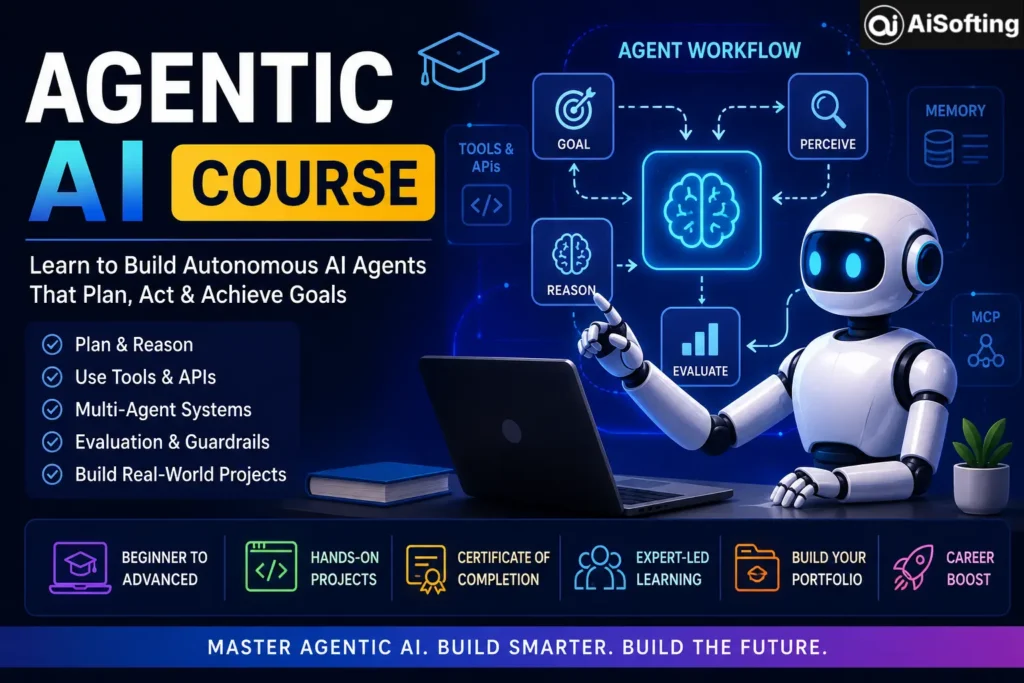
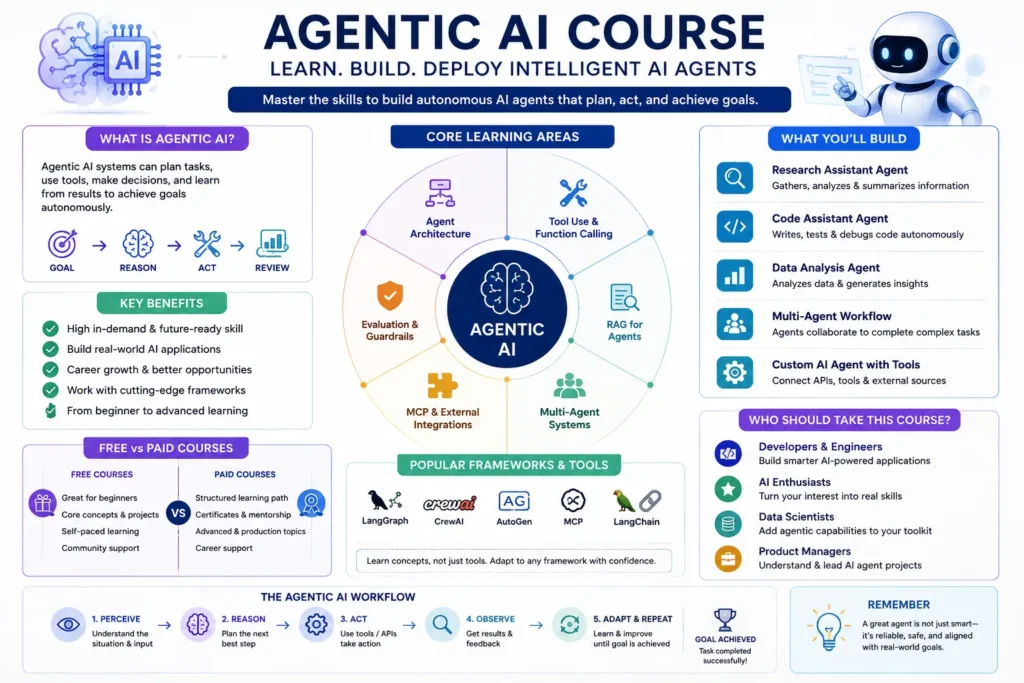
Agentic AI refers to systems that don’t just respond to a single prompt — they plan a sequence of steps, call tools or APIs, evaluate their own progress, and adjust course when something doesn’t go as expected. Instead of a chatbot answering one question at a time, an agent might research a topic across multiple sources, write code, test it, fix its own errors, and hand back a finished result.
This is a meaningful shift from earlier generative AI tools. A regular LLM chat interaction is one request, one response. An agentic system operates in a loop: perceive the situation, reason about what to do next, take an action, observe the result, and repeat until the task is done.
Why the Sudden Demand for Agentic AI Courses
A few forces are driving the current rush to learn this skill:
- Frameworks have matured. Tools like LangGraph, CrewAI, AutoGen, and the Model Context Protocol (MCP) have moved from experimental to production-ready, so companies are actually shipping agent-based systems now rather than just prototyping them.
- The hiring market is reacting. AI engineering roles have consistently ranked among the fastest-growing jobs, and job postings increasingly specify agent-building experience, not just general “AI familiarity.”
- The skill gap is real. Plenty of developers can use ChatGPT effectively; far fewer can architect a multi-agent system that behaves reliably in production, which is exactly the gap employers are trying to close through hiring — and why interest in structured courses has spiked.
What to Look For in a Good Agentic AI Course
Not all courses labeled “agentic AI” actually teach agentic AI. Some are prompt-engineering courses with a rebrand. Before enrolling, check for these things:
1. It Goes Beyond a Single Framework
A course that only teaches you the syntax of one tool (say, just LangChain) leaves you stuck when that framework changes its API — which happens often in this space. Look for courses that teach the underlying patterns (like the ReAct loop, planning, and tool-calling) so you can apply the concept regardless of which framework a future employer uses.
2. It Includes Multi-Agent Systems
Single-agent tutorials are a good starting point, but real interview and job expectations in 2026 increasingly involve multiple agents coordinating with each other. A solid curriculum should cover orchestration between agents, not just one agent calling one tool.
3. It Covers Production Concerns, Not Just Demos
A flashy demo that works once in a notebook is very different from a system that handles failures, avoids infinite loops, and includes guardrails. Strong courses address evaluation, error handling, and reliability — not only “how to build a cool agent.”
4. It Has Real Projects, Not Just Video Lectures
Agentic AI is a hands-on skill. Watching someone else build an agent is not the same as debugging your own broken tool call at 11pm. Prioritize courses with graded projects or a portfolio-style capstone.
5. It’s Being Kept Current
Because frameworks change quickly, check when a course was last updated. A syllabus frozen from early 2025 may already be teaching deprecated patterns.
Free vs. Paid Agentic AI Courses
You don’t need to spend a lot of money to get a solid introduction. Free courses from established AI education platforms — like DeepLearning.AI’s agent-focused courses and the Hugging Face AI Agents Course — cover real frameworks and hands-on building, not just theory.
Paid options tend to add structured certificates, mentorship, and more advanced production-level content, which can matter if you’re using the course for a career switch and want a credential to point to on a résumé or LinkedIn profile. Coursera’s growing catalog of agentic AI specializations, for example, includes options aimed specifically at both technical builders and business leaders who need to understand agentic systems strategically rather than build them from scratch.
Skills a Solid Course Should Actually Teach You
- Core agent architecture: perception, reasoning, action, and feedback loops
- Tool calling and function calling patterns
- Retrieval-Augmented Generation (RAG) as it applies to agent memory and context
- Multi-agent orchestration and communication
- The Model Context Protocol (MCP) and how agents connect to external tools
- Evaluation, guardrails, and failure handling for production systems
Benefits of Taking an Agentic AI Course
- Structured learning path instead of piecing together scattered blog posts and documentation
- Hands-on projects you can point to in interviews or add to a portfolio
- Faster ramp-up than self-teaching through trial and error
- Exposure to multiple frameworks so you’re not locked into one vendor’s approach
- A credential that can help with a career pivot into AI engineering roles, depending on the course
Common Mistakes People Make When Choosing a Course
- Picking a course based on the length of its syllabus rather than its depth. A long course covering only basic function calling isn’t more valuable than a shorter one that goes deeper into architecture.
- Learning only one framework. Interviewers increasingly ask why you’d choose one framework (like CrewAI) over another (like AutoGen) for a given use case — a single-framework course won’t prepare you for that.
- Stopping at the demo stage. Building an agent that works in a notebook is very different from one that survives real-world edge cases; skipping the production and reliability modules leaves a real gap.
- Ignoring how recently the course was updated. Agentic AI frameworks change fast enough that a course from a year ago may already be outdated in places.
- Assuming a certificate alone guarantees hireability. Employers are increasingly testing practical skills directly in interviews, so the certificate matters less than what you can actually build and explain.
Best Practices for Getting the Most Out of an Agentic AI Course
- Build every project yourself instead of just following along — retyping code from a video isn’t the same as debugging your own mistakes
- Try to rebuild at least one project using a second framework once you finish, to test whether you understood the underlying pattern or just memorized syntax
- Keep a small portfolio repository as you go, so you have something concrete to show in interviews
- Join a community or forum tied to the course (many free courses have active Discord or forum communities) — debugging agent failures is much faster with other learners around
Personal Experience
I went into my first agentic AI course assuming it would feel similar to earlier machine learning courses I’d taken — mostly conceptual, with some code along the way. It didn’t. The first project had me building a simple tool-calling agent, and within an hour I ran into an infinite loop where the agent kept calling the same API over and over because I hadn’t set a stopping condition. That single mistake taught me more about how agent loops actually work than any lecture slide could have.
What surprised me most was how quickly the “framework of the month” problem showed up. I learned one orchestration tool first, felt confident, and then discovered in a job-adjacent side project that the company I was helping used a completely different framework. Because the course I’d chosen had spent real time on the underlying reasoning pattern rather than just tool-specific syntax, switching over took a weekend instead of starting from scratch — which reinforced how much the “framework-agnostic” advice above actually matters in practice.
The other lesson: production concerns are not optional extras. My early agent prototypes worked fine in testing and then broke almost immediately when I tried feeding them slightly messier, real-world input. Courses that treat error handling and guardrails as an afterthought leave a real gap that only becomes obvious once you try to use what you built for something that matters.
If I were starting over, I’d spend less time hunting for the “best” course and more time checking whether a course’s projects forced me to debug real failures — that’s where the actual learning happened.
FAQs
Do I need a programming background to take an agentic AI course?
Most technical agentic AI courses assume basic Python knowledge, since most frameworks (LangChain, LangGraph, CrewAI) are Python-based. Business-focused courses aimed at leaders and non-technical roles typically don’t require coding experience.
How long does it take to learn agentic AI?
Building a first working agent typically takes one to two weeks with a well-structured course, or less if you already know how to work with LLM APIs. Reaching production-level competence with evaluation and multi-agent systems usually takes a few months of consistent, hands-on practice.
Are free agentic AI courses good enough, or should I pay?
Several free courses from established AI education providers cover real frameworks and hands-on projects at a genuinely solid level. Paid courses tend to add structured certificates, deeper production content, and sometimes mentorship, which matters more if you need a credential for a career change.
What’s the difference between prompt engineering and agentic AI?
Prompt engineering focuses on crafting inputs to get better responses from a language model in a single exchange. Agentic AI goes further, covering systems that plan multi-step tasks, call tools, and adjust their approach based on results, without a human prompting each step.
Which frameworks should an agentic AI course cover?
Look for coverage of at least a couple of major frameworks (such as LangGraph, CrewAI, or AutoGen) plus the Model Context Protocol (MCP), which has become a common standard for connecting agents to external tools.
Is an agentic AI certificate worth it for job hunting?
A certificate can help get past initial resume screening, but most hiring managers in this field test practical skills directly in interviews. A certificate paired with real, explainable projects is far more valuable than the certificate alone.
Conclusion
Agentic AI has moved past the experimental stage, and the demand for people who can actually build and maintain these systems isn’t slowing down. The right course for you depends less on rankings and more on whether it forces you to build real, breakable projects, covers more than one framework, and takes production reliability seriously rather than stopping at a demo. A shorter, deeper course will usually serve you better than a long one padded with framework trivia.
Actionable takeaways:
- Prioritize courses with hands-on, debuggable projects over passive video lectures
- Make sure the curriculum covers multi-agent orchestration, not just single-agent tool calling
- Check for production topics like evaluation, guardrails, and failure handling
- Confirm the course has been updated recently, given how fast agentic frameworks evolve
- Try rebuilding at least one project in a second framework to test real understanding, not memorization
Discover more AI tools, guides, and the latest AI insights at Aisofting
Disclaimer: This article reflects publicly available course information and general industry trends as of July 2026. Course content, pricing, and certificate value can change, so check each provider’s official page for current details. This is not a guarantee of employment outcomes or salary figures, which vary widely by region, experience, and employer. Personal experience described reflects one individual’s learning path and may not represent every learner’s results.