

Manus is an AI agent from Singapore-based Butterfly Effect that plans and carries out multi-step tasks, such as research reports, slide decks and websites, on its own cloud computer. You describe a goal; it returns finished files. As of November 2026, it has a free plan, paid plans from $20 a month, and is independent of Meta.
Many explainers still describe Manus as a Meta product. That is out of date. Meta announced the purchase on December 29, 2025, and 119 days later China’s economic planner ordered the deal reversed.
This guide covers what Manus does, how its credit pricing works, what changed this year, and what to check on safety before you connect an account.
Is Manus AI owned by Meta?
No. As of November 2026, Manus says it operates as an independent company. Meta announced the acquisition on December 29, 2025, but China’s National Development and Reform Commission (NDRC) prohibited it on April 27, 2026 and required the parties to withdraw from the transaction.
| Date | What happened | Basis |
|---|---|---|
| March 6, 2025 | Manus launches as an invitation-only beta | Wikipedia; consistent with other coverage |
| December 29, 2025 | Meta announces it is acquiring Manus; Meta did not disclose terms | AP; Manus statement |
| Reported value | The Wall Street Journal reported the deal at more than $2 billion | Reported, not confirmed by either company |
| April 27, 2026 | The NDRC prohibits the deal and orders the parties to withdraw | Reuters, AP and Wikipedia summaries |
| June 15, 2026 | Meta announces it is cutting ties with Manus | Wikipedia, citing Bloomberg |
| August 11, 2026 | Manus announces it will return to independent operation | Manus blog post, “A Note to Our Users” |
| September 1, 2026 | Manus reportedly resumes independent operations formally | Secondary reports |
| September 28, 2026 | Manus releases Manus 2.0 | Manus blog |
| October 8, 2026 | Butterfly Effect announces a round of more than $500 million, co-led by Boyu Capital and IDG Capital; valuation not disclosed | CNBC and other outlets |
What most people miss: the unwinding touched user data. Manus said data generated by certain users on or after December 29, 2025 would be deleted from August 23 to August 24, 2026 (Singapore time). It said affected users could back up first and restore from August 25. Manus said this was not a security incident. It also said its data is stored in the United States and Singapore.
Reports say the founders and existing investors bought Meta’s stake back at roughly the original price. Manus has not published those terms in the sources reviewed, so treat that as reported only. A $4 billion valuation for the October round is also unconfirmed.
How does Manus AI work?
Manus works as a goal-to-deliverable agent. According to its official documentation, it runs in a sandbox: a virtual computer with internet access, a persistent file system, and the ability to install software and create custom tools.
You state an outcome. Manus plans the work, runs steps inside that sandbox, and hands back files, pages or decks.
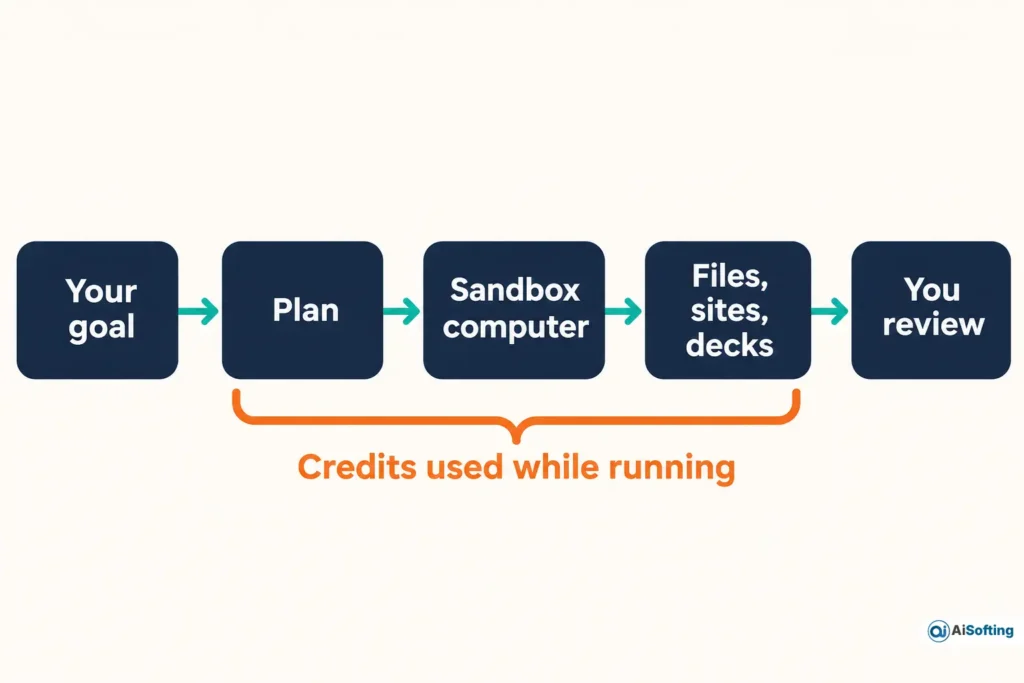
Three details the short summaries skip:
- Two modes. Manus’s plans documentation recommends Chat mode for simple questions, because full agent runs consume more credits.
- Browser features are separate. The cloud browser runs inside Manus’s environment. Browser Operator is a browser extension that turns your own browser into an agent. A well-known Google summary blends these two.
- Manus 2.0 changed the product. Manus’s September 28, 2026 announcement lists a new agent harness called Cascade, a purchasable Cloud Computer, event-triggered Automations, and a desktop app renamed Manus Studio. It also adds a Video Editor and Game Dev environment, plus Cue, a separate personal-agent app in early access with an invite code. The announcement says that in one tested configuration, Cascade used 23.2% fewer tokens, finished 28.2% faster and cost 32% less than the previous system. That is a vendor claim from a single configuration.
Manus does not publish an accuracy rate for finished work. Its own documentation advises reviewing intermediate results on long jobs to avoid wasting credits.
What can Manus AI do?
Manus’s documentation lists these capabilities. The “Notes” column shows what the documentation does and does not say.
| Capability | What the documentation describes | Notes |
|---|---|---|
| Wide Research | Parallel agents that each handle one item in a large list, then combine results | Best for many independent items |
| Slides | Research, content, design, visuals and speaker notes from a description | Quality is not independently benchmarked in sources reviewed |
| Websites and apps | Build, preview, publish; backend, database and storage; GitHub export; mobile app publishing | Hosting and usage have their own billing page |
| Data analysis | Turns raw data into charts and dashboards | Credit cost varies by task |
| Browser work | Cloud browser plus the Browser Operator extension | Operates inside logged-in sessions if you allow it |
| Automations | Scheduled tasks and, since Manus 2.0, tasks triggered by events such as a new email or Slack message | Plan limits apply |
| Media | Image, video, audio and 3D models; Video Editor; Game Dev | Built-in models consume credits |
| Integrations | Connectors for Gmail, Notion, Slack and GitHub; MCP connectors; Zapier; an API | Connectors give Manus access during a task |
The launch-era demos (resume screening, stock analysis) are still quoted as if they were the product. The current documentation centers on projects, automations and builders.
How much does Manus AI cost? Is it free?
Manus has a free plan, but it is a trial, not unlimited agent work. According to Manus’s Help Center pricing article, read on November 17, 2026:
| Plan | Price | Credits | Concurrent tasks / scheduled automations | Notes |
|---|---|---|---|---|
| Free | $0 | 300 daily refresh credits | 1 / 2 | Daily credits are capped at 1,500 a month and work only with Manus 2.0 Lite |
| Pro | From $20 a month | From 4,000 a month | 20 / 20 | 17% discount on annual billing |
| Pro (higher) | From $40 a month | From 8,000 a month | 20 / 20 | 17% discount on annual billing |
| Team | From $20 per seat a month | Shared pool | Pro features | Adds SSO, a data-training opt-out, usage analytics, access controls and shared slide templates |
The Help Center says everything is subject to the live pricing page, which could not be read directly in our check. Third-party trackers report more tiers above $40, but those were not verified.
What does a credit buy?
Credits are used for LLM tokens, virtual machines and third-party APIs, and only while a task is actively running. Manus publishes three worked examples. The dollar figures below use $5 per 1,000 credits, which follows from $20 for 4,000 credits and $40 for 8,000 credits.
| Official example | Duration | Credits | Cost at $5 per 1,000 | Times it fits in 4,000 credits |
|---|---|---|---|---|
| NBA scoring-efficiency chart | 15 minutes | 200 | $1.00 | 20 |
| Wedding invitation webpage | 25 minutes | 360 | $1.80 | 11 |
| Daily sky-events web app | 80 minutes | 900 | $4.50 | 4 |
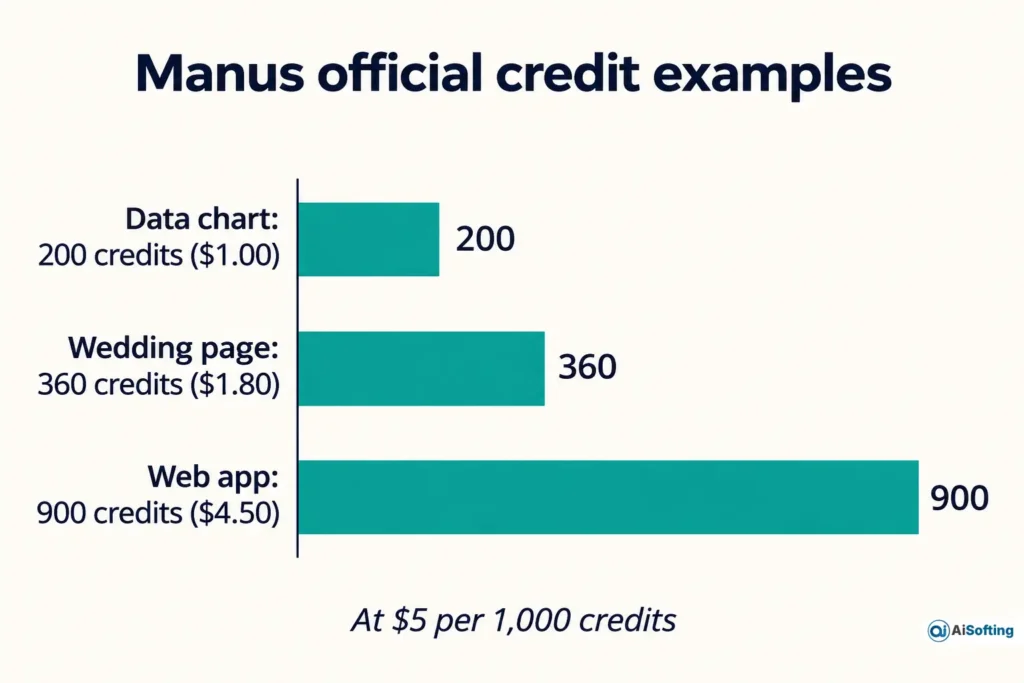
The “times it fits” column is illustrative arithmetic, not a promise. Your own tasks may cost more or less. The annual discount brings the $20 tier to about $16.60 a month, based on the stated 17%.
Hidden costs and edge cases
- No rollover. Monthly credits reset each cycle.
- Add-on credits conflict. A current Help Center article says add-on credits work only with an active paid subscription. An older official credits page says they never expire. Treat the stricter reading as safer.
- Negative balances happen. Manus deducts each action’s cost at the start of the next action, so a final step can overshoot your balance. You cannot start new tasks until the balance recovers.
- Refunds are narrow. Manus refunds credits for tasks that fail because of technical problems on its side. The policy as written does not mention outputs you find unsatisfactory.
- Some things bill separately. A Cloud Computer is bought separately, and its price was not verified. A Cue phone number is purchased separately from a Manus membership.
Is Manus AI safe to use?
Manus is as safe as the access you give it. The agent browses pages, runs code and, if you connect accounts, can reach your email and files. Manus’s own documentation says connectors give it access to those services during a task.
Verified from Manus: the Team plan includes an opt-out from data training. Manus says user data is stored in the United States and Singapore. The privacy policy page did not render in our check, so read it yourself before connecting accounts.
Reported by outsiders:
- Security firm Aurascape says it found “SilentBridge” prompt-injection flaws in Manus. It says a normal request like “summarize this page” could trigger Gmail data theft or code execution, and that Manus applied mitigations in November 2025 before the February 24, 2026 write-up. Aurascape sells security products, and this is a single-source account.
- Dark Reading reported research from Salt Labs describing a prompt-injection flaw that allowed remote code execution in another user’s Manus environment. The fix status was not confirmed in the material reviewed.
Prompt injection means hidden instructions inside web pages, emails or documents that steer the agent. OWASP ranks it first among AI application risks, and no complete fix exists.
Practical rules:
- Connect a secondary email account first, not your main inbox.
- Do not feed it regulated data (health, payment card or government records) without written compliance documentation from Manus.
- Be cautious asking it to “research” unfamiliar topics while sensitive connectors are active.
- Review anything it sends or publishes before it goes out.
Is Manus AI the same as Manus VR, Monica or OpenManus?
No. The name is shared across unrelated or loosely related things.
| Name | What it is | Related to Manus AI? |
|---|---|---|
| Manus AI | General AI agent from Butterfly Effect, headquartered in Singapore | This article’s subject |
| MANUS Technology Group (“Manus Meta”) | Dutch maker of motion-capture and VR data gloves | Unrelated company |
| Monica | Butterfly Effect’s earlier browser assistant; Manus’s privacy page covers both | Same company, different product |
| OpenManus | Community open-source imitation built after the launch | Not from Manus |
| Meta Platforms | The would-be acquirer in 2025 and 2026 | Not the owner now |
The Dutch glove company’s “Manus Meta” branding is a frequent source of mix-ups with Meta Platforms.
Who should use Manus, and who should skip it?
Good fit:
- You can define “done” in one sentence.
- You produce research packs, decks or site drafts repeatedly.
- You can check results in minutes.
- You want cloud compute without setting up machines.
Skip it if:
- The task needs your judgment every few seconds.
- The data cannot leave your control.
- You want predictable monthly spend with no variable burn.
- You only need quick answers (a chat assistant is cheaper).
A quick hand-off test
This is an illustrative framework, not a Manus feature. Before you spend credits, answer four questions with yes or no:
- Can I describe the finished result in one sentence?
- Can I verify the result in under ten minutes?
- Is every file and account involved safe to expose to a cloud agent?
- Is the likely credit cost small next to my time? (Using the official examples, the three tasks cost about $1 to $4.50.)
Four yeses means a good candidate. Any no means narrow the task or do it yourself.
What mistakes do new Manus users make?
- Writing vague goals. Manus’s own guidance recommends specific requests.
- Using full agent mode for questions Chat mode could answer.
- Buying an annual plan before measuring how fast credits burn.
- Assuming unused credits carry over.
- Connecting a primary Gmail or work account on day one.
- Trusting finished files without spot-checking sources and numbers.
- Relying on articles that still call Manus a Meta product.
Myths and facts
| Myth | Fact |
|---|---|
| Manus is a Meta product | Not as of November 2026; the deal was unwound |
| Manus beat every rival on benchmarks | Manus published GAIA results in March 2025 using its own evaluation setup. That is vendor-claimed, and no later independent verification turned up in the sources reviewed |
| Free means free agent work | Free daily credits run only Manus 2.0 Lite and are capped at 1,500 a month |
| Manus is open source | Wikipedia lists it as proprietary; OpenManus is a separate community project |
FAQs
Is Manus AI free?
Partly. The Free plan gives 300 daily refresh credits, capped at 1,500 a month, and runs only the Lite model. Paid plans start at $20 a month for 4,000 credits, as of November 2026.
Who made Manus AI?
Butterfly Effect Pte. Ltd. built it. Xiao Hong founded the company in 2022, and Ji Yichao is a co-founder and chief scientist. The name comes from the Latin word for “hand.”
Is Manus AI Chinese?
It was founded in China, and the company relocated its headquarters to Singapore in 2025. Chinese regulators nonetheless asserted jurisdiction in April 2026 when they blocked the Meta deal. Several of its investors, including Tencent, HSG and ZhenFund, are Chinese-linked, per reports.
Does Manus have an app?
Yes. Manus 2.0 is available on web, desktop and mobile, according to Manus’s September 28, 2026 announcement. Its pages list downloads for macOS, Windows, iOS and Android.
How do Manus credits work?
Credits pay for LLM tokens, virtual machines and third-party APIs while a task runs. Plan credits reset monthly and do not roll over. Completed tasks and stored outputs consume no credits.
Does Manus have an API?
Yes. Manus’s documentation lists an API for programmatic access to the agent, plus MCP connectors, Zapier and a Slack integration. Check the current docs before building anything on it.
How is Manus different from a chatbot?
Manus positions itself as an agent that works on its own computer and returns finished deliverables. Several chat products now offer agent modes too, so compare specific features and costs rather than the label.
What happened to Manus user data in August 2026?
Manus deleted data generated by certain users on or after December 29, 2025 between August 23 and August 24, 2026 (Singapore time). It offered a backup tool beforehand and restoration from August 25. Manus says the deletion was not a security incident.
Key takeaways and next step
- Manus is an independent, credit-metered agent. The Meta deal was announced in December 2025 and reversed in 2026.
- Free is a trial. Paid plans start at $20 a month for 4,000 credits, and official examples run from about $1 to $4.50 per task.
- The main risk is delegated access, not the model. Limit what you connect.
Next step: start on the Free plan with one small task you can verify in minutes. Watch how many credits it uses before paying for anything. For ideas on what to hand off, see this guide to what tasks generative AI is actually good for. If you want to automate wider business work, read how to automate your business. Other agent-style tools are covered in our explainer on the Comet AI browser and in Skywork AI vs ChatGPT.
Related: Agentic AI course guide
Disclaimer
This article is for informational purposes only. It is not affiliated with, sponsored by or endorsed by Manus, Butterfly Effect, Meta or any other brand mentioned. Prices, features, plans and policies may change, so check Manus’s live pages before you buy. Information last verified on November 17, 2026. AI output can be inaccurate, and AI agents can act on your connected accounts, so review results and limit access.