Hummingbird Humanity is a business consulting firm, listed on LinkedIn with a New York headquarters, that works with organizations to build human-centered workplace cultures where representation matters. Its founder and CEO is Brian McComak. Its framework combines diversity, equity and inclusion, social impact, human-centered leadership and holistic wellness. People who search the name usually want to know who is behind it and what it offers. This guide answers both. It then covers a question the top results skip: how to apply that framework when a company rolls out AI tools, so the technology helps the people doing the work instead of unsettling them.
What Is Hummingbird Humanity?
The firm describes its work as consulting, workshops and speaking on workplace culture. Public profiles agree on the basics.
| Item | What public sources say |
|---|---|
| Type | Business consulting and services; LinkedIn lists New York as headquarters |
| Founder and CEO | Brian McComak |
| Author credit | “Humanity in the Workplace,” listed in his bio as a 2023 book |
| Podcast | Hummingbird Hour, which McComak runs and which is available on YouTube |
| Resources | A resource collection hosted by IYI covering inclusive language, microaggressions, employee resource groups, representation, and workplace mental health |
According to his guest bio on a podcast, McComak was previously Global Head of Inclusion at Tapestry, the parent of Coach, Kate Spade and Stuart Weitzman. The same bio says he held leadership roles at The Walt Disney Company, L’Oréal and Christie’s. That is a self-supplied bio, not independent verification.
The framework: four aspects and four lenses
The most distinctive thing about Hummingbird Humanity is its structure. A speaker-bureau profile describes four aspects of a human-centered culture: diversity, equity and inclusion; social impact; human-centered leadership; and holistic wellness. The same profile says each aspect can be viewed through four lenses of representation: people, culture, customers and community.
| Aspect | Plain-language question |
|---|---|
| Diversity, equity and inclusion | Who is in the room, and who is treated fairly once they are? |
| Social impact | What does the organization do for communities beyond its payroll? |
| Human-centered leadership | Do leaders show empathy, vulnerability and trust in daily behavior? |
| Holistic wellness | Can people do the job without paying for it with their health? |
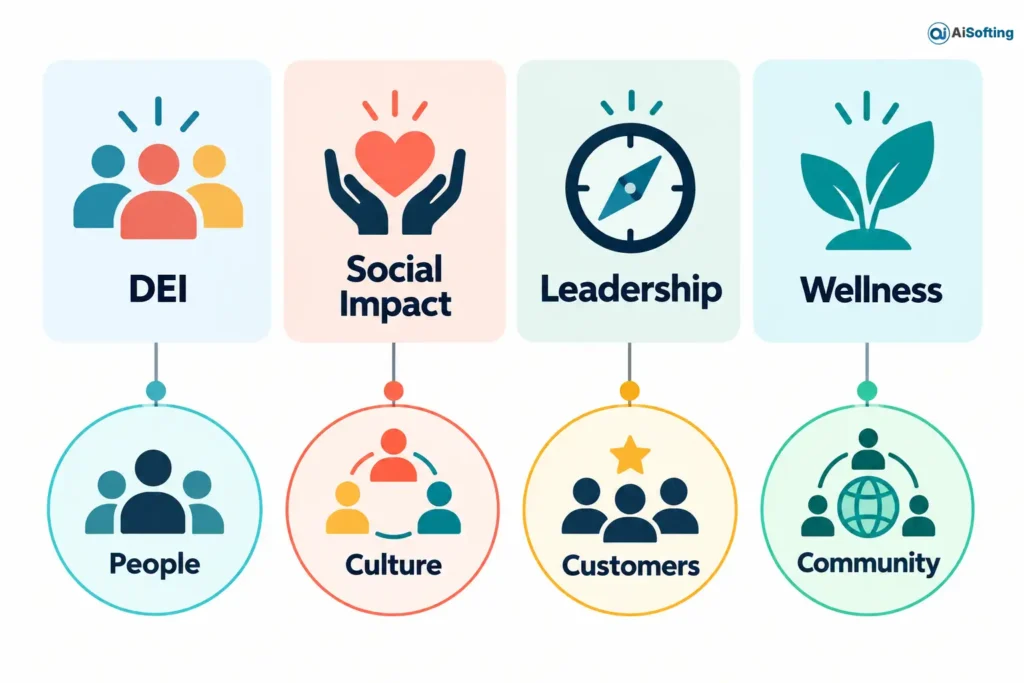
| Lens | What it asks |
|---|---|
| People | Does the workforce reflect the talent available? |
| Culture | Does everyone feel they belong? |
| Customers | Do products and service reflect the people who buy them? |
| Community | Does the company show up where it operates? |
The lenses move representation beyond headcount. The profile frames it as a holistic reality that meets people where they are, not a box to check.
Names that cause confusion
Searching “Hummingbird” without context returns unrelated organizations. Hummingbird Ventures is an early-stage venture fund based in London. Hummingbird, a separate regtech company, builds tools for anti-money-laundering and counter-terrorist-financing investigations. Hummingbird.org is a LinkedIn prospecting service for financial professionals. None of these is connected to the consultancy described here.
A practical verification tip: when this article was researched in October 2026, the hummingbirdhumanity.com homepage led with an environmental footprint calculator and listed a generic webmail address in its footer. That does not match the consulting profile on LinkedIn and speaker directories. It does not tell you who operates the page. Before you share information or pay anyone, confirm contact details through the firm’s LinkedIn page or the founder’s verified profile.
Why Human-Centered Thinking Matters When AI Arrives
Most advice on AI at work starts with tools. Worker data points elsewhere, and this is where a culture framework becomes practical. If you run a software team or a small business, why AI transformation projects fail is a good companion read.
- Workers were worried before the current adoption wave. In a Pew Research Center survey run in October 2024, 52% of workers said they were worried about AI’s future impact in the workplace, 36% felt hopeful, and 33% felt overwhelmed.
- Use is now widespread. Gallup reports that 47% of U.S. employees said their organization had integrated AI tools in the second quarter of 2026, up from 41% the quarter before. About 30% use AI at work a few times a week or more.
- Fear has not faded with familiarity. Gallup’s August 2026 analysis found that workers who use AI frequently are twice as likely to fear job displacement, and that supportive managers can substantially reduce those concerns. Gallup also found that fear depends on whether workers receive clear, credible information from their organization about what AI means for their role.
- Managers are the weak link. Only 36% of employees in AI-integrating organizations strongly agree that their manager actively supports their team’s use of AI. In Gallup’s Q1 2026 data, frequent AI use was 79% among employees whose managers actively support it, against 46% among those whose managers do not.
Fear, trust, belonging and leadership behavior are the territory Hummingbird Humanity’s framework covers. The firm has not published an AI methodology that I could find. The mapping below is this article’s own analysis, and it uses the firm’s four aspects as a checklist.
Applying the Four Aspects to an AI Rollout
| Aspect | Question to ask about the AI tool | Practical action |
|---|---|---|
| DEI | Does it work for people with different abilities, languages and working styles? Does it screen anyone out? | Test with a varied group before launch. Keep a non-AI path for anyone who needs one. |
| Social impact | What does it do to customers and communities, including data use? | Tell customers when AI is involved. Be honest internally about roles that will change. |
| Human-centered leadership | Can every manager explain it and answer hard questions? | Train managers before the announcement, not after. |
| Holistic wellness | Does it raise pace, pressure or monitoring? | Review workload after adoption. Decide in advance what the tool will never measure. |
Then run each tool through the four lenses. Ask what it means for your people, your culture, your customers and your community. A tool that passes for customers but fails for your own staff has not passed.
How to Roll Out an AI Tool in a Human-Centered Way
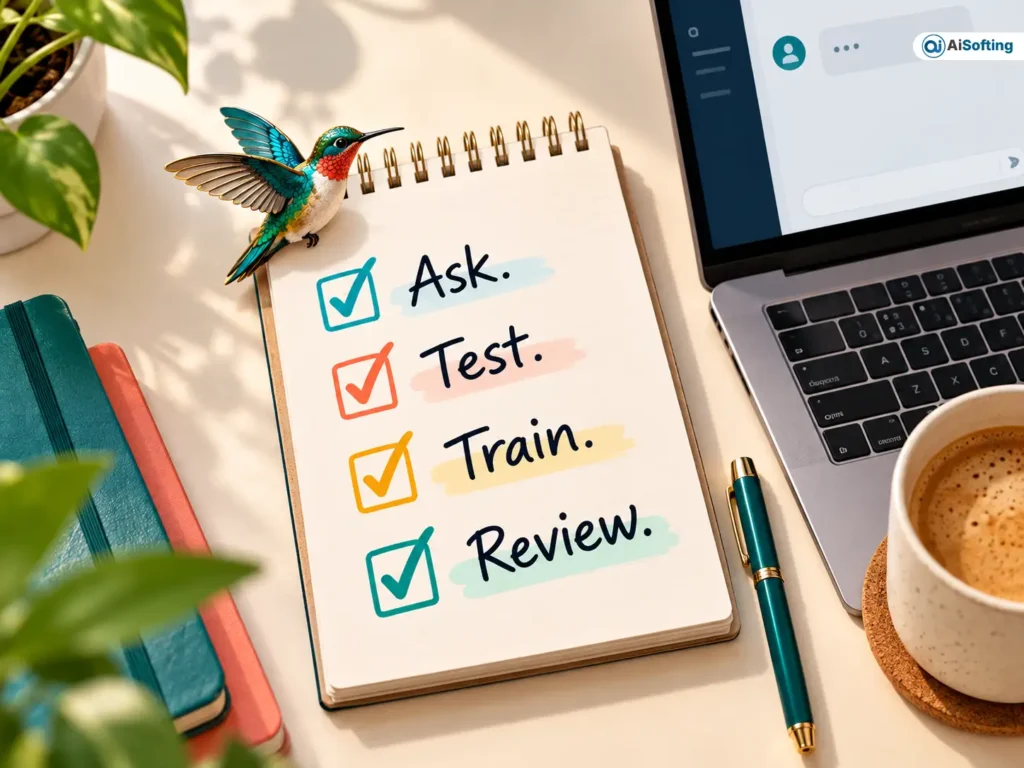
Take an example: a team adopts an AI meeting-notes assistant. The steps below apply to that or to any other tool.
- State the purpose in one plain sentence. “This saves note-taking time” is clear. “This transforms collaboration” is not.
- Ask the people affected before you choose. The U.S. Surgeon General’s workplace framework includes engaging workers in workplace decisions as part of “mattering at work.”
- Separate tools that touch people decisions. Anything that influences hiring, promotion, discipline or pay needs legal review. See the next section.
- Check fit for the work. Match the tool to tasks it handles well. Which tasks generative AI is actually good for explains where the limits are.
- Train managers first. Give them answers on data use, job impact and where to send concerns.
- Publish a short, plain-language use policy. Cover what data goes in, what is off limits, and where a human reviews the output.
- Review at 90 days. Collect feedback and outcome data, then adjust or retire the tool. If you are also automating processes, how to automate your business covers the process side.
AI in Hiring and People Decisions: What U.S. Rules Say Now
This area moves quickly, and the rules differ by place. Federal agencies removed several AI guidance documents from their websites in early 2025, so there is no single federal AI-hiring rulebook to follow. Existing anti-discrimination statutes still apply to employment decisions regardless of the tool. The more specific rules sit at the city and state level.
| Jurisdiction | What it requires | Status as of October 2026 |
|---|---|---|
| New York City, Local Law 144 | An independent bias audit of automated employment decision tools, a published summary, and notice to applicants and employees ten business days before use | In force |
| Illinois, HB 3773 | Notice when AI is used in employment decisions, and a ban on AI use that results in discrimination, including using zip codes as proxies for protected characteristics | Effective January 1, 2026 |
| California, Civil Rights Council rules | Applies the state’s Fair Employment and Housing Act to automated decision systems and requires AI-related records to be kept for four years | Effective October 1, 2025 |
| Colorado | SB 26-189, signed May 14, 2026, repeals and replaces the 2024 AI Act with a narrower framework centered on transparency and consumer rights tied to consequential automated decisions | Effective January 1, 2027 |
Colorado deserves a second look because many articles still say the original law starts June 30, 2026. That date passed without the law taking effect.
Notice and transparency requirements are not only legal chores. They are the same practice the human-centered approach recommends: tell people when a machine is involved in decisions about them. For a finance-flavored look at why explanations matter, see explainable AI in finance.
The legal setting for diversity programs has also shifted. Executive Order 14173 was issued on January 21, 2025, and the EEOC and the Department of Justice published two technical assistance documents on “DEI-related discrimination” on March 19, 2025. Those documents do not change Title VII and do not carry the force of law, but they signal what the EEOC may investigate. Any inclusion program should be reviewed by employment counsel.
Common Mistakes
- Announcing the tool before briefing managers. Gallup’s data shows manager support is the strongest lever, and most managers are not yet providing it.
- Treating fear as a communication glitch. Employees often have accurate reasons for concern. Answer them with specifics about roles, data and review.
- Buying a screening tool and assuming the vendor handled fairness. Under NYC’s law, the employer carries the audit and notice duties.
- Measuring only speed. Pew found that workers who have used AI chatbots are more likely to find them helpful for speed than for improving quality. Track quality and wellbeing as well.
- Running the culture work and the AI work as separate projects. The people designing inclusion programs and the people choosing tools rarely sit in the same meeting. Put them there.
Practical Insights
These points combine verified data with reasoning. They are not anecdotes.
Manager enablement is the cheapest lever. Gallup’s numbers show frequent use jumping from 46% to 79% when managers actively support AI, yet only 36% of employees report that support. Before buying another license, brief and equip managers.
Fear is partly an information problem. Gallup ties displacement fear to the clarity and credibility of what the organization says. A one-page, plain-language statement on which tasks the tool will change, which it will not, and how roles are reviewed costs little and addresses the documented driver.
Culture belongs inside AI governance. The AI Risk Management Framework from NIST, released January 26, 2023 for voluntary use, is organized around Govern, Map, Measure and Manage. Govern is the cross-cutting function covering accountability, policies and culture. A culture framework such as the one Hummingbird Humanity promotes can feed that function.
Wellbeing has a public-health reference point. The Surgeon General’s framework, released on October 20, 2022, names five essentials: protection from harm, connection and community, work-life harmony, mattering at work, and opportunity for growth. They translate directly into AI-era questions. Does the tool protect people? Does it leave room for connection? Does it respect boundaries? Does it show people they matter? Does it build skills?
For teams comparing specific tools, AI productivity tool updates tracks what is changing, and the AI coverage on AI Softing offers broader reading.
Frequently Asked Questions
What is Hummingbird Humanity?
It is a consulting and speaking firm focused on human-centered workplace cultures. LinkedIn lists it under business consulting and services with a New York headquarters. Its work centers on inclusion, representation and leadership.
Who founded Hummingbird Humanity?
Brian McComak is the founder and CEO. He is also the author of “Humanity in the Workplace” and host of the Hummingbird Hour podcast, according to his public profiles.
What is the Hummingbird Humanity framework?
It has four aspects: diversity, equity and inclusion; social impact; human-centered leadership; and holistic wellness. Each can be viewed through four lenses of representation: people, culture, customers and community.
Does Hummingbird Humanity offer AI services?
Public profiles describe culture consulting and speaking, not AI development or implementation. The AI application in this article is an independent analysis built on the firm’s published framework.
Is it related to the other companies called Hummingbird?
No. Hummingbird Ventures, the regtech firm Hummingbird and Hummingbird.org are separate organizations in different industries, per their own Crunchbase profiles.
Do U.S. employers have to tell candidates about AI screening?
It depends on location. New York City requires notice before an automated employment decision tool is used, and Illinois requires notice when AI is used in employment decisions. Other places have different rules or none, so check where your candidates and employees are based.
Are DEI programs legal?
Title VII has long barred employment discrimination based on protected characteristics. Since 2025, federal agencies have signaled closer scrutiny of programs they view as unlawful. The EEOC’s technical assistance is not binding law, so have employment counsel review any program.
How can a small team start?
Pick one AI tool, name its purpose in a sentence, ask the affected people what worries them, and brief managers before launch. Review the results after 90 days.
Where to Start: Actionable Takeaways
Hummingbird Humanity’s framework is a culture model, and its four aspects and four lenses make a useful checklist for technology decisions. The data supports the logic. Workers are anxious about AI, adoption keeps rising, and managers shape how the change is received.
- Brief managers before you announce any AI tool.
- Put the purpose, data rules and human-review points in plain language.
- Ask affected employees before you choose a tool.
- Treat any tool touching hiring or promotion as a legal question first.
- Confirm a source’s identity before you contact or pay any firm that shares the name “Hummingbird.”
- Reassess after 90 days using both performance and wellbeing signals.
Disclaimer
This article is general information about workplace culture, AI tools and U.S. employment rules. It is not legal, HR or professional advice. Laws on AI in hiring and on DEI programs differ by city and state and change often, so consult a qualified employment lawyer before acting. Details about Hummingbird Humanity come from public profiles and may change, so confirm services directly with the firm. Information current as of October 2026.