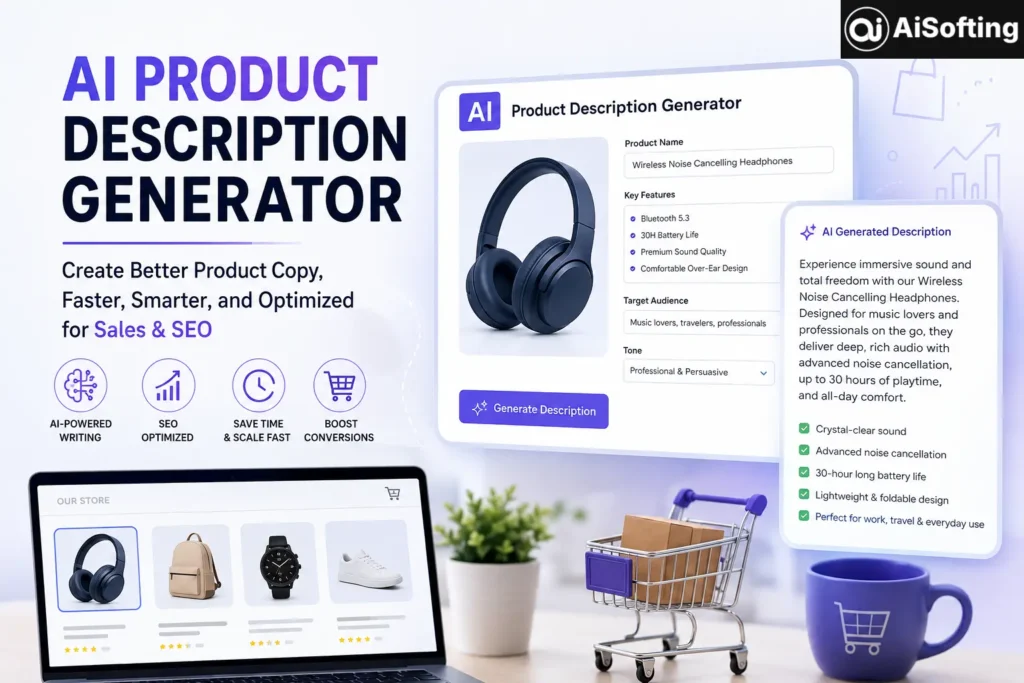
If you’ve ever stared at a blank screen trying to write the 47th product description for your Shopify store, you already know the pain. It’s tedious, it’s repetitive, and somewhere around product number 30, every item starts to sound the same. That’s exactly where an AI product description generator steps in — and honestly, it’s changed the way a lot of e-commerce operators, copywriters, and small business owners approach product content at scale.
But here’s the thing: most articles about these tools either oversell them as magic bullets or dismiss them as gimmicky shortcuts. The truth, as always, sits somewhere in the middle. This guide breaks down what these tools actually do, how to use them effectively, what mistakes to avoid, and what the experience of working with them day-to-day really looks like.
What Is an AI Product Description Generator?
An AI product description generator is a software tool — typically powered by large language models (LLMs) like GPT-4, Claude, or Google Gemini — that takes basic product information (name, features, category, target audience) and produces ready-to-use or near-ready product copy.
These tools are designed to solve a very specific content bottleneck: writing compelling, SEO-optimized, and conversion-focused descriptions for hundreds or thousands of products without burning out your writing team or your budget.
Popular tools in this space include:
- Jasper AI — one of the earliest AI writing platforms with a dedicated e-commerce mode
- Copy.ai — strong for short-form product and marketing copy
- Writesonic — known for Shopify and WooCommerce integrations
- Hypotenuse AI — built specifically for bulk product description generation
- Anyword — focuses on performance scoring and A/B optimization
Beyond standalone tools, many e-commerce platforms like Shopify have started embedding AI description generators natively into their dashboards, which lowers the barrier even further.
Why Product Descriptions Actually Matter (More Than You Think)
Before getting into the “how,” it’s worth grounding the “why.”
Product descriptions aren’t just filler text. They serve three jobs simultaneously: they inform, they persuade, and they rank. A well-written description answers the buyer’s questions, addresses objections, and contains the kind of natural language that both Google’s algorithm and AI-powered search tools (like AI Overviews, ChatGPT Shopping, and Perplexity) can surface in response to buyer queries.
The SEO Angle
Google’s algorithm has become increasingly sophisticated at recognizing thin, duplicate, or low-value content. Stores that use generic manufacturer descriptions — the same text appearing across dozens of sites — often see their product pages suppressed in search results. A good AI product description generator helps you create unique content at scale, which is a meaningful SEO advantage.
The Conversion Angle
Studies from the Baymard Institute and Nielsen Norman Group consistently show that poor product content is one of the leading reasons shoppers abandon product pages. Missing specs, vague language, and generic benefits copy fail to answer the specific questions buyers bring to the page.
How an AI Product Description Generator Actually Works
Most tools follow a similar workflow:
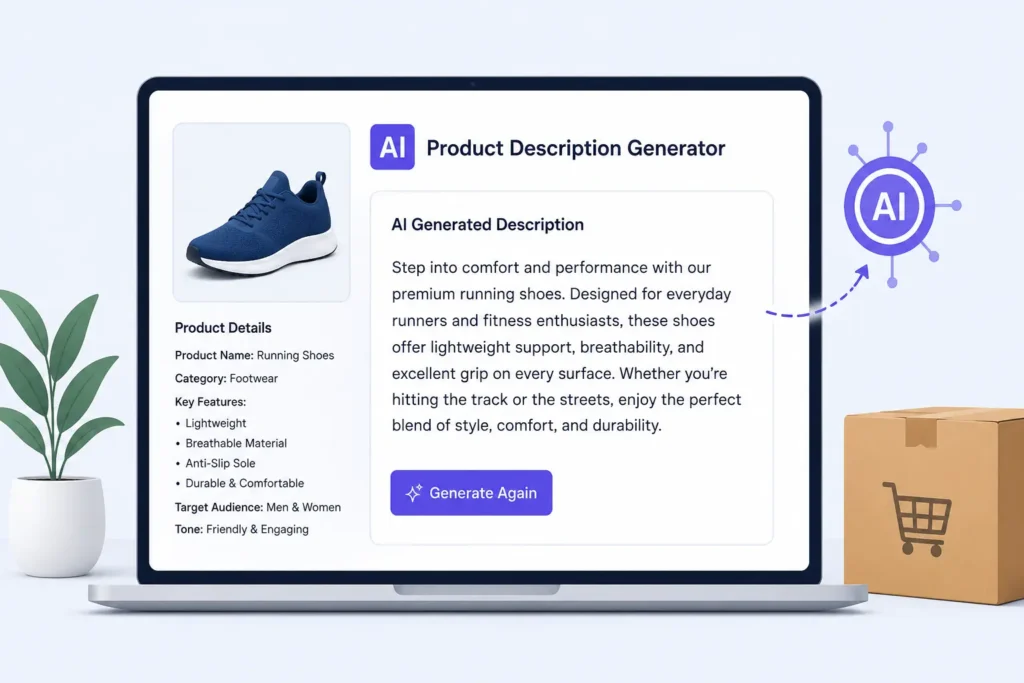
- Input your product data — You provide a product name, key features, category, and sometimes a tone preference (professional, playful, luxury, etc.)
- The AI generates a draft — Using its training data and prompt engineering, the model produces a structured description
- You review and edit — Most workflows involve a human pass to refine, fact-check, and brand-align
- Publish — The final copy goes live on your store, marketplace listing, or catalog
Some platforms like Hypotenuse AI allow bulk CSV uploads, meaning you can generate descriptions for thousands of products in a single workflow — which is a game-changer for large catalogs.
What These Tools Are Good At
- Producing consistent tone and structure across large catalogs
- Generating first drafts significantly faster than human writers
- Suggesting SEO-relevant phrasing based on keyword inputs
- Adapting the same product for different audiences (e.g., B2B vs. B2C)
- Creating variations for A/B testing
What They Still Struggle With
- Deep technical accuracy (always verify specs manually)
- Truly original, brand-specific voice without heavy customization
- Emotional nuance for complex or sensitive product categories
- Replacing strategic human judgment about what a buyer actually needs to hear
Tips for Getting the Best Results from AI Product Description Generators
1. Feed It Better Inputs
The single biggest factor in output quality is input quality. “Blue running shoes” produces a generic description. “Lightweight trail running shoes with carbon fiber plate, targeted at ultramarathon runners who train in wet conditions” produces something far more useful.
2. Define Your Brand Voice Upfront
Most premium tools let you set a custom tone or upload brand style guides. Use this feature. The difference between “durable and reliable” and “built to take whatever you throw at it” is entirely about voice — and AI handles it well when instructed clearly.
3. Always Include a Human Edit Pass
This isn’t about distrust — it’s about accuracy. AI tools occasionally hallucinate product specs, misunderstand technical details, or produce phrasing that sounds slightly off-brand. A 5-minute human review catches 90% of these issues.
4. Optimize for Semantic Search
Don’t just stuff keywords. Use the AI to naturally weave in related terms — synonyms, use-case phrases, materials, and problem-specific language. This is exactly what Google’s Helpful Content system and AI Overviews reward.
5. Use Bullet Points and Structured Formats
Many tools let you toggle between paragraph and bullet formats. For product pages, a combination works best: a short narrative paragraph followed by a structured bullet list of specs or features. This structure also makes your content more likely to appear as a featured snippet or AI-cited answer.
Common Mistakes to Avoid
Over-relying on the first draft. The AI’s first output is a starting point, not a final product. Treat it like a junior copywriter’s draft — useful, but needing review.
Ignoring platform-specific requirements. Amazon listings have different copy rules than Shopify pages or Etsy shops. What works in one environment may violate another platform’s style or character limits.
Skipping competitor research. AI generates content based on patterns in its training data — which means it sometimes produces descriptions that sound exactly like your competitors. Differentiation still requires human research and strategic thinking.
Publishing without fact-checking. This is critical for technical, health, or safety-related products. AI tools are not databases — they don’t “know” your product’s actual specs unless you tell them.
Personal Experience: What I Learned Running AI-Generated Descriptions on a Real Store
A few years ago, I was managing content for a mid-sized home goods brand with over 800 SKUs. Writing unique descriptions for every item manually was simply not possible within budget and timeline constraints. We started using an AI product description generator — at the time, Jasper was the main option — to handle the first-pass copy.
The results were genuinely mixed at first. The outputs were grammatically clean and structurally sound, but they felt interchangeable. A ceramic mug and a bamboo cutting board came out sounding like they’d been written by the same bored intern. The breakthrough came when we built a detailed brand prompt — specific vocabulary the brand used, words it explicitly avoided, the emotional territory it lived in (warm, artisanal, approachable but not cutesy).
With that prompt in place, generation quality improved dramatically. We went from spending roughly 25 minutes per product description to about 8 minutes — including the human editing pass. Over 800 products, that’s a meaningful time savings.
What surprised me most was the SEO impact. Within three months of publishing the new descriptions, product-level organic traffic increased noticeably. The pages had more unique, crawlable content, and Google’s systems appeared to favor them over the thin or duplicate copy we’d had before.
The lesson: AI product description generators work best when you treat them as a collaborative tool, not a replacement. The human judgment — about voice, accuracy, and buyer psychology — still makes the difference.
Best Practices Summary
- Always define target audience and tone before generating
- Use structured outputs (intro paragraph + bullet features) for better search and conversion performance
- Batch-generate and review in rounds rather than one at a time
- Test multiple AI tools for different product categories — no single tool wins every use case
- Integrate keyword research into your input prompts, not just as an afterthought
For deeper reading on AI-assisted content workflows, the Search Engine Journal guide to AI content tools and Shopify’s official blog on product descriptions are solid starting points.
You can also explore Google’s guidance on helpful content to understand how AI-generated product copy should be evaluated against E-E-A-T principles.
Frequently Asked Questions
1. What is an AI product description generator?
An AI product description generator is a tool that uses large language models to automatically create product copy based on inputs like product name, features, and target audience. It’s designed to speed up e-commerce content creation while maintaining quality and SEO relevance.
2. Are AI-generated product descriptions good for SEO?
Yes, when done correctly. AI-generated descriptions that are unique, detailed, and naturally written perform well in search because they avoid the duplicate content penalties associated with generic manufacturer copy. They also tend to include semantic keyword variety that supports broader search visibility.
3. Which AI product description generator is best?
It depends on your use case. Hypotenuse AI is strong for bulk catalog generation. Jasper and Copy.ai offer more flexibility for brand voice customization. Writesonic integrates well with Shopify. Testing two or three tools against your actual product catalog is the best way to find your fit.
4. Do I still need a human copywriter if I use an AI generator?
For most businesses, yes — at least for reviewing and refining outputs. AI tools handle volume and speed well, but human editors add brand authenticity, factual accuracy, and the nuanced judgment that distinguishes average copy from genuinely persuasive content.
5. Can AI product description generators write for Amazon listings?
Yes, most tools can be prompted to write Amazon-optimized copy, including A+ content structures. However, Amazon has its own formatting and character limit requirements, so you’ll want to tailor your prompts and review outputs against those specific guidelines.
6. How long should an AI-generated product description be?
For most e-commerce use cases, 75–200 words works well for the main description, paired with a bullet list of 4–6 features. Product pages on marketplaces like Amazon often benefit from longer, more detailed copy to support both search and conversion.
7. Will Google penalize AI-generated product descriptions?
Not automatically. Google’s Helpful Content guidelines focus on whether content is useful, accurate, and created with the audience in mind — not on whether a human or AI wrote it. The risk comes from publishing unedited, thin, or repetitive AI output at scale without adding real value.
Conclusion
An AI product description generator isn’t magic, and it isn’t a shortcut that lets you skip the thinking. What it is, genuinely, is a force multiplier — one that lets a solo operator compete with a content team, or lets a content team work at catalog scale without burning out.
The brands and operators getting the most out of these tools are the ones who treat them as intelligent drafting partners: feeding them thoughtful inputs, maintaining a human review step, and continuing to refine their prompting approach over time. When that workflow is in place, the results in both efficiency and search performance are real.
If you haven’t experimented with an AI product description generator yet, the barrier to entry has never been lower. Start with one product category, test two or three tools, and measure what changes — in time, in quality, and in how your pages perform in search.
Visit: Aisofting
Disclaimer: This article is intended for informational and educational purposes only. The tools, platforms, and results mentioned reflect general industry experience and publicly available information. Individual outcomes with AI product description generators will vary based on product category, brand requirements, and implementation approach. Always review AI-generated content before publishing to ensure factual accuracy and compliance with platform guidelines.