

Most people don’t fail at building wealth because they lack ambition. They fail because nobody ever showed them how the pieces fit together. A budget is useful. An investment account is useful. But neither, on its own, is a financial plan — and that distinction matters more than most people realize.
Comprehensive financial planning is the practice of looking at your entire financial life as a system: income, spending, debt, insurance, investments, taxes, estate documents, and long-term goals — all at once, all in relation to each other. Done well, it’s one of the most high-leverage activities a person can undertake. Done poorly, or not at all, it’s one of the most expensive omissions a life can contain.
This guide — updated for 2026 — goes deeper than the basics. It covers the mechanics, the psychology, the overlooked strategies, and the mistakes that quietly derail even disciplined people.
What Comprehensive Financial Planning Actually Means
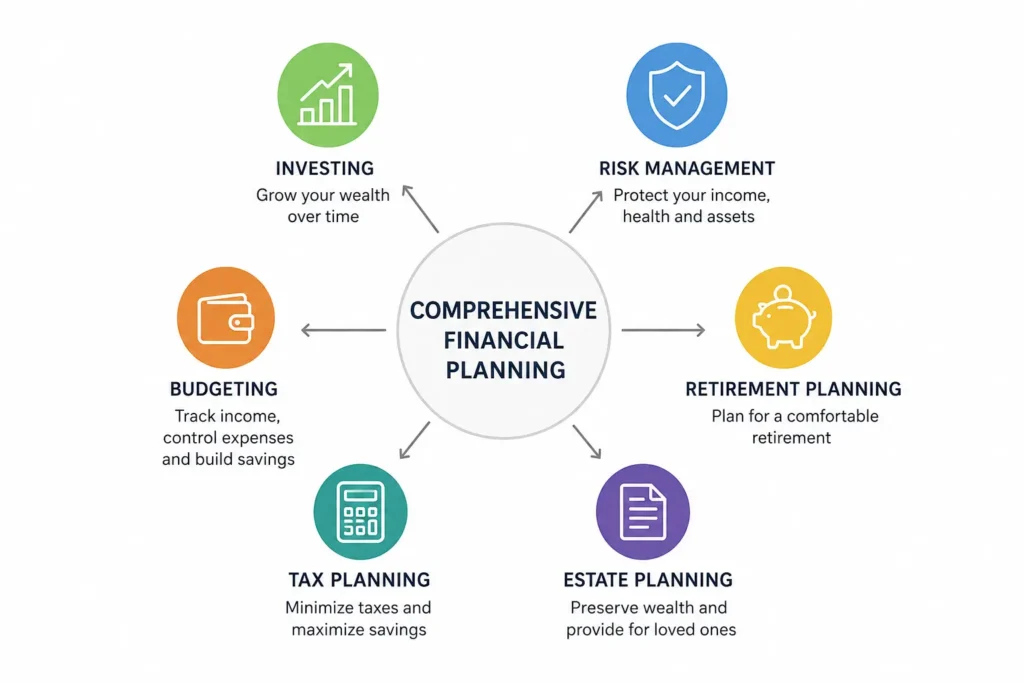
The term gets thrown around loosely. A financial plan isn’t a retirement calculator output or a spreadsheet of monthly expenses. According to the Certified Financial Planner Board of Standards (CFP Board), a genuine financial plan addresses six interconnected domains:
- Financial statement analysis — net worth, cash flow, and debt structure
- Investment planning — asset allocation, risk tolerance, and portfolio construction
- Tax planning — strategies to legally minimize lifetime tax liability
- Risk management and insurance — protecting income, assets, health, and dependents
- Retirement planning — projecting needs, choosing vehicles, managing withdrawal strategies
- Estate planning — transferring wealth intentionally and efficiently
The word “comprehensive” signals that none of these areas can be optimized in isolation. Aggressive investing without adequate insurance is gambling. A strong emergency fund paired with high-interest credit card debt is a contradiction. Tax planning that ignores estate implications wastes money. The value of comprehensive planning lies in its integration.
The Foundation: Getting Your Financial Picture Clear
Before any strategy can be designed, you need an honest accounting of where things stand. This sounds obvious, but it’s astonishing how many people in their 30s and 40s have only a vague sense of their net worth, their effective tax rate, or how much they’re actually spending each month.
Net Worth: The Scoreboard That Actually Matters
Net worth — total assets minus total liabilities — is the single number that tells you the most about financial health. It’s not your income. It’s not your savings rate, though that’s important. It’s the accumulated result of every financial decision you’ve ever made.
Assets include:
- Cash and savings accounts
- Investment and retirement accounts
- Real estate equity (current value minus outstanding mortgage)
- Business equity
- Other property (vehicles, collectibles, etc.)
Liabilities include:
- Mortgage balances
- Car loans
- Student loans
- Credit card balances
- Any other outstanding debt
Calculate this number honestly. Revisit it quarterly. Watching it grow over years is one of the most motivating things in personal finance.
Cash Flow: The Engine of Every Financial Plan
Net worth is the scoreboard; cash flow is the engine. Positive cash flow — spending less than you earn — is the non-negotiable prerequisite for everything else. Without surplus cash, there’s nothing to invest, nothing to build an emergency fund with, nothing to put toward debt.
Track three numbers with precision:
- Gross income — everything before taxes
- Take-home income — what actually lands in your account
- Monthly outflows — fixed and variable spending
The gap between take-home income and monthly outflows is your working capital. A 10–20% surplus is a solid foundation. More is better. Less requires a hard look at either the income side or the spending side.
Emergency Funds: The Most Underappreciated Planning Tool
Financial advisors often discuss emergency funds as a checkbox — “have three to six months of expenses saved” — and move on. But the emergency fund is actually strategic infrastructure, not just a safety net.
Here’s why it matters beyond the obvious: people without emergency funds make terrible financial decisions under pressure. They sell investments at market lows. They take on high-interest debt to cover unexpected expenses. They drain retirement accounts and pay penalties. An emergency fund isn’t just protection against emergencies; it’s protection against panic-driven decisions that compound into long-term damage.
How much is enough? It depends:
- Stable W-2 employment, low fixed expenses: 3 months
- Variable income (freelance, commission-based): 6–9 months
- Self-employed, dependent household members, health conditions: 9–12 months
Where you keep it matters too. High-yield savings accounts at institutions like Marcus by Goldman Sachs, Ally Bank, or similar online banks currently offer yields meaningfully above traditional bank rates. There’s no reason to keep emergency funds in a checking account earning near zero.
Debt Management: Not All Debt Is Equal
The financial planning world sometimes treats all debt as the enemy. That’s too simple. The real framework is cost of debt vs. expected return on alternatives.
High-interest consumer debt (credit cards, payday loans, some personal loans) should be eliminated aggressively before meaningful investing begins. An 18–25% APR credit card balance is a guaranteed negative return that no investment strategy is likely to beat after taxes.
Low-interest debt — a 3% mortgage, a 4% student loan — is a different calculation. If your expected investment return over time is 7–9%, paying off a 3% mortgage early may be less valuable than investing the same dollars. This isn’t universally true (there’s value in being debt-free and the psychological relief it brings), but the math deserves honest examination rather than reflexive “all debt is bad” thinking.
The debt avalanche method (paying highest interest rate first) is mathematically optimal. The debt snowball (paying smallest balance first) generates psychological momentum that helps some people stay the course. Both work. Consistency matters more than method.
Investment Planning: Building Wealth Over Time
This is where most financial articles focus their energy — and where most people get distracted by the wrong details (what’s hot, what’s a good stock to buy, what sector will outperform). Comprehensive financial planning takes a different approach: start with goals, build a structure, and then select vehicles.
The Risk-Return Framework
Every investment carries risk. The question is whether you’re being compensated for the risk you take. Historically, stocks have returned roughly 7–10% annually (real returns closer to 7% after inflation), but with significant short-term volatility. Bonds provide lower returns with less volatility. Cash preserves principal but loses purchasing power to inflation.
Your asset allocation — the mix of stocks, bonds, and other assets — should reflect:
- Time horizon: Longer horizon = more capacity for short-term volatility
- Risk tolerance: Both financial (can you absorb losses?) and psychological (will you panic-sell?)
- Goals: A retirement 30 years out is a different target than a house down payment in 5
Tax-Advantaged Accounts: The Hierarchy
Before investing in taxable accounts, maximize tax-advantaged vehicles:
- 401(k)/403(b) to the employer match — free money, always take it first
- Health Savings Account (HSA) — triple tax advantage if you have a qualifying high-deductible health plan
- IRA (Roth or Traditional) — $7,500/year limit in 2026 (up from $7,000 in 2025); $8,600 for those 50 and older; Roth is generally better for younger earners
- Max out 401(k) — $24,500 limit in 2026; $32,500 for those 50 and over; savers aged 60–63 get a special enhanced catch-up of $11,250 under SECURE 2.0
- Taxable brokerage accounts — no limits, but no special tax treatment
The Roth vs. Traditional debate hinges largely on whether your tax rate is higher now (Traditional is better) or expected to be higher in retirement (Roth is better). Most financial planners recommend Roth for younger earners who are likely in lower tax brackets.
Low-Cost Index Funds: The Evidence-Based Default
Decades of research — including work by Nobel laureate Eugene Fama and the pioneering analysis by Jack Bogle that led to Vanguard’s index funds — consistently shows that most active fund managers underperform their benchmark index after fees over the long term. The implication is clear: for most investors, low-cost diversified index funds are the default strategy.
Expense ratios matter enormously over time. A 1% annual fee vs. a 0.05% fee on a $500,000 portfolio over 20 years represents hundreds of thousands of dollars in foregone compounding. Vanguard, Fidelity, and Schwab all offer excellent low-cost index options.
Tax Planning: The Highest-Leverage Financial Activity
If there’s one area where most people leave the most money on the table, it’s taxes. Not because they’re doing anything wrong — but because they’re not being intentional about the structure of their finances.
Tax Planning vs. Tax Preparation
Tax preparation is what happens in April. Tax planning is what happens year-round, shaping decisions in advance to minimize liability. The difference can be enormous over a lifetime.
Key strategies worth understanding:
Tax-loss harvesting: Selling investments at a loss to offset capital gains, reducing your current-year tax bill. Sophisticated investors and robo-advisors like Betterment or Wealthfront do this systematically.
Roth conversions: Converting Traditional IRA funds to Roth during low-income years (retirement, job change, market downturn) locks in lower tax rates on future growth.
Asset location: Placing tax-inefficient investments (bonds, REITs) in tax-advantaged accounts and tax-efficient ones (index funds) in taxable accounts.
Qualified charitable distributions (QCDs): For those 70½ and older, donating directly from an IRA to charity satisfies required minimum distributions tax-free.
Bunching deductions: In years where you’re close to the standard deduction threshold, bundling charitable contributions or other deductible expenses into one year can push you over the itemization threshold, then taking the standard deduction in alternating years.
Insurance: The Risk Management Layer
Insurance is the part of financial planning most people find least exciting — and most likely to neglect. That neglect can be catastrophic.
The purpose of insurance in a comprehensive financial plan isn’t to cover every possible expense. It’s to protect against financially catastrophic events that would derail your plan entirely.
The four most critical coverage areas:
Disability insurance: Your ability to earn income is your most valuable asset, particularly in your working years. Yet many people are adequately insured against dying but not against becoming unable to work. Group disability coverage through employers is often insufficient; individual policies through providers like Guardian or Principal are worth examining.
Health insurance: Medical bankruptcy remains a significant financial risk. Understanding your plan’s out-of-pocket maximum is the single most important number — it’s the most you’d pay in a catastrophic year.
Life insurance: Term life is appropriate for most people with dependents — it’s clean, inexpensive, and does the job. Permanent life insurance (whole life, universal life) can serve estate planning purposes for high-net-worth individuals but is frequently oversold and misunderstood.
Umbrella liability insurance: For homeowners and those with assets worth protecting, umbrella policies provide $1–5 million in additional liability coverage at relatively low cost. Often the most overlooked, most high-value insurance a middle-class household can own.
Retirement Planning: Beyond “Save More”
Most retirement planning advice reduces to: “save more, start earlier, use tax-advantaged accounts.” That’s true but incomplete. The more nuanced challenges involve how much is enough, how to withdraw efficiently, and how to manage longevity risk.
The 4% Rule and Its Limitations
The “4% rule” — withdrawing 4% of your portfolio annually in retirement — originated from the Trinity Study (1998) and has become a standard rule of thumb. But it has important limitations in the current environment: it was based on historical U.S. market data, assumes a 30-year retirement, and was calculated before today’s lower bond yields.
Many planners now use 3–3.5% as a more conservative starting point, particularly for early retirees who may need portfolios to last 40+ years.
Sequence of Returns Risk
This is one of the most underappreciated risks in retirement planning. If markets drop significantly in the early years of retirement — while you’re withdrawing — the recovery may not be sufficient to restore your portfolio. This is why advisors often recommend holding 1–2 years of expenses in cash or short-term bonds as a buffer: so you’re not forced to sell equities at market lows.
Social Security Optimization
For most Americans, Social Security represents a significant component of retirement income. The decision of when to claim — anywhere from age 62 to 70 — has substantial financial implications. Each year you delay claiming past full retirement age increases your benefit by approximately 8%. For healthy individuals who expect to live into their 80s, delaying to 70 is often mathematically advantageous.
Estate Planning: The Most Overlooked Pillar
Estate planning isn’t only for the wealthy. It’s for anyone who has people they care about and assets — however modest — they want to transfer intentionally.
The core documents every adult should have:
Will: Directs asset distribution and, critically, names guardians for minor children. Dying without one (intestate) leaves these decisions to state law, which may not reflect your wishes.
Durable power of attorney: Names someone to manage financial affairs if you’re incapacitated. Without this, families may need to go through expensive court proceedings.
Healthcare proxy / medical power of attorney: Names someone to make medical decisions on your behalf.
Beneficiary designations: 401(k)s, IRAs, and life insurance policies pass by beneficiary designation — outside of your will entirely. Outdated beneficiary designations (common after divorce or death of a spouse) are one of the most common and costly estate planning errors.
Trusts — revocable living trusts in particular — can be valuable tools to avoid probate, maintain privacy, and provide more nuanced control over asset distribution. They’re not exclusively for the ultra-wealthy; anyone with a house and dependent children might benefit from consulting an estate attorney about a basic trust structure.
The Behavioral Side: Why Smart People Still Fail
Technical knowledge isn’t sufficient. The financial planning literature is increasingly clear that behavior is the primary determinant of financial outcomes, not investment selection or even savings rate in isolation.
The most destructive financial behaviors:
Loss aversion: The psychological pain of losses is roughly twice as intense as the pleasure of equivalent gains. This leads investors to sell during downturns — locking in losses — and to avoid necessary risk.
Present bias: Humans systematically overvalue present consumption vs. future gains. We know we should save more but keep spending now, always planning to start “next month.”
Overconfidence: Individual investors consistently overestimate their ability to pick winning stocks or time the market. The data is unambiguous: it rarely works.
Lifestyle inflation: As income rises, spending tends to rise in proportion, preventing wealth accumulation even among high earners.
The behavioral economics work of Daniel Kahneman, Richard Thaler, and others has made it into mainstream financial planning. Automated savings, employer-matched contributions with auto-enrollment, and target-date funds are all structural solutions designed to work with human psychology, not against it.
My Experience with Comprehensive Financial Planning
When I first started seriously engaging with financial planning, I made the mistake most people make: I treated the components as separate topics rather than as parts of a system. I opened a Roth IRA, felt good about it, and continued carrying credit card debt at 19% APR. The math on that was embarrassing in retrospect — I was effectively paying 19% interest to earn a potential 7–8% investment return.
What changed wasn’t a single piece of advice. It was developing an integrated view. When I finally mapped out my entire financial situation — all assets, all liabilities, all insurance coverage, estimated tax liability, projected retirement needs — the contradictions became visible. Not just the debt-while-investing issue, but also: I was underinsured on disability, had outdated beneficiary designations on an old 401(k), and was holding cash that could have been in an HSA generating tax-free returns.
The process of comprehensive planning also forced some uncomfortable clarity about goals. It’s easy to say “I want to retire early” without ever running the numbers. When I actually projected what an early retirement would require — accounting for healthcare before Medicare eligibility, inflation over a 40-year horizon, and sequence of returns risk — the target became specific and actionable rather than aspirational and vague.
One lesson I’d pass along: don’t wait until you have “enough” money to plan. The planning process is most valuable precisely when resources are limited, because that’s when the opportunity cost of misallocation is highest. Getting the structure right when you’re 30 and earning a moderate income is worth far more than optimizing at 55 with a large portfolio.
How to Work With a Financial Planner
If you decide to work with a professional, the credentials and compensation model matter significantly.
CFP (Certified Financial Planner): The most recognized credential for holistic financial planning. CFPs are required to complete extensive education, pass a rigorous exam, accumulate experience, and adhere to fiduciary standards when providing financial planning.
Fee-only vs. commission-based: Fee-only planners (who charge hourly rates, flat fees, or a percentage of assets under management) have no financial incentive to recommend particular products. Commission-based advisors earn money when you buy certain investments or insurance — a potential conflict of interest worth understanding. NAPFA (National Association of Personal Financial Advisors) maintains a directory of fee-only planners.
Fiduciary standard: A fiduciary is legally required to act in your best interest. Not all financial advisors operate under this standard. The distinction matters more than most consumers realize.
For those who want comprehensive planning without ongoing advisory fees, fee-only planners who charge for one-time comprehensive plans are an increasingly accessible option. A $2,000–$5,000 fee for a thorough financial plan is often excellent value.
The Digital Tools Landscape
Technology has made certain aspects of financial planning more accessible:
Budgeting and tracking: Monarch Money, YNAB (You Need a Budget), and Copilot offer robust household cash flow tracking with various approaches to behavioral change.
Net worth tracking: Empower (formerly Personal Capital) remains a strong free option for aggregating accounts and tracking net worth over time.
Investment management: Robo-advisors like Betterment and Wealthfront offer automated portfolio management at low cost, including tax-loss harvesting and automatic rebalancing.
Retirement projection: Fidelity’s retirement planning tools offer reasonably sophisticated free projections.
Technology is useful but not sufficient. Tools can track and automate, but they can’t replace judgment about goals, values, trade-offs, and the behavioral work of following through.
Common Mistakes That Derail Financial Plans
Even people who have a plan often see it underperform because of predictable errors:
1. Neglecting inflation in projections: A plan that projects $1 million at retirement without adjusting for what $1 million will actually buy in 30 years is not a useful plan. Use real (inflation-adjusted) returns and project future needs in today’s dollars.
2. Ignoring healthcare costs in retirement: Healthcare is one of the largest expenses in retirement, yet it’s routinely underestimated. Fidelity estimates that a 65-year-old couple retiring today may need $315,000 for healthcare expenses in retirement, not including long-term care.
3. Treating home equity as a reliable retirement asset: Homes are illiquid, expensive to maintain, and subject to local market risk. Over-concentrating retirement plans in home equity is a structural vulnerability.
4. Not updating the plan: Life changes — marriage, divorce, children, job changes, inheritances, health events. A financial plan that isn’t reviewed and revised at major life transitions quickly becomes misaligned with reality.
5. Confusing complexity with sophistication: More investment products, more accounts, more strategies does not equal better financial planning. Simplicity and consistency outperform complexity and active management for most households.
FAQ: Comprehensive Financial Planning
What is comprehensive financial planning and why does it matter?
Comprehensive financial planning is the integrated management of all aspects of a person’s financial life — budgeting, debt, insurance, investments, taxes, retirement, and estate planning — as a unified system. It matters because isolated financial decisions frequently contradict each other, and only by viewing the whole picture can you optimize the parts effectively.
At what age should I start comprehensive financial planning?
As early as possible, but the second-best time is now. The core value of early planning is compounding — both financial (investment returns on saved capital) and behavioral (building habits and structures that accumulate over decades). That said, a thorough financial plan developed at 45 is still extraordinarily valuable given the wealth-building years still ahead.
How much does it cost to work with a financial planner?
Costs vary significantly by model. Fee-only planners may charge $200–$400/hour, $2,000–$5,000 for a comprehensive one-time plan, or 0.5–1% of assets under management annually for ongoing advisory relationships. Commission-based advisors may appear “free” but earn compensation through the products they recommend. Understanding the full cost structure is essential before engaging anyone.
Do I need a financial planner or can I do this myself?
Many people manage their finances successfully without a professional planner, particularly with the resources now available. DIY is most viable for those who are willing to invest time in learning, have relatively straightforward financial situations, and can maintain emotional discipline during market volatility. Complex situations — business ownership, significant wealth, estate planning, divorce, major medical conditions — typically benefit from professional guidance.
What’s the difference between a financial planner and a financial advisor?
These terms are often used interchangeably but have technical distinctions. “Financial planner” generally implies a holistic approach to all areas of personal finance, ideally with CFP credentials. “Financial advisor” is a broader term that can include investment managers, brokers, and insurance agents who may focus on a narrower set of services. Always verify credentials, compensation model, and fiduciary status regardless of title.
How often should I review my financial plan?
A comprehensive review should happen at least annually, and immediately after major life events: marriage, divorce, birth of a child, significant income change, inheritance, health diagnosis, or approaching retirement. Markets and tax laws change; so do personal circumstances. A plan that isn’t maintained is quickly a plan that doesn’t fit.
Conclusion: Building a Financial Life That Actually Works
Comprehensive financial planning isn’t a destination. It’s an ongoing process of alignment — between where you are, where you want to go, and how your money is actually structured to get you there.
The key takeaways from this guide:
- Start with an honest baseline — net worth, cash flow, and debt structure — before designing any strategy
- Build in sequence: emergency fund and high-interest debt before aggressive investing
- Maximize tax-advantaged vehicles in the right order before touching taxable accounts
- Insurance protects the plan: disability coverage is the most undervalued protection most households can buy
- Behavior matters more than technical knowledge: automate where possible, keep complexity low, avoid reactive decisions
- Estate documents are for everyone with people they care about, not just the wealthy
- Professional guidance is worth considering for complexity, but verify fiduciary status and understand compensation
The single most useful shift in perspective is from viewing personal finance as a series of independent decisions (should I open this account? should I pay off this debt?) to viewing it as a system with feedback loops, trade-offs, and compounding effects over time. That’s what makes it comprehensive — and that’s what makes it powerful.
For deeper reading on behavioral financial planning, the CFP Board’s resources offer practitioner-grade information grounded in the same standards used by certified financial planners. The process of getting your financial life in order rewards patience, honesty, and consistency over brilliance. Start there.
Visit: Aisofting