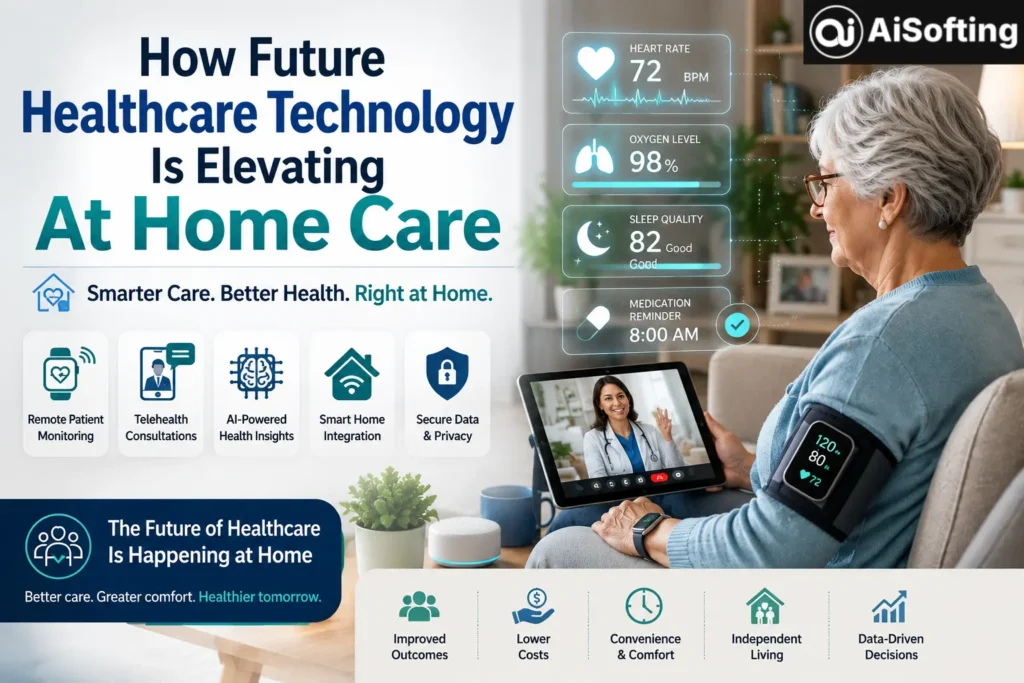
How future healthcare technology is elevating at home care is one of the most consequential questions in modern medicine not because it’s trendy, but because the math of an aging world leaves us no other option. By June 2026, home care is no longer a fallback for those too sick to travel or too frail to wait in a clinic. It is rapidly becoming the default model, driven by demographic pressure, skyrocketing facility costs, and a generation of technologies that have quietly crossed from experimental to essential.
This isn’t a story about gadgets. It’s about a structural shift in where and how medicine is practiced and understanding it matters whether you’re a patient, a family caregiver, a clinician, or a healthcare investor navigating what comes next.
The Scale of the Shift: Why Home Is Becoming the New Hospital
To understand how future healthcare technology is elevating at home care, start with the numbers and they are striking.
$265 Billion Estimated value of care services that could migrate from traditional facilities to home-based settings, according to McKinsey & Company.
The World Health Organization projects that by 2030, 1 in 6 people globally will be aged 60 or above a demographic wave that no hospital system is equipped to absorb without fundamental changes to care delivery. The math is stark: either we find scalable ways to deliver care outside clinical walls, or we face a catastrophic capacity gap.
The American Association of Nurse Practitioners identified remote monitoring and AI as the defining healthcare trends of 2026, noting that tools which once complemented traditional care are now becoming standard components of clinical practice. According to Grand View Research, North America alone accounts for over 50% of the global AI-in-RPM market, with adoption accelerating sharply.
Technology is filling the gap left by overstretched facilities. But it’s doing so in ways that are more nuanced and more complicated than most coverage suggests.
Remote Patient Monitoring: The Backbone of At-Home Care Technology
The clearest example of how future healthcare technology is elevating at home care is remote patient monitoring (RPM). The term tends to conjure images of sleek wrist devices and colorful dashboards, but the reality is both more mundane and more transformative.
RPM in 2026 includes:
- Continuous glucose monitors (CGMs) that communicate directly with insulin pumps, closing the loop on diabetes management at home
- Connected blood pressure cuffs that log readings automatically to cloud-based care platforms with zero extra steps for the patient
- Pulse oximeters that flag declining oxygen saturation before a patient notices symptoms
- Cardiac monitors that detect arrhythmias across thousands of hours of data accuracy that no manual review schedule could match
- AI-powered fall detection sensors that alert caregivers in real time, a critical advance for elderly patients living alone
Philips’ Future Health Index found that remote patient monitoring is the single largest area of planned AI investment among healthcare leaders globally, with 41% of decision-makers committed to significant deployment. By 2026, that investment is yielding results: studies show significantly reduced hospital readmissions and emergency room visits when RPM is incorporated into home health services.
$100B+ Global RPM market projected to exceed $100 billion by 2033, with AI at its core per IntuitionLabs research analysis.
What makes modern RPM genuinely powerful isn’t data collection it’s data interpretation. An AI model trained on millions of patient trajectories, flagging a subtle overnight dip in oxygen saturation combined with an elevated resting heart rate, delivers early warning capability that previously required inpatient monitoring around the clock.
The Interoperability Problem Nobody Talks About
Here’s what optimistic coverage tends to skip: these devices don’t naturally talk to each other. A cardiac monitor from one manufacturer, a glucose sensor from another, a blood pressure cuff from a third each typically lives in its own app, its own cloud, its own data silo.
Researchers published in JMIR mHealth and uHealth identified interoperability across diverse RPM systems as one of the field’s most persistent unsolved problems. Clinicians managing patients at home face a fragmented picture: multiple separate dashboards, each with its own alert logic and threshold settings, with no unified view of the patient as a whole person. Standardized data formats may ultimately matter more than the next impressive device launch.
In 2026, next-generation RPM platforms are beginning to address this by consolidating vitals, risk scores, trends, and adherence data into unified dashboards with hospitals reporting 20–30% reductions in routine manual tasks as a result.
Artificial Intelligence: Where the Real Leverage Lives
Understanding how future healthcare technology is elevating at home care means looking honestly at where AI creates the most impact and the answer may surprise you.
Much AI coverage focuses on diagnostics AI reading scans, detecting cancer, analyzing pathology slides. For at-home care specifically, AI’s most immediate 2026 impact is happening somewhere less glamorous: in the back office and in predictive risk models.
According to KMS Technology’s healthcare AI analysis, McKinsey estimates AI technologies could generate between $200 billion and $360 billion in annual value across the healthcare industry through improved efficiency and better clinical decision-making. The dominant near-term use case in home care is ambient clinical documentation: tools that listen to patient-provider conversations and automatically generate clinical notes.
The Silicon Valley Bank Future of Healthtech 2025 report found that 75% of healthcare providers who adopted ambient AI documentation reported improved work efficiency, with meaningfully lower rates of burnout. When clinicians spend less time on electronic health records, they have more capacity to serve patients at home rather than concentrating all their time in-office.
Predictive Analytics: From Reactive to Proactive Home Care
On the clinical side, AI is shifting home care from reactive to predictive and this is arguably the most transformative dimension of how future healthcare technology is elevating at home care in 2026.
Traditional home care responds to events: a fall, a hospitalization, a sudden decline. Predictive analytics, trained on physiological data streams from home monitoring devices, can identify patients likely to deteriorate before deterioration occurs. Commercial platforms in 2026 are already doing this for congestive heart failure, COPD, diabetes complications, and post-surgical recovery and AI tools are now predicting health changes before symptoms worsen across a widening range of conditions.
The practical implication: a home health nurse who receives a risk flag three days before a patient is likely to need emergency care has a fundamentally different job than one who only responds to crises. Preventive intervention is clinically better and substantially cheaper. Preventing one hospital readmission can cost far less than a month of intensive home monitoring.
Telehealth: Beyond the Video Call in 2026
Telehealth expanded rapidly during the pandemic, contracted in many markets as restrictions lifted, and has now matured into something more integrated and more useful than either peak was. The meaningful evolution isn’t the technology itself video calls aren’t new. It’s the context available during those calls.
A clinician reviewing a week’s worth of blood pressure trends, glucose readings, sleep patterns, and activity data before speaking with a patient has a fundamentally different conversation than one relying on self-reported summaries. Decisions are more grounded. Interventions are more targeted.
Telehealth-aided acute care-at-home programs are going further still handling conditions that previously required inpatient admission (pneumonia, cellulitis, COPD exacerbations) entirely in the home setting, with daily virtual check-ins and nurse visits as needed. These programs consistently report patient satisfaction scores that exceed inpatient care, with readmission rates that are comparable or better for appropriately selected patients.
On the regulatory side, Medicare in 2026 has expanded coverage of RPM services when prescribed by a healthcare provider as part of a formal care plan a significant shift that removes one of the biggest historical barriers to adoption.
Smart Home Integration: The Ambient Layer of At-Home Healthcare
A less-discussed dimension of how future healthcare technology is elevating at home care is the role of the home environment itself. Motion sensors, smart lighting, door sensors, and ambient voice systems can collectively create a passive health surveillance network that monitors daily patterns without requiring the patient to actively use a device.
Changes in routine are often the earliest signal of decline in older adults getting up more frequently at night, taking longer to move between rooms, skipping meals. These patterns are invisible to a weekly nurse visit but fully detectable by a system logging passive sensor data continuously. Some platforms now combine ambient monitoring with AI-driven baseline comparison, alerting family members or care coordinators when behavior deviates meaningfully from an established pattern.
The privacy implications deserve serious consideration. Continuous home monitoring represents a significant intrusion into personal space. Deployment without genuine informed consent including from people whose cognitive capacity to consent may be compromised raises ethical questions the industry has been quicker to solve commercially than to address honestly.
My Experience with How Future Healthcare Technology Is Elevating At Home Care
I’ve spent several months examining this space closely reviewing clinical studies, industry reports, and conversations with people on both sides of the stethoscope: patients managing chronic conditions at home, and the nurses, physicians, and care coordinators working with them through 2025 and into 2026.
What struck me most wasn’t the technology itself but the gap between how it’s described and how it’s actually experienced. Marketing materials for remote monitoring platforms show clean dashboards and satisfied patients. The reality I encountered was messier: a 72-year-old with heart failure who couldn’t connect her Bluetooth scale to the app; a home health aide working three jobs with no time to troubleshoot a connectivity error; a physician who received a critical alert four hours late because a server sync had failed overnight.
None of this means the technology doesn’t work. It does, when it works. The problem is that the gap between ideal deployment and real-world deployment is wider than the industry typically acknowledges. Older adults the primary beneficiaries of home care technology are also the demographic most likely to struggle with device setup, software updates, and the cognitive burden of managing multiple systems simultaneously.
The most effective implementations I reviewed weren’t the ones with the most sophisticated technology they were the ones with the most thoughtful onboarding. Programs that sent a nurse or technician to set up devices in the patient’s home, confirmed everything was working, and followed up within 48 hours had dramatically better adherence rates. The hardware was nearly identical across programs. The difference was entirely human. That’s a lesson the industry could stand to absorb far more broadly.
Real Challenges That Could Undermine the Promise
No honest assessment of how future healthcare technology is elevating at home care can skip the barriers.
The Digital Divide
The populations who most need home care technology are often the least equipped to use it. Lower-income patients may lack reliable broadband. Older adults may lack the digital literacy to manage multiple connected devices. Rural patients face connectivity infrastructure gaps no app can bridge. Digital equity in healthcare isn’t just a fairness issue it’s an outcomes issue.
Data Privacy and Security
Home health devices collect extraordinarily sensitive data: continuous physiological measurements, behavioral patterns, medication adherence, sleep quality. This data is valuable and therefore a target. Federated learning and other privacy-preserving AI techniques offer partial solutions, but they’re not yet standard practice in most commercial home health platforms.
The Reimbursement Maze
The financial case for home care technology is clear in aggregate lower readmissions, fewer emergency visits, better chronic disease management. But the entity paying for monitoring often isn’t the entity capturing the savings. This misaligned incentive structure slows adoption in ways that technology improvements alone cannot fix. Medicare’s 2026 expansions help, but coverage gaps remain significant.
The Workforce Shortage
Home care agencies face persistent workforce shortages, with demand for home health aides, personal care workers, and skilled nurses outpacing supply. Technology amplifies the capacity of the workforce that exists but it cannot manufacture caregivers from nothing.
What the Next Five Years Actually Look Like
Some trajectories in home healthcare technology look durable regardless of near-term market turbulence:
- Continuous, non-invasive monitoring will expand. Biosensors embedded in clothing, patches, and everyday objects will make the separate “medical device” category increasingly obsolete. Monitoring will become ambient and invisible.
- AI triage at home will become standard. The question won’t be whether AI is reviewing home monitoring data, but how well it’s doing so and who is accountable when it’s wrong.
- Integrated platforms will replace fragmentation. A patient’s cardiac monitor, glucose sensor, and pharmacy living in separate ecosystems is unsustainable. Interoperability mandates and platform consolidation will drive a more unified picture over the next decade.
- Personalization will deepen. Population-level protocols will give way to individualized care plans driven by a patient’s actual physiological responses, behavioral data, and emerging genetic profile. The generic discharge instruction sheet will eventually look as antiquated as a house call with a black bag.
- Reimbursement frameworks will catch up slowly. Medicare’s 2026 RPM expansions are a meaningful signal, but full parity between home-based and facility-based care reimbursement remains years away in most markets.
Frequently Asked Questions
What does “how future healthcare technology is elevating at home care” mean in practice in 2026?
It means technologies like AI, remote patient monitoring, telehealth, and smart home sensors are collectively shifting serious medical care from hospitals into patients’ homes with comparable or better outcomes for many conditions. The result is earlier intervention, reduced hospitalizations, and more independent living for millions managing chronic or post-acute conditions.
What is remote patient monitoring and how does it work at home?
Remote patient monitoring (RPM) uses connected medical devices blood pressure cuffs, glucose monitors, pulse oximeters, cardiac sensors to collect health data in the patient’s home and transmit it to clinical teams in real time. Clinicians receive automated alerts for concerning readings and can intervene before conditions escalate, all without the patient leaving home. In 2026, Medicare covers RPM when prescribed as part of a formal care plan.
Are home health monitoring devices accurate enough for clinical use?
Most FDA-cleared home monitoring devices are clinically accurate when used correctly. The larger challenge is usability: devices operated without clinical supervision can generate inaccurate readings. Research has flagged usability as a primary patient safety concern in real-world RPM programs, making onboarding and setup support critical.
How does AI improve at home care specifically?
AI improves at-home care in two primary ways. Clinically, it analyzes data streams from home monitoring devices to detect early warning signs and predict deterioration before it becomes an emergency. Administratively, it automates documentation, scheduling, and care coordination freeing clinicians to spend more time on direct patient care and home visits.
What are the biggest barriers to home healthcare technology adoption in 2026?
The main barriers remain digital literacy challenges (especially among elderly patients), inconsistent broadband access in rural and low-income areas, data privacy concerns, device interoperability problems, and fragmented reimbursement structures. Technology quality is rarely the limiting factor deployment, training, and systemic integration are.
Is telehealth at home as effective as in-person care?
Evidence in 2026 suggests telehealth-enhanced home care is comparable to in-person care for a wide range of chronic condition management, post-surgical recovery, and medication management. Acute care-at-home programs often match or exceed inpatient outcomes for appropriately selected patients, particularly when integrated with continuous remote monitoring data.
What happens when home health technology fails?
Technology failure connectivity drops, sync errors, battery issues is an underacknowledged risk in remote home care. Robust programs build in redundancy: backup contact protocols, regular device checks, and clear escalation pathways when data goes silent. Assuming “no alerts = patient is stable” is clinically dangerous without verified connectivity.
Conclusion: A New Model of Care, Built One Home at a Time
How future healthcare technology is elevating at home care ultimately comes down to this: in 2026, we are in the middle stages not the beginning of dismantling the hospital’s monopoly on serious medicine. A distributed network of connected homes, AI-driven monitoring, and a more technologically empowered care workforce is no longer a vision. It is an operational reality for millions of patients.
The possibility of catching a heart failure exacerbation three days before hospitalization, managing diabetes in real time rather than through quarterly lab reviews, supporting an older adult aging independently at home rather than in institutional care these represent meaningful improvements in human wellbeing, not just efficiency metrics.
But the path is not a straight line. The hard work of equity, usability, reimbursement reform, data privacy, and workforce development runs alongside technical innovation and is equally determinative of whether any of this reaches the patients who need it most. The technology exists. Whether we deploy it wisely, equitably, and safely is the defining question of the next decade of home-based healthcare.
External sources: McKinsey & Company · World Health Organization · Philips Future Health Index · Grand View Research · IntuitionLabs · AllSeniors.org · KMS Technology · Millipixels RPM Analysis · AllHeart Care 2026 Guide · Mexico Business News / AANP
Visit: Aisofting