Introduction
Every business owner has heard it at least once: “I really want this, but I just can’t afford it right now.” That moment is either a lost sale or an opportunity, depending on whether you’ve set up the right customer financing solutions. Over the past few years, financing options have shifted from something only car dealerships and furniture stores offered to a standard checkout feature across nearly every industry — from dental practices to SaaS companies to online retailers.
Customer financing solutions aren’t just a nice-to-have anymore. They’ve become a competitive necessity, especially as consumers grow used to flexible payment options like buy now, pay later (BNPL), in-house financing, and third-party lending partnerships. But offering financing isn’t as simple as slapping a “Pay Later” button on your website. Done poorly, it can hurt cash flow, create compliance headaches, and even damage customer trust.
This article breaks down what customer financing solutions actually are, the main types businesses use today, how to choose the right one, and what I’ve personally learned helping businesses implement these programs without shooting themselves in the foot.
What Are Customer Financing Solutions?
Customer financing solutions are payment programs that let customers pay for a product or service over time instead of paying the full amount upfront. Instead of losing a sale because a customer can’t pay $2,000 today, financing spreads that cost into manageable installments — sometimes interest-free, sometimes not.
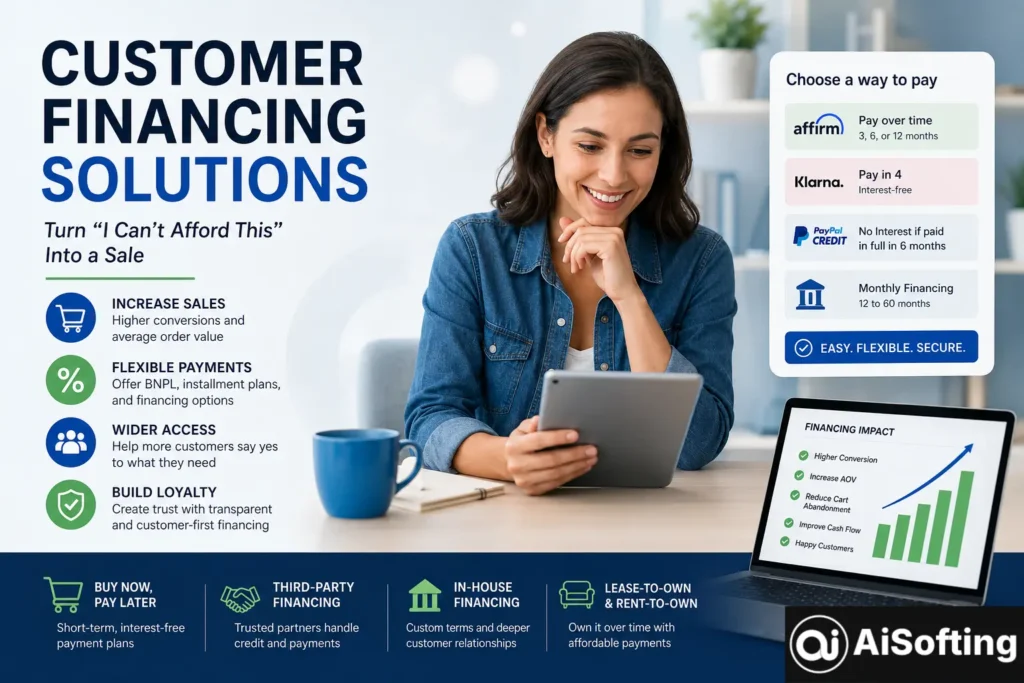
These solutions generally fall into a few categories:
- Third-party financing partners (e.g., Affirm, Klarna, PayPal Credit, Synchrony) that handle underwriting, payments, and risk
- In-house financing programs where the business itself extends credit and manages repayment
- Buy now, pay later (BNPL) short-term installment plans, usually four payments over six weeks
- Lease-to-own models, common in furniture, appliances, and equipment sales
- Line-of-credit partnerships, often used in healthcare, home improvement, and higher-ticket services
Why Customer Financing Solutions Matter for Modern Businesses
The shift toward financing isn’t just a trend — it reflects how consumers actually make purchasing decisions today. According to the Consumer Financial Protection Bureau’s research on buy now, pay later usage, this type of financing has grown rapidly, with a significant share of borrowers using multiple BNPL loans simultaneously. That growth signals real consumer demand, not a passing fad.
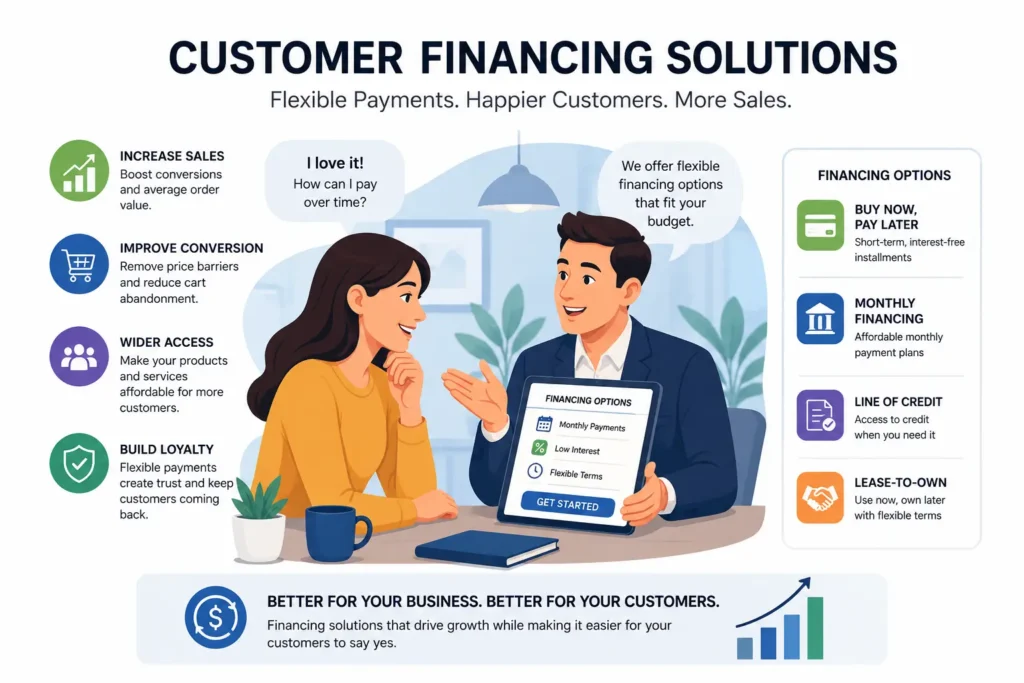
For businesses, offering financing can:
- Increase average order value, since customers spend more when payments are spread out
- Reduce cart abandonment at checkout
- Improve conversion rates for high-ticket items
- Build customer loyalty through flexible, low-friction payment experiences
- Open access to a wider customer base, including those without high-limit credit cards
The Flip Side: Risks Businesses Need to Understand
Financing isn’t free money. Third-party providers charge merchant fees, sometimes 2–8% per transaction, which eats into margins. Investopedia’s overview of how BNPL works breaks down how these fee structures typically function for both merchants and consumers. In-house financing shifts default risk directly onto the business. And regulatory scrutiny around BNPL has increased, meaning businesses need to stay aware of disclosure requirements and fair lending practices.
If you’re weighing financing against other conversion-boosting tools, our guide on choosing the right AI tools for your business covers related decision-making frameworks for evaluating vendors and ROI.
Types of Customer Financing Solutions Explained
Third-Party Financing Partners
This is the most common approach for small and mid-sized businesses because it removes the burden of underwriting and collections. Companies like Affirm, Klarna, and Synchrony evaluate the customer’s creditworthiness, front the funds to the business, and collect payments directly from the customer. The business gets paid upfront (minus fees), while the financing partner assumes the repayment risk.
In-House Financing
Some businesses, especially in industries like dental, medical, and home services, choose to manage financing internally. This gives more control over terms and customer relationships but requires proper legal structuring, credit risk assessment, and often a dedicated system to track payments and defaults.
Buy Now, Pay Later (BNPL)
BNPL has exploded in e-commerce because it’s fast, requires minimal credit checks, and integrates directly into checkout flows. It works well for smaller purchases but is less suited for very high-ticket items due to repayment terms typically capped at a few months.
Lease-to-Own and Rent-to-Own Models
Common in furniture, electronics, and appliance retail, these programs let customers use a product while paying it off, with ownership transferring after the final payment. This model often serves customers with limited or poor credit history.
How to Choose the Right Customer Financing Solution
1. Understand Your Average Order Value
High-ticket businesses (home renovation, healthcare, education) often benefit more from long-term financing partnerships, while smaller order values are usually better suited to BNPL.
2. Evaluate Your Customer Base
If your customers skew younger or have thinner credit files, BNPL tends to perform well. If your audience values traditional credit relationships, a financing partner like Synchrony may be a better fit.
3. Factor in Fees vs. Conversion Lift
Run the math. If a financing partner charges 5% per transaction but increases conversion by 20%, it’s often still a net positive — but only if margins can absorb it.
4. Check Compliance Requirements
Financing involves consumer protection laws that vary by state and country. The Federal Trade Commission’s guidance on consumer lending practices is a useful starting point for understanding disclosure obligations. Working with an established provider often reduces compliance risk since they handle much of the regulatory burden. For businesses layering financing into a broader digital strategy, our AI implementation checklist can help ensure new customer-facing tools, including financing widgets, are rolled out without gaps.
5. Test Before Committing Long-Term
Many providers allow phased rollouts. Test with a subset of products or a limited time window before fully integrating financing into your checkout experience.
Common Mistakes Businesses Make with Customer Financing
- Choosing a provider based purely on brand recognition rather than fee structure and customer fit
- Not clearly disclosing financing terms, which damages trust and can create legal exposure
- Offering financing without training staff on how to explain it to customers
- Ignoring the psychological impact of prominently displaying financing options versus burying them at checkout
- Underestimating default risk in in-house financing programs without proper credit vetting
Best Practices for Implementing Financing Programs
- Clearly display financing options and estimated monthly payments on product pages, not just at checkout
- Train sales and support staff to explain terms accurately and avoid overpromising
- Monitor default rates closely if managing financing in-house
- Offer more than one financing option when possible, since customer preferences vary widely
- Review provider contracts annually, since fee structures and terms change
Personal Experience: What I’ve Learned Helping Businesses Roll Out Financing
The first time I helped a mid-sized retailer add financing to their checkout, we assumed it would be a plug-and-play win. It wasn’t. Conversion did go up, but so did customer service tickets — mostly confusion about repayment schedules and what happened if a payment was missed. That taught me the technical integration is the easy part; the customer communication is where most financing rollouts actually succeed or fail.
On another project, a healthcare client wanted to offer in-house financing to avoid third-party fees. It looked great on paper until we ran the numbers on staff time spent chasing late payments. Within four months, they switched to a hybrid model — using a third-party provider for smaller balances and reserving in-house financing for long-term patients with an established relationship. That mixed approach ended up working far better than an all-or-nothing choice.
One pattern I’ve seen repeatedly: businesses that display financing options early in the buying journey, not just at checkout, see noticeably higher engagement. Customers want to know a $3,000 purchase can become $85 a month before they’ve mentally committed to walking away. Waiting until checkout to reveal that option often means you’ve already lost the sale.
The biggest lesson, honestly, is that financing is as much a trust exercise as a financial one. Businesses that are transparent about rates, terms, and what happens with missed payments consistently see better long-term customer relationships than those that treat financing purely as a conversion tactic.
Frequently Asked Questions
What are customer financing solutions?
They’re payment programs that allow customers to pay for products or services in installments rather than all at once, often through in-house plans, third-party lenders, or buy now, pay later services.
Is buy now, pay later the same as customer financing?
BNPL is one type of customer financing, typically used for shorter repayment periods and smaller purchase amounts, while broader financing programs can extend over months or years.
Do customer financing solutions hurt a business’s cash flow?
Third-party financing generally improves cash flow since the business is paid upfront. In-house financing can strain cash flow since payments are collected gradually over time.
What fees do businesses pay for financing programs?
Fees vary by provider but typically range from 2% to 8% per transaction, depending on the financing type and repayment terms offered to customers.
Are customer financing solutions good for small businesses?
Yes, many small businesses use financing partners to increase average order value and reduce cart abandonment without taking on direct credit risk.
What happens if a customer misses a financing payment?
This depends on the provider and program terms. Third-party providers usually handle collections, while in-house financing puts that responsibility on the business itself.
Which industries benefit most from customer financing?
Healthcare, home improvement, furniture, electronics, education, and e-commerce are among the industries that see the strongest results from offering financing options.
How do I choose between in-house financing and a third-party provider?
It depends on your order value, risk tolerance, and administrative capacity. High-ticket, long-term relationships may favor in-house financing, while transactional retail often benefits from third-party partners.
Conclusion
Customer financing solutions have moved from a niche offering to a core part of the modern buying experience. Done right, they increase sales, improve customer loyalty, and open access to buyers who would otherwise walk away. Done poorly, they create compliance risk, strain cash flow, and confuse customers at the worst possible moment — right before they’re about to buy.
If you’re considering adding financing to your business, start small, test with a limited product set, and prioritize transparency over aggressive upsell tactics. The businesses that treat financing as a trust-building tool, not just a conversion hack, are the ones that see the strongest long-term results.
Disclaimer: This article is for informational purposes only and does not constitute financial, legal, or tax advice. Financing terms, fees, and regulations vary by provider, industry, and jurisdiction, so businesses should consult a qualified financial advisor, accountant, or legal counsel before implementing any customer financing program. Aisofting.com is not liable for decisions made based on the general information provided here.