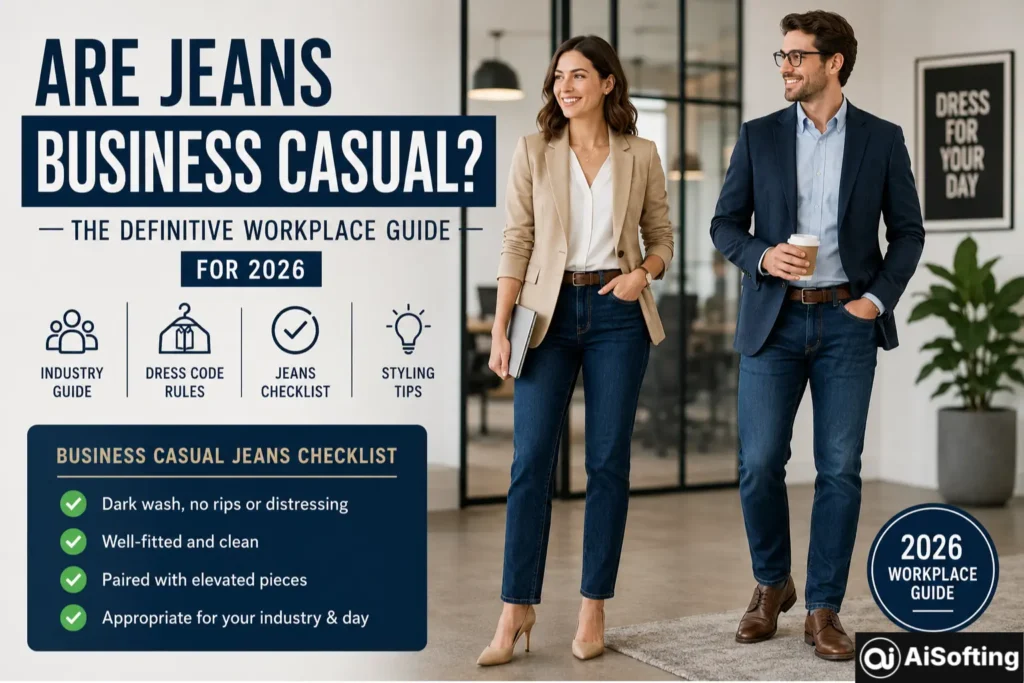
The question of whether jeans qualify as business casual has quietly become one of the most searched dress code questions in modern professional life and in 2026, the answer is more nuanced than ever. Hybrid work schedules, return-to-office mandates, and a post-pandemic redefinition of professionalism have all reshaped what “dressed for work” actually means.
Here’s the short version: dark, well-fitted, undistressed jeans can absolutely be business casual in 2026 but the word “can” is doing a lot of heavy lifting there. Whether they are appropriate depends on your industry, your company’s unspoken norms, the specific context of your day, and how you style everything around them. This guide gives you the complete picture.
What the Numbers Say About Dress Codes in 2026
Before diving into the style specifics, the data is worth knowing. According to Gallup’s most recent figures, 41% of U.S. workers dress in business casual attire, making it the single most common workplace dress code in the country. A separate Monster poll from 2025 found that among employees who do have a dress code, 63% say their office leans business casual and 43% reported having no formal dress code at all.
The hybrid shift has moved the needle significantly. A study by the International Workplace Group found that 79% of hybrid workers say their companies now allow jeans in the office. That’s a remarkable figure but it comes with an important caveat: not all jeans, and not in all situations. The same workers who wear jeans freely on internal work days still reach for trousers before a client presentation.
Meanwhile, 41% of employees admit they’re unsure whether what they plan to wear is actually office-appropriate, according to recent workplace surveys. That uncertainty is precisely why this question keeps trending in search.
What “Business Casual” Actually Means in 2026
Business casual has never had a universal definition, and it’s arguably gotten more ambiguous since the pandemic, not less. Fashion forecasting platform WGSN identified “polished casual” as the defining workplace trend for 2025–2026 describing it as the intersection of comfort dressing and professional polish. That framing is genuinely useful: the goal isn’t to look formal, it’s to look deliberate.
In 2026, business casual means:
- A clear step above athleisure, graphic tees, and weekend clothes
- A clear step below business formal (suits, ties, structured heels)
- An emphasis on fit, fabric quality, and coordination over rigid item rules
What’s shifted is that specific garments including jeans are less important than overall intentionality. A $30 pair of dark, perfectly fitted jeans worn with a blazer and leather shoes reads more professional than rumpled chinos with a polo that doesn’t fit.
The Direct Answer: Are Jeans Business Casual?
Yes with conditions. Law firms throughout America have adopted “Dress for Your Day” policies that explicitly permit jeans when circumstances allow. Goldman Sachs began allowing jeans in 2019, and that signal has rippled outward through financial services ever since. The consensus in 2026 across most knowledge-work industries is that anyone who sets a business casual dress code without adding “no jeans” is implicitly accepting dark, clean denim.
But that consensus doesn’t apply universally. Certain industries, certain roles, and certain days still call for leaving the jeans at home.
Industry-by-Industry Reality Check
This is the most practically useful section most articles skip. “Business casual” means different things in different rooms.
Tech and Startups
Dark jeans are essentially the default uniform. In many tech environments, wearing trousers signals you’re either in an interview or heading to an investor pitch. Jeans with a clean button-down or quality tee are completely unremarkable here even on client-facing days in many cases.
Creative Industries (Marketing, Design, Media)
Strong acceptance, with room to push further. Fashion-forward styling wide-leg dark jeans, an oversized blazer, clean sneakers is not just accepted but often respected as a signal of cultural awareness. The 2026 trend toward oversized blazers pairs particularly well with straight-leg denim in creative office environments.
Finance and Banking
Still conservative, though loosening. Jeans may appear on Casual Fridays or remote days, but client-facing roles and formal internal settings typically expect dress trousers. The 2026 guidance from most style experts covering this sector: avoid jeans in conservative finance environments, even with a blazer, until you’ve confirmed the culture allows it.
Law and Legal Services
“Dress for Your Day” policies have given lawyers more latitude, but the default remains conservative. Jeans in a law firm context generally work only when explicitly cleared for internal casual days, not for client meetings, hearings, or formal presentations.
Healthcare (Administrative Roles)
Clinical staff operate within uniform requirements. Administrative, operations, and non-clinical healthcare professionals increasingly wear dark jeans in office settings, particularly in hybrid or remote-leaning roles.
Education
Highly variable. University and higher education settings tend toward relaxed norms. Private K–12 institutions often maintain stricter standards, especially for faculty.
Consulting and Client Services
Context is everything. Internal days allow jeans in most consulting environments; client-facing days typically call for stepping up, especially if the client comes from a conservative sector.
The 2026 Jeans Checklist: What Makes Denim Professional
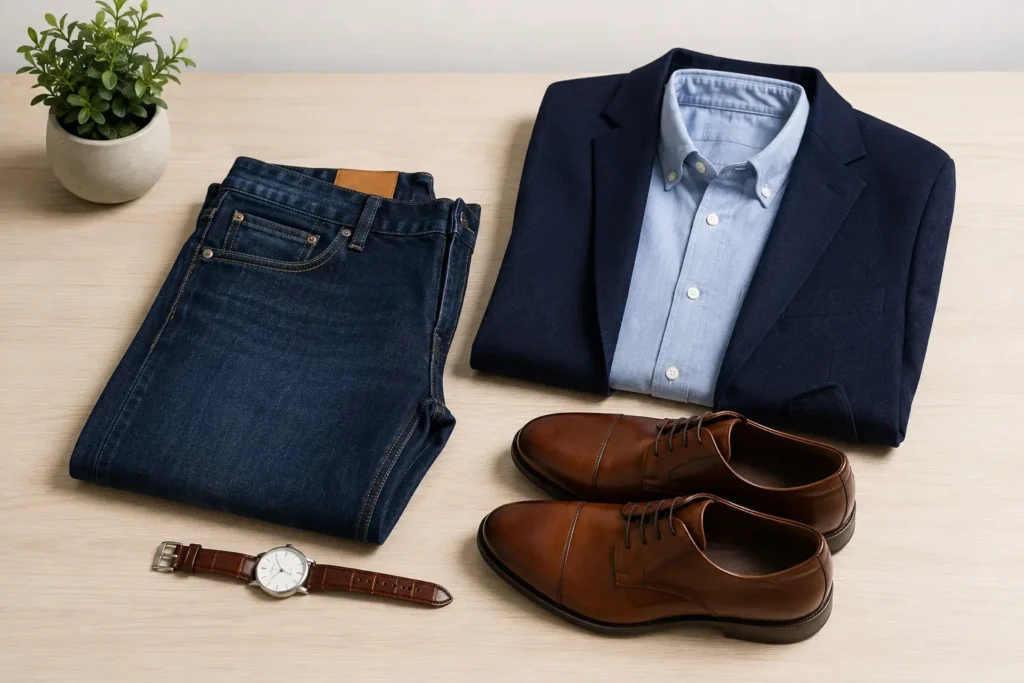
Research and practical observation align on the same criteria. If your jeans hit all of these, they’re business casual-appropriate in most environments:
Color: Dark indigo, raw denim, or black. These read closest to formal trousers at a glance which is the test worth applying. Medium wash requires more careful styling. Light wash is almost always too casual.
Fit: Slim or straight leg with a clean hem. The 2026 trend toward straight-leg and tapered silhouettes works well here they read modern without looking casual. Wide-leg jeans are trending, but in traditional workplaces they can read as too fashion-forward. Baggy or excessively cropped cuts generally stay outside the business casual line.
Condition: No rips, no heavy fading, no fraying, no distressing real or fake. A stained or wrinkled pair of jeans undermines a polished outfit regardless of any other element.
Rise: Mid to high rise. Low-rise jeans read dated and can slip into unprofessional territory when you’re moving around.
Embellishments: None. No decorative stitching, rhinestones, heavy branding, or patches.
Styling Architecture: What You Wear With Jeans Matters More
The most overlooked insight in this space: jeans are a neutral canvas. The professional signal comes from what surrounds them.
Footwear is disproportionately important. Leather loafers, Oxford shoes, Derby shoes, Chelsea boots, or clean suede chukkas significantly elevate dark jeans into business casual territory. Clean, minimalist leather sneakers can work in casual-leaning offices. Athletic running shoes, flip-flops, or worn canvas shoes cancel out everything else.
The 2026 oversized blazer trend is your best friend. Fashion sources consistently identify the oversized or unstructured blazer as the dominant workplace outer layer of 2025–2026. Paired with straight-leg dark jeans and a fitted top or button-down, this combination is the clearest example of “polished casual” done right and it works across industries from tech to mid-level finance.
Tops matter for the camera too. With hybrid work meaning a significant portion of professional interactions happen on video, your top half is what colleagues and clients actually see. A wrinkled collar or casual neckline amplifies on screen. A crisp shirt, well-fitted crewneck, or structured blouse lifts the whole outfit.
Hidden Factors Most Style Articles Miss
Seniority Creates Asymmetric Rules
A junior employee wearing jeans to a meeting reads differently than a VP wearing the same jeans. Senior professionals have built credibility that insulates them from dress code judgment. If you’re early in your career or new to an organization, the safer default is formal trousers until you’ve read the room and established your own standing.
“Dress for Your Day” Is Becoming Policy, Not Just Philosophy
Law firms and professional services organizations are formally codifying what was previously informal: attire expectations shift based on what’s actually on your calendar. An internal team workshop calls for different choices than a board presentation and increasingly, that’s written into policy rather than left to individual judgment.
The Video Call Exception (and Its Limits)
On video calls, only your top half is visible most of the time. Many professionals who wouldn’t wear jeans to an in-person client meeting wear them freely on calls without anyone noticing. This is widely normalized now. The caveat: stand-up moments, office hot-desking, and in-person portions of hybrid days mean jeans still need to be calibrated for the full day, not just the frame.
The Retention Signal
A 2025 Monster poll found that 44% of workers would consider changing jobs if a company’s dress code better aligned with their personal style. This has made dress code flexibility a genuine retention and recruitment lever for employers which means progressive dress codes (including jeans acceptance) are likely to keep expanding in talent-competitive industries.
When to Leave the Jeans Home, No Matter What
Some situations call for stepping up regardless of default office culture:
- Job interviews Almost universally, skip jeans. Even companies with fully casual cultures expect candidates to dress up for interviews as a signal of effort and respect.
- First week at a new job Observe first. Dress formal until you’ve confirmed what the real norms are.
- External client meetings Default to your client’s industry standard, not your own office’s.
- Board presentations, investor meetings, or executive briefings The stakes are high enough that the downside risk isn’t worth it.
- Formal presentations or public-facing events These are credibility moments; dress to the occasion.
My Experience with Jeans in Business Casual Settings
Navigating this question across multiple professional environments has taught me that written dress codes are almost always less informative than what you observe in the first week. Early in my career, I wore dark jeans with a blazer to a financial services meeting where every other professional wore pressed trousers. The jeans were clean, dark, and well-fitted they still stood out in the wrong way.
That experience changed how I approached dress code reading. I started paying more attention to what senior people were wearing in their daily work, not what the policy document said. The senior partner who wears jeans on Fridays is telling you something real about the culture. So is the junior associate who never deviates from formal trousers regardless of the day.
What I’ve found consistently is that footwear and the blazer do more work than any other element when wearing jeans professionally. I’ve worn the same dark jeans to meetings in the same week once with an unstructured blazer, tucked button-down, and leather Derbies, and once with a polo and clean sneakers. The first outfit earned a comment about looking “sharp.” The second barely registered. Same jeans; completely different professional read.
The lesson I’d pass on most strongly going into 2026: the “polished casual” framing is genuinely useful. Ask yourself whether each element of your outfit looks like a deliberate choice rather than a default grab. Jeans that look chosen and styled always land better than trousers that look like you just grabbed whatever was clean.
2026 Trends Reshaping the Jeans-at-Work Question
Several converging trends are worth watching:
Straight-leg and wide-leg silhouettes are dominant. The skinny jean has largely exited the professional wardrobe. Straight-leg and tapered cuts are the current standard; wide-leg styles are growing but work better in fashion-forward environments than traditional ones.
“Smart casual” is growing faster than business casual. Industry observers note that smart casual is the fastest-growing dress code category in 2026 and it’s the category where elevated denim has fully arrived. If your office is moving toward smart casual, jeans are squarely within bounds when styled well.
The return-to-office push hasn’t reversed casualization. Despite many major employers mandating more in-office days, the casualization of workplace dress that accelerated during the pandemic has largely held. Employees who established comfortable-but-polished wardrobe habits during hybrid work have kept them.
Fit is now more important than formality. Multiple style experts and workplace sources are converging on the same principle for 2026: a well-fitted garment at any formality level outperforms an ill-fitted garment at a higher formality level. A $200 suit that fits poorly signals less care than dark jeans that fit perfectly.
For further reading on evolving workplace dress norms, the Society for Human Resource Management (SHRM) maintains updated guidance on dress code policy trends, and Business of Fashion covers the market forces shaping professional denim. For a deep dive into fit-first dressing principles, Artful Tailoring’s 2026 dress code guide is worth reading in full.
FAQ: Are Jeans Business Casual in 2026?
Q: Can I wear jeans to a job interview at a casual tech company?
A: Still no, in almost all cases. Interviews are a specific context where candidates are expected to dress one level above the company’s daily standard to signal effort and seriousness. Even if everyone in the office wears jeans daily, show up in clean trousers or chinos. You can always ask the recruiter for specific guidance if you’re unsure.
Q: What color jeans are most appropriate for business casual?
A: Dark indigo and black are the most professional choices in 2026. They read closest to dress trousers at a glance, which is the informal test worth applying. Medium-wash jeans work in relaxed environments with careful styling. Light-wash, heavily faded, or distressed jeans fall outside business casual in most professional contexts regardless of how you style them.
Q: Are wide-leg jeans business casual?
A: Potentially, in fashion-forward or creative environments. Wide-leg denim is a strong 2026 trend and can be styled professionally with a tailored blazer and heeled boots or loafers. In traditional or conservative workplaces, however, the silhouette may read as too casual or trend-driven. Straight-leg remains the safer universal choice.
Q: How do I know if my specific office actually accepts jeans?
A: Look at what your manager and senior colleagues wear on ordinary working days not what the employee handbook says. Dress codes in 2026 are lived in behavior, not documented in policy. If senior professionals routinely wear dark jeans without comment, that’s your real signal. If you only see chinos and dress trousers, mirror that until you’ve established enough standing to test the limits.
Q: Is it ever okay to wear jeans to a client meeting?
A: Depends entirely on the client’s industry. In tech, creative, or startup environments, dark jeans with a blazer are often completely appropriate even for client-facing meetings. In finance, law, or traditional corporate settings, the answer is almost always no, regardless of what your own office culture allows. When in doubt, dress to the client’s standard, not yours.
Conclusion: Jeans in 2026 Earned, Not Assumed
The bottom line for 2026: dark, well-fitted, clean jeans styled with elevated separates have earned their place in the business casual wardrobe for most knowledge-work industries. They are not automatically business casual, but they are no longer the bold move they once were.
Key takeaways:
- 79% of hybrid workplaces now allow jeans but the conditions (dark, fitted, no distressing) still apply.
- Industry and company culture are the primary determinants. Tech and creative say yes broadly; finance and law still say rarely or never.
- Fit now outranks formality as the primary signal of professionalism. A perfectly fitted pair of dark jeans beats rumpled trousers.
- The 2026 oversized blazer trend is the easiest way to elevate jeans into polished-casual territory.
- High-stakes moments interviews, client meetings, first impressions still call for stepping up regardless of daily norms.
- Observe what senior colleagues wear on ordinary days. That’s the real dress code.
The professionals who navigate this best in 2026 aren’t the ones who have memorized a list of rules. They’re the ones who understand that clothing is communication and who choose each element of their outfit deliberately enough that the choice reads as intentional. Jeans done with that mindset? Completely business casual. Jeans grabbed without a thought? That’s where the risk lives.
Visit: Aisofting