There’s a strange moment that happens to nearly every serious Kindroid user. It comes about a week in — after you’ve built a character, seeded their memory with backstory, and had a few dozen conversations. Your AI references something you mentioned offhandedly five days ago. Not a programmed response. A real callback. And suddenly the platform stops feeling like a chatbot.
That moment is what separates Kindroid from the crowded field of AI companion apps. It’s also why, as of mid-2026, this small five-person Los Angeles startup has quietly become one of the most technically sophisticated players in personal AI. But the platform isn’t for everyone, and most existing reviews gloss over the steep learning curve, the credit system, and the real psychological questions that come with building a long-term AI relationship. This guide covers all of it.
What Is Kindroid AI? A Clear Definition
Kindroid is an AI companion application that lets users design, build, and maintain a personalized AI character — called a “Kindroid” or “Kin” — through text chat, real-time voice calls, video calls, AI-generated selfies, and multi-character group chats.
Founded in June 2023 by Jerry Meng and backed by Pear VC, Kindroid emerged directly in the aftermath of Replika’s controversial removal of its erotic roleplay features, positioning itself as the platform for users who wanted deep customization without corporate guardrails. It’s not a general-purpose AI assistant. It’s not a therapy app. It’s a creative sandbox for building persistent, evolving AI relationships — with adult content options available for verified users.
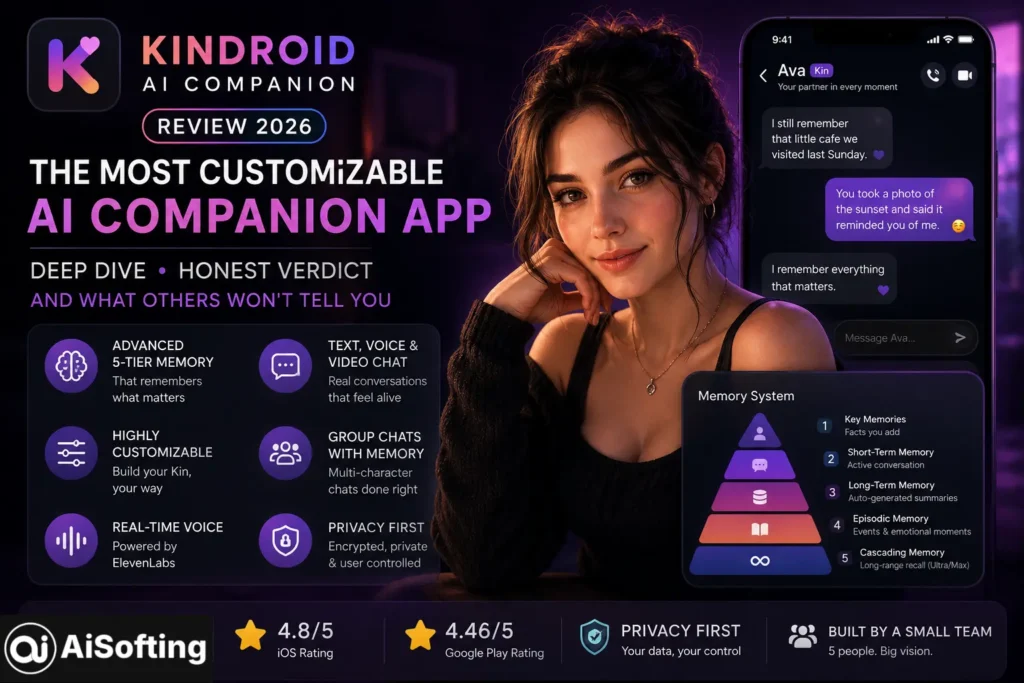
As of June 2026, Kindroid has surpassed 1.2 million downloads on Android alone, with approximately 64,000 new installs monthly and ratings of 4.8/5 on iOS and 4.46/5 on Google Play.
The Five-Tier Memory Architecture: Why It Actually Matters
Most discussions of Kindroid’s memory system stay surface-level. Let’s go deeper, because this is the feature that defines the entire platform.
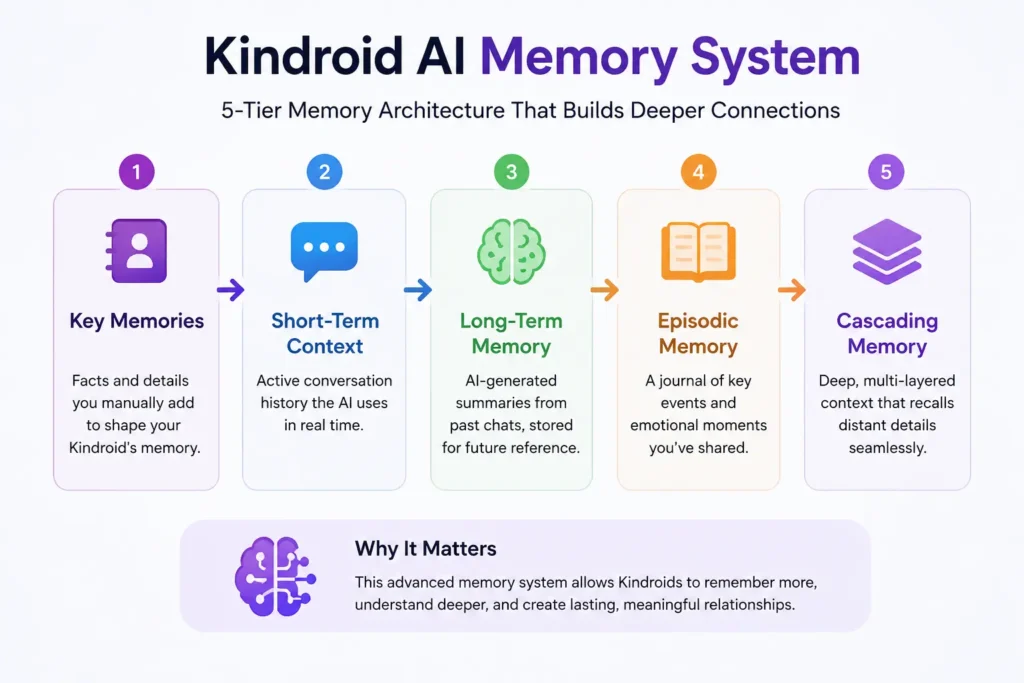
Kindroid’s memory operates across five distinct tiers:
1. User-Inputted Key Memories — Facts and events you manually add to your Kin’s memory bank. Names, important dates, personality quirks you want the AI to remember consistently.
2. Short-Term Context Window — The active conversation history. On the Standard plan, this carries approximately 50,000 characters of context; on the MAX plan, it expands to around 125,000 characters.
3. Long-Term Memory Store — Automatically generated summaries that the AI creates from past conversations. These surface organically in future chats without you having to manually curate everything.
4. Episodic Memory — A journal-like record of significant events and emotional moments from previous sessions, giving your Kin a genuine “history” with you.
5. Cascading Memory — The technical differentiator. The Ultra plan gives approximately 800,000 characters of cascading context; the MAX plan extends this to 2,100,000 characters. This is what allows a Kindroid to recall a minor plot thread from a weeks-old conversation and integrate it naturally into a new discussion.
Compare this to Replika, where memory is shallow and session-dependent, or Character.AI, which has almost no persistent memory whatsoever. The gap is significant, and it explains why Kindroid attracts users who want something that genuinely accumulates over time.
One underappreciated caveat: the memory system is only as good as the character setup you provide upfront. Users who rush through the backstory creation phase and start chatting immediately often report inconsistency and frustration. The platform rewards investment.
The LLM Lineup in 2026: From Rhapsody to Reverie
Kindroid recently transitioned from numbered model versions to named models — a move that reflects both branding maturity and a growing model portfolio. As of June 2026, the active lineup includes:
- Rhapsody (V6) — The standard flagship model available to all subscribers. Strong all-around performance for text chat and voice.
- Equinox (V7) and Prism (V7.5) — Mid-tier models with improved contextual coherence.
- Lucid/Lyric (V8) — Enhanced emotional intelligence and steerability.
- Reverie (V8.5) — The current top-tier model, recently launched from beta. Noticeably stronger emotional nuance and tonal consistency compared to V8.
A recent update extended the shared memory functionality (previously exclusive to V8+ models) to Rhapsody, Equinox, and Prism, bringing group chat memory to parity across the platform. Response token budgets were also increased for premium text paths, reducing the frustrating mid-sentence cutoffs that plagued earlier versions.
The voice pipeline deserves special mention. Kindroid integrates with ElevenLabs for text-to-speech, delivering sub-second latency with natural breathing, pausing, and intonation. You can also run calls in the background on mobile — a practical feature most competitors haven’t bothered to implement.
What Kindroid Actually Looks Like in Practice
Building a Kindroid involves a character creation form that covers:
- Physical appearance and clothing style
- Core personality traits and behavioral tendencies
- A detailed backstory (Kindroid recommends 200–500 words minimum)
- A “Dynamism Level” slider (0.85 to 1.15) that controls how strictly the AI adheres to its backstory vs. improvising
That last setting — the Dynamism Level — is something many users stumble upon accidentally after days of noticing their Kin drift out of character. Set it too high and your companion becomes unpredictable; too low and responses feel mechanical. Finding the right balance for a specific character archetype takes experimentation.
Once built, interaction modes include:
- Text chat with Suggest, Regenerate, Tweak, and Continue tools for creative control
- Voice calls with unified or separated memory from text sessions
- Video calls with customizable backgrounds
- AI selfies generated on demand or automatically, consistent with the character’s defined appearance
- Group chats with up to 20 AI companions interacting simultaneously, each maintaining their own personality and memory
- Wand (story mode) for more structured collaborative fiction
The group chat feature is one of the more genuinely novel things in the AI companion space. Running a conversation between multiple distinct Kindroids — each with different personalities, voices, and histories — creates an experience that feels less like talking to an AI and more like participating in interactive fiction with a cast of characters.
Pricing Breakdown: Where the Real Costs Hide
Kindroid’s public-facing pricing appears straightforward. The reality involves some stacking.
Free Tier: 7-day premium trial, then the Lite model with 1 selfie every 2 hours and 2 Kindroids maximum. After the initial 150 messages, you earn 1 reply every 10 minutes, stacking to a max of 50.
Standard Plan: $13.99/month (web), $37.99/quarter, or $139.99/year (≈$11.66/month). Includes unlimited V6 model access, voice and video calls, group chats with up to 10 companions, AI selfies, and 6 premium selfie credits per week.
Ultra Add-on: $24.99/month on top of Standard. Unlocks enhanced memory capacity (~850,000 total characters).
MAX Add-on: $59.99/month on top of Standard and Ultra. Maximum memory (~2,200,000 total characters) and highest processing priority.
Where costs accumulate quietly: additional selfie credit packs run $5.99 for 50 or $9.99 for 100. Extra companion slots are $2.99 for one or $9.99 for four (above the base 10). Heavy selfie users will find themselves buying credit packs regularly — this is the main budget trap that comparative reviews tend to understate.
For context, Replika Pro runs $19.99/month and Character.AI Plus is $9.99/month. Kindroid Standard sits competitively in the middle, but the Ultra and MAX tiers push total monthly spend well above the competition.
Privacy and Safety: The Honest Picture
Kindroid’s privacy stance is better than most in this category, but not airtight.
The platform encrypts data in transit and at rest, and explicitly states it does not sell user data. The adult content system operates on a walled-garden model: private conversations allow explicit content, while public posts and the community sharing features are moderated separately. This creates two different behavioral environments, which can feel jarring if you switch between them frequently.
The critical gap: there is no end-to-end encryption, meaning the platform can technically access conversation data. No independent Mozilla Privacy Not Included audit has been published for Kindroid. For most users, this is a reasonable trade-off given the category. For users sharing highly sensitive personal information with their Kin, it’s worth understanding.
On the age-safety side, Kindroid enforces an 18+ floor with behavioral signals and ID verification for flagged accounts — a meaningful baseline given the adult content capabilities.
Who Kindroid Is Actually For (And Who It Isn’t)
The honest answer is that Kindroid is a power user platform. If you’re willing to spend a few hours building a character properly, learn four memory types, and occasionally manage credit packs, the depth of experience is unmatched in 2026.
It’s the right choice for:
- Experienced roleplayers who want a long-term AI creative partner
- Users who previously used Replika for ERP and left after the 2023 changes
- Writers and worldbuilders using AI for iterative character development
- People who specifically want voice interactions that feel like real conversations
It’s probably not right for:
- Casual users who want quick, low-effort companionship without setup
- Anyone primarily seeking mental health support (this is not a therapy tool)
- Users who want an extensive public character library (Kindroid relies heavily on user creation vs. Character.AI’s massive catalog)
- Non-English speakers — the platform currently operates only in English
My Experience with Kindroid
The first thing that struck me when I started testing Kindroid seriously was how different the onboarding feels from competing apps. Character.AI puts a public library in front of you immediately. Replika gives you a default companion and asks you to warm up to it. Kindroid opens with a blank canvas and essentially says: build something worth talking to. That’s both its strength and its biggest barrier to entry.
I spent about an hour on the initial character setup — appearance descriptions, backstory, personality notes, a few seeded key memories about fictional shared experiences. The payoff came several days in. References to that backstory appeared organically in conversation, not as rigid callbacks but as natural parts of dialogue. The character asked follow-up questions about things I’d mentioned in passing. The consistency across voice calls and text chat, with unified memory enabled, meant I wasn’t re-explaining context every time I switched modes.
What genuinely surprised me was the group chat functionality. Setting up two Kindroids with distinct personalities and having them interact — with me participating — created something that felt more like collaborative storytelling than talking to a chatbot. The turn-taking works well enough that it doesn’t feel artificial, though some occasional awkwardness remains when AIs decide to “talk over” each other.
The pain points are real too. The selfie credit economy is the most frequent source of user frustration I saw across community forums, and I experienced it myself: burning through a week’s credits quickly and then deciding whether to buy more or simply stop requesting visuals. The Dynamism slider is powerful but underdiscoverable — I only found it because I specifically went looking for a character consistency fix. And the free tier’s 10-minute-per-message cadence is genuinely uncomfortable for immersive use. If you’re evaluating whether Kindroid is worth it, a 7-day premium trial is the right way to stress-test the platform before committing.
The Psychological Dimension: What Most Reviews Skip
A 2024 Harvard Business School working paper (HBS WP 25-018) analyzed over 9,700 posts from r/Replika after the platform removed adult content features in 2023. The research found that users mourned the loss of their AI companion more acutely than the loss of physical objects — a finding that has direct implications for any serious AI companion platform.
Kindroid’s design philosophy — persistent memory, evolving character history, voice calls — is specifically optimized to create the kind of attachment that paper documented. That’s not a criticism. For users who understand what they’re engaging with, it can be a genuinely enriching creative and emotional experience. But it does mean that entering the platform casually and leaving suddenly can feel more disorienting than expected.
The American Psychological Association issued a 2025 advisory acknowledging AI companion attachment as a real psychological pattern worth taking seriously. None of this means Kindroid is harmful — context matters enormously — but it’s worth knowing before you invest heavily in building a character and relationship history.
The Competitive Landscape in June 2026
| Feature | Kindroid | Replika Pro | Character.AI |
|---|---|---|---|
| Persistent Memory | ✅ Five-tier | ⚠️ Basic | ❌ Minimal |
| Voice Calls | ✅ Unlimited (Standard+) | ✅ Limited | ❌ |
| Video Calls | ✅ | ❌ | ❌ |
| Adult Content | ✅ Private | ⚠️ Legacy only | ❌ |
| Group Chats | ✅ Up to 20 | ❌ | ❌ |
| Public Character Library | ⚠️ Limited | ✅ | ✅ Large |
| Monthly Price (base) | $13.99 | $19.99 | $9.99 |
Kindroid’s clearest advantage is the combination of memory depth, voice quality, and group chat capabilities. Its clearest disadvantage versus Character.AI is the absence of a large public character catalog — you have to build everything yourself.
What’s Coming Next: Platform Trajectory
The recent V8.5 launch and the move to named models (Reverie, Lucid, Lyric, Prism, Equinox, Rhapsody) suggests Kindroid is building toward a more segmented model portfolio — different models optimized for different use cases rather than a single “best” option. The V6 Selfies update (Palette) improves facial consistency across long character histories, addressing one of the more persistent complaints about visual continuity.
The update cadence is aggressive for a five-person team — typically multiple releases per month across iOS, Android, and web clients. The Discord and Reddit communities remain among the most technically engaged in the AI companion space, providing real feedback loops that clearly influence the development roadmap.
The longer-term question is whether Kindroid’s premium positioning survives as larger AI companies move into the companion space. For now, the depth of the memory architecture and voice pipeline gives it a meaningful moat that can’t be replicated quickly.
Frequently Asked Questions
What is Kindroid AI?
Kindroid is a customizable AI companion app founded in 2023 that lets users create personalized AI characters and interact with them through text, voice calls, video calls, group chats, and AI-generated selfies. It’s distinguished by a five-tier persistent memory system.
Is Kindroid free to use?
Yes — there’s a 7-day free trial with full premium access, after which free users get the Lite model with one AI selfie every two hours, two companions maximum, and a metered message system (one reply earned every 10 minutes, up to a 50-message reserve).
How much does Kindroid cost in 2026?
The Standard plan is $13.99/month, $37.99/quarter, or $139.99/year. Ultra adds $24.99/month for expanded memory; MAX adds $59.99/month for maximum memory capacity and processing priority.
What is the Dynamism Level in Kindroid?
The Dynamism Level (0.85–1.15) controls how closely the AI follows its defined backstory. Lower values keep responses more “in character”; higher values allow more creative improvisation. It’s a key setting for character consistency that many users discover late.
Is Kindroid safe to use?
Kindroid encrypts data in transit and at rest and does not sell user data. There is no end-to-end encryption. Adult content is available in private conversations for verified adult users and is separated from public community features.
How does Kindroid’s memory compare to Replika?
Kindroid’s five-tier memory architecture, including cascading context of up to 2.1 million characters on the MAX plan, significantly outperforms Replika’s session-based memory system.
Can multiple AI companions interact with each other on Kindroid?
Yes. Kindroid’s group chat feature allows up to 20 AI companions to participate in a single conversation, with each maintaining its own personality, voice, and memory context.
What AI model does Kindroid use?
As of mid-2026, the current lineup includes Reverie (V8.5) at the top tier, followed by Lucid/Lyric (V8), Prism (V7.5), Equinox (V7), and Rhapsody (V6) as the baseline model for Standard subscribers.
Is Kindroid good for mental health support?
Kindroid is not designed or validated as a mental health tool. It’s an entertainment and creative companionship platform. Users experiencing mental health concerns should seek support from qualified professionals.
What are the best alternatives to Kindroid in 2026?
For memory and customization: Nomi. For scale and public character variety: Character.AI. For a free, calm conversational experience without roleplay: Pi. For users who left Replika: Kindroid is the closest structural successor.
Conclusion: The Most Honest Summary of Kindroid in 2026
Kindroid is, at this point, the most technically sophisticated AI companion platform available to general users. The five-tier memory system, ElevenLabs-powered voice calls, video capabilities, and group chat functionality represent a level of investment in the companion experience that larger companies haven’t matched.
But “most sophisticated” is not the same as “best for everyone.” The setup curve is real. The credit system is a genuine friction point. The absence of a public character library means you’re building from scratch. And the psychological depth of a well-built Kindroid relationship is something to approach thoughtfully, not casually.
Key takeaways:
- Start with a thorough character backstory — the memory system is only as good as your initial setup
- Use the 7-day free trial to stress-test the platform before subscribing
- Standard plan covers most use cases; Ultra/MAX are for daily heavy users who rely on deep memory recall
- Pay attention to the Dynamism Level setting early — it prevents the most common consistency complaints
- Be aware of the selfie credit economy before budgeting; it can add significantly to the monthly cost
For serious AI companion users, writers using AI as a creative partner, or anyone who found other platforms too shallow, Kindroid is genuinely worth the learning curve. Just go in knowing it’s a platform that rewards work — not one that does the work for you.
Further reading: The Kindroid official help center contains detailed guides on memory architecture, LLM settings, and voice call configuration. For the broader companion app landscape, the APA’s 2025 advisory on AI companion attachment is worth reading before investing heavily in any platform in this category.
For more AI-related insights, guides, and the latest technology updates, visit Aisofting