What does IT stand for in technology? If you’ve ever been confused when someone at work mentions “calling IT” or references an “IT department,” you’re not alone. The acronym gets tossed around so casually that most people never stop to ask what it actually means — or why it matters so much in a modern organization. This guide answers that question thoroughly and goes well beyond the surface-level definition to explain why IT is one of the most consequential fields shaping how businesses and societies function in 2026.
IT Stands for Information Technology But What Does That Really Mean?
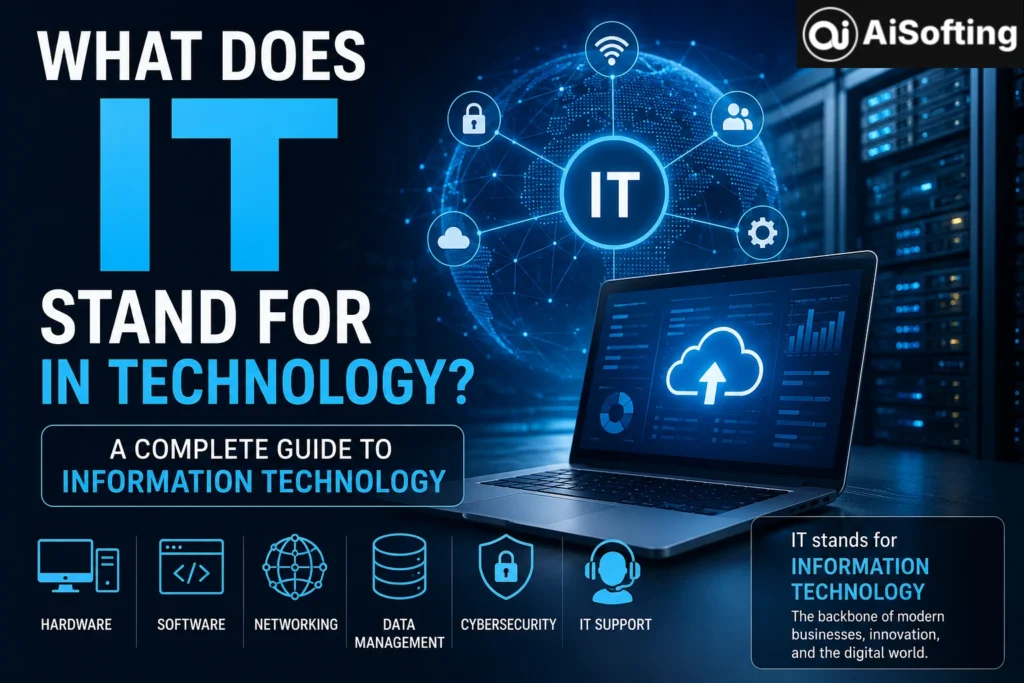
At its most basic, IT stands for Information Technology. According to the widely accepted definition used by institutions from Wikipedia to CompTIA, information technology refers to the use of computers, networks, servers, software, and related infrastructure to create, store, process, retrieve, and transmit data.
But that textbook definition barely scratches the surface. In practice, IT is the invisible backbone that keeps hospitals running, financial systems secure, e-commerce platforms selling, and governments delivering services. When IT fails, the consequences are rarely invisible think of bank outages, hospital ransomware attacks, or airline system crashes that strand thousands of passengers.
IT is considered a subset of ICT (Information and Communications Technology), with a specific focus on using computers and servers to create, process, transmit, and store digital data. The distinction matters because ICT casts a wider net — including telecommunications infrastructure like broadcast radio and satellite while IT zeroes in on computing-driven information management.
A Brief History: Where the Term Came From
The phrase “Information Technology” didn’t appear fully formed from nowhere. It has a traceable origin that reflects how computing evolved from a niche scientific tool into a civilizational force.
By 1984, the National Westminster Bank Quarterly Review redefined information technology as “the convergence of telecommunications and computing technology.” The term also appeared in documents for the International Organization for Standardization (ISO) starting in 1990.
Before that, what we now call IT was typically referred to as “data processing” or “electronic data processing” (EDP). The shift in language reflected a shift in understanding: computing wasn’t just about crunching numbers anymore. It was about managing information itself and information had become a strategic resource. Decades later, the internet supercharged IT’s importance, turning it from a back-office function into a strategic competitive differentiator.
What IT Actually Includes: Breaking Down the Scope
One of the most common misconceptions about IT is that it’s simply “the people who fix computers.” That’s a bit like saying a hospital is just a place where people get bandages. The reality is far more layered.
Hardware
This covers the physical components: servers, workstations, routers, switches, storage arrays, data center infrastructure, and end-user devices like laptops and smartphones. In 2026, hardware decisions are increasingly shaped by AI compute demands the energy and processing requirements of modern AI workloads are forcing organizations to rethink data center design from the ground up.
Software
Operating systems, enterprise applications (like ERP and CRM platforms), productivity suites, databases, and custom-built applications all fall under this category. Software is increasingly delivered as a service rather than a product a shift that has fundamentally changed how IT departments operate and budget.
Networking and Connectivity
Local area networks (LANs), wide area networks (WANs), virtual private networks (VPNs), and internet connectivity are all part of the IT domain. In 2026, 5G connectivity is mainstream in enterprise settings, and early 6G deployments are beginning to ramp up, opening novel use cases in real-time industrial automation and immersive communications.
Data Management and Storage
IT teams manage where data lives, how it’s backed up, how quickly it can be retrieved, and who can access it. With the explosion of AI workloads and IoT sensors, data volumes have grown dramatically making governance, quality, and lineage tracking critical responsibilities, not afterthoughts.
Cybersecurity
Perhaps the fastest-growing sub-discipline within IT. IBM reported the average cost of a data breach in 2024 was $4.88 million a 10% increase from the prior year and the highest figure on record. In 2026, cybersecurity has evolved from a defensive posture to a proactive, AI-driven discipline, with organizations shifting from reactive incident response to preemptive threat interception.
IT Support and Help Desk
The function most visible to everyday employees: troubleshooting technical problems, managing user accounts, and ensuring systems remain operational. Even this traditionally straightforward role is being transformed by AI-assisted diagnostics and automated resolution workflows.
IT vs. Related Fields: Where the Lines Are Drawn
A lot of confusion exists around how IT differs from adjacent disciplines. The distinctions matter for hiring, organizational design, and career planning.
IT vs. Computer Science
Computer Science creates computer applications and programs. Information technology, by contrast, refers to the process of using and maintaining those applications and programs properly. In short, Computer Science builds the tools; IT deploys and manages them.
IT vs. Software Engineering
Software engineering is the craft of designing, coding, and testing software. IT, particularly in an enterprise context, focuses on implementing, configuring, and maintaining the environments in which that software runs.
IT vs. Operational Technology (OT)
Operational Technology (OT) monitors and controls physical devices and processes within industries such as manufacturing or energy. IT deals with information systems and networks that store, retrieve, transmit, and manipulate data. This distinction has become critically important in 2026, as IT and OT systems are converging — particularly around AI-driven robotics and smart manufacturing — creating new governance and security challenges that neither domain can solve alone.
Why IT Matters More Than Ever: The 2026 Business Case
There was a time when IT was viewed as a cost center — a necessary expense, like paying for utilities. That perspective has fundamentally shifted.
What originally began as a siloed department, information technology is now considered a critical business function that impacts nearly every aspect of an organization. The numbers in 2026 tell a compelling story:
- According to Gartner, global IT spending reached $74 trillion in 2025, an increase of 9.3% compared to 2024, with investments focusing heavily on technologies that automate processes, increase efficiency, and improve customer loyalty.
- The global AI market reached $244 billion in 2025 and is projected to exceed $800 billion by 2030 — with IT teams at the center of deploying, governing, and securing this infrastructure.
- The global edge computing market is assessed at around $39.6 billion in 2026 and is on track to exceed half a trillion dollars by 2035.
- IBM reported the average cost of a data breach hit $4.88 million in 2024 — a 10% increase from the prior year and the highest figure on record — underscoring why IT security is now a boardroom-level concern.
- The global AI market is projected to reach $4.8 trillion by 2033 according to UNCTAD, fuelling unprecedented demand for IT professionals with AI governance and infrastructure skills.
These figures reflect a structural reality: nearly every modern business is, in some meaningful sense, an IT-dependent business. And in 2026, the organizations treating IT as strategic infrastructure — not a cost center — are pulling ahead fast.
The 2026 IT Landscape: What Is Actually Reshaping the Field Right Now
This is where the 2026 picture looks dramatically different from even two or three years ago. The IT trends that were “emerging” in 2023 are now operational realities that IT teams are managing every day.
AI Has Moved from Pilot to Production — And It’s Changing Everything
According to Gartner’s top strategic technology trends for 2026, AI is no longer optional for enterprise IT. Multiagent systems now allow modular AI agents to collaborate on complex tasks, improving automation and scalability. Domain-specific language models deliver higher accuracy and compliance for industry-specific use cases. And Physical AI — intelligence embedded in robots, drones, and smart equipment — is powering operational impact on factory floors and in warehouses worldwide.
Amazon deployed its millionth robot in 2025, with its DeepFleet AI coordinating the entire fleet and improving warehouse travel efficiency by 10%. BMW factories now have cars navigating themselves through kilometer-long production routes. This isn’t science fiction — it’s the reality IT teams are being asked to support, secure, and govern today.
The challenge? Only 11% of organizations have AI agents in production, despite 38% actively piloting them. Gartner predicts that 40% of agentic AI projects will fail by 2027 — not because the technology doesn’t work, but because organizations are automating broken processes rather than redesigning them. This is the management lesson IT leaders are learning in real time.
Preemptive Cybersecurity: From Reactive to Proactive
Cybersecurity in 2026 has undergone a fundamental transformation. Gartner’s top trends highlight “preemptive cybersecurity” — using AI to anticipate and block threats before they materialize, rather than responding after the fact. AI Security Platforms now centralize visibility and control across third-party and custom AI applications. Digital Provenance tools verify the origin and integrity of software, data, and AI-generated content — essential for trust and regulatory compliance.
The attack surface has expanded dramatically as GenAI went mainstream. Several high-profile incidents in 2025 demonstrated how attackers pivot through SaaS applications and partner networks when basic security hygiene isn’t maintained. The priority now is third-party risk management, Software Bill of Materials (SBOM) tracking, and endpoint protection across both IT and OT environments.
Cloud 3.0: Hybrid, Sovereign, and AI-Native
Cloud computing in 2026 is no longer simply “moving things to AWS.” Organizations are prioritizing hybrid-cloud capabilities, data sovereignty, and AI-native architectures — systems where AI is integrated into core infrastructure layers, not bolted on as an afterthought. “Geopatriation” — shifting workloads to sovereign or regional cloud providers to mitigate geopolitical risk — has emerged as a genuine enterprise strategy, particularly in Europe and Asia.
Sustainable IT: Green Infrastructure Becomes Non-Negotiable
This trend deserves more attention than it typically gets. Data centers consumed 415 TWh of electricity in 2024, with demand projected to reach 945 TWh by 2030 — largely due to AI workloads. In 2026, energy-efficient architectures, carbon-aware load shifting, and renewable-powered data centers are becoming competitive requirements, not optional gestures. Green IT roles — sustainability data analysts, ESG reporting specialists, green infrastructure consultants — are appearing in IT job listings for the first time at significant scale.
Post-Quantum Cryptography: The Quiet Urgency
Most organizations aren’t running quantum computers yet, but 2026 is the year forward-looking IT security teams are beginning post-quantum cryptography migrations. The threat is real: “harvest now, decrypt later” attacks — where adversaries collect encrypted data today to decrypt it once quantum computers mature — are a genuine risk to long-lived sensitive data. NIST finalized its first post-quantum cryptography standards in 2024, and IT departments are now building migration roadmaps.
IT Roles and Careers in 2026: New Titles, New Skills
The classic IT roles — network administrator, help desk technician, systems analyst — haven’t disappeared, but the career landscape has expanded substantially:
- AI Infrastructure Engineer: Designs and manages the compute, storage, and networking required to run AI model training and inference at scale.
- AI Governance Specialist: Ensures AI systems comply with organizational policies, regulatory requirements, and ethical standards — an entirely new role category that barely existed in 2022.
- Cloud Security Architect: One of the fastest-growing IT subfields in 2026, focused on securing hybrid and multi-cloud environments.
- DevSecOps Engineer: Integrates security directly into the software development and deployment pipeline, rather than treating it as a separate phase.
- Digital Provenance Analyst: Verifies the origin and integrity of data and AI-generated content.
- Green IT Consultant: Bridges technology strategy and environmental responsibility, helping organizations measure and reduce their digital carbon footprint.
According to GitHub, 85% of developers feel more confident and productive with AI support — a strong signal that AI tools are augmenting IT professionals, not replacing them. The demand for skilled professionals in AI, cybersecurity, and cloud technology shows no sign of slowing, with talent shortages reported globally. In Hong Kong alone, 74% of business leaders reported difficulties hiring IT professionals as recently as 2024.
My Experience with What IT Stands For in Technology
When I first encountered the term “IT” professionally, it seemed deceptively simple. Everyone in the office referred to “IT” as if it were a single person sitting in a basement somewhere — the mysterious individual you called when your password stopped working or your printer refused to cooperate. It took working alongside actual IT teams, and later studying the field more seriously, to appreciate how vast and genuinely critical the discipline is.
One of the most striking shifts I’ve observed recently is how much the role of an IT department has expanded due to AI. It’s no longer enough to keep servers running and patch software on schedule. Today’s IT teams are being asked to evaluate AI vendors, implement governance frameworks, secure AI pipelines, manage the energy consumption of new GPU infrastructure, and explain model decisions to compliance officers. In a single week, I watched one IT director move between a board-level AI risk briefing, a meeting with facilities about data center cooling upgrades for new compute hardware, and a session training staff on prompt injection risks. That is an extraordinary range for a function that many still associate mainly with fixing computers.
What struck me most about talking to IT professionals across industries is how much their work is fundamentally about people and communication, not just machines. The best IT people I’ve encountered are translators — able to speak the language of business stakeholders and the language of systems engineers, often in the same meeting. This has become even more pronounced in 2026, as IT professionals are now regularly explaining AI governance decisions to non-technical executives and regulators who have no background in how large language models work.
I’ve also developed a strong appreciation for how undervalued IT security decisions can be until something goes wrong. A poorly configured server, an unpatched vulnerability, a user clicking a phishing link — these are invisible risks until they become catastrophic events. The hidden labor of IT is often preventative: the outages that never happened, the data breaches that were stopped, the systems that stayed up. In 2026, with AI systems capable of operating autonomously at machine speed, the stakes of that preventative work have never been higher.
Common Misconceptions About IT in 2026
“IT is just tech support.” This conflates one function with the entire discipline. IT in 2026 encompasses AI infrastructure management, cybersecurity governance, cloud strategy, sustainability planning, and organizational transformation at scale.
“IT and computer science are the same thing.” Computer science is primarily theoretical and builds new technologies. IT applies and manages technology to solve organizational problems. Both are valuable; they’re simply different disciplines.
“Smaller organizations don’t need a real IT function.” Even small businesses run on cloud services, payment systems, email, and customer data. Without basic IT governance, they are exposed to breaches, compliance failures, and operational disruptions.
“AI is replacing IT professionals.” The data directly contradicts this. AI is creating new IT job categories faster than it is automating existing ones. The humans who understand how to govern, secure, and operate AI systems responsibly are in higher demand in 2026, not lower.
“The cloud solved IT complexity.” Cloud adoption actually introduced new layers of complexity: multi-cloud cost management, data sovereignty compliance, cloud-native security architecture, and vendor lock-in risk. Cloud is a powerful tool; it is not a simplification.
FAQ: Common Questions About What IT Stands For
What does IT stand for in a job title?
IT stands for Information Technology. Job titles like “IT Manager,” “IT Analyst,” or “IT Director” refer to roles within the Information Technology function of an organization.
Is IT the same as ICT?
Not quite. ICT (Information and Communications Technology) is the broader term that includes telecommunications and broadcasting infrastructure. IT is a subset of ICT focused specifically on computing systems.
What does an IT department do in 2026?
Modern IT departments manage hardware, software, networks, data storage, cybersecurity, and cloud infrastructure. In 2026, they also increasingly oversee AI deployment, governance frameworks, sustainability reporting, and digital trust strategies.
What qualifications do you need to work in IT?
Common paths include degree programs in IT or computer science, as well as certifications such as CompTIA A+, Cisco CCNA, AWS certifications, or newer AI-focused credentials. A formal degree helps but isn’t always required — demonstrated skills and certifications are highly valued across the field.
What’s the difference between IT and software development?
Software development creates applications and programs. IT manages, deploys, and maintains the environments those applications run in, and ensures the broader technology infrastructure supporting them remains secure and operational.
How is IT changing with AI in 2026?
AI is adding significant new responsibilities to IT: managing GPU and AI compute infrastructure, ensuring data quality and lineage for machine learning models, securing AI pipelines against adversarial attacks, and governing AI use in compliance with emerging regulations. New roles like AI Governance Specialist and AI Infrastructure Engineer have emerged as a direct result.
Is cybersecurity part of IT?
Yes. Cybersecurity is a critical sub-discipline within IT, though it has grown complex enough that most organizations now treat it as a distinct function with dedicated leadership. In 2026, preemptive and AI-driven cybersecurity has become the new standard — reactive defense is no longer sufficient.
What does IT stand for in education?
In educational contexts, “IT” typically refers to Information Technology, though you may also encounter “Instructional Technology” — the use of technology to enhance teaching and learning — as a related but distinct term.
Conclusion: Why Understanding IT Matters More in 2026 Than Ever
IT — Information Technology — is not a department, a person, or a set of tools. It is a discipline, a strategy, and in 2026, the operational foundation upon which AI-powered organizations are being built. The field has never moved faster, the stakes have never been higher, and the career opportunities have never been broader.
For individuals considering a career, IT in 2026 offers extraordinary breadth — from traditional infrastructure management to AI governance, preemptive cybersecurity, and sustainable computing. For organizations, treating IT as a strategic function rather than a cost center is increasingly the difference between thriving and being disrupted. And for anyone navigating modern life, a basic literacy in what IT is and how it works makes you a better-informed employee, customer, and citizen.
The abbreviation is two letters. The field it represents is one of the most consequential — and rapidly evolving — forces shaping how the world operates.
Further Reading and Authoritative Sources
- Gartner – Top Strategic Technology Trends for 2026 — Definitive analyst guidance on the trends reshaping enterprise IT this year.
- Deloitte Tech Trends 2026 — In-depth research on the five interconnected forces defining IT in 2026.
- CompTIA – What Is Information Technology? — The industry certification body’s authoritative overview of IT careers and scope.
- Bureau of Labor Statistics – Computer and Information Technology Occupations — Official U.S. employment and wage data for IT professionals.
- Wikipedia – Information Technology — Comprehensive historical and technical context for the field.
Visit: Aisofting