Quantum computing has spent most of the last decade as the ultimate “someday” technology — perpetually impressive in research papers, perpetually distant in commercial application. That story shifted meaningfully in 2024 and 2025, and the investment landscape responded accordingly. If you’ve been watching quantum computing ETFs from the sidelines, wondering whether the opportunity has passed or the risks are still too raw, this guide is for you.
We’ll cover what these funds actually hold, how they’ve performed, what most investors get wrong about them, and how to think about sizing a position in a sector that’s genuinely exciting but also genuinely speculative.
What Is a Quantum Computing ETF?
A quantum computing ETF (exchange-traded fund) is a basket of publicly traded stocks that provides investors with diversified exposure to the quantum computing industry — without requiring them to pick individual winners in an extremely technical and volatile sector.
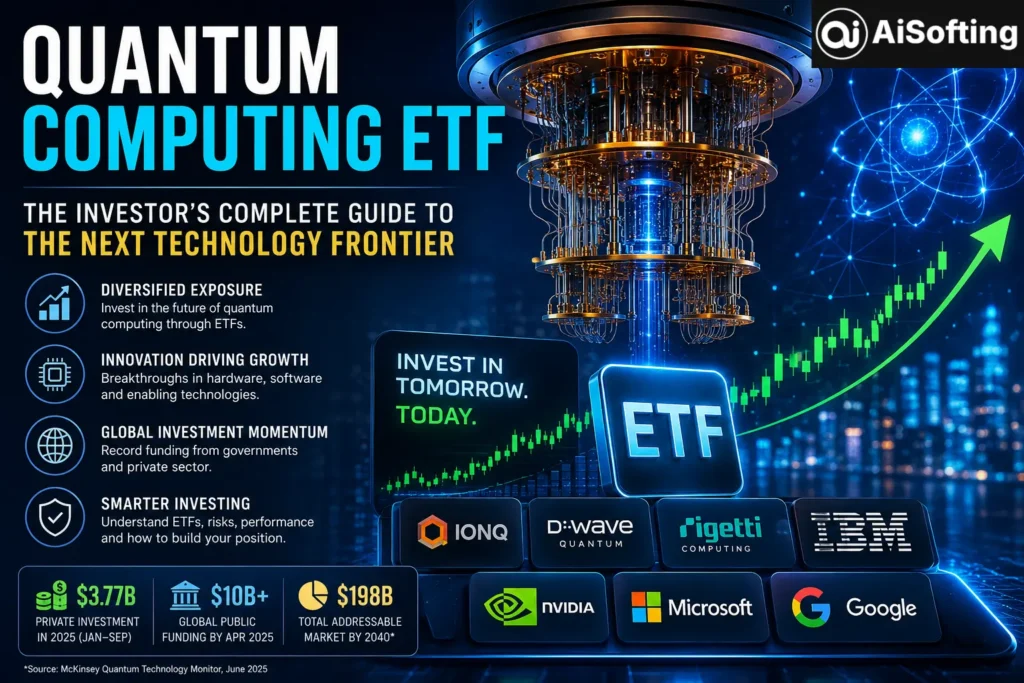
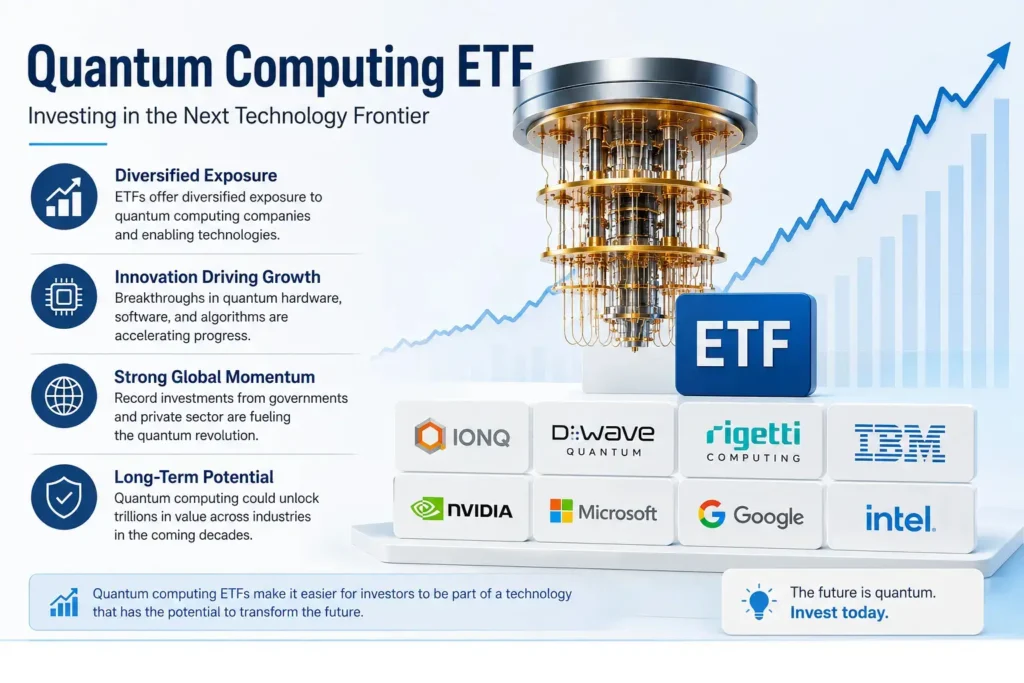
The catch, and it’s an important one, is that very few “pure” quantum computing companies are publicly listed. The most commercially advanced quantum hardware companies — PsiQuantum, Quantinuum (partially), and others — remain private. So what quantum computing ETFs actually hold is a blend: some pure-play quantum stocks like IonQ (IONQ), D-Wave Quantum (QBTS), and Rigetti Computing (RGTI), alongside major technology companies where quantum is one of many research initiatives, such as IBM, Google (Alphabet), Microsoft, and Nvidia.
Understanding this hybrid reality is fundamental to evaluating any quantum ETF. You are not buying a pure bet on quantum computing commercialization — you’re buying a thematic tilt toward quantum, embedded within a broader technology portfolio.
Why Quantum Computing Became an Investable Theme
For years, the standard dismissal of quantum computing investment was: “Great technology, but 10–20 years away from anything useful.” That timeline compression narrative started collapsing in late 2024 and accelerated through 2025.
A wave of hardware milestones from Google, IBM, and Microsoft converged with record capital inflows to shift market perception. Private funding in the quantum sector during the first nine months of 2025 alone reached $3.77 billion — nearly triple the total for all of 2024. Individual raises were substantial: PsiQuantum closed a $1 billion Series E, Quantinuum raised $800 million, and IonQ completed a $2 billion institutional equity offering.
On the government side, the numbers are even more striking. Global public funding for quantum computing reached $10 billion by April 2025, with Japan alone committing $7.4 billion as part of a national quantum strategy. The U.S. Department of Commerce announced a $2 billion funding injection under the CHIPS and Science Act in May 2026 specifically to secure domestic quantum infrastructure.
McKinsey’s June 2025 Quantum Technology Monitor concluded that accelerating investment and faster-than-expected hardware progress could push the quantum computing market to $100 billion within a decade — up from roughly $4 billion in worldwide revenue in 2024. By 2040, the firm projects a total addressable market of up to $198 billion.
These aren’t wishful projections anymore. They’re calibrated estimates backed by observable milestone progress, and ETFs are the most practical way for retail investors to participate.
The Major Quantum Computing ETFs: A Comparative Look
Defiance Quantum ETF (QTUM) — The Market Leader
Launched in September 2018, QTUM is the original and still the dominant quantum computing ETF by assets and track record. It tracks the BlueStar Quantum Computing and Machine Learning Index and holds approximately 78 names spanning quantum hardware, software, and enabling technologies.
Performance has been exceptional. QTUM returned 50.54% in 2024 and 36.69% in 2025 — outpacing the Nasdaq-100 (QQQ), which returned 25.58% and 20.77% in those same years. By late October 2025, the fund had crossed $3 billion in assets under management and earned a 5-star Overall Morningstar Rating based on risk-adjusted returns across 3-year and 5-year periods.
Its expense ratio of 0.40% is competitive for a thematic ETF, and its scale means tight bid-ask spreads and strong liquidity. Top holdings include Nvidia and IBM alongside pure-plays like IonQ and D-Wave Quantum, which gives the fund some ballast when smaller quantum stocks swing wildly. QTUM is the logical starting point for most investors exploring this space.
ARK Autonomous Technology & Robotics ETF (ARKQ) — The Actively Managed Option
ARKQ is not a quantum-only fund, but it’s one of the most discussed options for investors who want active management with quantum exposure mixed into a broader autonomous technology mandate. The fund holds $2.1 billion in assets and has delivered average annual returns of 22.8% over the past decade, with standout years of 48.8% in 2025 and 33.9% in 2024.
The expense ratio of 0.75% is the highest among major quantum-adjacent ETFs, but the active management thesis is that Cathie Wood’s team can pick the winners better than an index can. Typically only three to five of its holdings are directly in quantum computing companies at any given time. If you want quantum as part of a broader technological transformation bet, ARKQ fits. If you want concentrated quantum exposure, look elsewhere.
VanEck Quantum Computing UCITS ETF (QNTM) — Europe’s Pure-Play Option
Launched in May 2025, QNTM was the first dedicated UCITS ETF for quantum computing, making it the primary vehicle for European investors seeking regulated quantum exposure. It tracks the MarketVector Global Quantum Leaders Index and offers concentrated exposure to approximately 30 leading pure-plays and technology giants with significant quantum research programs.
QNTM is notable for its tighter mandate — it doesn’t drift as far into general semiconductors or AI as QTUM does. For investors specifically in Europe, or those who want the UCITS structure for regulatory or tax reasons, it fills a real gap.
WisdomTree Quantum Computing Fund — The Newest Entrant
Launched in late 2025, this fund aims to provide targeted exposure to companies driving innovation across the quantum computing ecosystem. WisdomTree co-developed its investment framework with quantum software company Classiq, which gives it some differentiated methodology versus index-based peers. With $235.4 million in AUM across 38 holdings as of mid-2026 and an expense ratio of 0.5%, it’s worth watching as it builds its track record.
Spear Alpha ETF (SPRX) — The High-Conviction Tech Play
SPRX is not primarily a quantum fund, but it has meaningful quantum exposure embedded within a concentrated tech-focused portfolio. Its five-year return of 93% speaks to strong stock selection, and because it leans heavily into long-horizon technology trends, it captures both the current AI boom and the emerging quantum opportunity in a single vehicle. The concentration level may concern more conservative investors, but SPRX suits those with a high risk tolerance and a long time horizon.
Pure Play vs. Hybrid: The Decision That Actually Matters
Most articles about quantum computing ETFs gloss over this distinction, but it’s arguably the most important choice you’ll make.
Pure-play ETFs (QTUM, QNTM) hold companies where quantum computing represents a meaningful portion of the business model. They give you genuine leverage to quantum’s commercial progress, but they also mean your returns are directly tied to the pace of a technology that’s still largely pre-revenue at the pure-play level.
Hybrid ETFs (ARKQ, SPRX) blend quantum with AI, robotics, semiconductors, and other emerging technologies. They tend to be less volatile in the short run because the larger-cap tech holdings provide ballast, but they dilute your quantum exposure. If quantum commercializes faster than expected, you’ll participate — just less directly.
The right choice depends on what you believe and what your portfolio already looks like. If you own significant positions in Nvidia, Microsoft, and Alphabet elsewhere, a pure-play fund like QTUM likely adds better diversification than another hybrid tech ETF.
What Most Investors Get Wrong About Quantum Computing ETFs
Mistake 1: Treating quantum ETFs as technology index funds. QTUM’s strong 2024 and 2025 performance partly reflects AI semiconductor exposure through holdings like Nvidia, not pure quantum momentum. Before concluding that quantum is delivering as an investment theme, understand what’s actually driving the returns in any given quarter.
Mistake 2: Ignoring dilution risk. Pure-play quantum companies collectively raised approximately $4.15 billion through share offerings in 2025 alone. These companies need capital to survive and grow, and that capital often comes at the expense of existing shareholders. Ongoing dilution is a structural feature of early-stage technology investing, not a temporary anomaly.
Mistake 3: Assuming the “timeline risk” is resolved. Hardware milestones in 2025 genuinely shortened the commercial timeline, but as one expert quoted in U.S. News noted: “Even specialist investors acknowledge QC won’t be replacing supercomputers in 2026, and industrial scale remains elusive. Expect volatility, longer timelines and frequent resets of market narrative.” The technology is advancing — but the commercialization trajectory remains highly uncertain.
Mistake 4: Sizing the position based on conviction about the technology, not risk tolerance. Being convinced that quantum computing will eventually matter commercially is very different from knowing when it will matter and which companies will capture the value. ETFs help with company selection risk but don’t eliminate timeline risk or sector risk.
The Geopolitical Dimension: An Overlooked Factor
The quantum computing race has become a geopolitical priority on the level of semiconductors. The United States, China, the European Union, Japan, South Korea, and the United Kingdom are all running government-funded quantum programs. South Korea saw four quantum ETF launches in a single month (March 2025), reflecting regional investor interest and government support.
This dynamic matters for ETF investors because government funding reduces the terminal risk for quantum companies — a startup with a federal grant and a DOE partnership is less likely to go to zero than one purely dependent on venture capital. It also introduces some geopolitical concentration risk: a fund heavy in U.S. quantum pure-plays is implicitly a bet that the domestic quantum ecosystem remains well-funded and internationally competitive.
The U.S. government’s $2 billion CHIPS and Science Act quantum funding announcement in May 2026 is the most concrete recent evidence that this policy support is structural, not cyclical.
How to Actually Build a Quantum Position in Your Portfolio
A few practical frameworks, depending on your situation:
The conservative approach: Allocate 2–3% of your overall equity portfolio to QTUM. You get meaningful quantum exposure, diversified across 78 holdings, with the Nvidia and IBM ballast limiting the downside from pure-play volatility. At the current 0.40% expense ratio, this is a cost-effective long-term thematic position.
The balanced approach: Core position in QTUM (70–80% of your quantum allocation) plus a smaller satellite position in QNTM or direct exposure to one or two pure-plays like IonQ. This gives you diversified baseline exposure with some additional leverage to the pure-play story.
The aggressive approach: Direct exposure to pure-plays (IonQ, D-Wave, Rigetti) alongside QTUM. Accepts maximum volatility in exchange for maximum leverage to commercial breakthroughs. Appropriate only for investors with a multi-year horizon and genuine tolerance for 50%+ drawdowns.
For most investors, the conservative to balanced approach makes sense. The sector is compelling but speculative, and sizing accordingly — rather than conviction-sizing based on excitement about the technology — tends to lead to better long-term outcomes.
My Experience with Quantum Computing ETFs
I’ll be honest about how I arrived at this topic. I spent several months researching emerging technology ETFs in late 2024, initially focused on AI semiconductors. Quantum computing kept appearing as a secondary theme in the funds I was analyzing — not as a primary driver, but as a component that certain fund managers seemed increasingly serious about. That led me down a research path that took considerably longer than expected.
The first thing that genuinely surprised me was how much of the performance of “quantum ETFs” in 2024 was attributable to Nvidia and other AI infrastructure names. QTUM’s 50%+ return looked extraordinary, but when I mapped the holdings, a material chunk of that return came from the same semiconductor trade driving every tech portfolio that year. That’s not necessarily bad — it means the fund captured a real tailwind — but it complicates the attribution story. Investors claiming quantum is “already delivering returns” in 2024 are sometimes conflating quantum exposure with AI semiconductor exposure.
The second thing that shaped my view was digging into the pure-play companies. IonQ’s revenue figures, D-Wave’s concentration risk in enterprise contracts, Rigetti’s dependence on government grants — these are genuinely early-stage businesses by any traditional financial metric. Understanding that helped me recalibrate how much of a portfolio these positions deserve. Strong conviction in the long-term technology thesis doesn’t translate cleanly into portfolio sizing when the commercialization timeline is measured in years, not quarters.
What I ultimately found most useful was treating quantum ETF exposure as a structural portfolio theme — a small, consistent allocation held across a 5–10 year horizon — rather than a tactical trade on near-term catalysts. The breakthroughs that drive quantum computing forward tend to be technical and gradual, not the kind of obvious earnings beats that let you time entries and exits. Long-term, low-cost, diversified exposure to the theme through QTUM has struck me as the most intellectually honest approach for investors who aren’t quantum physicists themselves.
FAQs
What is the best quantum computing ETF for beginners?
The Defiance Quantum ETF (QTUM) is generally the best starting point. It has the longest track record (launched 2018), the largest assets under management ($3+ billion), the lowest expense ratio among major quantum ETFs (0.40%), and a 5-star Morningstar rating. Its blend of pure-play quantum stocks with larger technology companies provides exposure to the theme with meaningful diversification.
Are quantum computing ETFs risky?
Yes, meaningfully so. Pure-play quantum companies exhibit extreme volatility by any conventional measure, and the commercial timeline for large-scale quantum computing remains uncertain. ETFs reduce individual stock risk through diversification, but they don’t eliminate sector risk or timeline risk. Most financial advisors suggest limiting thematic ETF allocations like quantum to a small percentage of an overall equity portfolio.
How is a quantum computing ETF different from a tech ETF?
A standard technology ETF (like QQQ) holds companies based on market-cap weight within the technology sector. A quantum computing ETF is thematically constructed — it specifically targets companies involved in quantum hardware, software, enabling technologies, and adjacent fields. This means higher concentration in smaller, earlier-stage companies than a broad tech index, along with higher potential returns and higher volatility.
Do quantum computing ETFs pay dividends?
Most quantum computing ETFs do not pay meaningful dividends. The holdings are predominantly growth-oriented technology companies that reinvest earnings rather than distributing them. QTUM’s dividend yield has historically been minimal. Investors in this space should expect returns to come from price appreciation rather than income.
Is now a good time to invest in quantum computing ETFs?
This question is genuinely difficult to answer, and anyone who answers it with confidence is probably oversimplifying. The technology milestones and capital inflows of 2024–2025 have validated the sector’s trajectory, but valuations have risen accordingly. The more honest framing is: if you have a 5–10 year investment horizon and can tolerate significant short-term volatility, quantum ETFs offer exposure to a technology that could be transformative at commercial scale. If you need returns in the next 1–2 years, the risk/reward is much less favorable.
What industries will benefit most from quantum computing?
Financial services (portfolio optimization, risk modeling), pharmaceuticals (drug discovery and molecular simulation), logistics (supply chain optimization), cybersecurity (post-quantum encryption), and artificial intelligence (faster machine learning) are consistently identified as the sectors where quantum computing’s commercial impact is likely to arrive first. ETFs with holdings in quantum software companies alongside hardware are better positioned to capture this industry diversification.
Conclusion: Calibrated Optimism, Not Hype
Quantum computing ETFs occupy an unusual investment position: the underlying technology is real, the government and private capital support is substantial, and the commercial potential is enormous. But the timeline from “promising hardware milestone” to “revenue-generating enterprise product” remains uncertain and likely measured in years rather than quarters.
The funds worth owning — QTUM first and foremost, with QNTM for European investors and a WisdomTree fund worth monitoring as it matures — offer sensible structures for capturing this theme at reasonable cost. What they can’t do is tell you when quantum’s commercial inflection point arrives, which company captures the most value, or whether the current valuations are pricing in a realistic or optimistic scenario.
Invest in this space because you believe in the long-term technological and economic trajectory, size the position to reflect genuine uncertainty, and resist the temptation to over-trade based on hardware announcements. The investors who will benefit most from quantum’s commercial development are probably the ones who buy a diversified position in 2025 or 2026 and still hold it in 2032.
For more on how to evaluate and size positions in emerging technology sectors, the Defiance ETFs research page offers useful fund-level data, and McKinsey’s Quantum Technology Monitor provides the most rigorous public-domain analysis of the market’s commercial trajectory.
Disclaimer: This article is for informational purposes only and does not constitute financial advice. Investing in ETFs and individual stocks involves risk, including possible loss of principal. Always consult a qualified financial advisor before making investment decisions.
Visit: Aisofting