Introduction
If you’ve ever tried to make a decision based on gut feeling and later wished you’d had actual numbers to back it up, you already understand why data collection matters. Understanding the different types of data collection methods is the first step toward gathering information you can actually trust whether you’re running a small business, managing a research project, building a product, or just trying to understand your customers better. The quality of your decisions is only as good as the quality of the data behind them.
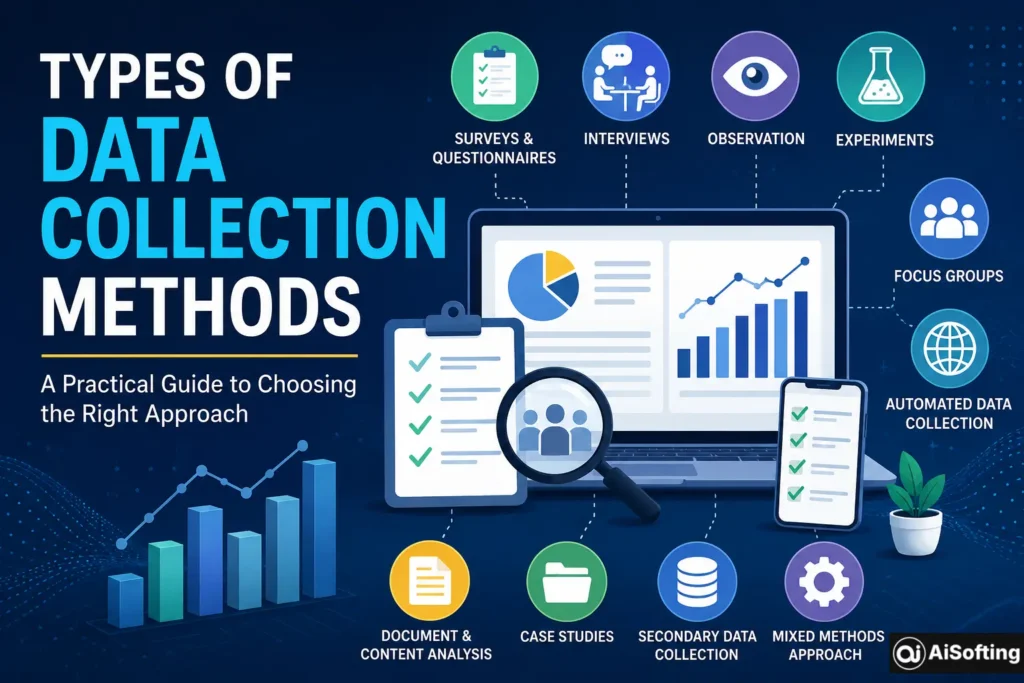
There are many types of data collection methods, ranging from simple surveys and interviews to complex sensor networks and automated web scraping tools, and each one fits a different kind of question. The method you choose shapes everything downstream your analysis, your conclusions, and ultimately, the actions you take.
I’ve spent years working with data in different contexts, from small-scale customer research to larger analytics projects, and one thing has become clear: there’s no single “best” method. There’s only the method that’s best for your specific question, budget, timeline, and audience. This guide walks through the major types of data collection methods, when to use each one, the mistakes people commonly make, and some lessons I’ve picked up the hard way.
What Is Data Collection?
Data collection is the systematic process of gathering and measuring information on variables of interest, in order to answer research questions, test hypotheses, or evaluate outcomes. It’s the foundation of the entire data pipeline before you can clean, analyze, or visualize data, you need to collect it accurately and in a way that fits your goals. Below, we break down the major types of data collection methods you’re likely to encounter, along with when each one makes sense.
Poor data collection leads to what statisticians call “garbage in, garbage out.” No amount of sophisticated analysis can fix data that was collected badly in the first place.
Primary vs. Secondary Data Collection
Before diving into specific methods, it helps to understand the two broad categories.
Primary Data Collection
This involves gathering new, original data directly from the source. You control the process from start to finish, which means better relevance to your specific question but usually higher cost and more time investment.
Secondary Data Collection
This means using data that already exists collected by someone else for a different purpose. Government databases, published research, industry reports, and public datasets from sources like the U.S. Census Bureau or World Bank Open Data fall into this category. It’s faster and cheaper, but you have less control over how the data was originally gathered.
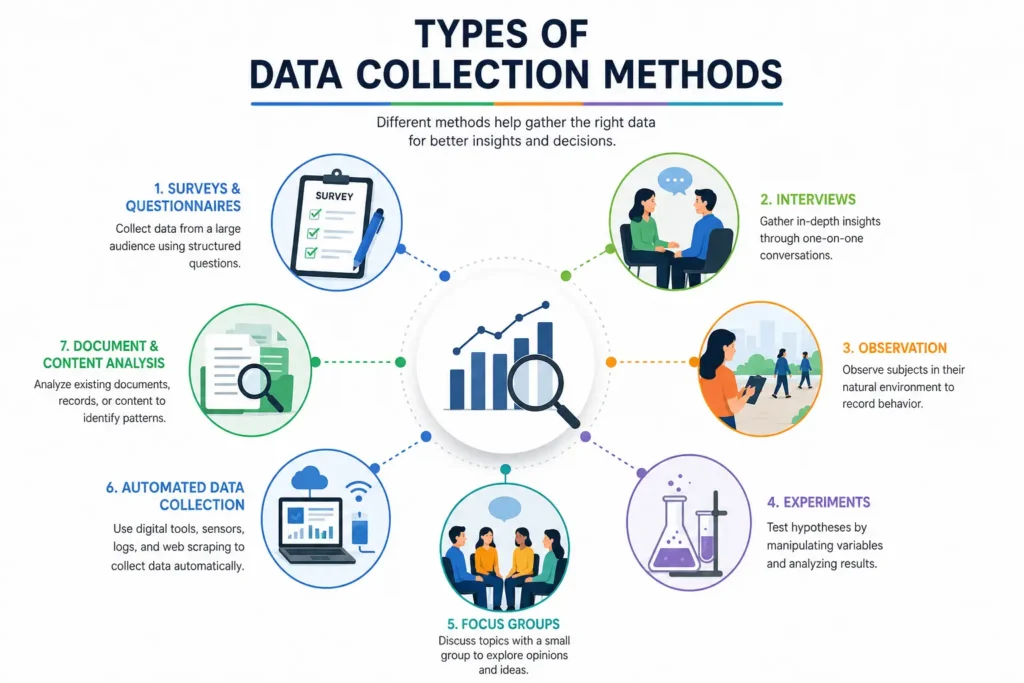
Types of Data Collection Methods (In Detail)
1. Surveys and Questionnaires
Surveys remain one of the most widely used data collection methods because they scale well and can be deployed digitally at low cost. Tools like Google Forms, SurveyMonkey, and Typeform have made it easy to reach large audiences quickly.
Best for: Measuring opinions, satisfaction, preferences, and self-reported behavior across large groups.
Common mistake: Leading or double-barreled questions that skew responses. Asking “How much did you love our fast and friendly service?” practically forces a positive answer.
2. Interviews
Interviews structured, semi-structured, or unstructured allow for deeper, more nuanced data than surveys. They’re a staple in qualitative research and user experience (UX) studies.
Best for: Exploring the “why” behind behaviors, uncovering motivations, and gathering detailed narratives.
Trade-off: Interviews are time-intensive and harder to scale, and the interviewer’s presence can influence responses (a phenomenon researchers call interviewer bias).
3. Observation
Observational methods involve watching subjects in their natural environment without direct interference. This can be overt (participants know they’re being observed) or covert (they don’t).
Real-world example: Retail companies use in-store observation and heat-mapping to understand how customers move through a space, which directly informs store layout decisions.
4. Experiments
Experimental methods involve manipulating one variable to observe its effect on another, typically using control and treatment groups. A/B testing, widely used in marketing and product development, is a modern application of experimental design.
Best for: Establishing cause-and-effect relationships rather than just correlation.
5. Focus Groups
A moderated discussion with a small group of people, focus groups are common in market research. They generate rich qualitative insight but are prone to groupthink, where louder participants sway the group’s stated opinions.
6. Automated Data Collection (Sensors, Logs, and Web Scraping)
Modern data collection increasingly happens without direct human involvement. IoT sensors, website analytics tools like Google Analytics, application logs, and web scraping scripts collect data continuously and at scale.
Best for: Behavioral data, performance metrics, and situations requiring continuous or real-time monitoring.
Consideration: Automated methods raise important questions about data privacy and consent, especially under regulations like GDPR in the EU and the CCPA in California.
7. Document and Content Analysis
This method involves systematically reviewing existing documents, records, social media posts, or other content to identify patterns. It’s often used in historical research, media studies, and increasingly in analyzing large volumes of unstructured text for sentiment or thematic trends.
8. Case Studies
A case study is an in-depth examination of a single subject, event, or organization. It’s less about statistical generalization and more about producing a detailed, contextual understanding that can inform broader theory.
Quantitative vs. Qualitative Data Collection
Most of the methods above fall into one of two broad families:
- Quantitative methods (surveys with closed questions, experiments, sensor data) produce numerical data suited to statistical analysis.
- Qualitative methods (interviews, focus groups, open-ended observation) produce descriptive data suited to understanding context, meaning, and nuance.
Many strong research designs combine both a practice known as mixed-methods research to get the statistical power of quantitative data along with the depth of qualitative insight.
Choosing the Right Method: Key Factors
- Research question: Are you trying to measure “how many” or understand “why”?
- Budget and timeline: Surveys and automated tools scale cheaply; interviews and experiments cost more time per data point.
- Sample size needed: Quantitative conclusions typically require larger samples for statistical validity.
- Ethical and privacy considerations: Especially relevant for health data, minors, or any personally identifiable information.
- Tools available: Platforms like Qualtrics, SPSS, and Python libraries such as pandas and BeautifulSoup all support different stages of the collection and analysis pipeline.
Common Mistakes in Data Collection
- Sampling bias collecting data only from an easily accessible group rather than a representative one.
- Leading questions wording that nudges respondents toward a particular answer.
- Ignoring data quality checks not validating or cleaning data as it comes in.
- Skipping a pilot test launching a survey or experiment at full scale without testing it on a small group first.
- Overlooking consent and privacy a mistake that can carry serious legal and reputational consequences.
Best Practices for Reliable Data Collection
- Define your research question clearly before choosing a method.
- Pilot test instruments (surveys, interview guides) on a small sample first.
- Document your methodology so results are reproducible.
- Triangulate use more than one method when possible to cross-verify findings.
- Stay compliant with relevant privacy regulations from the outset, not as an afterthought.
Personal Experience: What I’ve Learned Collecting Data in the Field
A few years back, I was involved in a customer feedback project for a mid-sized e-commerce brand. We started with a straightforward online survey, expecting quick, clean results. Instead, we got a pile of vague, unhelpful answers lots of “it was fine” and “no complaints” responses that told us nothing actionable.
The turning point came when we switched part of the study to short phone interviews with a smaller group of customers who had recently returned a product. Those conversations revealed a specific, fixable issue with sizing information on product pages something the survey never surfaced because we hadn’t asked the right closed-ended question, and customers hadn’t volunteered it unprompted.
That experience taught me something I now treat as a rule of thumb: quantitative methods are great for confirming what you already suspect, but qualitative methods are often what you need to discover what you didn’t know to ask about in the first place.
Another lesson came from a web analytics project where we relied heavily on automated event tracking. The data looked great high engagement, low bounce rate until we noticed a spike that turned out to be a bot crawling the site, not real users. Lesson learned: automated data collection needs the same scrutiny as any other method. Numbers don’t lie, but they can absolutely mislead you if you don’t check where they came from.
If there’s one takeaway from years of doing this, it’s that no method is foolproof on its own. The best results almost always came from combining methods a survey to get breadth, interviews to get depth, and analytics to validate behavior against what people actually said.
Frequently Asked Questions
1. What are the main types of data collection methods?
The main types include surveys, interviews, observation, experiments, focus groups, automated data collection (sensors and logs), document analysis, and case studies. Each serves different research goals.
2. What is the difference between primary and secondary data collection?
Primary data is collected firsthand for a specific purpose, while secondary data is pre-existing information originally gathered by someone else for a different purpose.
3. Which data collection method is best for market research?
Surveys and focus groups are most common for market research because they efficiently capture consumer preferences and opinions, though interviews are used when deeper insight is needed.
4. Is a survey a quantitative or qualitative data collection method?
Surveys can be both. Closed-ended questions (multiple choice, rating scales) produce quantitative data, while open-ended questions produce qualitative data.
5. What is mixed-methods research?
Mixed-methods research combines quantitative and qualitative data collection methods within a single study to balance statistical rigor with contextual depth.
6. How do you avoid bias in data collection?
Use random or representative sampling, avoid leading questions, pilot test your instruments, and where possible, use multiple data collection methods to cross-check findings.
7. What tools are commonly used for data collection?
Common tools include Google Forms, SurveyMonkey, Qualtrics, Google Analytics, and programming libraries like Python’s pandas and BeautifulSoup for automated collection and analysis.
8. Why is data privacy important in data collection?
Data privacy protects individuals’ personal information and ensures compliance with regulations like GDPR and CCPA, which is both a legal requirement and a matter of maintaining trust with respondents or users.
9. What is observational data collection?
Observational data collection involves recording behavior or events as they naturally occur, without directly interacting with or influencing the subjects being studied.
10. How much data do I need to collect for reliable results?
Sample size depends on your research goals, population size, and desired confidence level. Quantitative studies generally need larger samples for statistical significance, while qualitative studies can yield useful insight from much smaller samples.
Conclusion
Data collection isn’t just a technical step before the “real” analysis begins it’s the foundation that determines whether your conclusions will hold up. Surveys, interviews, observation, experiments, and automated tools each bring different strengths and trade-offs, and the right choice depends entirely on what question you’re trying to answer.
If you take one actionable step away from this guide, let it be this: before you collect a single data point, get specific about your research question, and be honest about which method actually answers it not just which one is easiest to run. Combine methods where you can, pilot test before scaling up, and always check your data for quality issues before trusting the conclusions it leads you to.
Disclaimer: This article is for general informational purposes only and does not constitute legal, compliance, or professional research advice. Data privacy laws such as GDPR and CCPA vary by jurisdiction and change over time, so consult a qualified legal or compliance professional before designing a data collection process involving personal information.
Visit: Aisofting