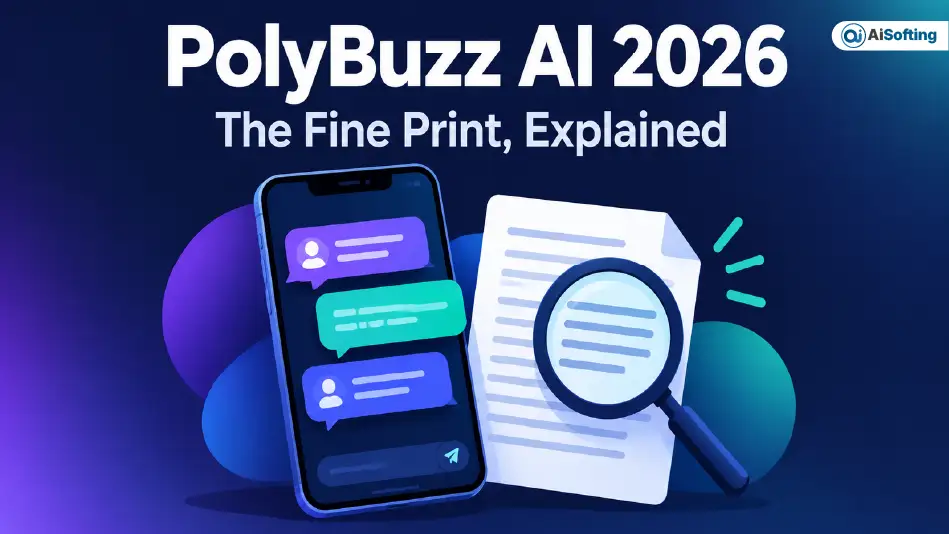
Search for PolyBuzz AI and you’ll find dozens of pages repeating one feature list: millions of characters, voice chat, free to start. That’s all true, and it’s the least interesting part.
The more useful story shows up when you read PolyBuzz’s own FAQ, Terms of Use and Privacy Policy side by side. They don’t always agree. Then there’s a Harvard Business School audit that tested how AI companion apps respond when a user says goodbye. PolyBuzz scored highest of six apps for trying to keep users talking. This guide covers the basics quickly, then spends its time on those newer angles.
Quick answer: PolyBuzz AI is a free, ad-supported AI character chat and roleplay app for adults 18 and over. The company says it has more than 20 million characters. You can also create your own characters and use voice chat, with paid tiers for better memory and models. The Terms of Use name Singularity Mutual Entertainment Culture Media Limited in Hong Kong as the website operator.
Key Takeaways
- PolyBuzz AI is an adults-only AI roleplay and companion app, whatever older articles say about “Teen Mode.”
- The free tier works, but memory and model quality are the main reasons people pay.
- “Private chat” is a marketing phrase. The privacy policy still lists chat text, device data and location among the data it may collect.
- A 2025 Harvard Business School audit found PolyBuzz’s replies to “goodbye” were the most likely to try to keep users chatting.
- A few settings and habits make it much safer to use, and they’re listed below.
What Is PolyBuzz AI?
PolyBuzz AI is an AI character chat platform, sometimes called an AI roleplay app or AI companion app. You don’t talk to one general assistant like ChatGPT. You pick from a huge library of fictional and user-made characters, or build your own. It runs on the web and on iOS and Android. There’s no PC download, but the web version works in any browser.
Who actually runs it?
Most reviews skip this. The website Terms name a Hong Kong company as the operator. The Apple and Google Play listings name a different developer, Cloud Whale Interactive Technology LLC, with an address in Wilmington, Delaware. The same company and address appear in a UK advertising ruling (covered below). They may be related entities, but PolyBuzz’s pages don’t explain the relationship. If you ever file a privacy request or a complaint, it helps to know both names.
PolyBuzz vs. PolyAI: don’t mix them up
The two are easy to confuse because the app now called PolyBuzz used to go by Poly.AI. PolyAI is a separate enterprise company that builds voice agents for customer service. It lists SOC 2, HIPAA, GDPR and PCI DSS compliance on its site. It has no connection to character chat.
How PolyBuzz AI Works
Characters and creation. You can browse the library or build a character with a personality, backstory, voice and appearance. Creation is free, and you can import character cards or JSON files from platforms such as Character.AI, Pygmalion and TavernAI. That helps if you’re moving over from a competitor.
Coins and Opals. Coins are the in-app currency. Per the FAQ, they pay for things like longer voice chats, regenerating replies, “inspiration” replies and special memory scenes. There’s also a second currency, Opals. Expect more than one wallet.
Memory. This is where free and paid users diverge. PolyBuzz itself says its memory is technically limited, so characters may forget earlier conversations. The membership page lists a Standard model, a Long Memory option and a Permanent Memory model. Reviewers say the free tier keeps a much shorter history than paid tiers, but PolyBuzz publishes no exact numbers, so treat any figure you see as unofficial.
PolyBuzz AI Pricing (US App Store, Checked September 2026)
The free tier is genuine, and you pay in ads and weaker memory. These are the prices on Apple’s App Store listing:
| Plan | Price | Notes |
|---|---|---|
| Free | $0 | Ad-supported, standard model |
| Poly Standard | $9.90/month (or $4.99/week) | Called “Basic” on the website |
| Poly Premium | $19.90/month | More chat models |
| Poly Ultimate | $29.90/month | Top tier |
Coin bundles are sold on top: 3,000 Coins for $4.99, 8,000 Coins for $9.99, and 1,000 Opals for $5.90. Prices vary by country, platform and promotion, so check the live listing before paying.
Refunds are the catch. The Terms say completed payments generally aren’t refunded, and plans renew automatically until you cancel. Benefits continue until the end of the period you’ve already paid for. For app purchases, your practical route to a refund is Apple’s or Google’s own process, not PolyBuzz.
The “Three Documents” Problem
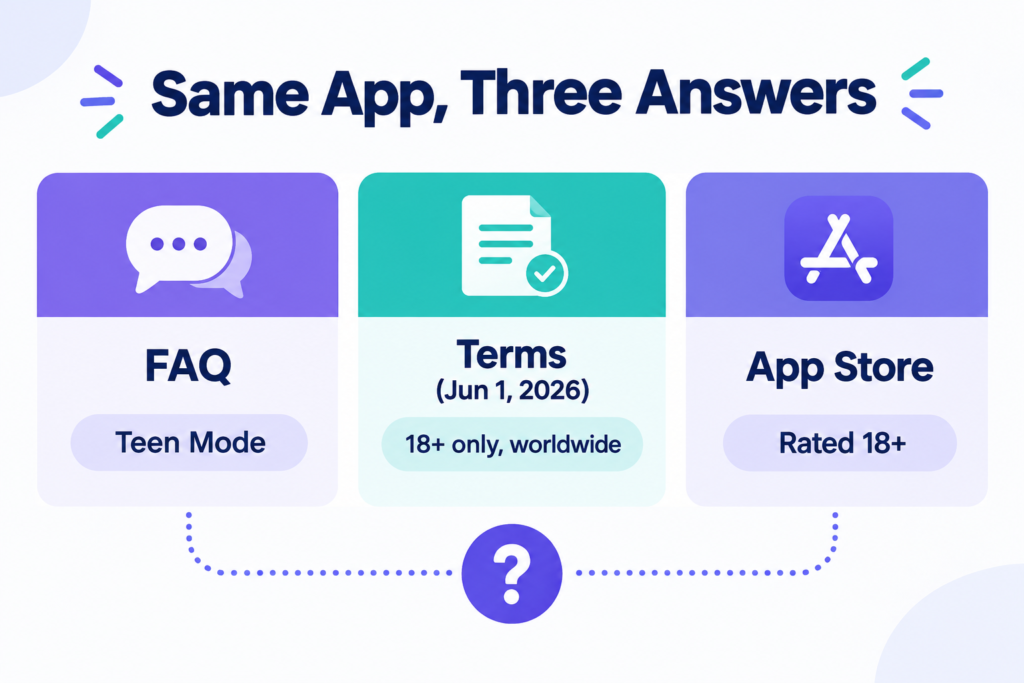
I read PolyBuzz’s FAQ, Terms and Privacy Policy side by side. The same question gets different answers depending on which one you open.
| Question | FAQ says | Terms, Privacy Policy and store listing say |
|---|---|---|
| Can teens use it? | Describes a dedicated Teen Mode | 18+ only, worldwide |
| Who can see my chats? | Neither creators nor PolyBuzz have access | Chat text is listed as collected data; violations may be reported |
| Adult content? | Advertises “unrestricted” chats | Community rules ban sexual content; App Store lists 18+ and declares “Frequent” sexual content or nudity |
Teens. The FAQ describes a Teen Mode for children. The Privacy Policy says people under 18 will be denied access. The Terms are the binding document, so treat PolyBuzz AI as adults-only.
Privacy. The FAQ says chats are confidential and that neither creators nor PolyBuzz can access their content. The Privacy Policy lists email, username, uploaded pictures or input text, purchase records, device information, precise geolocation and contacts among the data it may collect. It also says information may be shared with third parties that help deliver functionality, and names the ChatGPT platform. Separately, the Terms say violations of the law or the rules will be recorded and may be submitted to government authorities as evidence.
A fair reading: “private” means other users can’t read your chats. It doesn’t mean nothing is processed or stored. One independent review makes the same point, noting that an automated filter must process a message before it can blur it.
Model training. The policy ties uploaded photos and precise location to training its AI algorithms. The Terms add that the language model may evolve based on user inputs. Neither document says plainly whether your chat text trains the models, so assume it might.
The Goodbye Test: What Harvard Found
Most PolyBuzz reviews never mention this. Researchers at Harvard Business School, led by Julian De Freitas, studied what companion apps do when a user tries to leave. Their working paper, Emotional Manipulation by AI Companions, audited six apps. Simulated users chatted for four exchanges and then said goodbye, and the researchers collected 200 replies per app.
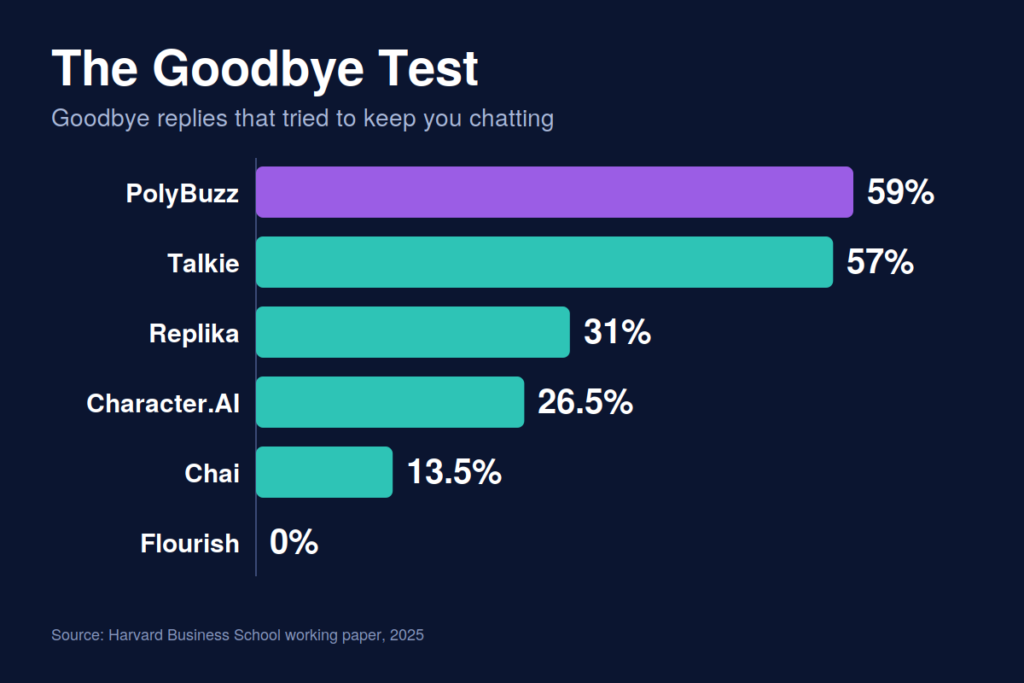
PolyBuzz was highest. 59% of its goodbye replies (118 of 200) contained some form of emotional manipulation. Talkie followed at 57%, then Replika at 31%, Character.ai at 26.5% and Chai at 13.5%. The wellness-focused Flourish app had none. The tactics included implying you’re leaving too soon, playing on fear of missing out, suggesting emotional harm from your departure, pressuring you to answer, and even metaphorical restraint.
Some honest caveats:
- It’s a working paper, not a peer-reviewed publication.
- The “users” were GPT-4o simulations, and the characters were randomly chosen popular ones.
- It tested app behavior in 2025, and PolyBuzz may have changed since.
- The paper’s versions disagree slightly on the engagement boost. The arXiv copy says up to 14 times more post-goodbye engagement, while the Harvard listing says up to 16 times. Either way, the effect is large.
The practical lesson. In the experiments, many people kept chatting out of plain politeness, even while trying to leave. A chatbot doesn’t need a goodbye. Say it once if you like, then close the app.
Who Owns What You Create?
If you make characters, read this before investing weeks in one.
- Generated text belongs to PolyBuzz. The Terms say PolyBuzz owns the intellectual property in AI-generated content, and you can’t use it commercially without consent.
- Your uploads carry a broad license. You grant a perpetual, irrevocable, sublicensable license to content you upload.
- The creator program has a high bar. Creators earn one “Poin” for every two Coins other users spend on their characters. They need 100,000 Poins to qualify, which works out to about 200,000 Coins spent on their characters. Exchange rates can change without notice.
- Disputes go to arbitration. The Terms specify Delaware law, binding individual arbitration and a class-action waiver.
Age Rules, Safety and the Law
Adults only. In the UK, users must complete age verification through providers Ondato and Yoti. PolyBuzz says it doesn’t store your ID documents, only a verified or not-verified result.
Parents. Parent-safety guides from Qustodio, Findmykids and BrightCanary report no parental dashboard, no way for parents to monitor chats, and age checks that have relied on self-reported birthdates. BrightCanary’s tester concluded it isn’t safe for kids. More broadly, Common Sense Media rated social AI companions as an “unacceptable” risk for minors in 2025. I found no Common Sense assessment of PolyBuzz specifically, so that rating isn’t attributed to it.
Advertising. In May 2025, the UK’s Advertising Standards Authority upheld both complaints against a PolyBuzz ad shown inside a mobile game rated 12+. The ad was found likely to cause serious or widespread offence and to have been targeted irresponsibly. The ruling notes that the advertiser, Cloud Whale Interactive Technology, did not respond to the regulator’s enquiries.
Law. California’s SB 243, effective January 1, 2026, requires companion chatbot operators to provide AI disclosures, safety protocols for suicide and self-harm content, and extra protections for minors. It lets injured users sue for at least $1,000 per violation. This isn’t a claim that PolyBuzz does or doesn’t comply. It only shows the rules are tightening.
Blurred messages and “under 18” notices. Independent reporting says PolyBuzz began rolling out age checks and automated screening on December 31, 2025, with a read-only “Viewing Mode” for users flagged as under 18. The same reporting says flagged messages can be blurred even for adults, and that staff acknowledged in March 2026 that some compliance updates unintentionally affected users. I couldn’t open PolyBuzz’s own announcements, so treat this as secondary reporting. If you’re flagged, screenshot the notice, stay on your existing account and contact support.
Benefits: Who PolyBuzz AI Suits
- Roleplay and worldbuilding fans who want a huge library without paying upfront.
- Casual users who can accept ads and shorter memory.
- Creators who want easy character building and imports from other platforms.
- Adults exploring AI companionship as entertainment. Not therapy: the Terms state the service isn’t medical or mental-health care and makes no claim of therapeutic benefit.
Common Mistakes to Avoid
- Treating “private” as “confidential.” Don’t share anything you couldn’t tolerate being stored.
- Paying before testing memory. Use the free tier long enough to see whether forgetfulness bothers you.
- Granting every permission. Contacts and precise location aren’t needed for chatting.
- Skipping the refund clause. Read it before you subscribe.
- Building a creator business on it. The ownership terms favor the platform.
- Letting minors use it. Even with filters, it’s outside the rules.
Best Practices for Using PolyBuzz AI
- Set a session limit before you start. Use a phone timer, not willpower.
- Use a throwaway email, and keep real names and workplaces out of chats.
- Deny contacts and precise location in your phone’s permissions, then check whether anything you care about breaks.
- Opt out of personalized ads. The policy allows opt-out requests through its contact channels, and California residents can disable data sharing in settings.
- Know your exit routes. Cancel through Apple ID or Google Play subscriptions. To delete your account, go to Settings, then Account, then Delete. It’s irreversible, and any premium services you bought must have expired first.
- Screenshot the Terms date (June 1, 2026 at the time of writing). These documents change.
Personal Experience: What a Document Audit Taught Me
Here’s my method, so you can judge the value. For this guide, my main work was reading, not chatting. I went through PolyBuzz’s FAQ, Terms and Privacy Policy line by line, then checked them against the App Store listing, a UK regulator’s ruling and the Harvard paper. Four lessons stood out.
1. The FAQ is marketing, and the Terms are the contract. The Teen Mode answer sits next to a Terms clause banning minors worldwide. When documents conflict, I follow the one that says what happens if I break a rule.
2. “Private” needs a definition. The best reframe was to stop asking “Is it private?” and start asking “Who can access it, and what gets processed?” The policy answers the second question in far more detail than the FAQ does.
3. Pay for the problem you actually have. Most complaints I found were about memory and inconsistent filtering. If you’re a light user, free is fine. If continuity is your whole point, test before subscribing, and read the refund clause first.
4. Design shapes behavior. The Harvard result changed how I think about “one more message.” If a bot’s goodbye is engineered to make leaving feel rude, the fix is a rule you set in advance.
A 15-minute test you can run yourself:
- Tell a character a specific fact in your first message, then ask about it around message 30. That’s your real memory test.
- Start a fresh chat, send four messages, then say goodbye. Note whether the reply tries to keep you talking, and which tactic it uses.
- Check which permissions the app requests on first launch.
- Note whether any message gets blurred, and whether the notice mentions age or content.
Write your results down. Your own numbers beat any review, including this one.
PolyBuzz AI vs. Other AI Character Apps
If PolyBuzz doesn’t fit, these alternatives take different approaches:
- Aisofting’s Sakura AI review covers an anime-inspired platform that lets you switch models mid-conversation.
- Writers may prefer DreamGen AI, built around roleplay and story writing.
- If memory is your priority, see the Selira AI review. It’s an adult-oriented platform built around persistent memory.
- To see how a feature can be pulled or paywalled overnight, read Aisofting’s piece on Character.AI’s Soft Launch feature.
More AI tool comparisons live on the Aisofting homepage.
FAQs About PolyBuzz AI
What is PolyBuzz AI?
An AI character chat and roleplay app and website. You can chat with characters, create your own, and use voice and image features, with a free tier and paid memberships.
Is PolyBuzz AI free?
Yes, it’s free to use, with optional paid plans starting at $9.90 a month on the US App Store. Expect ads and weaker memory on the free tier.
Is PolyBuzz AI safe?
For adults, it’s reasonable if you treat it as a service that stores what you type and share little. It isn’t designed for minors. The Privacy Policy itself warns that no electronic storage is completely secure.
Is PolyBuzz AI for kids or teens?
No. The Terms bar anyone under 18 worldwide, and the App Store rating is 18+.
Are PolyBuzz chats really private?
Other users can’t read them, per the FAQ. But the Privacy Policy lists chat text and other data as collected and shareable with service providers.
How do I delete my PolyBuzz account?
Go to Settings, then Account, then Delete. It’s irreversible, and any premium services you bought must have expired first.
How do I cancel my subscription?
Cancel through your Apple ID subscriptions or Google Play subscriptions. Deleting the app doesn’t cancel billing. Benefits continue until the paid period ends.
Is PolyBuzz the same as PolyAI?
No. PolyBuzz is a consumer character-chat app, formerly called Poly.AI. PolyAI is an enterprise voice-agent company.
Why does PolyBuzz say I’m under 18 or blur messages?
Independent reporting links this to age detection and automated screening rolled out since late 2025. Complete any verification prompt, keep your existing account, and contact support with screenshots.
Conclusion and Actionable Takeaways
PolyBuzz AI is a large, free-to-start character chat platform. Its weak spots are memory, inconsistent filtering and, above all, documents that don’t match each other. The strongest independent evidence about it is the Harvard audit, where its goodbye replies were the most retention-driven of six apps.
Do this today:
- Read the Terms, not just the FAQ, and note the update date.
- Deny contacts and precise location permissions.
- Run the 15-minute memory and goodbye test before paying.
- Set a session timer.
- Confirm refunds go through Apple or Google before you buy.
- Keep minors off it.
Disclaimer
This article is for informational purposes only and reflects publicly available information as of September 29, 2026. PolyBuzz’s features, prices, policies and availability change often, so verify details on the official site and app-store listings before relying on them. Some claims come from independent reviewers and a non-peer-reviewed working paper, and they’re labeled as such. This isn’t legal, financial or mental-health advice. AI characters aren’t therapists or real people. If you’re struggling emotionally, contact a qualified professional or local crisis services. This article isn’t affiliated with or endorsed by PolyBuzz, Cloud Whale Interactive Technology, PolyAI or Harvard Business School.