Quick answer
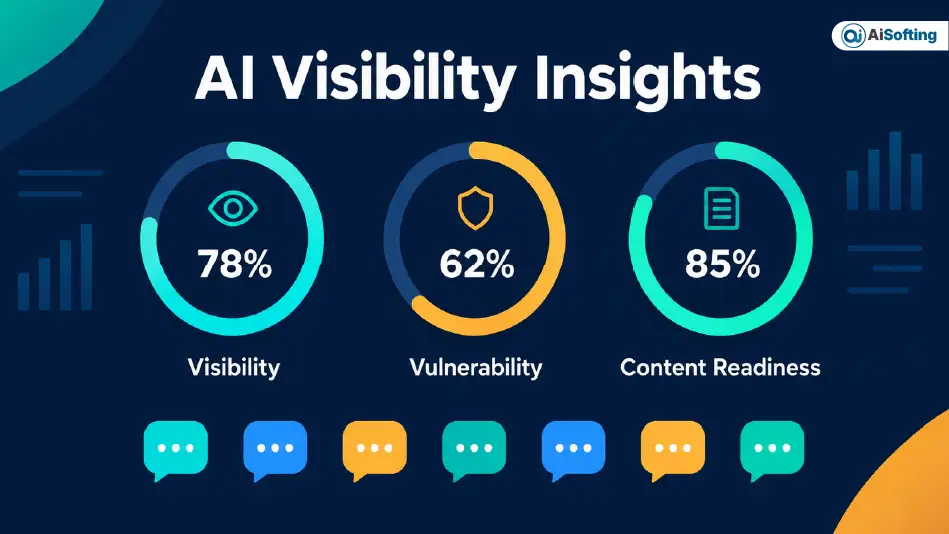
A brandrank.ai visibility insights analysis is a review of how AI answer engines mention, describe and recommend your brand. BrandRank.AI builds it on a Brand Health and Trust framework with three scores: Visibility, Vulnerability and Content Readiness. Read the scores as trends across many prompts, not as a single ranking.
Introduction
A few years ago, “visibility” meant where your page sat on a results page. Today a buyer can ask an AI assistant which product to buy and get one composed answer that names a handful of brands. If you’re not named, you never made the shortlist.
BrandRank.AI is one of the platforms built around that shift. Most write-ups repeat the vendor’s feature list. I did something different: I read BrandRank’s public material, ran a set of small tests, and compared its claims with independent research and Google’s official guidance. This article separates what’s confirmed from what’s only claimed.
What is brandrank.ai visibility insights analysis?
BrandRank.AI is a Cincinnati-based company led by founder and CEO Pete Blackshaw. In September 2026 it announced the first closing of a $3 million seed round co-led by Grit Capital Partners and QCA Ventures, and it says it monitors roughly 100 brands. Based on its own site, the analysis works like this:
- It tests priority prompts daily: category questions, “best” queries, comparisons and brand searches.
- It tracks seven answer engines: ChatGPT, Gemini, Perplexity, Grok, Claude, Meta AI and DeepSeek.
- It captures full responses and the sources they cite, then scores what it finds.
The three scores, explained
Visibility: do you show up?
Visibility measures how often your brand is cited across AI platforms and how prominently. It’s the closest equivalent to classic share of voice.
Vulnerability: what does AI say about you?
BrandRank describes this as risk from misinformation, omissions or competitor encroachment. In August 2026 it launched a Brand Risk Monitor that traces unfavorable answers back to the government, regulatory, news and independent sources behind them. If an engine keeps repeating an outdated recall, this is where it surfaces.
Content Readiness: can machines use your content?
The Readiness score is built on three factors the company names: content liquidity, search capital and algorithmic anchors. “Liquidity” is BrandRank’s word for content that flows easily into AI systems. Blackshaw has said companies often bury strong material, such as sustainability records, in PDFs the engines struggle to read.
Visibility vs. Recommendation Share
The headline metric is Recommendation Share™. BrandRank separates it from visibility: visibility is how often you appear, while Recommendation Share is how often you’re the brand the answer actually names.
Picture a skincare brand that appears in 60% of “best moisturizer” answers, but always as the last of five names. Visibility looks healthy, yet few buyers act on it. Recommendation Share tries to capture whether you were chosen, not just listed. That’s a useful distinction, but BrandRank’s public pages don’t spell out its exact formula, so ask for it before you rely on the number.
New angle #1: the consistency problem behind every AI visibility score
Most articles skip the uncomfortable question of whether AI answers are stable enough to measure. SparkToro’s Rand Fishkin and Gumshoe.ai’s Patrick O’Donnell tested exactly that. Their 600 volunteers ran 12 prompts through ChatGPT, Claude and Google’s AI features, about 2,961 runs in total. The same brand list came back less than once in 100 runs, and the same order less than once in 1,000.
Fishkin still concluded that tracking can work. His view is that visibility percentage across dozens to hundreds of prompts, run multiple times, is a reasonable metric, while any single “ranking position in AI” is unreliable. In one example, City of Hope appeared in 69 of 71 ChatGPT answers about West Coast cancer hospitals, a 97% visibility rate, yet was the first mention in only 25.
Two caveats: the study ran in November and December 2025, and it was not peer reviewed. Gumshoe is also an AI tracking vendor, a conflict Fishkin discloses. Even so, it changes how to read any dashboard. When you open a brandrank.ai visibility insights analysis, favor averaged, repeated measurements, and ask how many runs sit behind each score.
New angle #2: market share is not answer share
BrandRank’s own research offers some of its most interesting data. Blackshaw told Ohio Tech News that high market share does not equate to high answer share. He said established brands often score lower than their market position suggests, while smaller challengers with clear content can pull ahead.
BrandRank’s private-label study puts numbers on it. The company tracked 4.3 million AI recommendations across ChatGPT, Claude, Gemini, Grok and Perplexity from January to July 2026. National brand share fell from 97.0% to 94.3%, while private label, retailer own-brand and generic-ingredient answers gained. Two details stand out:
- Engines behave differently. Perplexity moved most toward private label, gaining 6.2 percentage points, while Claude moved least at 0.6.
- Sometimes the brand disappears. In health and wellness, models increasingly recommend the underlying compound, such as magnesium glycinate, instead of any brand.
This is company research covering US and UK consumer categories with client identities withheld, so it can’t be independently checked. It still shows what this kind of analysis can surface that keyword tools cannot: where AI treats your product as interchangeable.
New angle #3: where vendor advice and Google’s guidance differ
If Google’s AI Overviews and AI Mode matter to you, read Google’s own guidance next to any vendor’s playbook. Google’s generative AI optimization guide (updated July 2026) says these features are rooted in its core ranking and quality systems. It says you can ignore llms.txt files, content “chunking,” and the pursuit of inauthentic mentions. It also states that no third-party tool has access to Google’s internal ranking or AI systems, and it points site owners to the Generative AI performance report in Search Console.
That’s a difference in scope, not a contradiction. BrandRank’s fourth lever is closing third-party citation gaps, which works when the coverage is earned. Google’s warning targets manufactured mentions. My reading: use a monitoring tool to find weak spots, then fix them with real content and real coverage.
One more note on evidence. The often-quoted “up to 40%” figure comes from the Princeton-led GEO paper, presented at KDD 2024. A later critical survey points out it describes a relative gain in a simulator with five documents already in context, not a promise of ranking in ChatGPT.
Personal Experience: what I tested and what happened
I have not been a BrandRank client, so I tested what can be tested from the outside. These were small, single-pass checks, so read them as directional, not statistical.
Test 1: Can machines read BrandRank’s own content?
I fetched its homepage, FAQ, knowledge hub and the private-label study with an automated fetcher. All four came back as complete, readable text, including tables and FAQ blocks. The study opens with a short quick-answer summary and uses question-style headings. That’s a good real-world example of “liquid” content: plain HTML, answer first, data in tables, not locked in a PDF.
Test 2: Does BrandRank appear for generic buyer searches?
I ran three non-branded searches: best AI brand visibility monitoring tools, enterprise AEO platform Recommendation Share, and how to track what ChatGPT says about my brand. About 26 results came back in total. BrandRank.ai appeared in none of them. Other vendors dominated, including Profound, Scrunch AI, Peec AI, AthenaHQ, Otterly, Ahrefs Brand Radar, HubSpot, Goodie and Siteimprove. This was web search, not a chatbot, so it says nothing certain about AI answers. It does suggest BrandRank is a niche, enterprise-focused name rather than a default recommendation in this crowded category.
Test 3: Is there independent proof from customers?
A branded search surfaced a software-directory listing showing zero user reviews and no public pricing. A 2026 roundup did include BrandRank among AI visibility tools and described it as strong for high-level monitoring but less robust for technical SEO workflows and deep prompt experimentation. I found no independent customer reviews, so the client results below remain the company’s own.
Test 4: Claims audit
| Claim | Status |
|---|---|
| Seven engines tracked; Visibility, Vulnerability, Content Readiness scores | Confirmed on BrandRank’s own site |
| Seed funding co-led by Grit Capital Partners and QCA Ventures | Confirmed by BrandRank and Ohio Tech News |
| Averi.ai technology acquired to add content creation | Confirmed by BrandRank and Ohio Tech News |
| SparkToro consistency findings | Confirmed on the original study |
| “170 phrases across 7 engines” | Appears only in a sample dashboard with espresso-concentrate prompts; treat as illustrative |
| Client gains of +300%, +40%, +30% | Company-reported; no baselines or methodology shown |
| Baseline in 30 days, improvement in about 90 days | Company estimate |
| Consumer statistics on the homepage | Company-cited; not independently verified |
Test 5: The 60-run consistency test
Not run, for the reason stated at the top. Use this table for your own results:
| Prompt | Runs | Times your brand appeared | Visibility % | Inaccurate claims noted |
|---|---|---|---|---|
| (your prompt 1) | 60 | |||
| (your prompt 2) | 60 |
Lesson learned: the most useful output isn’t a score. It’s the list of specific claims AI repeats about you and the sources behind them.
How to run a basic AI visibility check yourself
- Pick 15 to 20 buyer prompts. Mix “best X for Y,” comparisons and brand questions, written the way customers talk.
- Run each prompt many times. SparkToro’s work suggests 60 to 100 runs per prompt, each in a fresh session.
- Log every brand named, and whether the description is accurate.
- Calculate visibility percentage: appearances divided by runs. Ignore list position.
- Flag wrong or outdated claims and note which sources engines seem to rely on.
- Fix, publish, re-test after a few weeks.
Benefits
- It shows where AI omits, misdescribes or replaces your brand.
- It benchmarks you against named competitors on the same prompts.
- It links gaps to fixable causes such as unreadable PDFs and thin proof.
- It gives legal, comms and marketing teams a shared evidence base.
Common mistakes
- Treating one screenshot as data.
- Chasing rank position instead of repeated visibility percentage.
- Ignoring differences between engines.
- Optimizing for AI at the expense of human readers.
- Buying without asking for methodology, sample sizes and the definition of “recommended.”
- Skipping business measurement in your own analytics.
Best practices
- Put key claims in crawlable HTML, not only in PDFs. A technically sound, fast website makes this easier; our web development team can help.
- Back claims with evidence that can be verified.
- Keep facts consistent across your site, profiles and press.
- Earn third-party coverage instead of buying mentions.
- Build on solid SEO fundamentals, which Google says still apply to its AI features.
- Re-measure on a schedule and change one thing at a time.
Who it fits
The public materials describe enterprise-style offerings such as multi-brand dashboards, data feed integration, quarterly strategic reviews and multiple user seats. Its named clients and case material lean toward large consumer brands. Pricing goes through a sales conversation, while some competitors publish prices. For a small site or solo marketer, the manual method above is a sensible starting point.
Frequently asked questions
What does BrandRank.ai measure?
Visibility, Vulnerability and Content Readiness across AI answer engines, plus Recommendation Share, which shows how often your brand is the one actually named.
Which AI engines does BrandRank.ai track?
ChatGPT, Gemini, Perplexity, Grok, Claude, Meta AI and DeepSeek. Some of its published studies cover a smaller set of five.
Is BrandRank.ai free or priced publicly?
No public price list appears on its site; plans route to a sales conversation.
How is AI visibility different from SEO rankings?
SEO competes for a position among links, while AI visibility is whether you’re included in a composed answer. Google says SEO fundamentals still apply to its AI features.
Can I trust AI visibility scores?
Trust averages over many runs, not single answers. Independent research found brand lists almost never repeat exactly, so ask how many runs sit behind a score.
How long until AI visibility improves?
BrandRank says about 90 days is typical after changes. That’s the vendor’s estimate, and results vary.
Do I need llms.txt for Google’s AI Overviews?
No. Google says its Search ignores llms.txt files, so they neither help nor harm.
Where do I see Google AI performance for my site?
In the Generative AI performance report in Google Search Console.
Conclusion and actionable takeaways
A brandrank.ai visibility insights analysis works best as a diagnostic: it shows where AI answers leave you out, get you wrong, or hand your spot to a cheaper equivalent. It works less well as a scoreboard, because answers vary from run to run.
- Run the manual check before buying any tool.
- Judge every dashboard by sample size and methodology, not the headline number.
- Fix accuracy first, then close content gaps.
- Earn third-party coverage instead of manufacturing it.
- Connect visibility to traffic, leads and sales in your own analytics.
Disclaimer: This article is for information only and is not legal, financial or purchasing advice. BrandRank.AI figures come from the company’s own materials and press coverage and were not independently verified. My tests were small and used a search tool, not AI chatbots. AI systems and products change quickly, so confirm current details on official sites. The author has no affiliation with BrandRank.AI.