If you’ve spent any time in developer Discords, Janitor AI communities, or SillyTavern setup threads over the last year, you’ve probably run into the same three words over and over: “just use Chutes.” Usually it’s followed by a screenshot of a bearer token, a link to a dashboard, and someone insisting a 70-billion-parameter model just answered their prompt for free.
That’s the Chutes API in a nutshell — and also exactly why it’s confusing. Most explanations either read like raw API documentation or like a Reddit thread full of half-truths about “free GPUs.” Neither actually tells you what’s happening under the hood, why the pricing looks the way it does, or why your requests sometimes queue for thirty seconds during peak hours.
This guide covers all of it: what the Chutes API actually is, how its decentralized backend works, what it costs in 2026, how to integrate it into real tools, and the parts almost nobody explains — the miner economics, the trust model, and the new privacy layer that’s changing how people think about using it for sensitive workloads.
What Is the Chutes API?
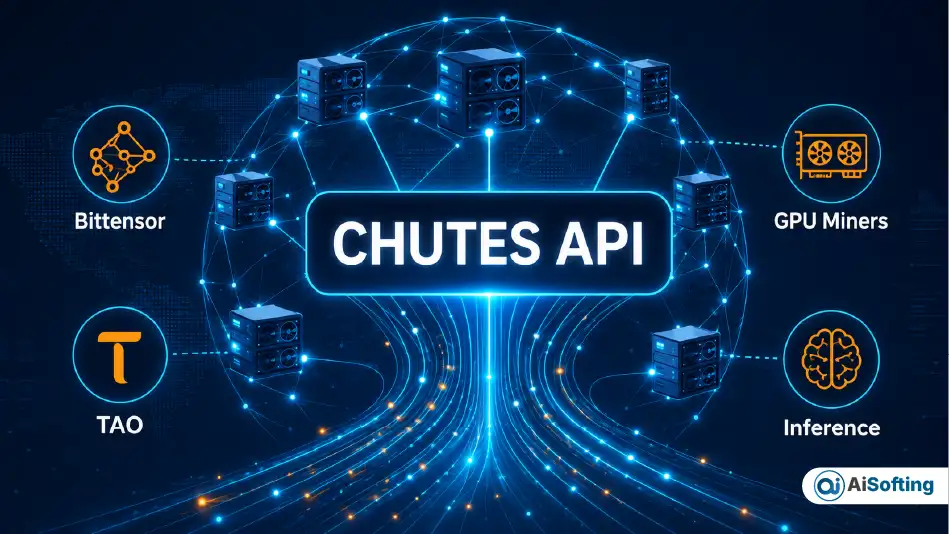
The Chutes API is the programmatic interface to Chutes.ai, a serverless AI inference platform that lets developers call large language models, image generators, and audio models through standard REST requests — without owning, renting, or managing a single GPU. You send a prompt, a distributed network of hardware processes it, and you get a response back in an OpenAI-compatible format.
What makes Chutes genuinely different from Fireworks, Together AI, or DeepInfra is where the compute comes from. Chutes isn’t a company that leases racks in a data center. It runs as Subnet 64 on the Bittensor network, a decentralized machine-learning protocol where independent GPU owners (“miners”) register their hardware, deploy models, and get paid in Bittensor’s native token, TAO, based on how well they perform. There’s no central cloud bill driving the pricing — there’s a token incentive system instead, and that structural difference is the real story behind why Chutes is so cheap.
How the Chutes API Actually Works (The Part Most Guides Skip)
The “Chute” Is the Deployable Unit
In the Chutes SDK, a Chute is a Python object that extends FastAPI and represents one deployable AI application — a model, an endpoint, a set of hardware requirements, all bundled together. Developers define a chute with a NodeSelector that specifies GPU count, minimum VRAM, and preferred hardware (H100s, A100s, and so on), then the platform matches that definition against available miner hardware automatically. This is the same underlying mechanism whether you’re calling a public model someone else deployed or shipping your own custom inference container.
Miners Compete, Validators Grade Them
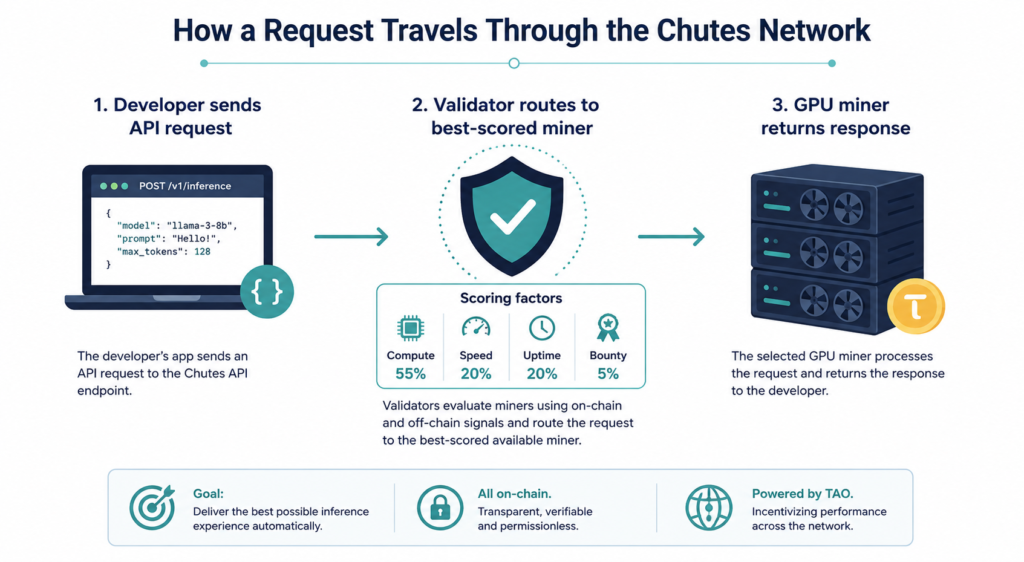
Here’s the piece that explains almost everything about how Chutes behaves in practice: every miner on Subnet 64 is scored on a rolling basis using four weighted factors — roughly 55% compute capacity, 20% response speed, 20% availability, and 5% bounty performance. Validators continuously audit output quality and uptime, and miners who under-perform lose their share of TAO emissions. In effect, the “cloud provider” isn’t one company — it’s hundreds of competing operators, each economically punished for slow or flaky service.
This is why reliability on Chutes feels different from AWS or Azure. You’re not renting guaranteed capacity from a single vendor with an SLA; you’re routing through a marketplace where quality is enforced by incentives rather than contracts. Most of the time that marketplace performs beautifully. During demand spikes, it can queue.
Why the Pricing Looks Almost Too Good
Because miners are subsidized through TAO emissions rather than needing to recoup a data-center lease, Chutes can offer some open-source models at effectively zero marginal cost to the developer, and premium models at a fraction of typical cloud inference pricing — reports put per-million-token costs for popular open models somewhere in the $0–$0.30 range depending on demand and model size. This isn’t a promotional discount; it’s a structural side effect of decentralized compute economics. It’s also why pricing on Chutes fluctuates more than a typical SaaS price sheet — it moves with TAO’s market value and subnet emission schedules, not with a quarterly pricing review.
Getting a Chutes API Key
- Create an account at the official Chutes.ai platform.
- Navigate to the API/developer section of your dashboard and generate a bearer token.
- Store that key securely — treat it like any other API secret, not a value to hardcode into a public repo.
- Test it with a basic chat completion request against the OpenAI-compatible endpoint before wiring it into a production app.
Most tools that support “OpenAI-compatible” providers can point at Chutes by simply swapping the base URL and API key — no separate SDK required for basic usage, though a dedicated Python chutes package exists for developers who want to deploy their own custom chutes rather than just consume public ones.
OpenAI Compatibility and Where People Actually Use It
Because Chutes mirrors the OpenAI request/response schema, it plugs into an enormous ecosystem of existing tools with minimal configuration:
- TypingMind and similar chat UIs — add Chutes as a custom OpenAI-compatible provider and get pay-per-use access to dozens of models in one interface.
- SillyTavern and roleplay frontends — Chutes is a popular backend for community roleplay setups precisely because it supports large open-weight models at low cost. This is the same reason API-driven narrative platforms like the ones we cover in our DreamGen AI review have leaned so heavily into external API and SillyTavern support — the demand for affordable, uncensored-by-default inference is real.
- Janitor AI’s “Bring Your Own Key” mode — a huge share of Chutes’ organic traffic reportedly comes from BYOK roleplay users, the same crowd we discuss in our Sakura AI review when comparing companion platforms that support custom API backends.
- Coding assistants like Kilo Code — developers point their agent at the Chutes endpoint to experiment with free or discounted coding models without burning through a metered OpenAI budget.
- OpenRouter — Chutes is listed as one of OpenRouter’s provider options, meaning you can access it indirectly even without a direct Chutes account, alongside mainstream providers.
If you’re building anything that relies on function calling or tool use against these open models, it’s worth understanding how small, efficient models handle that task differently from frontier models — we go deeper on that in our breakdown of Hammer AI’s function-masking approach to on-device tool calling.
Reliability, Rate Limits, and the 429 Problem
The most common complaint you’ll find in Chutes-related search traffic is the dreaded 429 - Infrastructure is at maximum capacity error. Because compute comes from independently owned miners rather than a single elastic cloud pool, demand spikes — a viral roleplay bot, a popular open-source model trending on Hugging Face — can genuinely outpace available hardware for a given model in real time.
Practical mitigation tips:
- Build in retry logic with exponential backoff rather than hammering the endpoint immediately after a 429.
- Have a fallback model or fallback provider configured for time-sensitive applications — this is standard practice with any decentralized or best-effort inference layer, not a Chutes-specific weakness.
- Avoid peak US evening hours for latency-sensitive testing if you can shift workloads.
- Warm up a chute ahead of expected traffic using the platform’s warm-up endpoint, which triggers scale-up before real requests arrive.
Chutes vs. OpenRouter vs. Together AI vs. Groq
| Factor | Chutes API | OpenRouter | Together AI | Groq |
|---|---|---|---|---|
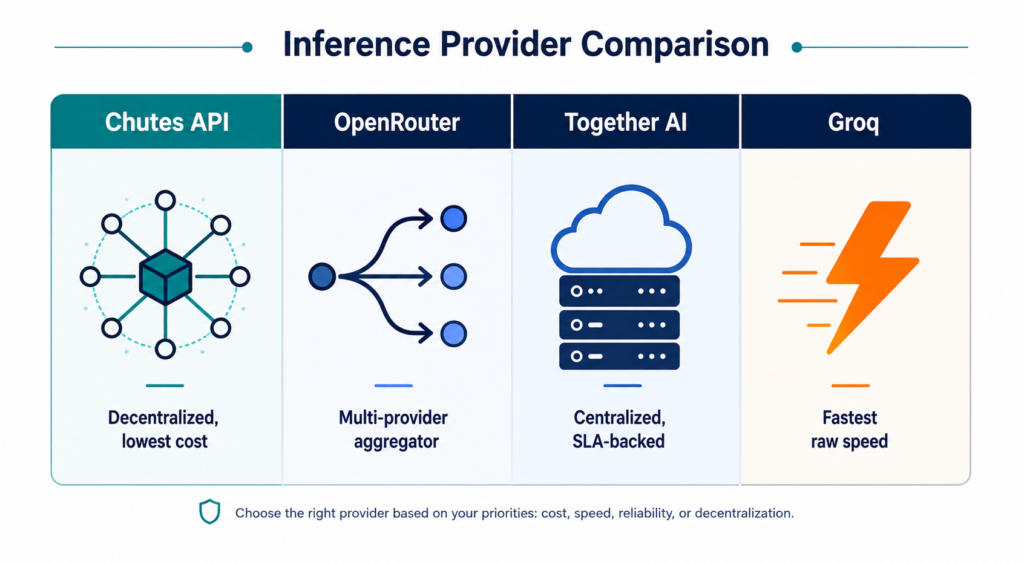
| Compute source | Decentralized Bittensor miners | Aggregates multiple providers (including Chutes) | Centralized cloud GPU clusters | Custom LPU hardware |
| Typical pricing | Very low to free (TAO-subsidized) | Varies by routed provider | Competitive, standard cloud pricing | Premium, speed-focused |
| Best for | Cost-sensitive, high-volume, open-model workloads | Multi-provider flexibility and failover | Production workloads needing consistent SLAs | Ultra-low-latency inference |
| Reliability model | Incentive/reputation-based | Depends on upstream provider | Contractual SLA | Contractual SLA |
| Data handling | Passes through whichever miner wins the request | Depends on routed provider | Centralized, more controllable | Centralized, more controllable |
None of these are strictly “better” — they solve different problems. Chutes wins on raw cost-per-token for open-weight models; centralized providers win on predictability.
Security and Privacy: The TEE Shift Nobody’s Talking About Yet
This is the part most Chutes explainers miss entirely, largely because it’s new: Subnet 64 has been actively rolling out Trusted Execution Environment (TEE) support in 2026, using TDX-based hardware attestation so a chute’s execution — and the data passing through it — can be cryptographically verified as running in an isolated, tamper-resistant enclave, with per-instance evidence available via the API. In practical terms, this addresses the biggest historical objection to decentralized inference: that your prompt data technically passes through an unknown third-party miner’s hardware.
TEE-enabled chutes don’t eliminate every trust question, but they materially change the conversation. Until it’s fully rolled out across the miner base, the sensible default is still: use Chutes freely for experimentation, open-source workloads, and non-sensitive applications, and treat regulated or personally identifiable data with the same caution you’d apply to any provider without a signed enterprise data processing agreement.
Benefits of the Chutes API
- Aggressive pricing on open-weight models like Llama, Qwen, and DeepSeek variants, driven by token-subsidized decentralized compute rather than discounting.
- No infrastructure management — no provisioning GPUs, no autoscaling configuration, no idle-server cost.
- OpenAI-compatible format means near-zero migration friction from existing tooling.
- Model diversity spanning text, image, and audio generation from a single account.
- Fast iteration for indie developers who can’t justify enterprise cloud commitments.
Common Mistakes to Avoid
- Assuming 100% uptime like a hyperscaler. Decentralized compute means occasional queuing — design for it.
- Sending sensitive or regulated data without checking TEE availability for the specific chute you’re calling.
- Ignoring model-specific rate limits and being surprised by throttling under load.
- Not monitoring usage — Chutes provides usage logs in the dashboard; ignoring them makes cost surprises more likely even on a cheap platform.
- Treating free-tier models as production-grade without testing latency and quality under your actual traffic patterns.
Best Practices for Production Use
- Pair Chutes with a fallback provider for anything customer-facing.
- Pin model versions/revisions where the platform allows it, so a backend model swap doesn’t silently change your output quality.
- Use the
chutes sharemechanism if you’re distributing access to a privately deployed chute within a team, rather than sharing raw API keys. - Log latency and error rates per model — with a multi-miner backend, performance can vary by model far more than with a single-vendor API.
Personal Experience: What Actually Happens When You Use Chutes Day to Day
I started testing the Chutes API a few months ago for a side project that needed cheap access to a couple of open-weight coding models, mostly out of curiosity about whether the “practically free inference” claims held up.
The first thing that struck me was how normal the integration felt. Pointing an existing OpenAI-compatible client at the Chutes base URL took less time than reading their docs page — swap the URL, swap the key, done. The second thing that struck me was less flattering: my very first burst of test traffic, run late on a weekday evening, hit a capacity error on a popular model within a few minutes. That’s the decentralized trade-off in action — you’re not paying data-center prices, so you’re also not getting data-center-grade guaranteed headroom.
Once I added simple retry logic and picked a slightly less popular model as a fallback, the experience stabilized considerably. For batch or non-real-time work — generating synthetic training data, running evaluations overnight, testing prompts before committing to a paid frontier model — Chutes has genuinely saved real money. For anything user-facing and latency-sensitive, I keep a paid fallback provider wired in, and I’d recommend anyone building production software do the same rather than trusting a single decentralized endpoint as their only path.
The other lesson: read the model list regularly. Because miners deploy and retire chutes based on incentive economics, the “best free model” this month isn’t guaranteed to be the best free model next quarter. Treat the model catalog as a living thing, not a fixed menu — the same advice we give in our broader look at how fast the AI productivity and tooling landscape shifts year over year.
Frequently Asked Questions
Is the Chutes API free to use? Some models are effectively free because miner compute is subsidized by TAO token emissions, while other, larger, or higher-demand models carry a small per-token cost. Pricing is not fixed the way it is with a typical SaaS API — it shifts with subnet economics.
How do I get a Chutes API key? Sign up at chutes.ai, open the developer/API section of your dashboard, and generate a bearer token. No separate SDK installation is required for basic OpenAI-compatible chat requests.
Why do I keep getting a 429 “infrastructure at maximum capacity” error? This happens when demand for a specific model temporarily exceeds available miner capacity on Subnet 64. Retry with backoff, warm up the chute ahead of expected load, or fall back to an alternate model.
Is Chutes the same as OpenRouter? No. Chutes is a decentralized compute provider running as Bittensor Subnet 64; OpenRouter is a model aggregator that routes requests across many providers, and Chutes happens to be one of the providers available through it.
Is Chutes safe for sensitive or private data? Treat it cautiously by default. Requests are processed by whichever miner wins the routing auction, and while Trusted Execution Environment (TEE) support is rolling out to add cryptographic attestation for privacy, it isn’t yet universal across the network. Avoid sending regulated or personally identifiable data unless you’ve confirmed TEE coverage for that specific chute.
Does Chutes work with SillyTavern or Janitor AI? Yes — its OpenAI-compatible format and low per-token cost have made it a popular “Bring Your Own Key” backend for roleplay and companion-chat frontends.
What models are available on Chutes? The catalog spans open-weight LLMs (Llama, Qwen, DeepSeek, Mistral variants), image generation models, and audio models, alongside custom developer-deployed “chutes.” Availability shifts as miners register and retire hardware.
Can I deploy my own model on Chutes instead of using an existing one? Yes — the Chutes SDK lets developers define a custom Chute with hardware requirements via a NodeSelector, then deploy it to the miner network for others (or just yourself) to call.
How does Chutes keep prices so low compared to OpenAI or AWS? It doesn’t operate its own data centers. Compute comes from independent GPU miners paid in TAO for serving requests, which removes the traditional cloud markup and shifts the economics to a token-incentive model instead.
Conclusion
The Chutes API isn’t just “a cheap way to call open-source models” — it’s a genuinely different economic model for AI inference, built on Bittensor’s decentralized compute layer instead of a traditional cloud bill. That’s exactly why it’s so inexpensive, and exactly why it behaves differently from providers like OpenAI, Groq, or Together AI when demand spikes.
If you’re building something cost-sensitive, experimental, or already OpenAI-compatible, it’s worth a real test — just go in understanding the trade-off: variable capacity in exchange for aggressive pricing, and an evolving but not yet universal privacy layer via TEE attestation. Start small, add fallback logic, keep an eye on the model catalog, and treat it as one strong tool in a multi-provider stack rather than a single point of failure.