Introduction
If you’ve spent any time on Discord, TikTok, or Twitch, you already know the name Packgod. He built a reputation as one of the internet’s sharpest roasters — the kind of guy who can turn a single sentence about your outfit into a punchline that lives in your group chat for weeks. Naturally, once something gets that popular, people start asking the obvious question: can an AI do that?
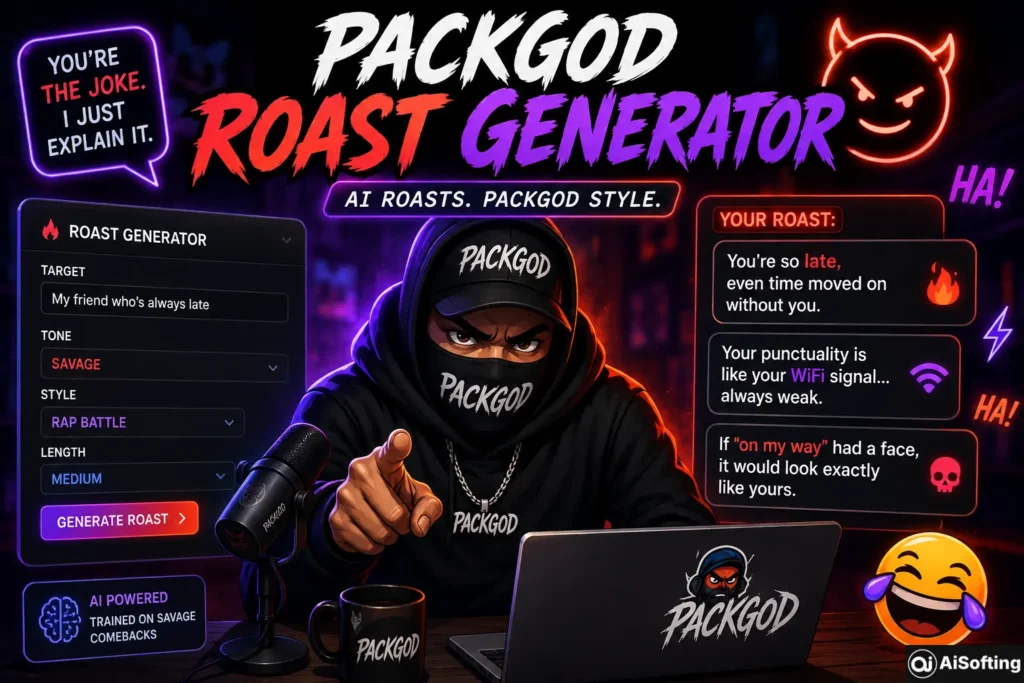
That’s exactly what a packgod roast generator is trying to answer. These are AI-powered tools built to mimic his rapid-fire, savagely funny insult style — you type in a target or a topic, and the tool spits out a roast that’s supposed to sound like it came straight from Packgod himself. Some of them genuinely nail the vibe. Others just produce generic insults with his name slapped on for search traffic. In this guide, I’ll break down how these tools actually work, which ones are worth your time, and what I’ve learned from testing a handful of them myself.
Who Is Packgod, and Why Does His Style Get Copied So Often?
Packgod became known for his roasting sessions, where he takes on callers or targets live and fires back razor-sharp comebacks built on wordplay, exaggeration, and perfectly timed delivery. What makes his style distinct isn’t just that the insults are mean — plenty of people can be mean. It’s the precision: the way he connects a roast to something specific and absurd about the target, delivered with comedic timing that lands more like stand-up than a random insult generator.
That’s a genuinely hard thing for AI to replicate well, which is exactly why the quality of packgod roast generators online varies so wildly. Some tools focus purely on generating punchy one-liners; others try to capture the rapid, stacked-insult cadence of an actual roasting session.
How a Packgod Roast Generator Actually Works
The Basic Mechanic
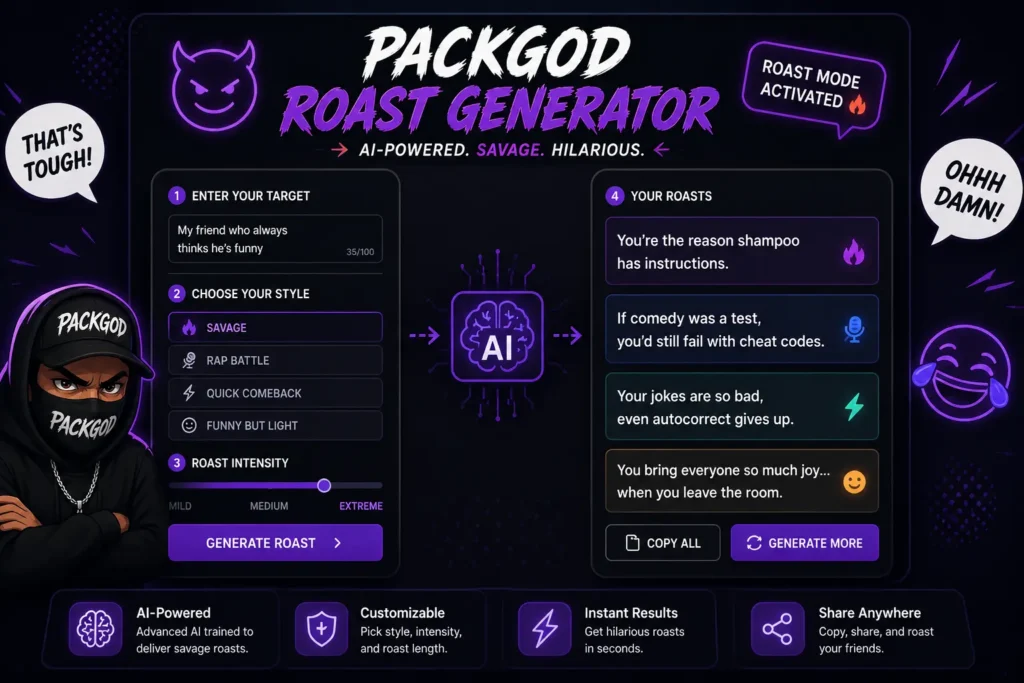
Most of these tools work the same way at their core: you give it a target (a name, a description, or a specific trait — “my friend who’s always late,” “someone who mains a certain video game character,” etc.), and the AI generates roast lines built around that input using a large language model trained or prompted to mimic exaggerated, insult-comedy phrasing.
Text-Only vs. Multimedia Tools
There are two general categories worth knowing about:
- Text generators — these simply output roast lines, one-liners, or full paragraphs in a Packgod-adjacent tone. Some let you pick a “type,” like a rap-battle bar, a quick comeback, or a longer roasting paragraph.
- Multimedia add-ons — some platforms pair roast text with AI-generated images or memes, letting you turn the roast into a shareable graphic rather than just plain text. It’s worth knowing that these image-focused tools usually don’t write the roast themselves — you still need a text generator first, then feed that line into the image tool.
Customization Options
The better tools in this space let you steer the output with a few extra details: a theme or keyword (“gaming,” “fashion,” “school”), a tone setting (light-hearted vs. savage), and sometimes a format choice, like a single punchline versus a longer rapid-fire set. The more specific detail you feed in, the less generic the output tends to be.
Real-World Examples of How People Use These Tools
- Friend group banter — dropping an AI-generated Packgod-style roast into a group chat as a joke, usually aimed at a specific inside joke or trait everyone will recognize.
- Discord and Twitch culture — using generated lines as material during voice chats or roast-themed streams, where rapid-fire insult comedy is already part of the community norm.
- Content creation — creators building short-form videos or memes using generated roast lines as scripts, sometimes paired with reaction footage or AI-generated art.
- Icebreakers at gatherings — some people use lighter, “not overly harsh” prompt templates to generate friendly, low-stakes roasts for parties or team events.
Benefits of Using a Packgod Roast Generator
- Instant material — no need to come up with a clever line under pressure; you get a few options in seconds.
- No skill required — you don’t need to be naturally quick-witted to get a genuinely funny line out of a good prompt.
- Free and accessible — most of these tools require no signup or payment for basic use.
- Good for practice — if you’re trying to sharpen your own comedic timing, seeing how an AI structures a roast (setup, exaggeration, punchline) can actually be a useful reference.
Common Mistakes People Make
- Using vague prompts. “Roast my friend” gives the AI almost nothing to work with, and you’ll usually get a generic insult that could apply to anyone. Specific details — a hobby, a habit, an inside joke — produce sharper, funnier results.
- Assuming every “Packgod” tool is actually good at the style. A lot of tools use his name purely for search visibility without genuinely capturing his rhythm or wit. If the output reads like a random insult generator with no timing or wordplay, that’s a sign the tool isn’t really built around his style.
- Forgetting the line between funny and genuinely hurtful. AI doesn’t know your friend group’s boundaries. A joke that reads fine as text can land very differently out loud, especially aimed at something someone’s actually sensitive about.
- Using it on strangers or in public spaces. What works as private banter between close friends can come across as straightforwardly mean or even harassing when aimed at someone who didn’t opt into the joke.
Best Practices for Getting Actually Funny Results
- Be specific in your prompt — name a trait, hobby, or habit rather than just a name.
- Try a few different tools if the first one feels flat; quality genuinely varies across this category.
- Use the “light-hearted” or “friendly” setting when one is available, especially for anything you plan to send to someone directly rather than just posting for laughs among people who already expect the joke.
- Treat the output as a draft, not a final product — tweak the wording so it sounds like something an actual person would say, not a generic template.
Personal Experience
I tested a handful of these tools while putting together roast material for a friend’s birthday roast night — the kind of event where everyone expects to get lightly torched, so the stakes were low and the humor was welcome. My first few attempts with vague prompts were honestly underwhelming — generic lines like “you’re so slow you make dial-up internet look fast” that could’ve applied to literally anyone in the room. Nothing that felt like it captured the sharp, specific style Packgod is actually known for.
Things improved a lot once I got more specific. Instead of just naming the person, I described a very particular habit — someone who always shows up late and blames traffic despite living five minutes away — and the output was noticeably sharper and more tailored. That one detail made the difference between “generic insult” and “something that actually landed.”
The other thing I learned the hard way: not every tool that puts “Packgod” in its name is actually trying to nail his cadence. A few felt like they’d just slapped the name on a basic insult generator to catch search traffic, and the output read more like a random meme caption than an actual roast with structure. If a tool’s results feel flat after a couple of specific prompts, it’s probably not worth sticking with — there are enough options in this space that you don’t need to force it.
One more lesson: I ran a test roast on myself first before using any lines on someone else, mostly out of curiosity, but it turned out to be a genuinely good practice. It’s a fast way to gauge whether a tool’s humor style matches the tone of the event before you commit to reading a line out loud in front of a group.
FAQs
1. What is a Packgod roast generator? It’s an AI-powered tool designed to generate insult-comedy roasts styled after Packgod’s rapid-fire, exaggerated, and witty roasting persona, usually based on a name or description you provide as the target.
2. Are Packgod roast generators free to use? Most of them are free and don’t require signup, though some platforms offer premium features like image generation or unlimited use as part of a broader AI tool suite.
3. How do I get better, funnier results from these tools? Give the AI something specific to work with — a habit, hobby, or particular trait — rather than a vague or generic prompt. Specificity is consistently what separates a flat line from a genuinely funny one.
4. Is it okay to use an AI-generated Packgod roast on someone? It depends entirely on context and consent. Roasts work as comedy between friends who expect and enjoy the format; the same line aimed at someone who didn’t opt in, or touching on something they’re genuinely sensitive about, can easily cross into hurtful territory instead of funny.
5. Do these tools sound exactly like the real Packgod? Not usually. AI can mimic tone, structure, and wordplay patterns reasonably well, but capturing genuine comedic timing and delivery — the thing that makes his actual roasting sessions land — is still a gap most generators haven’t fully closed.
6. Can I use a Packgod roast generator for content creation? Yes, plenty of creators use generated lines as scripts or captions for short-form videos, memes, and roast-themed content, often pairing the text with AI-generated images or reaction clips.
Conclusion
A packgod roast generator can genuinely deliver a laugh-out-loud line when you feed it something specific to work with, and it’s a fun, low-effort way to add material to a roast night, group chat, or piece of content. Just go in with realistic expectations — not every tool with his name attached actually captures his style, and the difference between “funny” and “just mean” comes down entirely to context, consent, and how specific your prompt is. Treat the output as a starting point you can sharpen, not a guaranteed punchline machine.
Actionable takeaways:
- Always give the AI a specific detail to work with instead of a vague prompt.
- Test a roast on a low-stakes target (or yourself) before using it on someone in a real social setting.
- Be picky — try a few different generators, since quality in this category varies a lot.
- Keep consent and context in mind; a roast that’s funny among friends can land very differently elsewhere.
If you’re building any kind of content or humor-focused platform around trends like this, it helps to have a site that’s actually built to be found and to hold up under traffic — see how professional SEO strategy can improve discoverability for trend-driven content, and how solid custom web development keeps a site running smoothly when a piece of content suddenly takes off.
For further reading, see a general breakdown of how large language models generate creative text, Discord’s own community guidelines on harassment and acceptable conduct, and a broader look at AI-generated humor and its current limitations.
Disclaimer: This article is for general informational and entertainment purposes only. AI-generated roasts can be misinterpreted or land differently than intended — use good judgment, get consent before roasting someone directly, and avoid content that targets protected characteristics or crosses into harassment. This article is not affiliated with or endorsed by Packgod.