Introduction
If you’ve spent any time digging through Reddit threads or Discord servers dedicated to AI roleplay, you’ve probably run into the name AgnAI (also written as Agnai Chat, agnai.chat). It’s one of those tools that doesn’t get the same marketing push as the big-name AI companion apps, yet it keeps coming up in conversations among people who actually know what they’re doing with prompt engineering and character design.
I spent several weeks testing AgnAI across different AI engines, poking at its memory system, and comparing it against the more polished, closed-source competitors. If you’re new to configuring prompts and AI agents in general, our agentic AI course guide is a good primer before you dive into a tool this customizable. This review breaks down what AgnAI actually does well, where it falls short, and something most reviews conveniently skip: how the fast-moving 2026 regulatory environment around AI companion apps could directly affect how you use a platform like this. That’s the part nobody else is really talking about yet, and if you’re serious about using AgnAI long-term, it matters.
What Is AgnAI?
AgnAI is a free, open-source AI character chat and roleplay platform built by the developer group agnaistic/agnai and released under the AGPL-3.0 license. It’s been in active development since 2022, and by 2026 it has grown into a fairly mature product used by hundreds of thousands of people every month.
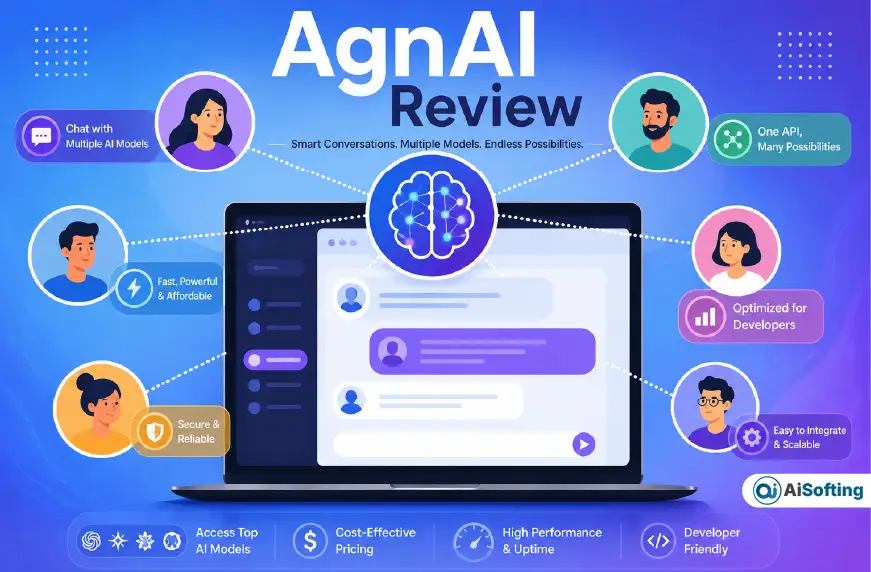
The core idea behind AgnAI is right there in its own tagline: it’s an “AI Agnostic” platform. Instead of locking you into one proprietary model, AgnAI lets you plug in whichever AI engine you want — free community-powered options, your own paid API keys, or the platform’s own hosted models. That single design decision is what separates AgnAI from most of its competitors.
Core Features That Define AgnAI
1. True Multi-Engine Flexibility
This is AgnAI’s headline feature. From the Presets page, you can wire up your character chats to run on:
- AI Horde – a completely free, community-donated compute network, good for casual testing.
- OpenAI API (GPT-4o and similar) – consistent, if you’re willing to pay per token.
- Anthropic Claude API – generally praised in the AgnAI community for producing more natural, less repetitive long-form dialogue.
- OpenRouter – a single gateway to multiple model providers without juggling several API keys.
- Agnaistic hosted models – AgnAI’s own in-house models, prioritized for paying subscribers.
- Smaller integrations like Mancer and Replicate for more advanced users.
In practice, this means two people using AgnAI can have completely different experiences depending on which engine they’ve hooked up. That’s a double-edged sword — more on that in the “common mistakes” section below. If you’re already weighing model providers for cost and reliability, our Kie AI review looks at a similar multi-model API approach and is worth a read before you settle on which engine to wire into AgnAI.
2. Memory Books and World-Building Tools
Long-form roleplay lives or dies on whether the AI remembers who your character is three hundred messages later. AgnAI tackles this with a layered memory system:
- Memory Books – structured lore and background entries the AI references during chat.
- Scenarios – pre-built scene setups so you can jump straight into a story.
- Templates – lets advanced users rewrite the underlying prompt structure sent to the model.
- Embeddings – vector-based memory retrieval for pulling up relevant context from earlier in a long conversation, rather than just relying on a fixed context window.
This is genuinely one of the stronger memory implementations I’ve tested among free tools, and it’s a big part of why AgnAI is often mentioned in the same breath as SillyTavern.
3. Group Chats
AgnAI supports multi-character group conversations, letting several AI personas interact with you and each other in the same thread. It’s a feature a lot of competing platforms either lack entirely or bury behind a paywall.
4. Character Import and Card Compatibility
AgnAI supports the widely used Character Card / Tavern JSON format, so if you’ve built a character library on SillyTavern or another compatible tool, you can bring it over without starting from scratch.
5. Full Source-Code Transparency
Because AgnAI is AGPL-3.0 licensed, the entire codebase is public on GitHub. You can audit it, self-host your own private instance, or fork it and modify the features you don’t like. For anyone who’s had a favorite AI app suddenly change its rules or shut down overnight, this transparency is a real point in AgnAI’s favor.
Pricing: What Actually Costs Money
The core AgnAI experience is free. Character creation, chatting, Memory Books, and the AI Horde engine cost nothing and don’t require a subscription. Where costs come in:
- Bring-your-own-key usage: if you connect OpenAI or Claude, you pay that provider directly based on token usage — AgnAI doesn’t mark this up.
- Agnaistic hosted models and image generation: available through a paid subscription tier for people who don’t want to manage their own API keys.
- Self-hosting: technically free beyond your own server costs, but requires comfort with Docker and basic server administration.
The Part Most Reviews Skip: Regulation Is Catching Up to AI Companion Apps
Here’s the angle that’s genuinely new and worth paying attention to if you’re evaluating AgnAI or any similar roleplay platform in 2026.
In April 2026, the U.S. Senate Judiciary Committee unanimously advanced the GUARD Act — formally the Guidelines for User Age-verification and Responsible Dialogue Act — which targets AI chatbots offered to the public, with specific focus on risks to users under eighteen. A companion bill was also introduced in the House that same month. The proposed law would require platforms offering “AI companions” (defined as chatbots that simulate a sustained personal or emotional relationship) to verify user age, clearly disclose that users are talking to a machine rather than a person, and block minors from accessing companion features altogether. Once enacted, the law would take effect 180 days after signing, and it explicitly would not override stricter state-level rules already on the books.
Why does this matter for an open-source tool like AgnAI specifically? Because unlike a centralized commercial app such as Character.AI, AgnAI’s compliance responsibility gets murky. If you self-host your own instance, you become the “covered entity” running an AI companion service — which, depending on how the final law is written, could put age-verification obligations on individual hobbyist server admins, not just big companies. If you use the hosted agnai.chat version, that responsibility sits with the platform operator. Either way, this is a live legal development that could reshape how open-source roleplay tools operate within the next year, and it’s a factor that gets almost no coverage in existing AgnAI reviews.
On top of the federal push, individual states have been moving on their own AI companion laws, so depending on where you live, restrictions may already apply regardless of what happens in Congress.
Who Should Actually Use AgnAI
Good fit if you:
- Already have an OpenAI or Claude API key and want a flexible front end.
- Enjoy tuning prompts, memory settings, and engine choices rather than getting an out-of-the-box experience.
- Want the option to self-host for full data control.
- Have an existing character card library from SillyTavern-style tools.
Not a great fit if you:
- Want a plug-and-play experience with zero setup.
- Aren’t comfortable configuring API keys or reading documentation.
- Want built-in image generation without extra configuration.
Common Mistakes New Users Make
- Sticking with AI Horde and judging the whole platform by it. Horde is free, but response quality and speed vary wildly depending on community GPU availability. Testing with a paid API key gives a much fairer picture of what AgnAI can actually do.
- Skipping Memory Books entirely. New users often just start chatting without setting up any world info, then wonder why the AI forgets details. Spend ten minutes filling out a Memory Book before a long roleplay session — it pays off.
- Overloading the character card. Cramming too much personality detail into a single character description can confuse smaller or free-tier models. Keep core traits concise and let Scenarios and Memory Books carry supplementary detail.
- Ignoring engine-specific quirks. A prompt template tuned for GPT-4o won’t necessarily behave the same way on Claude or a Horde-hosted model. If your character starts acting strangely, check whether you recently switched engines.
Best Practices for Getting the Most Out of AgnAI
- Start with a small, well-defined character and expand gradually rather than writing a massive backstory on day one.
- Use Scenarios to save reusable openings for characters you chat with often.
- If you’re serious about long-term use, budget for a paid API key — the jump in coherence over free Horde models is noticeable.
- Back up your character cards regularly, especially if you’re self-hosting.
- Review AgnAI’s own documentation on GitHub periodically, since it’s a community-driven project and features change fairly often.
Personal Experience Section
When I first opened AgnAI, my honest first impression was that it felt more like a tool built by developers for developers than a polished consumer app — and that turned out to be both its biggest strength and its biggest early frustration.
Getting AI Horde running out of the box took about five minutes and worked immediately, but the responses were noticeably slower and less consistent than I expected, sometimes taking over a minute during peak hours. Once I connected my own Claude API key through the Presets page, the difference was night and day — dialogue felt more natural, characters stayed in tone longer, and the Memory Book actually seemed to influence responses in a way that felt intentional rather than random.
The feature that surprised me most was the group chat function. I set up a three-character scenario for a short interactive story, and watching the characters respond to each other (not just to me) added a layer of dynamism I hadn’t gotten from single-character platforms. It wasn’t flawless — occasionally two characters would echo similar phrasing, a common issue with multi-agent prompting — but for a free, open-source tool, it held up well.
My biggest lesson learned was about expectations management. AgnAI rewards people who are willing to tinker. If you go in expecting a Character.AI-style instant experience, you’ll likely be underwhelmed by the setup process. But if you treat it more like a hobbyist project — the way people treat Home Assistant or Obsidian — the depth of customization becomes the actual selling point rather than a barrier.
One thing I didn’t anticipate going in was how much the recent regulatory conversation changed how I thought about using the tool. Knowing that age-verification and disclosure requirements are actively moving through Congress made me pay closer attention to how the hosted version handles account setup, and it’s a consideration I’d now recommend to anyone testing similar platforms in 2026, not just AgnAI.
Frequently Asked Questions
Is AgnAI completely free to use?
Yes. Core features — character creation, chatting, and the AI Horde engine — are free with no message caps. Costs only apply if you use paid API keys or subscribe to the Agnaistic hosted model tier.
Is AgnAI safe to use?
AgnAI itself doesn’t apply content filters; the restrictions you experience depend on which AI engine you connect. Community-hosted Horde models are largely unrestricted, while OpenAI and Claude API connections follow those providers’ respective usage policies.
Do I need coding experience to use AgnAI?
No, but a basic comfort level with things like generating and pasting an API key helps a lot. Self-hosting does require more technical familiarity, typically with Docker.
How does AgnAI compare to SillyTavern?
The two are frequently mentioned together because both are open-source, multi-engine, and support Memory Books. The main practical difference is that AgnAI runs in the browser out of the box, while SillyTavern typically requires local installation, making AgnAI somewhat more approachable for non-technical users.
How does AgnAI compare to Character.AI or Janitor AI?
AgnAI offers significantly more technical freedom and engine choice than either of those platforms, but it trades away some of their polish and built-in ease of use in the process.
Can I import characters I’ve already built elsewhere?
Yes. AgnAI supports the standard character card JSON format used by SillyTavern and similar tools, so existing character libraries can generally be imported without rebuilding them from scratch.
Will the GUARD Act affect AgnAI users?
If the GUARD Act or similar state legislation is enacted, platforms offering AI companion-style chat — including AgnAI’s hosted version — would likely need to implement age verification and clearer AI-disclosure messaging. Self-hosted instances may face their own separate compliance questions depending on how final regulations define a “covered entity.”
Is my data private on AgnAI?
Because AgnAI is open-source, you can self-host it for full control over your data. On the hosted agnai.chat version, your data is subject to the platform’s own privacy policy, which is worth reviewing directly given the shifting regulatory landscape.
Does AgnAI support image generation?
Not natively as a core free feature — image generation is generally tied to the paid subscription tier or requires connecting an external service.
Conclusion
AgnAI earns its reputation in the open-source AI roleplay community honestly. Its multi-engine flexibility, layered memory system, and full source-code transparency make it one of the more capable free options available in 2026, especially for people who don’t mind a bit of setup work in exchange for real control over their AI experience.
That said, it’s not the platform for someone who wants a zero-friction, plug-and-play companion app — and with age-verification legislation like the GUARD Act actively moving through Congress, anyone using AgnAI or similar AI companion tools should keep an eye on how these rules could reshape account requirements down the line.
Actionable takeaways:
- Try AI Horde first to get a feel for the interface, then connect a paid API key before forming a final opinion on quality.
- Invest time in Memory Books early — it’s the single biggest lever for better long-term roleplay.
- If privacy is a priority, look into self-hosting via the AGPL-3.0 codebase on GitHub.
- Keep an eye on GUARD Act developments and any state-level AI companion laws relevant to your location, since they may affect account setup requirements in the near future.