Introduction
If you’ve spent any time building AI-powered apps, you already know the pain: every model lives behind its own API, its own pricing page, and its own rate limits. Want Veo 3 for video, Suno for music, GPT-4o for chat, and Nano Banana for image edits? That’s four accounts, four billing dashboards, and four sets of documentation to keep straight.
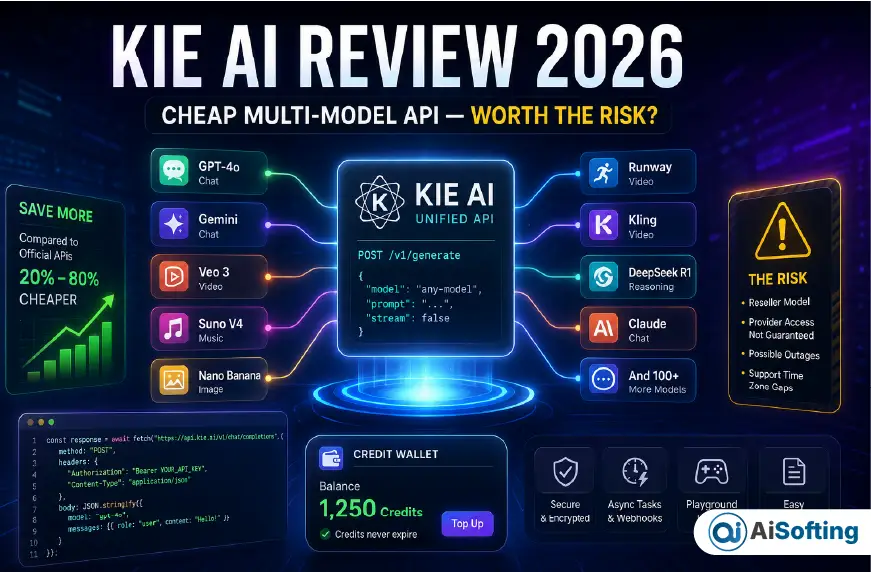
Kie AI markets itself as the fix — a single API key that unlocks hundreds of models from OpenAI, Google, ByteDance, Runway, Suno, and more, at prices that undercut the official providers by anywhere from 20% to 80%. It sounds almost too good to be true, and after digging through the platform’s documentation, pricing pages, and a pile of real user reviews on Trustpilot and developer forums, the honest answer is: it’s both genuinely useful and genuinely risky, depending on what you’re building.
This review breaks down what Kie AI actually is, how the credit system works, where it shines, where it’s burned users, and — importantly — the one structural detail almost no other review explains clearly: why Kie’s pricing model works the way it does, and what that means for your production stability.
What Is Kie AI?
Kie AI is a third-party AI API aggregator. Rather than building its own foundation models, it resells API access to models from major labs and studios — OpenAI, Anthropic, Google DeepMind, ByteDance, Runway, Suno, and others — through one unified endpoint at api.kie.ai. You deposit credits starting at $5, then pay per API call, with Kie claiming discounts of 20–86% compared to official API rates.
New accounts receive 80 free credits for testing models before committing to a paid workflow, and each model has its own interactive playground for trying prompts before writing any integration code, as outlined in Kie’s official API documentation. Failed generation tasks aren’t charged, which matters more than it sounds — video and image models fail often enough that this policy alone can save real money over a month of testing.
The Reseller Model: The Part Most Reviews Skip
Here’s the detail that explains almost every complaint and every strength in this review: Kie isn’t a licensed partner of most of the model providers it resells. It’s buying bulk API access and marking it down — which is exactly why the discounts are so aggressive, and exactly why long-term reliability is an open question.
The clearest proof point: Kie had to remove Midjourney from its platform after Midjourney’s team demanded it. That’s not a hypothetical risk — it already happened once. If you build a production pipeline around a specific model on Kie, you’re implicitly betting that the original provider won’t notice, object, or change its terms. For hobby projects and prototypes, that’s a manageable risk. For a revenue-generating SaaS product, it’s a single point of failure you don’t control.
Key Features
- Unified API gateway — switch between Veo, Kling, Seedance, Runway, Claude, GPT, Gemini, Nano Banana, and Suno without rebuilding your backend integration.
- Credit-based wallet — credits don’t expire, and failed requests aren’t charged, so you only pay for output that actually generates.
- Async task architecture — you fire a generation job, get a task ID back, and poll or receive a webhook when it’s done, which suits agent-based and automation workflows well.
- Model breadth — access to reasoning models like DeepSeek R1, music generation via Suno V4, and video via Runway Gen-3 Alpha Turbo and Sora 2, all through the same request pattern.
- Playground testing — every model page lets you test prompts in-browser before writing a single line of integration code.
Pricing: How the Credit System Actually Works
Kie AI runs on a prepaid credit wallet rather than a subscription. You buy a credit block (starting around $5), and each API call — whether it’s a chat completion, an image generation, or a video render — deducts a fixed number of credits based on that specific model’s cost.
One independent tester who compared Kie’s headline prices against official provider rates found that many models were priced around 30% lower than official APIs and marketplaces, with select high-demand models offering 60–70% savings, verified as of June 2026. Community-run cost breakdowns on developer sites like DEV Community back this up for specific models — one build log calculated Sora 2 video clips at roughly $0.15 each through Kie versus a $20/month subscription elsewhere for comparable output.
The catch is that pricing tiers for very high-volume usage aren’t always transparent upfront, and because Kie is reselling rather than setting its own base rates, prices can shift if an upstream provider changes its terms.
Reliability and Support: Where the Reviews Diverge Sharply
This is the section every prospective user should read twice, because the picture is genuinely split.
On the positive side: Kie AI advertises fast performance with 99.9% uptime and high-concurrency support, plus step-by-step documentation and around-the-clock customer support. One Trustpilot reviewer described a billing dispute where they were initially convinced they’d been wrongly charged — and support investigated, proved them wrong, and stayed patient and helpful throughout the exchange, with the reviewer calling the platform itself “cool and easy to use.” Another five-star review noted that $5 buys 1,000 usage credits, credits don’t expire, there’s no monthly commitment, and the platform is stable, well documented, and developer-friendly — with the caveat that Sora specifically had more failures than other models.
On the negative side: Kie.ai currently holds around a 2.5-out-of-5 rating on Trustpilot from roughly ten reviews, and the same complaints recur across Trustpilot, Reddit, and developer forums. Multiple reviewers use the word “scam” outright — describing credits disappearing due to platform glitches, support responding “sorry money gone” without a refund, support hours that effectively only cover Asian time zones (leaving US and European users waiting hours or days), and inconsistent NSFW filter behavior that some users allege changes after payment. A separate one-star Trustpilot review specifically called out the Sora 2 integration for constant outages that get patched for a day before the same failures return, calling it unusable for anything production-grade, with support responsiveness heavily skewed toward Asia time zones.
The pattern that emerges: core chat and image models seem to run fairly reliably for most users, while the most in-demand, resource-heavy video models (Sora 2 in particular) are the flashpoint for outage complaints. That’s consistent with how reseller platforms typically behave — the harder a model is to get bulk access to, the shakier the resale layer tends to be.
Security and Legal Standing
Kie.ai’s privacy policy states the platform uses encryption to protect user information and commits to not exposing or compromising user data, and it outlines GDPR data access and deletion rights for EU users. The service is operated by NEXUSAI SERVICES LLC under Colorado law, which at least gives users a named legal entity and jurisdiction if a dispute needs to go further than a support ticket. That said, the platform is still relatively new, and independent third-party security audits or certifications don’t appear to be publicly available yet — so treat it the way you’d treat any young infrastructure vendor: useful, but not yet proven at scale.
Kie AI vs. Alternatives
- vs. fal.ai — fal tends to have stronger inference platform branding and tighter pipelines for certain models; Kie leans harder on price comparison and a single wallet spanning image, video, music, and chat.
- vs. Replicate — Replicate is the better choice for running open-source models and custom deployments; Kie’s strength is discounted access to closed, popular commercial models.
- vs. official provider APIs — going direct to OpenAI, Google, or Anthropic costs more but removes the reseller dependency risk entirely. For anything mission-critical, that trade-off is worth weighing carefully.
Common Mistakes to Avoid
- Treating Kie as your only AI provider. Experienced users tend to split their stack — keeping core LLM traffic on a direct provider or router like OpenRouter, and using Kie specifically for the “generate the image/video/audio” layer.
- Skipping the failure-rate check before scaling. Test the exact model you plan to depend on — especially Sora 2 or other high-demand video models — with real production-style volume before committing a workflow to it.
- Ignoring time-zone support gaps. If you’re outside Asia and something breaks over a weekend, expect a delay. Build retry logic and fallbacks rather than assuming instant support.
- Not reading the refund policy before topping up a large balance. Start with the minimum credit purchase and scale up only after you’ve verified reliability for your specific use case.
- Assuming price parity guarantees quality parity. A discounted resold model call is still the same underlying model — but only as long as Kie retains access to it.
Personal Experience
I ran a two-week trial specifically to stress-test the parts of Kie AI that marketing pages gloss over. My use case was modest: generating blog cover images and short product demo clips for a client site, plus a handful of chat completions routed through DeepSeek R1 for cost comparison.
The onboarding was genuinely fast — signing up, grabbing an API key, and burning through the free trial credits took under fifteen minutes, and the playground let me sanity-check prompts before writing any code. For image generation and chat completions, the experience was smooth: response times were reasonable, the async task pattern with webhook callbacks worked exactly as documented, and I didn’t hit a single failed charge.
Video was a different story. Attempting a batch of short clips through one of the higher-demand video models, I hit intermittent task failures that required manual retries — not catastrophic, since failed tasks weren’t billed, but frustrating enough that I wouldn’t trust it for a client deadline without a fallback provider on standby. When I reached out to support about a delayed task status, the reply came roughly ten hours later — well within a business day for their listed hours, but noticeably slower than what I’m used to from direct provider support.
The lesson I took away: Kie AI is a legitimately good tool for cost-sensitive prototyping, side projects, and content pipelines where an occasional retry doesn’t break anything. I would not, based on this trial, put a client-facing production video pipeline entirely on top of it without a secondary provider as backup. That’s not a dismissal — it’s the same advice I’d give for any reseller-model infrastructure vendor still building its track record.
Frequently Asked Questions
Is Kie AI legitimate or a scam?
Kie AI is a real, operating platform run by a named legal entity (NEXUSAI SERVICES LLC) with a functioning API and documentation. It is not a scam in the sense of being fake, but user reviews show real complaints about credit disputes and refund handling, so treat it with the same caution you’d apply to any young third-party reseller.
How does Kie AI pricing work?
You prepay into a credit wallet starting at $5, and each API call deducts credits based on the specific model used. Credits don’t expire, and failed tasks aren’t charged.
Does Kie AI offer a free trial?
Yes — new accounts receive free credits (commonly cited as around 80 credits) to test models in the playground before paying for a full workflow.
What models can I access through Kie AI?
Kie offers a unified API to models including GPT-4o, Claude, Gemini, DeepSeek R1, Veo 3, Kling, Runway Gen-3/Aleph, Sora 2, Suno, and Nano Banana, among hundreds of others, though the exact catalog changes as licensing agreements shift.
Is Kie AI good for production apps?
It depends on the model. Text and image generation appear stable enough for production use for many users. High-demand video models, particularly Sora 2, have drawn repeated outage complaints, so production video pipelines should include a fallback provider.
Why is Kie AI so much cheaper than official APIs?
Because it operates as a reseller buying bulk API access rather than a direct model partner, it can mark down prices — but that also means it doesn’t fully control long-term access to every model it lists.
What happened with Midjourney and Kie AI?
Kie AI had to remove Midjourney from its platform after Midjourney requested it, illustrating the real risk that comes with the reseller model: access to any given model isn’t guaranteed to be permanent.
Is customer support reliable on Kie AI?
Support experiences are mixed. Some users report fast, helpful responses; others — particularly those outside Asian time zones — report slow response times and difficulty resolving refund or credit disputes.
How does Kie AI compare to fal.ai or Replicate?
Kie competes on price and breadth across image, video, music, and chat in one wallet. fal.ai is often stronger for specific inference pipelines, and Replicate is the better choice for open-source and custom model deployments.
Is my data safe on Kie AI?
The platform states it encrypts user data and complies with GDPR access and deletion rights for EU users, but independent third-party security audits aren’t yet publicly available, so sensitive data should be handled cautiously.
Conclusion
Kie AI solves a real problem — the fragmentation and cost of accessing dozens of top AI models — and for prototyping, content pipelines, and cost-sensitive projects, it delivers on that promise more often than not. The credit system is fair, the free trial is genuinely useful, and the price gap versus official APIs is real, not just marketing copy.
But the reseller model that makes those prices possible is also the platform’s biggest structural risk, and the Midjourney removal is proof it’s not hypothetical. Mixed Trustpilot reviews, uneven support response times, and specific reliability issues with high-demand video models mean this isn’t a platform to bet a client-facing production system on without a backup plan.
Actionable takeaways:
- Start with the free trial credits and test your exact use case — especially any video model — before committing a real budget.
- Keep a secondary provider on standby for anything customer-facing or time-sensitive.
- Purchase credits in small increments until you’ve confirmed reliability for your specific workflow.
- Read the refund and support policies before scaling usage, not after something goes wrong.
Used with that mindset, Kie AI is a smart addition to an AI development stack. Used as a single point of failure for production infrastructure, it’s a gamble worth thinking twice about.
Disclaimer: This review reflects independent testing and research based on publicly available information, official documentation, and user reviews as of the publication date. We are not affiliated with, sponsored by, or compensated by Kie AI or NEXUSAI SERVICES LLC. Pricing, features, and reliability can change over time — always verify current details on the official Kie AI website before making a purchasing decision. This article does not constitute professional, legal, or financial advice.