
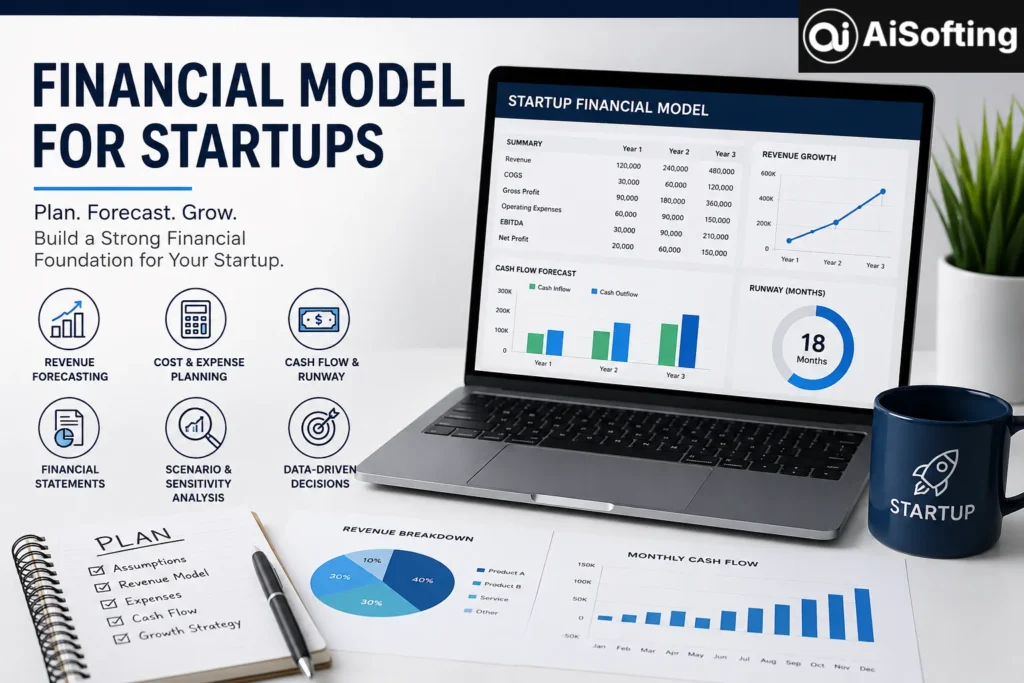
Most articles about a financial model for startups treat it like a fundraising checkbox: build a spreadsheet, hand it to investors, move on. That framing gets the purpose backwards. A financial model earns its keep long before — and long after — anyone asks to see it. It’s the tool that tells you, months in advance, whether the business you’re building can actually survive.
That distinction matters more than it sounds. Research from CB Insights on VC-backed startups that shut down since 2023 found that while “ran out of capital” is cited in roughly 70% of failures, that’s almost always the final symptom rather than the root cause. The deeper drivers were poor product-market fit (43%), bad timing (29%), and unsustainable unit economics (19%). A good financial model is one of the few tools that surfaces those root causes early — in the numbers — instead of letting you find out about them in an all-hands meeting about layoffs.
This article walks through what actually belongs in a startup financial model, how it should evolve by stage, where founders consistently get it wrong, and what the model can (and can’t) tell you about your odds of survival.
What a Financial Model for Startups Actually Is — and Isn’t
A financial model is a structured, assumption-driven forecast of how cash moves through your business over time. It is not a budget (a budget tells you what you’re allowed to spend; a model tells you what happens if you spend it), and it’s not a valuation (a valuation is one output that sometimes gets derived from a model, not the model itself).
The core job of the model is to connect a handful of drivers — pricing, customer acquisition, churn, headcount, cost of goods sold — to a single output that determines whether the company is alive: cash in the bank, month over month.
Everything else — the P&L, the balance sheet, the pretty investor charts — exists to support that one number.
The Core Components, and Why Each One Exists
Revenue: Build It Bottom-Up, Not Top-Down
The single most common mistake in early-stage models is starting with a market size and working down (“if we capture just 1% of a $50B market…”). Investors have seen this exact slide hundreds of times and it convinces almost no one. A credible revenue forecast is built bottom-up: number of customers, average price, expected conversion rate, and expected churn, multiplied out month by month. For subscription businesses this typically means modeling Monthly Recurring Revenue (MRR) and Annual Recurring Revenue (ARR) directly from a sales funnel and a churn assumption, rather than guessing at an aggregate growth curve.
Costs: Separate COGS from Operating Expenses
Hosting, customer support tooling, and payment processing usually belong in Cost of Goods Sold (COGS) because they scale with usage. Salaries, rent, and marketing spend are operating expenses (OpEx) because they don’t move in lockstep with each new customer. This separation isn’t academic — it’s what lets you calculate gross margin, which is one of the first numbers a serious investor will check, because it tells them whether the business gets more efficient as it grows or just gets bigger.
Burn Rate and Runway: The Two Numbers That Matter Most Pre-Revenue
As Brex’s breakdown of startup burn rate puts it, burn rate is how fast you’re spending cash. Gross burn is total monthly spend; net burn subtracts whatever revenue is coming in. Runway is the number of months you can survive at current burn before the bank account hits zero — calculated simply as cash on hand divided by net burn.
Where founders go wrong here isn’t the math, it’s the discipline: burn rate should be recalculated monthly against actuals, not left as a static number from the last fundraising deck. A rolling three-month average tends to smooth out one-off expenses and give a more honest picture than a single month’s snapshot.
There’s a rough industry convention worth knowing: 12–18 months of runway is generally considered healthy, with many advisors now recommending 18–24 months as a buffer given how unpredictable fundraising timelines have become. Under six months, absent a funding event already in motion, is widely treated as a danger zone.
The Three Financial Statements — and When You Actually Need All of Them
As EY’s guide to financial modeling for startups explains, a full three-statement model (P&L, balance sheet, cash flow statement) is standard practice for later-stage companies, but pre-revenue or early product-market-fit startups often don’t need that complexity yet. At that stage, a simplified P&L plus a cash flow forecast usually delivers more insight per hour of work than a full three-statement build that nobody on the team has time to maintain. The full three-statement model becomes genuinely valuable once you’re managing working capital, accounts receivable/payable, or debt — typically from Series A onward.
How the Model Should Change by Stage
| Stage | What the model needs to answer | Level of detail |
|---|---|---|
| Pre-seed / pre-revenue | How much capital do we need to reach product-market fit? | Simple P&L + cash flow, few tabs |
| Seed | What’s our burn multiple, and does unit economics improve with scale? | Adds unit economics (CAC, LTV, gross margin) |
| Series A+ | Can we manage working capital and debt as we scale? | Full three-statement model, scenario library |
One efficiency metric worth tracking from seed onward is the burn multiple — net burn divided by net new revenue added — which gives a quick read on capital efficiency independent of company size. It’s become a common shorthand among later-stage SaaS investors for separating startups that are buying growth efficiently from those burning cash to manufacture a growth story.
Scenario Planning: The Part Most Templates Skip
A model with a single growth trajectory is a guess dressed up as a forecast. Every serious financial model should carry at least three scenarios — base case, best case, and worst case — built around different assumptions for growth rate, churn, and a major risk event (a key customer leaving, a hiring delay, a slower-than-expected close rate). Presenting all three to investors doesn’t signal doubt; it signals that you understand your own risk profile, which is precisely what experienced investors are screening for.
Common Mistakes That Show Up Repeatedly
- Overly optimistic revenue ramps. Startups routinely take two to three times longer to hit a given revenue milestone than the original model assumed. Building in a longer timeline than feels comfortable is usually more accurate, not more pessimistic.
- Forgetting the small recurring costs. Software subscriptions, payment processing fees, and bank charges are individually tiny and collectively material once dozens of them accumulate.
- Treating the model as a one-time artifact. A model built for a fundraise and never touched again stops reflecting reality within a quarter. Updating actuals monthly and reviewing assumptions quarterly is the minimum cadence for a model that still tells the truth.
- Ignoring seasonality. Even B2B SaaS businesses see real dips around December and mid-summer; a model that doesn’t account for this will misread a seasonal slowdown as a growth problem.
- Conflating a model with a plan. The model shows what happens under a set of assumptions. It doesn’t make decisions for you — it just removes the guesswork about what a given decision will cost.
Tools: Spreadsheets Still Win for Most Startups
Excel and Google Sheets remain the default for a reason: they’re flexible, universally understood by investors, and don’t require anyone to learn a new interface. Purpose-built platforms — tools like Causal, Finmark, Runway, and Mosaic-style dashboards — add real value once a company has enough transaction volume that manually updating a spreadsheet becomes a liability, typically somewhere around Series A. For a pre-seed or seed-stage company, the honest advice is usually to start in a spreadsheet, get the underlying logic right, and only migrate to dedicated software once maintaining the spreadsheet itself becomes the bottleneck.
What the Failure Data Actually Tells You About Modeling
It’s worth connecting this back to why modeling matters at all. If poor product-market fit and unsustainable unit economics are the deeper causes behind most shutdowns, a financial model is one of the only places those problems show up in advance — as a gross margin that never improves, a CAC that keeps climbing relative to LTV, or a burn multiple that stays stubbornly above 2x quarter after quarter. Founders who update their model monthly against actuals tend to catch these patterns while there’s still runway left to change course. Founders who only look at the model right before a raise tend to discover the same problems with no room left to fix them.
My Experience Watching Founders Build (and Misuse) These Models
Across the founder conversations, post-mortems, and financial planning discussions this article draws on, a few patterns show up again and again — patterns that are more instructive than any single template.
The first is that the founders who treat the model as a living document consistently make better decisions than the ones who treat it as a one-time deliverable. The difference isn’t sophistication — it’s frequency. A founder checking actuals against forecast every month catches a pricing problem or a churn spike within weeks. A founder who opens the spreadsheet only before board meetings finds out the same thing months later, when the fix costs far more.
The second pattern is that the models which actually hold up under investor scrutiny are rarely the most complex ones. A messy but internally consistent model that a founder built themselves and can explain line by line, cell by cell, tends to land better than a beautifully designed template someone else built for them and that they can’t fully defend in a Q&A. Investors are less interested in polish than in whether the founder actually understands their own unit economics.
The third, and perhaps least discussed, pattern is how often the model becomes a source of false confidence rather than useful discipline. A spreadsheet full of green cells and hockey-stick charts can create a sense of control that isn’t earned — the numbers look rigorous, but the underlying assumptions (churn holding steady, CAC staying flat as spend scales) are often the least tested part of the whole exercise. The most useful version of a financial model is the one that’s stress-tested against its own worst-case assumptions, not the one that looks best in a pitch deck.
None of this replaces professional financial or legal advice specific to your situation — a model is a planning tool, not a substitute for a qualified accountant or CFO, particularly once things like equity structures, debt, or multi-entity operations get involved.
Frequently Asked Questions
How often should I update my startup’s financial model?
Update actuals monthly, right after closing your books, and compare them against your original forecast. Review the underlying assumptions at least quarterly, and update immediately if something material changes — a pricing shift, a new competitor, or a significant change in growth trajectory.
Do I need a full three-statement model before I raise a seed round?
Not necessarily. Pre-revenue and early product-market-fit startups are usually better served by a simplified P&L and cash flow forecast. Full three-statement models (adding the balance sheet) become more valuable from Series A onward, when working capital and debt management enter the picture.
What’s a healthy runway for an early-stage startup?
Most advisors now suggest 18–24 months post-funding, though 12–18 months is still considered acceptable by many investors. Less than six months of runway, without a funding event already underway, is typically viewed as a warning sign.
What’s the difference between burn rate and runway?
Burn rate is how fast you’re spending cash each month (gross burn is total spend; net burn subtracts revenue). Runway is how many months you can survive at that burn rate — cash on hand divided by net burn.
What is a burn multiple, and why does it matter?
It’s net burn divided by net new revenue added in a period. It’s a quick way to judge capital efficiency — whether growth is coming from smart spending or simply from spending more.
Should I build my financial model in Excel or use dedicated software?
Spreadsheets (Excel or Google Sheets) are the right starting point for almost every early-stage company — they’re flexible and familiar to investors. Purpose-built modeling platforms tend to earn their cost once transaction volume makes manual spreadsheet maintenance a real bottleneck, typically around Series A.
Why do startups with plenty of cash still fail?
Because cash alone doesn’t fix a product-market fit problem. Well-funded startups can extend their runway, but extra capital doesn’t create demand that isn’t there — several well-capitalized companies have failed for the same underlying reason as bootstrapped ones: the market didn’t want the product badly enough.
Key Takeaways
A well-built financial model for startups is only as useful as the discipline behind it. Build revenue bottom-up, separate COGS from OpEx so gross margin is visible, and treat burn rate and runway as numbers you check monthly, not just before a raise. Match the model’s complexity to your stage — simple P&L and cash flow pre-revenue, full three-statement modeling from Series A onward — and always carry at least a base, best, and worst case rather than a single optimistic line. Most importantly, use the model to surface the same root causes that show up in startup failure data: weakening unit economics, a stalling gross margin, or a burn multiple that won’t come down. Those signals show up in a well-maintained model months before they show up anywhere else.
Visit: Aisofting
Disclaimer: This article is for general informational and educational purposes only and does not constitute financial, legal, or investment advice. Startup financial planning involves company-specific variables that a general article cannot account for. Consult a qualified accountant, CFO, or financial advisor before making financial decisions for your business.