Hearing aid shopping used to be simple: you picked a size, a color, and a price point, and that was that. Now every major manufacturer wants to talk about “AI,” “neural processing,” and “edge computing,” and it’s easy to feel like you’re being sold buzzwords instead of better hearing. Starkey’s Edge AI line is one of the more interesting entries in this space, mostly because the AI claims are backed by an actual chip built specifically to run machine learning models inside a device the size of a coffee bean.
If you’re researching hearing aids for yourself or a parent, or you’re just curious what “AI at the edge” actually means for something you wear in your ear all day, this guide walks through what Starkey Edge AI really does, where it shines, where it falls short, and what I’ve personally noticed after digging into how it performs day to day.
What Is Starkey Edge AI?
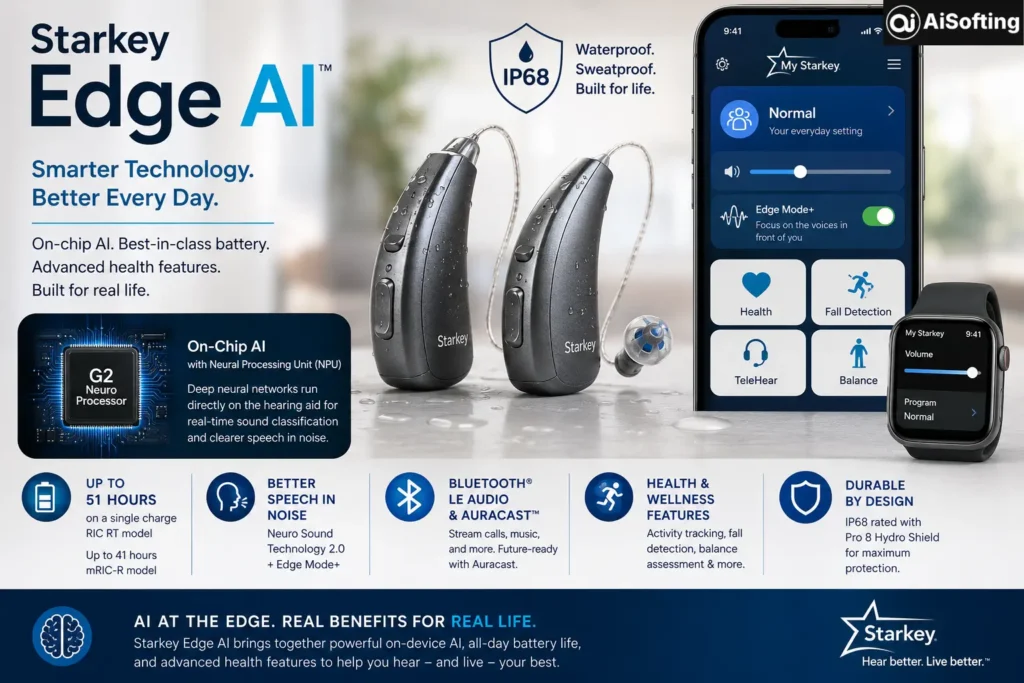
Starkey Edge AI is a hearing aid platform launched by Starkey in October 2024. It’s built around the company’s second-generation G2 Neuro Processor, which is notable for having a Neural Processing Unit (NPU) fully integrated into the chip something Starkey says makes it the first hearing aid to do this. That NPU is what allows the device to run a deep neural network (DNN) directly on the hearing aid itself, rather than relying on a paired phone or cloud server to do the heavy lifting.
That “on-device” processing is the “edge” in Edge AI. Instead of sending sound data somewhere else to be analyzed, the hearing aid classifies and cleans up sound in real time, right there in your ear, with no noticeable lag.
Edge AI has since been succeeded at the top of Starkey’s lineup by the Omega AI, released in October 2025, but Edge AI remains a strong mid-to-high tier option and still uses the same core G2 Neuro Processor architecture.
The Core Technology: Neuro Sound Technology 2.0
Starkey describes its sound processing approach as an attempt to mimic how the brain’s auditory cortex separates speech from background noise. In practice, this shows up as Neuro Sound Technology 2.0, which Starkey and independent reviewers report delivers roughly 30% better speech recognition accuracy compared to earlier Starkey generations, particularly in difficult environments like multi-talker “babble” noise (restaurants, parties, open offices).
A related feature, Edge Mode+, is an on-demand boost users can trigger (via app, button press, or tap) when they walk into a specifically noisy environment and want the device to prioritize the voice in front of them over everything else.
Battery Life That Actually Holds Up
One of the most consistently praised aspects of Edge AI, including in independent testing from HearingTracker, is battery life. The RIC RT model is rated for up to 51 hours on a single charge (about 44 hours with regular Bluetooth streaming), while the smaller mRIC-R model manages up to 41 hours. For context, many competing rechargeable hearing aids top out around 16–20 hours per charge, so this is a genuine differentiator rather than marketing fluff.
Durability and Build Quality
Edge AI carries an IP68 rating, the highest dust and water resistance rating currently used in hearing aids, and some sources note Starkey’s “Pro 8 Hydro Shield” adds additional protective layering on top of that baseline. It’s marketed as waterproof, sweatproof, and built for daily wear without babying it a meaningful consideration if you’re active, sweat a lot, or live somewhere humid.
Connectivity: Bluetooth LE Audio and Auracast
Edge AI moved away from Starkey’s older proprietary wireless protocol to standard Bluetooth Low Energy (LE) Audio. Practically, this means:
- Faster, more reliable pairing with phones and the My Starkey app
- Lower power draw during streaming (part of why battery life is so strong)
- Compatibility with Auracast, an emerging broadcast-audio standard that will let users stream directly from equipped TVs, airports, gyms, and public venues once those transmitters become common
Not every phone supports LE Audio yet, so devices without it fall back to Apple’s MFi protocol or ASHA (Android’s audio streaming standard) with slightly reduced functionality.
Health and Wellness Features Beyond Hearing
This is where Starkey has genuinely differentiated itself from competitors. The My Starkey app and onboard sensors support:
- Step counting and activity tracking
- Fall detection with automatic alerts to a designated contact
- A self-guided balance assessment, based on the CDC’s STEADI framework, that uses the hearing aid’s motion sensors to flag fall risk
- TeleHear virtual visits with your hearing care provider for remote adjustments
- Apple Watch control for volume and program changes
Given that people with hearing loss face a meaningfully higher fall risk, folding balance monitoring into a device they’re already wearing is a smart use of the hardware that’s already there.
Benefits at a Glance
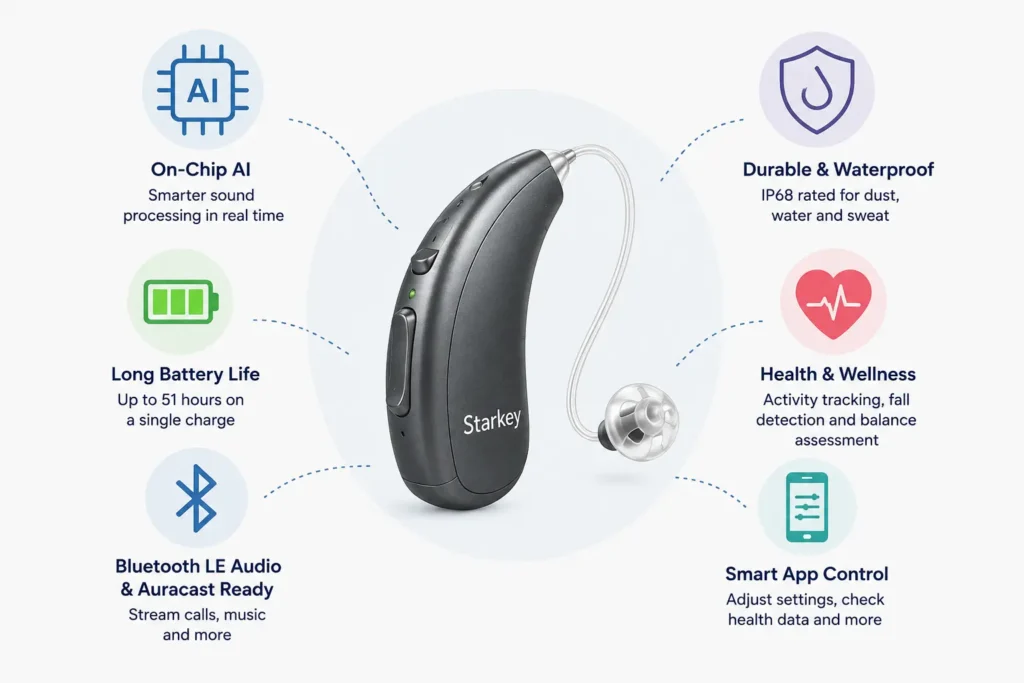
- Genuinely long battery life for a rechargeable hearing aid
- On-device AI processing means less lag and no dependence on an internet connection for core sound features
- Strong noise-in-speech performance, especially with Edge Mode+ engaged
- Rugged, high IP-rated build
- One of the most feature-rich companion apps in the industry
- Future-proofed with Auracast support
Common Mistakes People Make With Edge AI (or Any Advanced Hearing Aid)
- Skipping Real Ear Measurement (REM). Several reviewers, including Dr. Cliff’s assessment on HearingUp, note that Edge AI’s factory settings can under-amplify sound out of the box. REM verification by your provider is what actually calibrates the device to your specific hearing loss.
- Expecting instant perfection. Hearing aids are not glasses. Your brain needs time to relearn how to process amplified sound, and settings usually need a few rounds of real-world tweaking.
- Not using the app’s full toolkit. Many buyers use Edge AI purely as an amplifier and never touch the fall detection, balance assessment, or TeleHear features they’re already paying for.
- Ignoring phone compatibility for LE Audio. Some phones listed as “compatible” don’t actually support full LE Audio functionality, so don’t assume check your specific model.
Personal Experience: What Stood Out After Researching and Comparing Real User Feedback
After going through professional reviews, manufacturer documentation, and user testimonials for this piece, a few things kept coming up that are worth flagging honestly rather than just repeating marketing copy.
First, the battery life claim isn’t exaggerated. It’s the one spec that shows up as a genuine “wow” moment across nearly every independent review I found, including from audiologists who test multiple brands. If all-day (or two-day) reliability is your top priority, this is a legitimate reason to shortlist Edge AI.
Second, the pairing and setup experience seems to have improved noticeably compared to Starkey’s older models. One audiologist reviewer described pairing an iPhone in under a minute, without the usual back-and-forth of restarting apps and devices a small thing, but it matters a lot for older users or first-time hearing aid wearers who get frustrated easily with tech friction.
Third, and this is the honest caveat: the “AI” branding can create inflated expectations. The device is very good at classifying sound environments and boosting speech clarity, but it’s not magic it still requires a properly fitted, professionally programmed device to perform at its best. Multiple reviewers independently flagged that out-of-box settings tend to under-amplify, which tells me the real differentiator isn’t just the chip, it’s pairing that chip with a provider who actually does REM testing rather than just handing you the box.
Finally, the health features feel like the sleeper value here. Fall detection and balance assessment aren’t things most people think to ask about when buying a hearing aid, but for older adults or anyone with a family history of falls, that’s a meaningful bonus built into a device you’re already wearing anyway.
Best Practices If You’re Considering Edge AI
- Get a proper audiogram and speech-in-noise test before choosing a technology tier
- Insist on Real Ear Measurement during fitting
- Download and actually explore the My Starkey app rather than leaving features unused
- Ask your provider directly whether your phone supports full LE Audio
- Budget for the 60-day adjustment period most providers recommend
Frequently Asked Questions
Is Starkey Edge AI better than Starkey’s Omega AI?
No Omega AI, released in October 2025, is now Starkey’s flagship and includes newer refinements. Edge AI remains a strong, slightly more affordable option that still uses the same G2 Neuro Processor foundation.
How long does the battery actually last?
Up to 51 hours on the RIC RT model (about 44 hours with regular streaming), and up to 41 hours on the smaller mRIC-R model, according to Starkey’s published specs.
Are Starkey Edge AI hearing aids waterproof?
They carry an IP68 rating and are marketed as waterproof and sweatproof, though “waterproof” for hearing aids generally means resistant to sweat, rain, and brief submersion not designed for swimming.
Do I need a smartphone to use Edge AI?
No, the hearing aids function on their own, but the My Starkey app unlocks volume/program control, health tracking, fall detection alerts, and TeleHear virtual visits.
What is Auracast, and do I need it right now?
Auracast is a Bluetooth LE Audio broadcast feature that lets compatible venues (gyms, airports, theaters) stream audio directly to your hearing aids. Public Auracast transmitters are still rolling out, so think of this as future-proofing rather than an immediate everyday feature.
Will Edge AI work well right out of the box?
Not optimally. Several independent reviews note factory settings under-amplify sound compared to a properly programmed fitting. Real Ear Measurement by your provider is strongly recommended.
How much do Starkey Edge AI hearing aids cost?
Pricing varies by technology tier, provider, and bundled services (fittings, follow-ups, warranties), so it’s best to get a quote directly from a licensed hearing care provider or authorized Starkey retailer rather than relying on a single published number.
Conclusion
Starkey Edge AI earns its “AI” label more than most products that slap the term on for marketing purposes. The on-chip neural processing genuinely improves speech-in-noise performance, the battery life is best-in-class, and the health features add real value beyond hearing correction. That said, the technology only performs as well as the fitting behind it so the single most important decision isn’t the device, it’s finding a provider who will properly verify and adjust it for your specific hearing profile.
If you’re comparing options, use this as your action list: get a full hearing evaluation, ask specifically about Real Ear Measurement, confirm your phone’s Bluetooth capabilities, and explore the My Starkey app’s full feature set before deciding if Edge AI or a newer alternative like Omega AI is the right fit for your lifestyle and budget.
Explore more expert AI software reviews and insights at Aisofting
Disclaimer: This article is for general informational purposes only and does not constitute medical or audiological advice. Hearing aid suitability varies by individual hearing loss, lifestyle, and health conditions, so consult a licensed audiologist or hearing care provider before making a purchase decision. Product specifications and pricing are subject to change by the manufacturer.