If you’ve spent any time in the AI companion space lately, you’ve probably noticed it’s getting crowded. Character.AI, Replika, Candy AI, Moemate — the options multiply every few months. CaveDuck stands out, not because it invented something entirely new, but because it quietly refined what the category actually needs: deep character customization, multimodal interaction, multilingual support, and a community that genuinely creates rather than just consumes.
This guide covers everything — how CaveDuck works, what makes it meaningfully different from its competitors, where it falls short, and whether it deserves a place in your digital toolkit.
What Is CaveDuck AI?
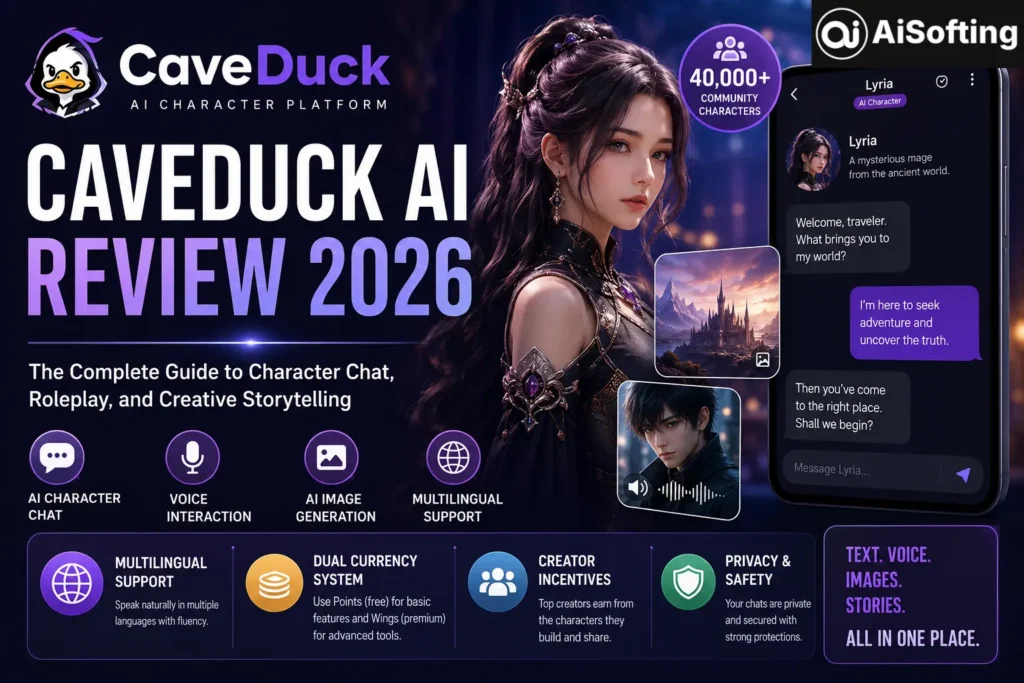
CaveDuck is an AI-driven character chat and creation platform where users can build custom digital personas, explore a library of 40,000+ community-created characters, and engage with them through text, voice, and generated images. It’s browser-based and available on iOS and Android, developed by a Korean team that has built the platform around multilingual accessibility from the ground up — which is rarer than it sounds.
The core pitch is simple: instead of talking to a generic AI assistant, you’re engaging with a character — one with a defined name, personality, backstory, tone, and even a visual appearance. Whether that character is a brooding fantasy knight, a cheerful language tutor, or something more intimate, the platform adapts to what you’re building rather than forcing you into a predefined template.
Under the hood, CaveDuck powers its conversations using large language models including Claude 3 Sonnet and GPT-4, which gives the dialogue a fluency and contextual depth that simpler platforms can’t match.
How CaveDuck Works: The Core Experience
Character Creation
Creating a character on CaveDuck takes under a minute at the basic level, but the system rewards patience. You set a name, define a personality through natural language prompts, add a backstory, assign a visual avatar (either from a library or AI-generated), and choose tags that categorize the character by genre and tone.
The more thoughtful your setup — the more clearly you define how the character speaks, what they remember, what they refuse — the better the actual conversation experience becomes. This is where CaveDuck separates casual users from people who get genuinely immersive results. The system reads your persona description as a kind of system prompt for the character, so specificity translates directly into consistency.
Chat and Memory
Conversations maintain context within a session, and the platform carries forward details you establish early — character history, in-world lore, relationship dynamics. During longer roleplay arcs, this narrative persistence is noticeably strong. If you tell the character your backstory in chapter one, it doesn’t forget by chapter five.
Long-term memory across separate sessions is less robust, and it’s one of the platform’s acknowledged weak points compared to Replika’s more mature relationship-tracking features. For users who want a companion that evolves over weeks and months, this is worth knowing before committing.
Multimodal Features: Voice and Images
Text is the backbone, but CaveDuck layers on voice (text-to-speech that gives each character an audible personality) and AI-generated images that respond to the roleplay scene. When a conversation reaches a visually significant moment — a setting, an action, an emotional beat — the system can generate an image that matches the context.
Voice options remain basic compared to voice-first platforms, and video generation isn’t a priority feature. But as a supporting layer to text-based storytelling, both the voice and image systems add genuine immersion rather than feeling like bolted-on extras.
The Points System: Understanding CaveDuck’s Economy
This is where new users most often get confused, so it’s worth explaining carefully.
CaveDuck doesn’t use a simple subscription model. It runs on a dual-currency system: Points (earned free through daily check-ins, referrals, and activity) for standard features, and Wings (purchased premium currency) for advanced AI models, image generation, and voice features.
Free users receive roughly 300–400 points daily, which provides meaningful access to the platform’s core chat functions using lighter models. The premium Plus plan runs approximately $11.99/month (with a $5.99 promotional first month), and Wings can also be purchased à la carte:
- 5,000 points: ~$4.99
- 10,000 points: ~$9.99
- 30,900 points: ~$29.99 (with a 3% bonus)
- 107,000 points: ~$99.99 (with a 7% bonus)
The honest assessment: light users who stick to text chat can get meaningful value from the free tier. Power users who want frequent image generation and premium model responses will spend more than they expect, partly because the Wings rate card isn’t prominently displayed. Know your usage patterns before buying a large bundle.
Where CaveDuck Genuinely Excels
Multilingual Support That Actually Works
Most AI companion platforms treat non-English as an afterthought — they offer translation, not native fluency. CaveDuck handles Japanese, Korean, English, and other languages as first-class experiences. Characters maintain their defined personality in whichever language you’re speaking, rather than producing English-translated dialogue that loses the character’s voice.
For users whose primary language isn’t English — a massive and underserved portion of the global AI companion market — this is a substantive differentiator, not a marketing bullet point.
The Creator Incentive Program
CaveDuck recently introduced a revenue-sharing model where top character creators earn a portion of Wings spent by users chatting with their characters. This is rare in the space. Character.AI, Replika, and most competitors keep the creative and financial value on the platform side. CaveDuck’s model means creators are motivated to build high-quality, well-maintained characters, which directly improves the experience for everyone.
The resulting ecosystem — 40,000+ characters and over 300,000 mobile reviews — reflects genuine community investment rather than a static library.
Content Flexibility
CaveDuck offers more permissive content policies than Character.AI, including adult content gated behind age verification (Safe Mode toggle, 18+ confirmation required). This isn’t for everyone, and it shouldn’t be evaluated purely as a selling point. But for users whose legitimate creative or companionship needs were frustrated by overly restrictive platforms, it represents a meaningful choice that adult users can make for themselves.
Where CaveDuck Falls Short
Long-term memory: The platform doesn’t yet offer robust cross-session memory. Your character won’t automatically “remember” conversations from three weeks ago the way a human relationship would evolve.
Pricing transparency: The Wings economy can surprise users who don’t research usage costs in advance. Heavy image generation or voice interactions drain premium currency faster than the free tier replenishes it.
Video: Candy AI introduced 120-second animated video features in early 2026. CaveDuck hasn’t matched this, and for users who prioritize visual immersion, that gap matters.
Server stability: Community feedback consistently mentions occasional server load issues during peak hours. For a platform where immersion is the point, unexpected slowdowns break the experience.
CaveDuck vs. Competitors: An Honest Comparison
CaveDuck vs. Character.AI: Character.AI has more sophisticated underlying models and a vastly larger user base. Its NSFW restrictions, however, frustrate users seeking mature or complex narratives. CaveDuck offers comparable intelligence for most creative use cases with significantly more creative freedom.
CaveDuck vs. Replika: Replika leads in long-term memory and emotional continuity — the “relationship that evolves” experience. CaveDuck leads in character variety, community creation, and multimodal features. They serve adjacent but distinct needs.
CaveDuck vs. Candy AI: Candy AI prioritizes a polished, user-friendly companion experience with strong visual features. CaveDuck offers deeper customization and better support for users who want to build characters, not just use them.
CaveDuck vs. Moemate: Moemate offers a comparable model menu but feels architecturally disconnected — different tools that don’t fully cohere. CaveDuck’s unified experience is more deliberately designed.
Who Should Actually Use CaveDuck
Writers and worldbuilders who want a character-development tool that talks back. Running a character through a conversation is genuinely useful for testing voice consistency and narrative logic.
Roleplay enthusiasts who find Character.AI’s restrictions limiting but want something more polished than unfiltered alternatives.
Language learners who benefit from multilingual character interactions that maintain conversational context across sessions.
Creators interested in monetization — the incentive program is one of the few genuine creator economy structures in the AI companion space.
Casual entertainment seekers who want something more personality-driven than a standard chatbot without investing in a premium subscription upfront.
CaveDuck is less suited to users who need persistent long-term relationship AI (Replika is better), users who prioritize video or photorealistic image quality (Candy AI leads here), or anyone primarily seeking a productivity-focused AI assistant.
My Experience with CaveDuck
I spent several weeks testing CaveDuck across different use cases — creative writing, language roleplay, and casual conversation — and came away with a nuanced view.
The first thing that struck me was how quickly the platform rewards investment in character setup. I built two characters: one hastily defined with minimal personality notes, one carefully crafted with a detailed backstory and explicit behavioral guidelines. The difference in conversation quality was dramatic. The carefully built character maintained voice consistency and surprised me with contextually appropriate narrative choices. The hastily built one felt generic after a few exchanges. The lesson: CaveDuck is a platform you get out of what you put in.
The multilingual experience was genuinely impressive. Testing in both English and Japanese, the character I built adapted without losing personality — it didn’t feel like a translation. For me, this was CaveDuck’s most underrated feature, one that most English-focused reviews gloss over because they never test it.
The points economy tripped me up initially. I assumed the free daily points would cover moderate image generation, and they didn’t — premium image features drained Wings faster than I expected. Once I mapped out my actual usage patterns, the cost made more sense, but the onboarding doesn’t help you do this calculation in advance.
The community character library is genuinely vast and varied, with quality ranging from impressively detailed to clearly rushed. Browsing trending characters gives a real sense of what’s possible; it’s both inspiring for your own creations and a useful shortcut when you want a well-developed persona without building one yourself.
Practical Tips for Getting the Most Out of CaveDuck
- Invest in character setup. Spend 10–15 minutes on personality notes, speaking style, and backstory. The character definition acts as a persistent prompt — quality in, quality out.
- Use the free tier strategically. Daily check-ins maintain your point balance. If your usage is primarily text chat with lighter models, the free tier is genuinely functional.
- Browse trending characters before building. Understanding what the community creates well will shape how you approach your own character creation.
- Test multilingual features if that’s relevant to you. This is CaveDuck’s most underappreciated differentiator.
- Track your Wings usage in the first week. Understand your consumption rate before purchasing large bundles.
- Join the Discord. The active community shares character creation strategies, image prompting techniques, and flags platform updates faster than official documentation.
The Broader Landscape: Where AI Companion Platforms Are Heading
CaveDuck’s creator incentive model hints at something important: the next phase of AI companion platforms will be community economies, not just content libraries. Platforms that create genuine value loops between creators and users will develop more diverse, higher-quality character ecosystems than those that keep all creative control centralized.
The multimodal direction — integrating text, voice, and image into a seamless experience — is clearly the roadmap for the category. CaveDuck is further along on text and image coherence than most competitors; voice remains a gap relative to voice-first platforms.
Long-term memory and relationship continuity are the hard problems. The platforms that solve persistent memory across sessions — building AI relationships that actually evolve over months — will define the category’s ceiling. CaveDuck acknowledges this gap; whether it closes it first remains to be seen.
Frequently Asked Questions
What is CaveDuck AI?
CaveDuck is a web and mobile platform for creating, chatting with, and sharing AI characters. Users can build custom personas with defined personalities and backstories, or explore 40,000+ community-created characters, interacting through text, voice, and AI-generated images.
Is CaveDuck free to use?
Yes. CaveDuck offers a free tier with daily points (roughly 300–400 per day) for basic chat using lighter AI models. Premium features — including advanced models, image generation, and voice — require Wings (premium currency) or a paid plan starting around $11.99/month.
What AI models does CaveDuck use?
CaveDuck powers conversations using models including Claude 3 Sonnet and GPT-4, providing contextually aware, fluent dialogue appropriate for roleplay and creative storytelling.
Is CaveDuck available on mobile?
Yes. CaveDuck is accessible via web browser and has native iOS and Android apps.
Does CaveDuck support NSFW content?
Adult content is available in an age-gated zone behind a Safe Mode toggle, requiring users to confirm they are 18+. It is off by default and must be explicitly enabled.
How does the Creator Incentive Program work?
Creators earn a share of Wings spent by users chatting with their characters. This revenue-sharing model rewards high-quality character creation and is one of the few genuine creator economy structures in the AI companion space.
How does CaveDuck compare to Character.AI?
CaveDuck offers more flexible content policies and comparable conversation quality for most creative use cases. Character.AI has a larger user base and potentially stronger underlying models, but stricter content restrictions. The right choice depends on whether content flexibility or raw model quality is your priority.
Is CaveDuck safe for younger users?
The platform includes built-in moderation tools and community reporting features. Adult content requires explicit age verification and is hidden by default. As with any online platform, CaveDuck is best suited for adult users; parents should supervise younger users accordingly.
What makes CaveDuck different from Replika?
Replika focuses on a single evolving companion with long-term emotional memory — a “relationship that grows over time.” CaveDuck offers a much broader character ecosystem and creative tools, but currently trails Replika in cross-session memory and relationship continuity.
Can I make money on CaveDuck?
Yes, through the Creator Incentive Program. Top character creators earn revenue based on user engagement with their characters. The specific terms and rates are available through the platform’s official documentation and Discord community.
Conclusion
CaveDuck has carved out a legitimate position in a crowded market by focusing on the things that make character-based AI chat actually work: deep customization, community creation, multimodal interaction, and multilingual support that isn’t an afterthought.
Key takeaways:
- CaveDuck rewards users who invest in thoughtful character setup — it’s a creative tool, not a vending machine.
- The multilingual experience is genuinely differentiated and consistently underrated in English-language reviews.
- The Creator Incentive Program is one of the most forward-thinking economic models in the AI companion space.
- The free tier is functional for text-focused users; heavy image or voice usage costs more than casual browsing suggests.
- Long-term memory and relationship continuity remain the platform’s most significant gap relative to Replika.
For writers, roleplayers, language learners, and anyone who wants more personality from their AI interactions, CaveDuck delivers a genuinely worthwhile experience — particularly if you’re willing to spend a few minutes building something rather than just consuming it. Try the free tier for two weeks, create at least one character yourself, and you’ll have a clear answer on whether it’s the right fit.
Please visit Aisofting for more interesting AI-related articles and insights.