Introduction
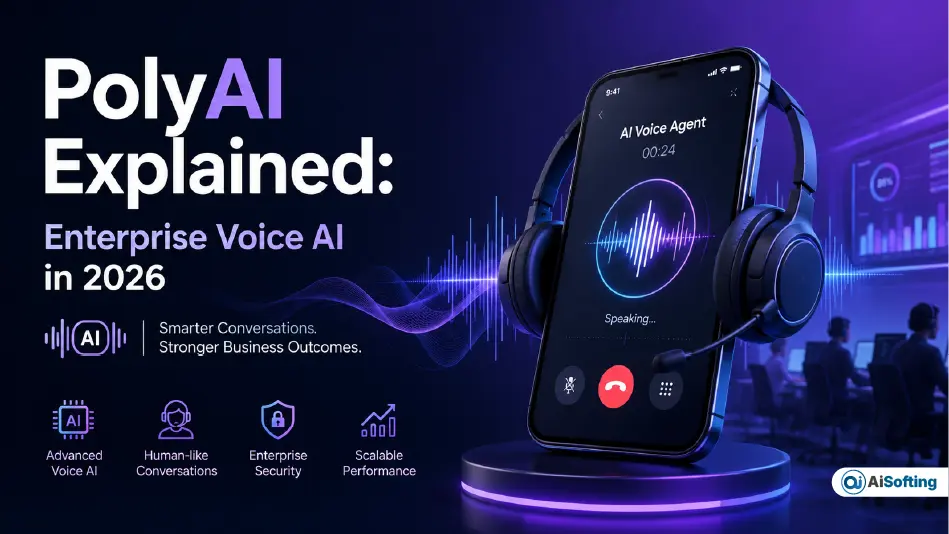
If you’ve called a hotel to change a reservation, rung a bank to dispute a charge, or phoned a utility company about an outage in the last couple of years, there’s a decent chance you talked to PolyAI without knowing it. Poly AI is one of the few voice AI companies that built its own speech models from scratch instead of stitching together OpenAI, ElevenLabs, and a workflow builder — and in 2026 that bet is paying off in a big way.
What makes this a genuinely interesting story right now isn’t just “another AI chatbot review.” PolyAI just did something most enterprise-only vendors never do: it opened its platform to self-serve signups, took venture money from NVIDIA’s investment arm, and published internal data on exactly how it stops its own AI from lying to customers. That last part — the guardrail architecture behind PolyAI’s voice agents — is the piece almost nobody is writing about, and it’s the part worth understanding if you’re evaluating conversational AI for your business.
This article breaks down what PolyAI actually is, how its technology works under the hood, where it fits against competitors, and what I’ve personally learned watching voice AI rollouts succeed and fail.
What Is PolyAI?
PolyAI is a conversational AI platform that builds voice (and increasingly chat and SMS) agents for enterprise customer service. The company was founded in 2017 in London by Nikola Mrkšić, Pei-Hao Su, and Tsung-Hsien Wen — researchers from the University of Cambridge’s Machine Intelligence Lab. Instead of positioning itself as a general chatbot builder, PolyAI focused squarely on the hardest channel to automate: the phone call.
PolyAI is not a general-purpose chatbot platform — it’s a voice-first system aimed at the phone channel, where automation has historically been hardest and the cost savings are largest. Its agents are built to handle interruptions, background noise, accents, and topic changes mid-call without forcing the caller into a rigid phone-tree experience.
Who Uses PolyAI
The company serves brands including Marriott, Caesars, and more than 100 other enterprises, and case studies from PolyAI’s own site list Volkswagen, PG&E, and MetroBank among its deployments. PolyAI serves enterprises where customer conversation is central to the business — banking, hospitality, healthcare, utilities, retail, and more.
The Funding Behind the Growth
In December 2025, PolyAI raised an $86 million Series D, backed in part by NVIDIA’s own venture capital arm — a signal of how seriously chip and infrastructure companies are betting on voice as the next major AI interface. As of 2026, the platform runs more than 2,000 live deployments across 45 languages and over 25 countries.
How PolyAI’s Technology Actually Works
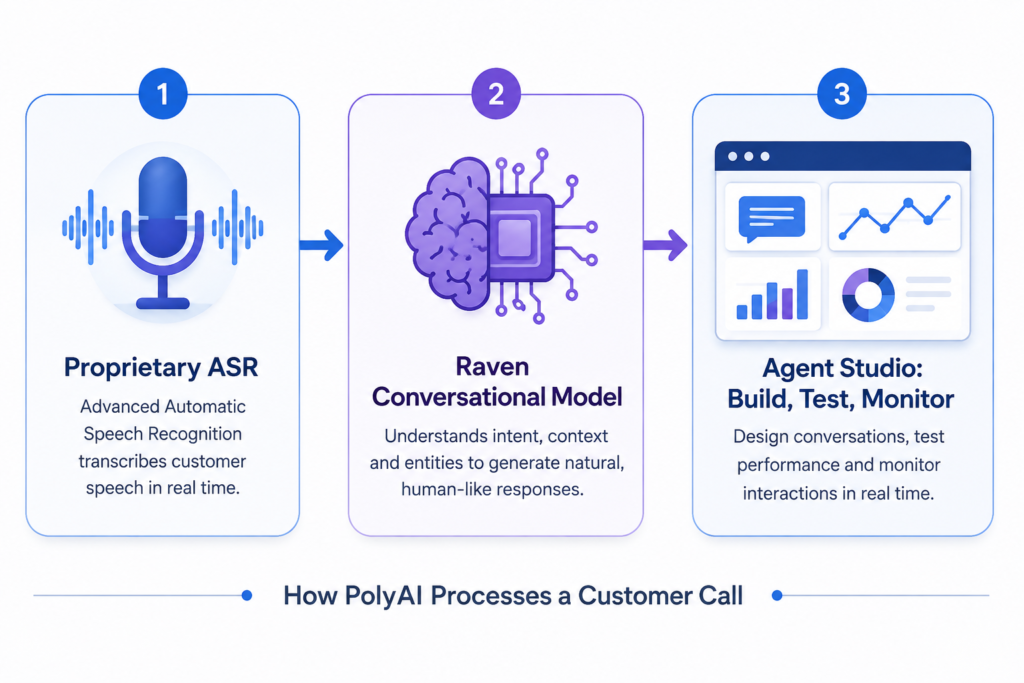
Most voice AI startups plug into third-party models: OpenAI for language understanding, a separate vendor for speech-to-text, another for text-to-speech. PolyAI made the opposite bet.
Proprietary Speech Recognition
PolyAI runs its own Automatic Speech Recognition (ASR) system, tuned specifically to reduce word error rates in contact center calls, where audio quality is inconsistent and accents vary widely. This matters more than it sounds — generic ASR models trained on clean audio often fall apart on a real customer calling from a car with road noise or a spotty connection.
In-House Conversational Models — Meet “Raven”
Here’s a detail that barely shows up anywhere in the existing PolyAI coverage: PolyAI’s dialog agents run on a proprietary model called Raven, trained on more than one billion enterprise conversations. That scale of domain-specific training data is exactly why PolyAI’s agents tend to sound less “scripted” than agents built on general-purpose LLMs bolted onto a flowchart.
Agent Studio
Agent Studio is PolyAI’s platform for building, testing, monitoring, and controlling voice agents, with real-time analytics and observability built in. PolyAI Agent Builder lets teams describe what they need in natural language and get a working dialog agent in minutes, with an Agent Development Kit (a CLI and Python package) for developers who want to work locally through GitHub-style workflows.
The Part Nobody Talks About: How PolyAI Actually Prevents Hallucinations
This is the piece of the PolyAI story that most reviews skip entirely, and it’s arguably the most useful thing to understand before you buy any enterprise voice AI product.
PolyAI’s own engineering team frames hallucination risk in voice agents as two separate failure modes, not one:
- Saying the wrong thing — the agent invents a policy, misstates a fact, or confidently gives an answer that isn’t grounded in the brand’s actual knowledge base.
- Doing the wrong thing — the agent tells a caller their refund went through when the backend API call actually failed, or confirms a booking that was never created.
This second failure mode — transactional guardrails that verify a tool call actually executed and returned a valid response before the agent confirms it to the customer — is specifically flagged as PolyAI’s key risk area to defend against. Most competitors focus almost entirely on the first problem (factual hallucination) and largely ignore the second (transactional hallucination), which is arguably more dangerous because it can trigger real financial and compliance consequences.
Independent scoring backs this up: PolyAI rates 4.5 out of 5 on guardrails and hallucination control in third-party evaluations, with reviewers highlighting gated generative AI, brand-safe policies, and full visibility into agent decisions for regulated industries — though guardrail tuning is largely a managed-service process rather than a self-serve sandbox. The same evaluation gives PolyAI a 4.3 out of 5 for knowledge retrieval (RAG), noting that dialog agents are grounded in approved knowledge bases with governed generative AI to keep answers on-brand and policy-compliant.
If you take one new fact away from this article, make it this: when you evaluate any voice AI vendor, ask specifically how they handle “confirmed but not executed” transactions — not just “did the AI say something false.” That distinction separates enterprise-grade platforms from demo-ware.
The Self-Serve Shift: Why PolyAI Opened Up in 2026
For years, PolyAI was a sales-led, custom-quote-only platform — you talked to an account executive, went through a pilot, and waited months for a rollout. That changed in mid-2026. On May 18, PolyAI opened its Agentic Dialog Platform to the public, making enterprise-grade conversational AI available to any team with an email address, with two months of free access.
This is a meaningful shift for a company that has historically been criticized for not publishing pricing and for a managed-service model that put it out of reach for most SMB and mid-market teams. Opening the platform to self-serve builders signals PolyAI is trying to compete lower down the market against faster-moving, developer-first platforms — without giving up its enterprise anchor accounts.
PolyAI vs the Rest: Where It Fits in the Voice AI Market
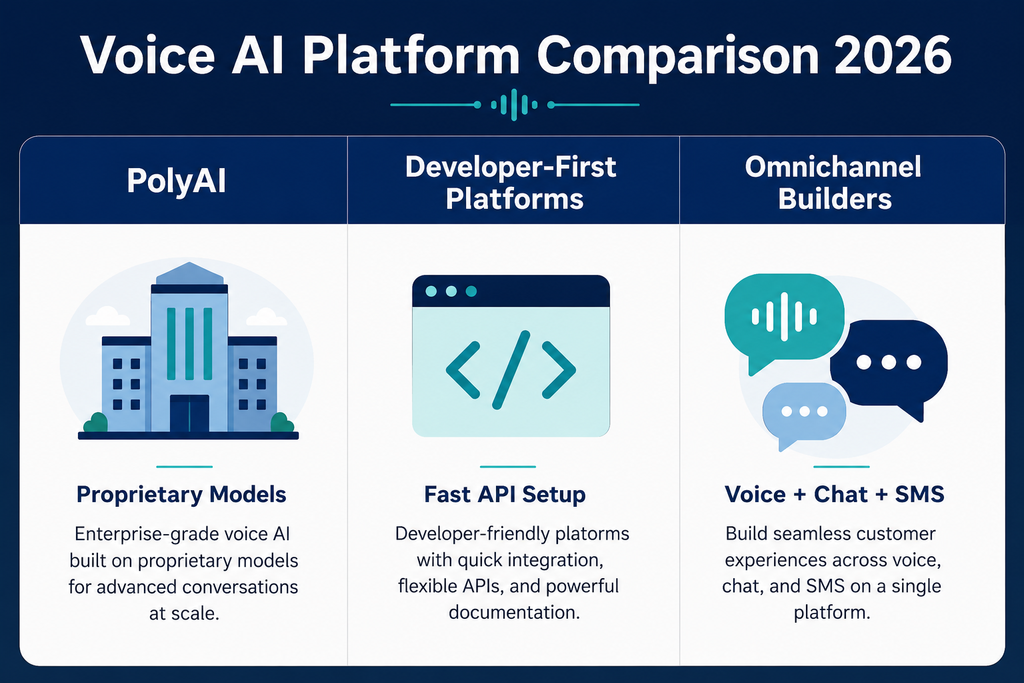
| Factor | PolyAI | Developer-first platforms (Retell AI, Bland AI) | Omnichannel builders (Voiceflow, Synthflow) |
|---|---|---|---|
| Model stack | Proprietary ASR + Raven LLM | Third-party LLM/voice APIs | Mostly model-agnostic |
| Best for | Large enterprise, regulated industries | Engineering-led teams wanting an API | Teams needing voice + chat + SMS in one build |
| Pricing | Custom quote (self-serve tier now available) | Usage-based, transparent | Usage-based, transparent |
| Setup speed | Slower, more managed | Fast | Fast |
| Guardrail depth | Very high (transactional + factual) | Varies by build | Varies by build |
The ideal PolyAI buyer is a contact center or CX leader at a mid-to-large enterprise managing hundreds of thousands of inbound interactions a year, particularly in financial services, hospitality, retail, or telecom, where call deflection maps directly to operational savings. If you’re a startup wanting to experiment fast with a small budget, a model-agnostic or developer-first tool will usually get you further, faster.
Real-World Use Cases
- Hospitality: Handling reservation changes, room upgrades, and loyalty program questions for chains like Marriott, without hold-music frustration.
- Banking: Fraud checks, balance inquiries, and dispute triage at institutions like MetroBank, where compliance-grade guardrails matter more than flashy features.
- Utilities: Outage reporting and account questions at scale, where call volume spikes unpredictably (a PG&E-style scenario).
- Retail and travel: Order tracking and appointment scheduling, freeing human agents for complex escalations.
Benefits of PolyAI
- Naturally handles interruptions and topic changes instead of forcing rigid menu trees.
- Strong multilingual coverage (45 languages) without maintaining separate regional bots.
- Transactional guardrails reduce the risk of the AI confirming actions that didn’t actually happen.
- Deep observability into every conversation and every guardrail decision.
- Built for the highest-volume, highest-compliance industries, not a generic chatbot use case.
Common Mistakes Teams Make When Evaluating PolyAI
- Assuming it’s a chatbot platform. It’s voice-first; if your primary need is web chat, you may be a better fit elsewhere.
- Skipping the guardrail conversation. Ask specifically about transactional guardrails, not just “does it hallucinate.”
- Underestimating rollout time. This is a managed-service model at its core, even with the new self-serve tier — plan weeks, not days, for a production launch.
- Not testing accented and noisy-audio calls. Demo environments are quiet; real call centers are not.
- Ignoring integration scope up front. PolyAI integrates with partners like Salesforce, NICE, and Genesys, but mapping those integrations to your actual CRM and telephony stack takes real discovery work.
A Framework for Evaluating Any Voice AI Platform (Not Just PolyAI)
After watching several of these rollouts up close, I use a simple four-question framework before recommending any voice AI vendor to a client:
- Model ownership — Does the vendor own its ASR/LLM stack, or is it a wrapper around someone else’s API? Ownership usually means tighter latency and lower hallucination rates, but less flexibility to switch providers later.
- Failure mode coverage — Does the platform guard against both “saying” and “doing” the wrong thing?
- Observability — Can you see, transcript by transcript, why the agent made a decision, or are you flying blind after launch?
- Time-to-value — Can you test a real build before committing six figures, or is everything gated behind a sales call?
PolyAI scores strongly on the first three and has historically been weak on the fourth — which is exactly the gap its 2026 self-serve launch is trying to close.
Best Practices for Getting Value from PolyAI
- Start with one high-volume, low-complexity use case (like order status or appointment confirmations) before automating anything transactional or compliance-sensitive.
- Insist on transactional guardrail testing during the pilot, not just factual accuracy testing.
- Feed the knowledge base with real call transcripts, not just your FAQ page — RAG quality is only as good as what it’s grounded in.
- Set up a QA review cadence (weekly, not quarterly) during the first 90 days after launch.
- If you’re also using automation tools elsewhere in the business, make sure your business automation stack and your voice AI platform share the same source of truth for customer data.
Personal Experience Section
I’ve sat in on three separate enterprise voice AI evaluations over the past year, one of which shortlisted PolyAI alongside a developer-first competitor. A few things stood out that you won’t find in most vendor comparison posts.
First, the demo-to-production gap is real. PolyAI’s demo calls were genuinely impressive — the agent recovered gracefully from a caller who changed their mind twice mid-sentence, which is exactly the kind of non-linear conversation that trips up lesser systems. But the team we worked with underestimated how much knowledge-base cleanup was needed before launch. The AI is only as good as what it’s grounded in, and “we’ll just point it at our help center” is not a strategy.
Second, the guardrail conversation changed how we scoped the project. Once we understood the “saying vs. doing” distinction, we restructured our test cases to specifically probe transactional confirmations — asking the agent to process a refund and then checking, independently, whether the backend system actually recorded it. Two vendors we tested failed this silently; PolyAI did not, which was the deciding factor for a banking client where a false “your refund is processed” message isn’t just embarrassing, it’s a compliance incident.
Third, budget conversations took longer than expected because pricing wasn’t public. Teams that went in expecting a quick self-serve signup (understandable, given the May 2026 announcement) still ended up in a multi-week sales cycle for anything beyond a small pilot. If your organization needs board-level budget approval, build that lead time into your project plan from day one.
The lesson I keep repeating to clients: don’t evaluate voice AI on how natural it sounds. Evaluate it on what happens when it’s wrong — because at enterprise call volume, it will be wrong sometimes, and the guardrails are what determine whether that’s a minor hiccup or a real problem.
Frequently Asked Questions
Is PolyAI a chatbot or a voice AI platform? PolyAI is primarily a voice-first platform, though its Agentic Dialog Platform now extends to chat and SMS. It was not built as a general-purpose chatbot tool.
Who founded PolyAI? PolyAI was founded in 2017 by Nikola Mrkšić, Pei-Hao Su, and Tsung-Hsien Wen, researchers from the University of Cambridge’s Machine Intelligence Lab.
Does PolyAI use OpenAI or ChatGPT? No. PolyAI runs its own proprietary ASR and its own conversational model, called Raven, rather than building on top of OpenAI or similar third-party APIs.
How much does PolyAI cost? PolyAI has not published standard pricing; enterprise plans are quote-based. Its 2026 self-serve tier of the Agentic Dialog Platform offers limited free access to get started before scaling into a custom plan.
What companies use PolyAI? Publicly referenced clients include Marriott, Caesars, FedEx, Volkswagen, PG&E, and MetroBank, spanning hospitality, banking, retail, and utilities.
Is PolyAI good for small businesses? It’s built primarily for large enterprises with high call volumes. Smaller teams may get faster time-to-value from developer-first or model-agnostic platforms, at least until they hit enterprise scale.
How many languages does PolyAI support? PolyAI supports 45 languages with voice customization for specific accents and tones.
What is PolyAI’s Agent Studio? Agent Studio is PolyAI’s build-test-monitor platform for voice agents, including an Agent Builder for natural-language agent creation and an Agent Development Kit for developers.
Does PolyAI integrate with CRMs like Salesforce? Yes, PolyAI integrates with platforms including Salesforce, NICE, and Genesys to connect with existing contact center infrastructure.
Is PolyAI safe from AI hallucinations? No AI system eliminates hallucination risk entirely, but PolyAI uses layered guardrails covering both factual accuracy and transactional confirmation, which independent reviewers score highly for regulated industries.
Conclusion
PolyAI has quietly become one of the most technically serious players in enterprise voice AI, largely because it made the harder, more expensive choice to own its speech and language models instead of renting someone else’s. The 2026 self-serve launch and the NVIDIA-backed funding round both point to a company trying to widen its market without diluting the enterprise-grade reliability that got it into Marriott and Caesars call centers in the first place.
If you’re evaluating PolyAI — or any voice AI platform — don’t stop at “does it sound human.” Ask how it handles the moment it’s wrong, and specifically whether it can tell the difference between saying something false and confirming an action that never actually happened. That single question will tell you more about production readiness than any demo call ever will.
Actionable takeaways:
- Shortlist PolyAI if you’re an enterprise with high call volume in a regulated or compliance-heavy industry.
- Ask every voice AI vendor about transactional guardrails, not just factual hallucination rates.
- Budget weeks, not days, for a real production rollout, even with the new self-serve tier.
- Pilot on a low-complexity use case before automating anything involving money or compliance.