Something changed in the last two years, and I don’t think it’s my imagination. I open a search result, a “top 10” listicle, a LinkedIn post, or even a YouTube explainer, and within the first three sentences I already know how it’s going to end. Same rhythm. Same hedge words. Same hollow conclusion that says nothing while sounding like it said everything.
That feeling has a name now: AI slop. It’s not just a meme or a complaint from cranky writers who miss typing everything themselves. It’s become a measurable, tracked, and actively fought phenomenon inside Google, YouTube, Meta, and even niche search engines like Kagi. And honestly, the boredom isn’t a side effect — it’s the whole problem. Slop isn’t offensive or wrong most of the time. It’s just nothing. It fills space without giving you a single reason to remember it existed.
This article isn’t another rehash of “AI content is bad, use humans instead.” I want to walk through what’s actually happening under the hood in 2026 — the detection systems, the traffic collapses, the tools built to fight slop, and what separates content that still feels alive from content that reads like it was squeezed out of a template. I’ll also share what I’ve noticed firsthand editing and auditing AI-assisted content for the past year, including mistakes I’ve made myself.
What Exactly Is “AI Slop”?
The term borrows from “slop” as in low-grade animal feed — something produced cheaply, in bulk, with zero care about the final product. Applied to content, AI slop generally means text, images, or video that is:
- Mass-produced with little to no human review
- Structurally repetitive (same headings, same intro pattern, same “in conclusion”)
- Devoid of new facts, data, or opinion — it just rephrases whatever already ranks
- Optimized purely to fill a keyword gap, not to answer a real question
The key distinction most people miss: slop isn’t defined by the tool, it’s defined by the intent and the outcome. Google’s own search liaison has said publicly that the company isn’t “anti-AI,” it’s “anti-crap.” A human can write slop too — thin, recycled, keyword-stuffed pages existed long before ChatGPT. AI just made it possible to produce that same emptiness at a scale no content farm could touch in 2015.
The Numbers Behind the Fatigue
This is where it gets interesting, because the data backs up the gut feeling:
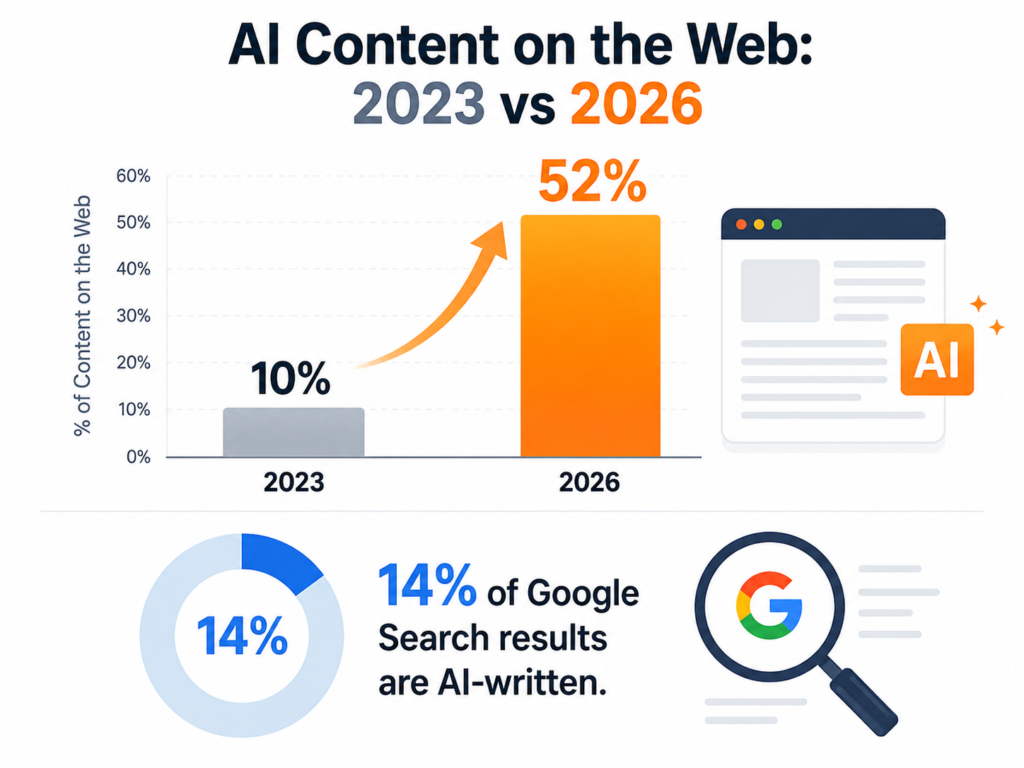
- Independent research trackers estimate that AI-generated content grew from roughly 10% to over 50% of new web content in about three years — a genuinely wild shift in how the web gets built.
- Despite that flood, only around 14% of actual Google Search results are estimated to be AI-written, which tells you Google’s filters are already doing real work — the slop that gets rejected from search doesn’t disappear, it just floods somewhere else: YouTube, Pinterest, Facebook groups, and low-authority blogs.
- YouTube’s own CEO named “managing AI slop” a top company priority for 2026, which is a remarkable admission from a platform that also profits from AI-generated uploads.
- A peer-reviewed mixed-methods study on biomedical educational videos found that roughly 5.3% of screened YouTube and TikTok videos in a health-related search sample were judged to be AI-generated and low quality — small in percentage, but concerning given the subject matter involved medical information people rely on.
None of this is abstract anymore. It’s tracked, published, and increasingly automated on both sides — the side making the slop and the side hunting it down.
Why AI Slop Is So Boring (Not Just Bad)
Bad content used to be at least distinctly bad — a rambling forum post, a poorly translated product page, an overly salesy article. AI slop is worse in a specific way: it’s competently mediocre. Grammatically clean, formatted correctly, technically “readable” — and completely forgettable.
A few reasons this specific flavor of boredom hits so hard:
1. Zero Information Gain
Google’s February 2026 core update leaned hard into a concept called Information Gain — essentially asking, “does this page say anything the top five existing results don’t already say?” If your article just rephrases Wikipedia or the current top-ranking page in different words, its information gain is zero. And increasingly, its ranking is zero too.
2. Predictable Structure
Once you’ve read fifty AI-written listicles, you can predict the sixth paragraph before you open the article. The brain checks out because there’s no unpredictability — and unpredictability is a huge part of what makes writing (or any content) engaging.
3. No Point of View
Slop rarely disagrees with anything. It rarely says “actually, I think most advice on this topic is wrong because…” It hedges everything into a soup of “it depends” and “there are many factors to consider,” which sounds safe but reads as hollow.
How Google, YouTube, and Others Are Actually Fighting It in 2026
This is the part most “AI slop” articles skip, and it’s the most useful thing to understand if you create content for a living.
The Coordination Signal
In mid-2026, Google published research — titled around scalable detection of adversarial synthetic content and coordinated media abuse — that shifted the entire framing of how slop gets caught. The core idea: the trigger isn’t “was this written by AI,” it’s coordination. Google’s systems increasingly look for clusters of accounts or domains mass-producing near-identical templated material to game rankings. A single AI-assisted article isn’t the target. A network of 500 near-identical AI-generated pages publishing on the same schedule absolutely is.
This matters because it means the old strategy — “just make the AI output sound more human and you’re safe” — doesn’t fully work anymore. The system is watching patterns across content, not just sentence-level phrasing.
Real Enforcement, Real Traffic Loss
Google’s scaled content abuse policy, folded into core ranking since 2024, was named as a primary target in the March 2026 core update. Sites publishing AI content at scale reportedly saw 50% to 80% of their organic traffic disappear within about two weeks of the update rolling out. That’s not a slap on the wrist — that’s a business-ending event for a content farm.
Consumer-Facing Slop Filters
The fight isn’t only happening on the backend. Kagi, the paid search engine, launched a community feature called “SlopStop” that lets users manually flag AI slop they encounter in search results. Independent browser extensions like AI Slop Meter now score search results in real time for how “human” they appear, flagging known content-farm domains automatically. This is a genuinely new development compared to a couple of years ago: readers are no longer passive. They have tools to push back, and they’re using them.
What Separates Genuinely Useful AI-Assisted Content From Slop
I want to be clear: AI-assisted content is not the enemy here. Plenty of excellent, well-researched writing today is drafted, outlined, or edited with AI tools. The difference is in what gets added on top of the draft.
Best Practices
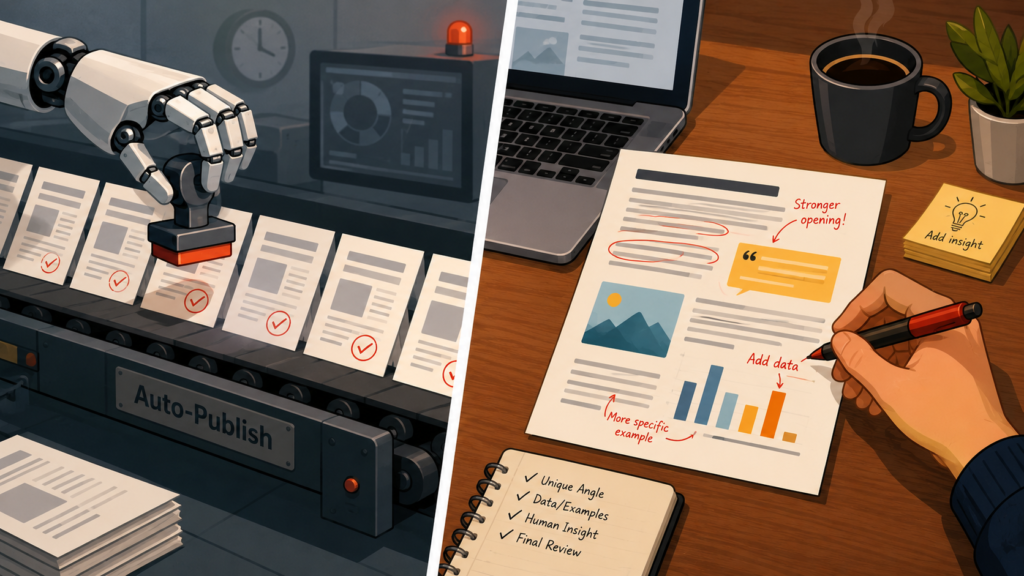
- Bring a real data point. A proprietary survey, an original chart, a small experiment — even something modest counts as information gain.
- State an actual opinion. “Most guides recommend X, but in practice we found Y works better because Z” is worth more than ten paragraphs of neutral summary.
- Cite primary sources, not other blog summaries. Link to research papers, official documentation, or government data instead of another article that itself summarized something else.
- Edit for voice, not just grammar. Read your draft out loud. If it sounds like it could have been published on fifty other sites with the brand name swapped out, it needs another pass.
- Vary your structure. Not every article needs the exact same five-heading skeleton. Predictability is efficient but forgettable.
Common Mistakes That Create Slop
- Publishing AI output with zero fact-checking or personal review
- Chasing keyword volume instead of answering the actual question a searcher has
- Reusing the same intro and conclusion template across dozens of articles
- Skipping real examples in favor of generic, hypothetical ones
- Treating AI as a replacement for expertise instead of a tool that speeds up an expert
Personal Experience: What I’ve Learned Auditing AI-Assisted Content
Over the last year, I’ve reviewed and edited a large volume of AI-drafted content for clients trying to scale their blogs — and I’ve made almost every mistake on that list myself early on.
The first thing that hit me was how fast slop becomes obvious once you’ve read enough of it. I can now spot an unedited AI draft within the first two sentences, usually because of a specific rhythm: a broad claim, followed by “and this matters because,” followed by a hedge. It’s not that the sentence is wrong. It’s that I’ve read that exact shape hundreds of times.
The second thing I learned is that adding a genuine opinion changes everything about how content performs — and reads. On one client site, we rewrote a generic “best practices” article to include a section where we openly disagreed with a popular but outdated recommendation in the niche, backed by a small before/after test we’d run ourselves. That single section did more for engagement and time-on-page than the rest of the six-page article combined. It wasn’t longer. It was just the only part that sounded like a person had actually done something.
The third lesson was uncomfortable: some of my earliest AI-assisted work was slop, and I didn’t notice until I re-read it months later. It ranked for a while, then quietly dropped after a core update — right around when Google’s scaled content abuse enforcement tightened. That was a wake-up call. Volume without substance is a loan you eventually have to repay, usually at a bad interest rate.
What’s worked since is treating AI the way I’d treat a very fast, very well-read intern: great for a first draft, a structure, or research summarization, but never the final word on anything I want a reader to trust.
Frequently Asked Questions
What does “AI slop” actually mean? AI slop refers to mass-produced, low-effort AI-generated content — text, images, or video — that adds no new value, expertise, or original data beyond what already exists online.
Does Google penalize all AI-generated content? No. Google’s official policy targets low-quality, spammy content regardless of how it was produced, not AI usage itself. Human-written thin content is treated the same as AI-written thin content under its scaled content abuse policy.
How can I tell if content I’m reading is AI slop? Watch for repetitive sentence structures, vague hedging language, no cited data or sources, generic examples, and conclusions that restate the introduction without adding anything new.
Is using AI to write content always bad for SEO? No. AI-assisted content that’s fact-checked, edited for voice, and includes original insight or data can perform well. The risk comes from publishing unedited, templated AI output at scale.
What is Google’s “Information Gain” concept? It’s the idea that a page should offer something the current top-ranking results don’t already provide — new data, a distinct opinion, or firsthand expertise — rather than simply rephrasing existing content.
Why is AI slop showing up more on YouTube and social media than in Google Search? Google’s filters increasingly catch and demote low-quality AI content in search, but that same content often gets redirected to platforms with lighter moderation, which is why YouTube and social feeds have seen a visible rise in slop.
Are there tools that detect AI slop for regular readers, not just SEOs? Yes. Browser extensions score search results for AI-generated patterns in real time, and platforms like Kagi let users manually flag suspected slop through community features.
Can small websites compete with AI content at scale? Often yes, precisely because scale is now a liability rather than an advantage. A smaller site with genuine expertise and original data can outperform a content farm that Google’s coordination-detection systems are actively trying to suppress.
Conclusion: The Boredom Is the Signal
AI slop isn’t dangerous because it’s malicious — it’s damaging because it’s forgettable, and a web full of forgettable content erodes trust in everything, including the good stuff sitting right next to it. The upside is that 2026 is shaping up to be the year the correction actually arrives: search engines are getting better at spotting coordinated, templated output, readers have tools to flag it themselves, and the sites still winning are the ones willing to add something a language model can’t invent on its own — real experience, real data, real opinions.
Actionable takeaways:
- Use AI to draft and structure, but never to finish
- Add at least one original data point, test, or opinion to every piece you publish
- Read your own content out loud before shipping it — if it sounds interchangeable, revise it
- Watch for coordination-style enforcement, not just phrasing-level AI detectors
- Treat “boring” as a real quality signal, not just a vibe
If you want to go deeper on how AI is reshaping visibility in search and how brands can stay ahead of it without falling into the slop trap, see our guide on improving brand visibility in AI search engines and our breakdown of AI search analytics with Ziptie. If you’re refining how your business uses AI internally before it ever reaches a reader, our piece on AI business context refinement is a useful next step.