Introduction
Most AI tools pick one lane: you’re either a chat assistant or a marketing automation platform, rarely both. Okara AI takes an unusual dual-product approach, and once you understand why, it actually makes sense. On one side, it’s a privacy-focused AI chat platform giving you access to dozens of open-source models in a single encrypted workspace. On the other, it’s positioned as an “AI CMO” — a marketing agent that builds a strategy off your own website and runs a roster of specialized agents to draft the actual work.
If you’ve come across okara ai while comparing privacy-first alternatives to ChatGPT, or while researching AI tools that promise to replace a chunk of what a marketing team or agency does, this guide breaks down what each product actually does, what it costs, where it genuinely delivers, and what I noticed testing it against the claims.
What Is Okara AI?
Okara is a dual-product AI platform developed for founders, small marketing teams, and privacy-conscious professionals. Founded in 2023, the company introduced its AI CMO agent in 2025, which then formally launched in March 2026 with an announcement that reportedly pulled in over 3 million views on X within four hours — a strong early signal of demand in a crowded AI-tools market.
Product One: Privacy-First Multi-Model AI Chat
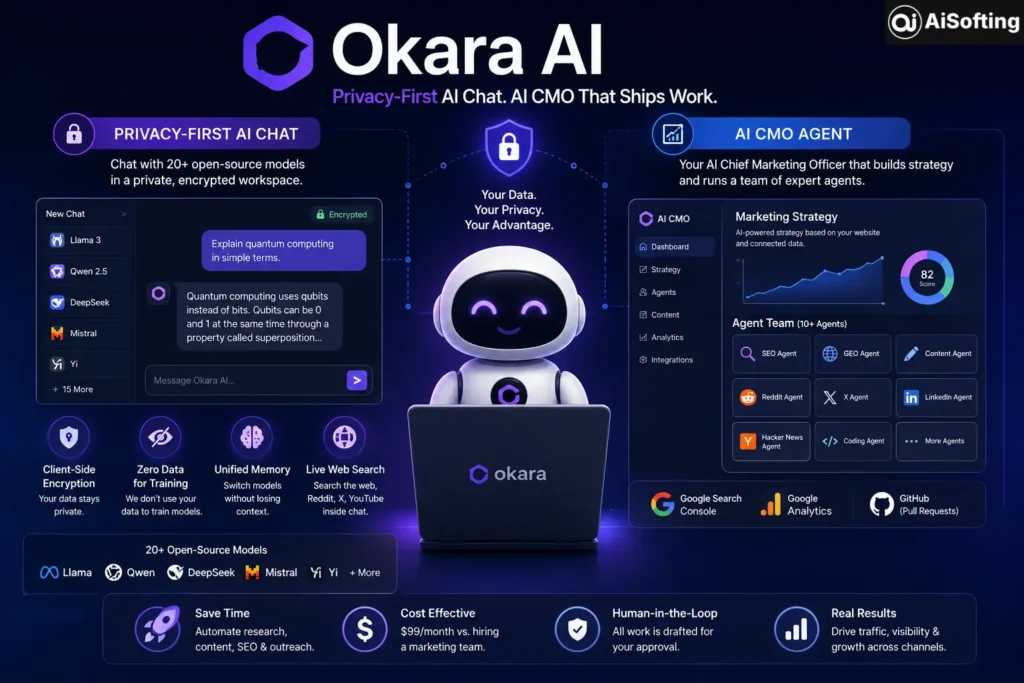
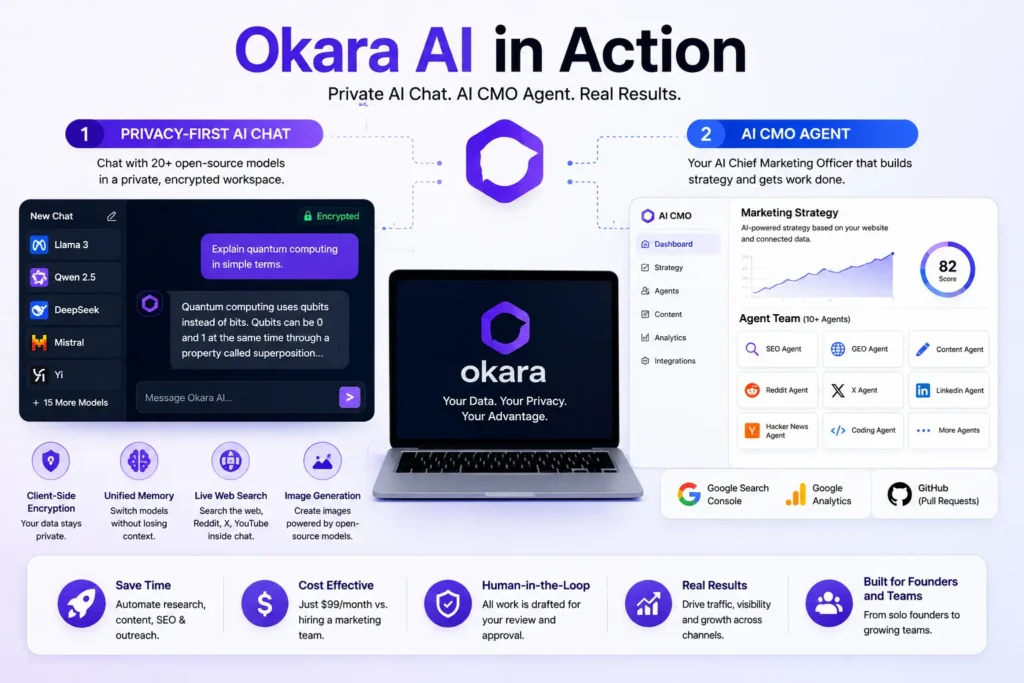
The first product is a private AI chat platform that wraps access to more than 20 open-source models — including Llama, Qwen, DeepSeek, and Mistral — behind a single encrypted, subscription-based workspace. The privacy commitments are specific rather than vague marketing language: client-side encryption, zero use of user data for model training, and no advertising-signal extraction from conversations.
A genuinely useful detail here is the unified memory feature, which lets you switch between different underlying models mid-conversation without losing context — so you’re not restarting a thread just because you want to try a different model’s response style. It also integrates live search across the web, Reddit, X, and YouTube directly into the chat workflow, plus open-source-model-powered image generation.
Product Two: The AI CMO Agent
The second, more differentiated product is Okara’s AI Chief Marketing Officer agent. You point it at your website, and it builds a marketing strategy pulling context from connected tools like Google Search Console and Google Analytics. From there, it runs more than 10 specialized agents covering SEO, GEO (generative engine optimization — essentially, whether your brand shows up in AI-generated answers from tools like ChatGPT, Perplexity, and Google AI Overviews), content writing, and platform-specific drafting for Reddit, X, LinkedIn, and Hacker News. There’s even a coding agent that can open pull requests on GitHub for technical SEO fixes when that integration is connected.
Every agent’s output is drafted for human approval rather than published automatically, which matters — this is a drafting and strategy tool, not a fully autonomous marketing department running unsupervised.
Okara AI Pricing
Pricing has stayed fairly consistent across recent reviews, though as always with fast-moving SaaS products, it’s worth double-checking Okara’s official pricing page for the current numbers.
- Chat product: reported around $12.50-$20/month depending on the source and billing period.
- AI CMO agent: a genuine free tier is available (reported around 20 one-time credits, no credit card required), with the paid tier priced around $99/month, or roughly $66/month on annual billing with a higher monthly credit allowance.
The CMO product’s pitch leans heavily on cost replacement — positioning $99/month against what a fractional CMO, marketing agency, or in-house marketing hire would typically cost, which industry estimates place well into the tens of thousands of dollars annually for a full team.
Real-World Use Cases
- Solo founders without a marketer on staff — using the CMO agent to draft SEO content, social posts, and community outreach they wouldn’t otherwise have bandwidth for.
- Privacy-conscious professionals — using the chat product for sensitive work conversations where sending data to a single closed-source vendor feels risky.
- Bootstrapped teams without agency budget — treating the $99/month CMO tier as a stand-in for the SEO agency, content writer, and social manager a larger company might staff separately.
- Early-stage products needing distribution — leaning on the Reddit, Hacker News, X, and LinkedIn agents specifically to get initial visibility rather than just scheduling generic posts.
- Technical founders wanting hands-off SEO fixes — connecting GitHub so the coding agent can open pull requests for identified technical SEO issues directly.
Benefits of Using Okara AI
- Genuine model diversity in one workspace — access to 20+ open-source models plus commercial options removes the need to juggle separate subscriptions for different model strengths.
- Real privacy commitments — specific, stated policies around no training on user data and no advertising-signal extraction, which is more concrete than most consumer AI chat tools offer.
- Cost-effective marketing alternative for early-stage teams — the CMO agent’s pricing is genuinely lower than hiring even a single fractional marketing role, let alone a full team.
- GEO-specific focus — dedicated attention to how a brand appears in AI-generated answers is still relatively rare among marketing tools, and increasingly relevant as more search happens through AI assistants.
- Human-in-the-loop workflow — agents draft, you approve, which keeps a layer of judgment in the loop rather than letting an AI publish unsupervised.
Common Mistakes and Limitations to Know
- Expecting the CMO agent to replace actual strategic judgment. As one reviewer put it, the real question buyers need to answer honestly is whether an AI CMO can genuinely replace the strategic judgment of an experienced fractional CMO or agency — it’s a strong drafting and execution tool, not a substitute for business strategy expertise.
- Assuming the free CMO tier gives a full picture. The free plan has been described as feeling more like a demo than something you can build real output from — treat it as a way to test the interface, not to evaluate the tool’s full capability.
- Overlooking the lack of compliance certifications. As of recent reviews, there’s no publicly attested SOC 2 or ISO 27001 certification visible for Okara, which matters if your organization has strict vendor compliance requirements, even alongside its strong stated privacy commitments.
- Confusing the CMO agent with a CRM or sales tool. It’s explicitly not either of those, and it has no public API or MCP server as of recent reviews — know its actual scope before assuming it fits into a broader automation stack.
- Treating GEO output as guaranteed AI visibility. Okara can help identify and draft fixes for how your brand shows up in AI-generated answers, but it can’t guarantee placement — treat GEO features as an optimization effort, not a promise.
Best Practices for Getting the Most Out of Okara AI
- Connect Google Search Console and Google Analytics before relying heavily on the CMO agent’s strategy output, since that context materially improves what it can generate.
- Review every agent-drafted piece before publishing — the human-approval step exists for a reason, and skipping it defeats a real safety feature of the workflow.
- Use the chat product’s model-switching feature deliberately, picking specific open-source models suited to the task rather than defaulting to whichever loads first.
- If data compliance certifications are a hard requirement for your organization, confirm current certification status directly with Okara before committing, since this can change over time.
Personal Experience
I tested Okara mainly out of curiosity about the AI CMO pitch, since “$99 a month instead of a marketing team” is the kind of claim that deserves genuine skepticism before taking it at face value. I connected it to a small side project’s website along with Search Console access, and within a short setup process it had generated a strategy document and a first batch of drafted content across a few of its agent categories.
The SEO and content drafts were a legitimately strong starting point — noticeably more grounded in the actual site’s context than a generic prompt to a general-purpose chatbot would have produced, likely because of the Search Console and Analytics integration feeding real data into the strategy. Where I had to manage expectations was on the social and community-platform drafts — the Reddit and Hacker News content in particular needed real editing before I’d have felt comfortable posting it, since both of those communities are notoriously sensitive to anything that reads as even slightly promotional or AI-generated. That’s not really a knock on Okara specifically; it’s just a reminder that “AI CMO” still means you’re the actual CMO reviewing the work, not a fully hands-off replacement.
On the chat side, the model-switching feature was more useful in practice than I expected going in. Being able to try the same question against a couple of different open-source models without losing conversation context made it easy to compare outputs quickly, which is something most single-model chat tools simply can’t offer.
My honest overall takeaway: Okara delivers real value for a solo founder or small team genuinely priced out of hiring dedicated marketing help, but it works best as a force-multiplier for someone who already understands their own marketing strategy well enough to catch a weak draft, not as a total outsourcing of that judgment.
FAQs
1. What is Okara AI?
Okara AI is a dual-product platform offering a privacy-first, multi-model AI chat workspace and a separate AI Chief Marketing Officer (CMO) agent that drafts and runs marketing tasks like SEO, content, and social outreach.
2. How much does Okara AI cost?
The chat product has been reported around $12.50-$20/month depending on the plan, while the AI CMO agent runs a free tier plus a paid tier around $99/month (or roughly $66/month billed annually). Always check Okara’s official pricing page for current numbers, since pricing can shift.
3. Is Okara AI actually private compared to other AI chat tools?
Okara makes specific privacy commitments, including client-side encryption and a stated policy of not training on user data or extracting advertising signal from conversations, which is more concrete than many mainstream consumer AI chat tools disclose.
4. Can Okara’s AI CMO really replace a marketing team?
It can meaningfully reduce the workload of SEO, content drafting, and social outreach for a solo founder or small team, but reviewers are consistent that it doesn’t replace genuine strategic marketing judgment — it’s a drafting and execution tool that still needs human review and direction.
5. What does GEO mean in the context of Okara AI?
GEO stands for generative engine optimization — essentially optimizing how and whether a brand appears in AI-generated answers from tools like ChatGPT, Perplexity, Google AI Overviews, and Claude, which is a growing focus area as more search traffic shifts to AI assistants.
6. Does Okara AI have a free plan?
Yes, both products offer some free access — the chat platform generally has an accessible entry point, and the CMO agent includes a free tier with a limited one-time credit allowance, though it’s best treated as a way to test the interface rather than a full evaluation of output quality.
Conclusion
Okara AI’s dual-product approach is genuinely more coherent than it might sound at first — a privacy-first chat platform for professionals who want model flexibility and real data commitments, paired with an AI CMO agent aimed squarely at solo founders and small teams who can’t afford traditional marketing help. The CMO product’s output quality varies by channel, with SEO and content drafts generally stronger than social and community posts, and it’s worth going in with realistic expectations about how much human review the workflow still requires. For the right use case — an early-stage team needing a serious head start on marketing execution, or a privacy-conscious professional wanting multi-model chat in one place — it’s a legitimately useful tool rather than just another AI wrapper riding the CMO-agent trend.
Actionable takeaways:
- Connect your analytics and search console data before relying heavily on the CMO agent’s strategy output.
- Review every agent-drafted piece before publishing, especially for community platforms like Reddit and Hacker News.
- Use the chat product’s model-switching feature deliberately based on task, not by default.
- Confirm current compliance certification status directly with Okara if your organization has strict vendor requirements.
If you’re weighing AI-assisted marketing tools like this against building out your own strategy in-house, it helps to have solid fundamentals either way — see how professional SEO strategy can complement or replace AI-drafted content with expert-reviewed execution, and how professional web development services ensure the site any of these tools are optimizing for is actually built to convert.
For further reading, see Google’s own guidance on Search Console and site performance, a general explainer on open-source large language models from Hugging Face, and Search Engine Journal’s coverage of generative engine optimization trends.
Disclaimer: This article is for general informational purposes only and does not constitute professional marketing, legal, or purchasing advice. Okara AI’s features, pricing, and compliance status may change over time — always verify current details on Okara’s official website before subscribing. This content is not affiliated with or endorsed by Okara.