If you searched “Sora AI watermark” hoping for a quick answer, here’s the short version: it’s a two-layer system a visible logo baked into the video frame and an invisible C2PA metadata signature underneath it that OpenAI uses to mark Sora-generated video as synthetic. But that short answer misses the part that actually matters right now, in mid-2026: the product landscape around that watermark has shifted dramatically, and most of what’s written about it online is already out of date.
Let’s get into what’s really going on.
What the Sora Watermark Actually Is
The Sora watermark isn’t one thing it’s two separate mechanisms doing two different jobs.
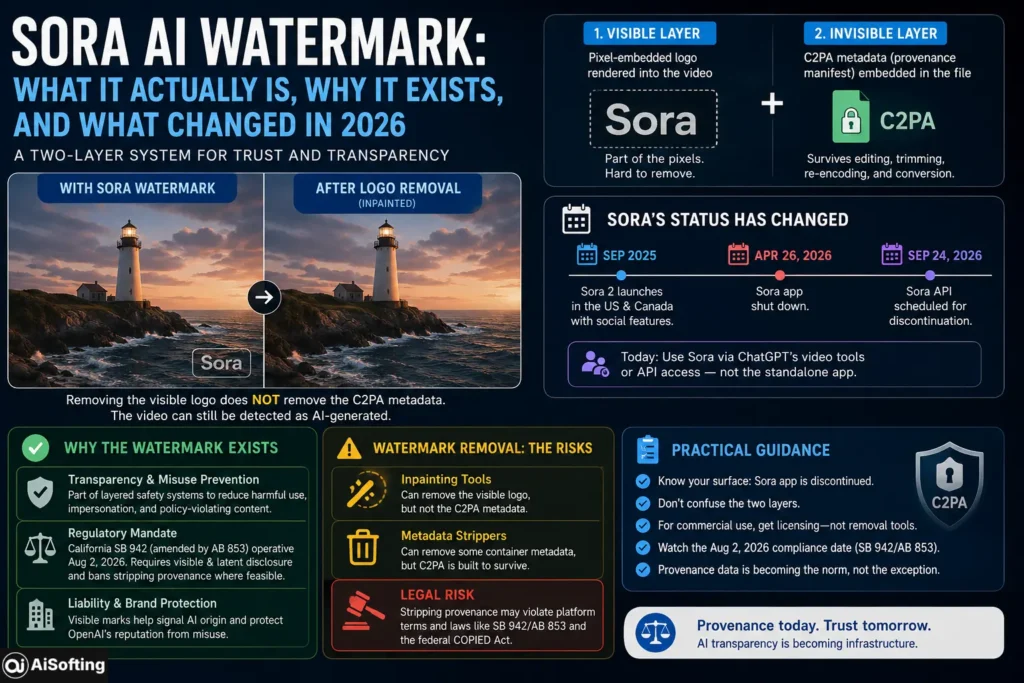
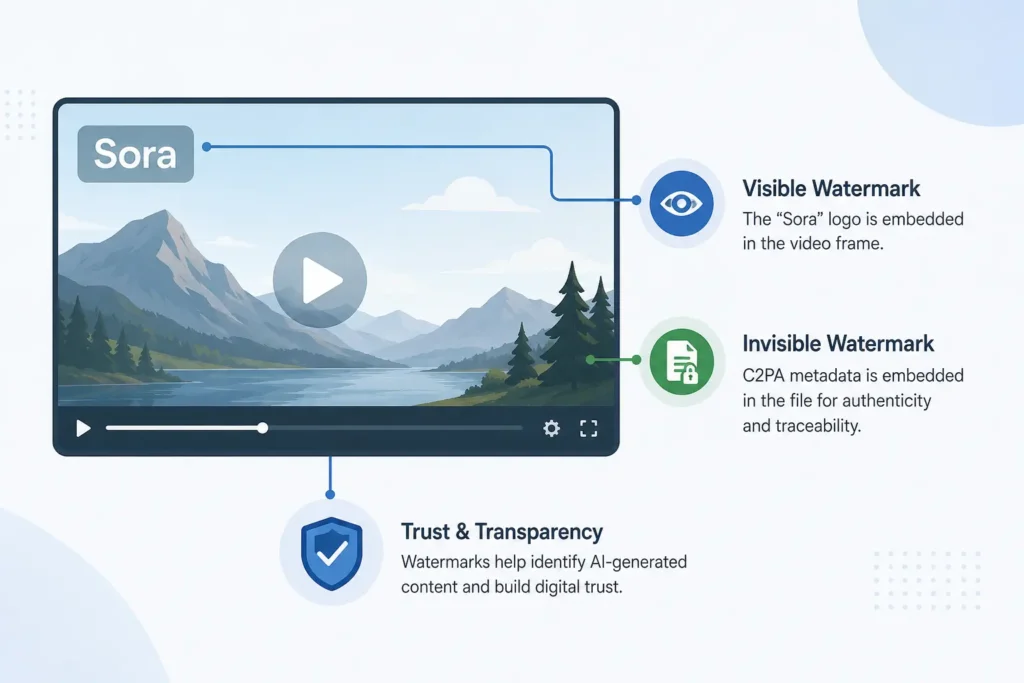
The visible layer is the small, often moving “Sora” or “OpenAI” logo stamped into the corner of a generated video. Unlike a TV network bug that sits on top of the footage as an overlay, this mark is rendered into the pixels themselves during generation. That distinction matters technically: you can’t strip it with a metadata editor or a simple crop, because it’s part of the image data, not a separate layer sitting above it.
The invisible layer is a C2PA (Coalition for Content Provenance and Authenticity) manifest embedded in the file. OpenAI has said every video generated with Sora carries both visible and invisible provenance signals, and that outputs embed C2PA metadata alongside internal reverse-image and audio search tools capable of tracing content back to Sora. OpenAI didn’t build this in isolation the company sits on the C2PA steering committee, the same standards body that Adobe, Microsoft, and camera manufacturers use for content authenticity work. That’s a detail a lot of “how to remove the Sora watermark” articles skip entirely, and it’s the reason the metadata layer is so much harder to defeat than the logo.
The Part Most Articles Are Missing: Sora’s Status Has Changed
Here’s the content gap. A huge share of what ranks for “Sora AI watermark” right now was written while Sora 2 was a live, actively growing consumer app and treats it that way. That’s no longer accurate.
Sora 2 launched to select users in the US and Canada at the end of September 2025 with social features built in, but the app was shut down on April 26, 2026, and the API is scheduled for discontinuation on September 24, 2026. Reporting at the time framed this as OpenAI stepping back from consumer video-social products to refocus on enterprise offerings. OpenAI’s own responsible-launch page now opens by noting that the standalone Sora product is no longer available, with Sora 2 and the Sora app described as the current iteration language that itself reflects a company in the middle of narrowing what it offers.
Practically, this means:
- If you’re generating new video today, you’re most likely doing it through ChatGPT’s video tools or API access rather than a dedicated Sora app.
- Older tutorials describing the Sora app’s feed, profiles, or social sharing features are describing a product that has since been shut down.
- The watermark and C2PA mechanics described below still apply to current OpenAI video generation, but the delivery surface has moved.
If you’re planning content, workflows, or tooling around “Sora,” it’s worth verifying against OpenAI’s current documentation rather than a six-month-old screenshot-heavy guide.
Why the Watermark Exists in the First Place
Watermarking synthetic video isn’t really OpenAI’s idea alone it’s converging regulatory pressure meeting a genuine trust problem.
Transparency and misuse prevention. OpenAI frames the watermark as part of “distinguishing AI content,” paired with layered content filters that scan prompts and outputs for sexual material, terrorist propaganda, and self-harm promotion, plus audio safeguards that block impersonation of living artists. The watermark is one piece of a broader safety architecture, not a standalone feature.
Regulatory mandate, not just goodwill. This is the part that changed the game in 2026. California’s AI Transparency Act (SB 942), originally set to take effect January 1, 2026, was amended by AB 853 and pushed to become operative on August 2, 2026. Under the law, covered generative AI providers those with more than one million monthly California users must offer a free public detection tool, provide an optional visible (“manifest”) disclosure, and embed a hidden (“latent”) watermark or provenance signal in AI-generated image, video, and audio, to the extent technically feasible. The law also bars covered platforms from knowingly stripping that provenance data where feasible to detect. You can read the underlying bill text directly on the California Legislative Information site. Similar provenance requirements are baked into the EU AI Act’s Article 50, which is part of why several watermark-removal guides now frame stripping metadata as a legal question rather than a purely technical one.
Liability and brand protection. A visible mark lets OpenAI point to a clear signal when a video is later misused, and it protects the company’s own reputation from being associated with deceptive deepfakes it didn’t intend to enable.
The Watermark-Removal Ecosystem (and Why It’s Riskier Than It Looks)
Search “Sora watermark” for five minutes and you’ll run into a second industry entirely: tools built specifically to erase it. This niche exploded almost immediately after Sora 2’s release watermark-remover tools were widely reported within about a week of launch, filling a demand gap that OpenAI clearly didn’t anticipate at that scale.
These tools generally fall into two camps:
- Inpainting-based removers (frame-by-frame reconstruction of the pixels behind the logo, using motion tracking to keep the fill convincing across camera movement).
- Metadata strippers (command-line tools like FFmpeg’s stream-copy mode, which can drop container-level metadata without re-encoding the video).
Here’s the nuance that gets lost in most “top 5 tools” listicles: removing the visible logo and removing the C2PA manifest are not the same job, and succeeding at one doesn’t mean you’ve succeeded at the other. Inpainting handles the logo. It does nothing to the embedded provenance manifest, which is specifically engineered to survive trimming, re-encoding, and format conversion. A video with a clean corner and intact C2PA data will still get flagged as AI-generated by any platform or tool that checks for it including, increasingly, the detection tools that SB 942 will require large providers to publish.
There’s also a genuine legal dimension now, separate from OpenAI’s terms of service. Provisions like the federal COPIED Act and California’s AB 853 amendments treat deliberate provenance stripping as more than a contract violation in some circumstances it starts to look like tampering with legally mandated disclosure. If you’re generating content for commercial use, the more durable answer is a licensing tier or API arrangement that legitimately authorizes watermark-free export, not a downstream removal tool.
My Experience Watching This Space Evolve
I’ve been tracking AI video provenance tooling since before Sora 2 shipped, and the thing that’s stood out most is how fast the removal tooling matured relative to the detection side. Within roughly a week of Sora 2’s public release, third-party watermark removers were already circulating widely long before most platforms had built any real-time C2PA verification into their upload pipelines. That gap between “generation capability” and “verification infrastructure” is the recurring theme in this entire category, not just with Sora.
The other pattern worth flagging: teams building workflows around Sora output consistently underestimate how much the product surface can shift under them. Plans built around a dedicated Sora app in late 2025 had to be rebuilt within months once that app was discontinued. If there’s one practical lesson from watching this closely, it’s to build your pipeline around the API and documentation rather than around any single consumer app’s interface, because the app layer is clearly the part OpenAI is most willing to change.
I’d also push back gently on treating watermark removal as a routine production step. The visible mark exists to signal AI origin to your audience, and stripping it changes what your audience is legally and ethically entitled to know about what they’re watching that’s a bigger decision than a “clean export” checkbox implies.
Practical Guidance If You’re Working With Sora Output
- Check what surface you’re actually using. “Sora” the standalone app is discontinued; verify whether you’re working through ChatGPT’s video tools or direct API access before following older tutorials.
- Don’t conflate the two watermark layers. Removing the visible logo does not remove C2PA metadata, and vice versa.
- If commercial, watermark-free output is the goal, look at licensing, not removal tools. It’s the only path that doesn’t create downstream legal exposure.
- Watch the August 2, 2026 compliance date. Once SB 942/AB 853 is operative, expect more visible disclosure requirements and public detection tools to show up across major AI platforms, not just OpenAI’s.
- Assume provenance data is becoming the norm, not the exception, across cameras, editing software, and AI tools alike SB 942’s companion legislation extends latent disclosure requirements to capture devices sold from 2028 onward.
Frequently Asked Questions
Does every Sora-generated video have a watermark?
Yes, on standard tiers. Free and standard-plan outputs carry both the visible logo and C2PA metadata. Higher-tier or licensed commercial access has, at various points, offered cleaner exports, but this depends on current plan terms rather than a universal setting.
Is the Sora app still available?
No. The standalone Sora app was shut down on April 26, 2026. OpenAI’s video generation capability continues through other surfaces, with the underlying API scheduled to be phased out by September 24, 2026.
Can I legally remove the Sora watermark?
It depends on jurisdiction and use case. Stripping visible branding to misrepresent AI content as human-made can violate platform terms of service and, increasingly, transparency laws like California’s SB 942/AB 853 and provisions tied to the federal COPIED Act. Legitimate licensing for watermark-free commercial use is a materially different situation from removing it after the fact to conceal AI origin.
Does removing the visible watermark also remove the metadata?
No. The C2PA manifest is a separate, independent layer designed specifically to survive editing steps that would remove a visible logo, including cropping, re-encoding, and trimming.
Why does OpenAI embed the watermark in the video pixels instead of as an overlay?
Embedding it at the pixel level during generation makes it far harder to remove with basic editing tools like cropping or metadata stripping, forcing removal attempts into more resource-intensive video reconstruction techniques.
Will AI watermarking requirements affect platforms other than Sora?
Yes. SB 942 and AB 853 apply to any generative AI provider with over one million monthly California users, not just OpenAI, and the EU AI Act includes comparable provenance obligations. Expect visible-disclosure options and provenance metadata to become standard across major AI video, image, and audio tools.
What’s the difference between a “manifest” and a “latent” disclosure under California law?
A manifest disclosure is one a person can see or recognize directly, like a visible logo. A latent disclosure is embedded but not immediately visible, like C2PA metadata the kind of layer that requires a compatible tool to read.
Conclusion
The Sora watermark is a two-layer system a visible, pixel-embedded logo and an invisible C2PA provenance manifest built to satisfy both human recognition and machine-level verification. What’s changed heading into the second half of 2026 isn’t the watermark mechanics themselves; it’s the surrounding context. The standalone Sora app has been discontinued, California’s SB 942/AB 853 framework is about to become enforceable on August 2, 2026, and the legal risk profile of stripping provenance data has moved well beyond a simple terms-of-service issue.
If you’re building anything around Sora-generated video, the practical move is to design for the API and documentation rather than a specific app interface, treat the visible and invisible watermark layers as separate problems, and solve for legitimate watermark-free access through licensing rather than after-the-fact removal. The regulatory direction is unambiguous: provenance disclosure is becoming infrastructure, not an optional feature, and that trend extends well beyond any single AI company’s product decisions.
Visit: Aisofting
Disclaimer: This article reflects publicly available information as of mid-2026 and is intended for general informational purposes only. It is not legal advice. AI product features, terms of service, and applicable regulations change quickly verify current details directly with OpenAI’s documentation and consult qualified legal counsel before making compliance decisions.