Introduction
Every business now claims to be “using AI.” Fewer of them are actually getting useful results from it. After working with teams that rolled out chatbots, automation tools, and AI copilots, I’ve noticed the same pattern over and over: the technology works fine, but the outputs feel generic, slightly off, or disconnected from how the business actually operates. The root cause is almost never the model itself. It’s a lack of AI business context refinement the ongoing process of feeding an AI system the right operational, cultural, and strategic information so its outputs actually reflect your business.
This isn’t a one-time setup task. It’s closer to onboarding a new employee who never stops learning about your company. And just like a poorly onboarded employee, an AI system without proper context refinement will produce work that’s technically correct but practically useless.
In this article, I’ll break down what AI business context refinement actually means, why it matters more than most companies realize, and how to do it properly based on real implementation experience, not just theory.
What Is AI Business Context Refinement?
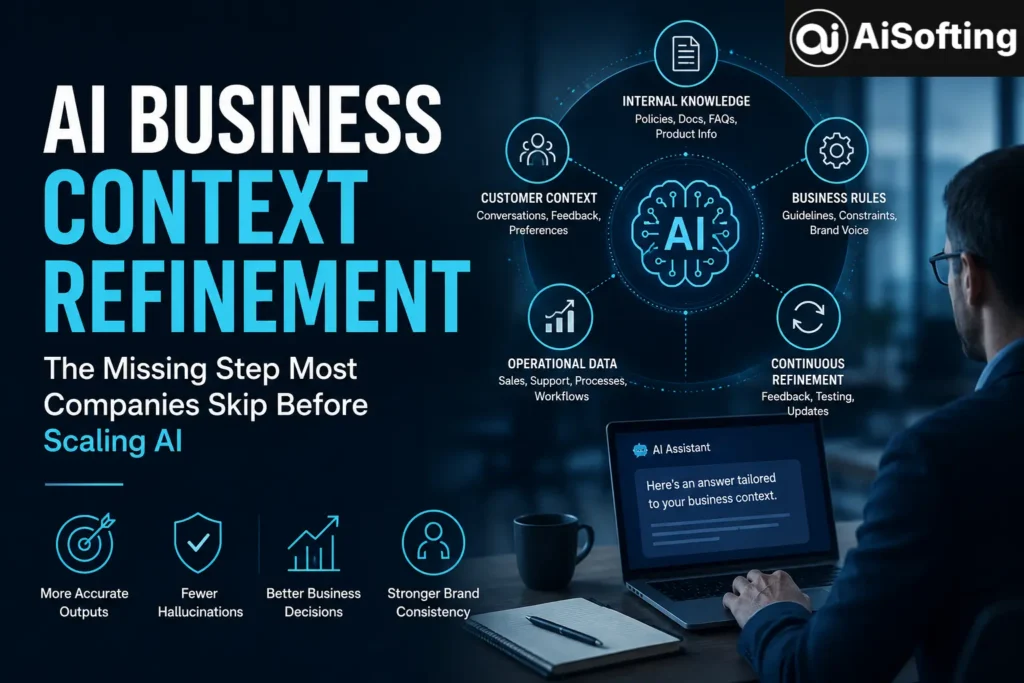
AI business context refinement is the process of continuously improving the information, instructions, and data an AI system uses to understand your business its products, tone, customers, workflows, and goals. It sits between “prompt engineering” and “data strategy,” but it’s broader than both.
Where prompt engineering focuses on how you phrase a request, context refinement focuses on what background knowledge the AI has access to before it even receives that request. Think of it as the difference between asking a stranger for advice versus asking a colleague who’s worked at your company for two years.
This process typically includes:
- Structuring internal knowledge (policies, product specs, brand voice, FAQs) so AI tools can reference it accurately
- Defining business rules and constraints the AI must follow
- Feeding relevant customer, market, and operational data into AI workflows
- Regularly updating context as the business evolves
- Testing outputs against real business scenarios and refining based on gaps
Why Business Context Matters More Than Model Choice
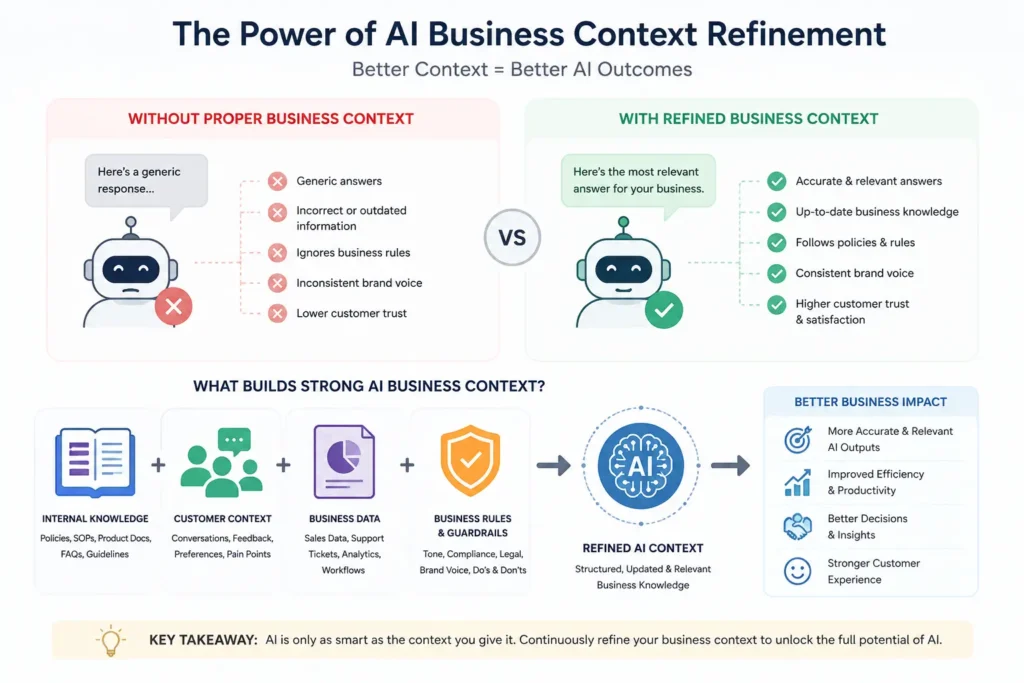
A lot of companies assume that switching to a “better” model say, moving from one large language model to another will fix quality issues. In practice, this rarely solves the underlying problem. Even the most capable models produce shallow or generic output if they lack proper business context.
According to McKinsey’s research on the state of AI in organizations, companies that see the highest returns from AI are those that redesign workflows and provide domain-specific context, not just those with access to advanced models. The model is the engine; business context is the fuel.
If you’re still evaluating which AI tools fit your workflow before investing time in context refinement, our guide to choosing the right AI tools for your business breaks down the key considerations.
Context vs. Data: They’re Not the Same Thing
A common mistake is confusing “having a lot of data” with “having good context.” A company might have terabytes of customer data sitting in a CRM, but if that data isn’t structured, summarized, or connected to the AI system in a usable way, it’s functionally invisible to the AI. Context refinement is about translation turning raw business information into something an AI model can actually reason with.
How AI Business Context Refinement Works in Practice
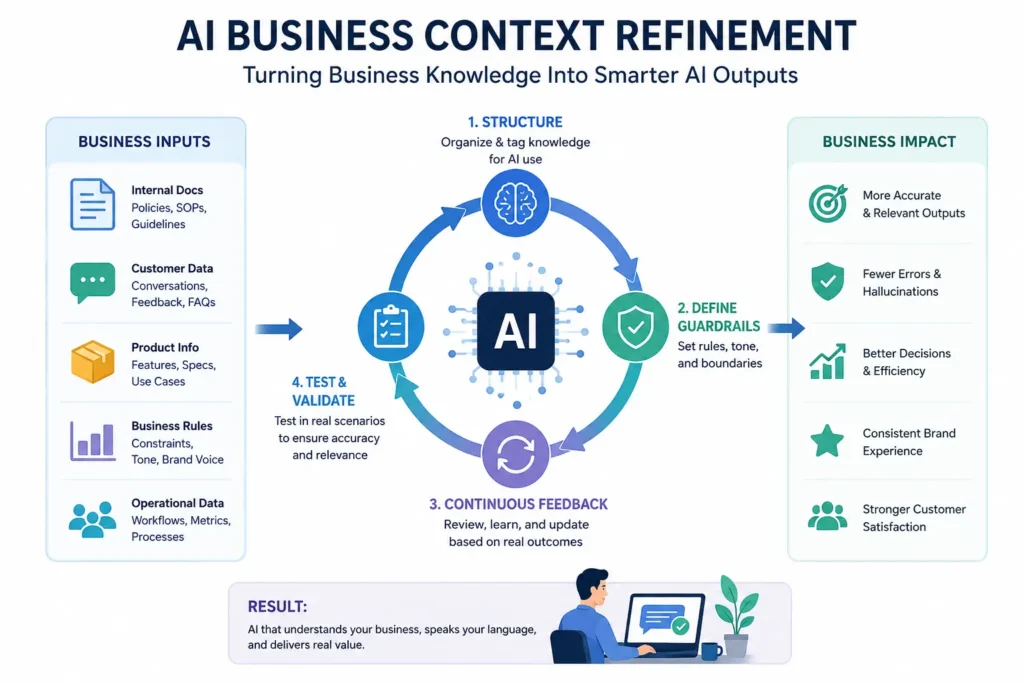
1. Auditing Existing Knowledge Sources
Before refining anything, you need to know what information already exists internal wikis, product documentation, past customer conversations, sales scripts, brand guidelines. Most businesses are surprised at how scattered this information is across tools like Notion, Google Drive, Slack threads, and old PDFs.
2. Structuring Information for AI Consumption
Once knowledge sources are identified, they need to be organized into formats AI systems can use efficiently clear, chunked, well-labeled documents rather than long unstructured files. This is where retrieval-augmented generation (RAG) systems and vector databases often come into play, allowing an AI tool to pull relevant context on demand rather than relying on a static prompt. For a deeper look at how this works, see our breakdown of retrieval-augmented generation and how it powers business AI.
3. Defining Guardrails and Business Rules
Context isn’t just facts it’s boundaries. What should the AI never say? What tone should it always maintain? What pricing or legal disclaimers must be included? These rules need to be explicit, not assumed.
4. Continuous Feedback Loops
This is the step most businesses skip. AI outputs should be reviewed regularly, and gaps should feed back into the context system. If an AI-generated customer response misses a key policy detail, that’s a signal the context needs updating not just the prompt.
5. Testing Against Real Scenarios
Generic testing doesn’t reveal much. Testing with actual customer questions, actual sales objections, and actual internal use cases exposes where the AI’s understanding of the business breaks down.
Benefits of Strong AI Business Context Refinement
- More accurate and relevant outputs across chatbots, content generation, and internal tools
- Reduced hallucinations, since the AI has grounded, business-specific information to reference
- Faster onboarding for new AI tools, since context libraries can be reused across systems
- Better brand consistency, especially for customer-facing AI applications
- Improved decision-making, since AI-generated insights are grounded in real business conditions rather than generic assumptions
Common Mistakes Businesses Make
- Treating context as a one-time setup. Businesses change constantly pricing, policies, product lines. Context that isn’t updated becomes a liability.
- Overloading the AI with irrelevant information. More context isn’t always better. Cluttered, poorly prioritized context can confuse outputs just as much as too little context.
- Ignoring edge cases. Businesses often refine context for common scenarios but skip rare, high-stakes situations, which is exactly where AI errors cause the most damage.
- Relying solely on prompts instead of structured context systems. Prompt tweaks are a band-aid; structured context is the actual fix.
- No ownership. If no one on the team is responsible for maintaining and refining context, it decays quietly until outputs noticeably degrade.
Best Practices for Effective Context Refinement
- Assign a clear owner or small team responsible for maintaining AI context libraries
- Use structured formats (FAQs, decision trees, tagged documents) instead of long-form unstructured text
- Prioritize high-impact use cases first customer support and sales tend to show ROI fastest
- Build a regular review cadence, similar to how you’d audit a website’s SEO or a CRM’s data hygiene
- Involve subject-matter experts, not just technical teams, when defining business rules
- Reference frameworks like NIST’s AI Risk Management Framework when setting guardrails, especially for regulated industries
- Follow platform-specific guidance, such as OpenAI’s best practices for prompt engineering, to understand how model providers recommend structuring instructions and context
- Once your context system is in place, our AI implementation checklist can help you validate it before a full rollout
Personal Experience: What I’ve Learned Implementing This
The first time I worked on refining business context for an AI-powered customer support tool, the initial setup looked great in a demo. Answers were fluent, well-formatted, and fast. Within two weeks of real customer traffic, though, the cracks showed. The AI kept giving outdated return policy information because nobody had connected it to the updated policy document the old version was still sitting in the reference folder it pulled from.
That single incident changed how I approach every AI implementation since. Now, the first thing I do isn’t prompt writing it’s a context audit. I map out every source of truth in the business: pricing sheets, support macros, internal Slack decisions that never made it into official docs, and even inconsistencies between what the sales team says and what the website says. More often than not, refining the business’s own internal alignment is half the work before the AI even gets involved.
Another lesson: teams that treat context refinement like ongoing maintenance similar to how they’d handle software updates get noticeably better long-term results than teams that treat it as a launch checklist item. I’ve seen the same AI model produce dramatically different quality outputs purely based on how well-maintained its context sources were, not because the underlying technology changed at all.
The biggest shift I’ve made personally is pushing clients to involve non-technical staff customer service leads, sales reps, operations managers in reviewing AI outputs regularly. They catch contextual errors technical teams often miss, simply because they know the business nuances better.
Frequently Asked Questions
What is AI business context refinement?
It’s the ongoing process of structuring, updating, and feeding business-specific information into AI systems so their outputs accurately reflect how a company actually operates.
How is context refinement different from prompt engineering?
Prompt engineering focuses on how a request is phrased. Context refinement focuses on the background knowledge available to the AI before that request is even made.
Why do AI tools give generic answers even with a good model?
Generic answers usually mean the AI lacks sufficient business-specific context, not that the model itself is weak.
How often should business context be updated?
Ideally on a regular schedule monthly for fast-changing businesses, or immediately after major policy, pricing, or product changes.
Does context refinement require technical expertise?
Some technical setup is needed (structuring documents, integrating with AI systems), but the most valuable input often comes from non-technical subject-matter experts.
Can small businesses benefit from AI business context refinement?
Yes. Small businesses often benefit faster since their knowledge base is smaller and easier to structure properly.
What tools help with context refinement?
Knowledge management platforms, retrieval-augmented generation (RAG) systems, and vector databases are commonly used to organize and serve business context to AI tools.
Does more data always mean better context?
No. Poorly structured or irrelevant data can confuse AI outputs. Quality and relevance matter more than volume.
Conclusion
AI business context refinement isn’t a technical afterthought it’s the difference between AI tools that genuinely understand your business and ones that just sound like they do. The companies getting real value from AI right now aren’t necessarily using the most advanced models; they’re the ones who’ve invested in keeping their AI systems grounded in accurate, current, well-structured business knowledge.
If you’re rolling out or scaling AI tools, start with an honest audit of your existing knowledge sources, assign ownership over context maintenance, and treat refinement as a continuous process rather than a one-time task. That single shift in mindset tends to produce better results than swapping models or tweaking prompts ever will.