If you’ve typed “what is the best AI for organic chemistry” into a search bar, you’ve probably already noticed the problem: most answers are either generic “top 10 AI tools” listicles with no real chemistry behind them, or marketing pages for a single product dressed up as objective advice. Neither actually tells you which tool will save you time on Monday night when you’re staring at a Diels-Alder mechanism and your textbook isn’t helping.
There isn’t a single “best” AI for organic chemistry. There’s a best tool for your specific job — learning mechanisms, planning a synthesis route, interpreting an NMR spectrum, or checking your homework before a TA does. This article breaks the landscape down by actual use case, explains where these tools quietly fail (because they do), and gives you a way to test any AI chemistry tool before you trust it with something that matters.
Why “Best AI for Organic Chemistry” Doesn’t Have One Answer
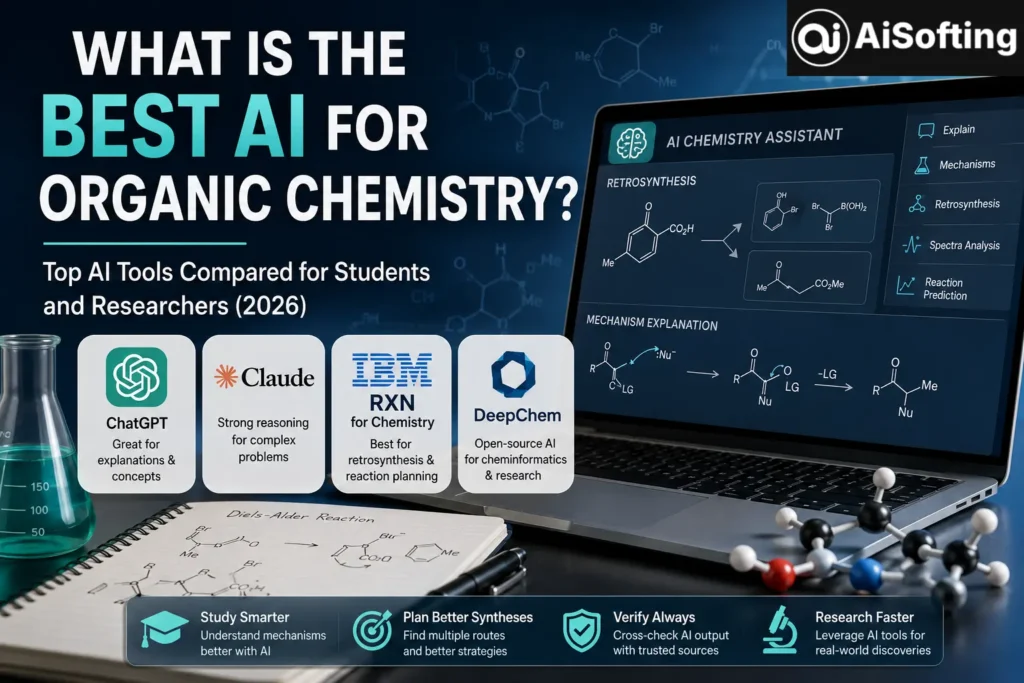
Organic chemistry isn’t one task. It’s a cluster of very different cognitive skills: pattern recognition (recognizing a functional group), spatial reasoning (visualizing a chair conformation or a stereocenter), electron-pushing logic (mechanisms), and synthetic planning (retrosynthesis, which is closer to puzzle-solving than memorization). A general-purpose chatbot like ChatGPT or Claude can be excellent at explaining a mechanism in plain language, yet still stumble on a multi-step retrosynthesis where a single misplaced disconnection makes the entire route chemically nonsensical.
This is the gap most “best AI” articles skip. They treat organic chemistry as a single subject an AI either “knows” or doesn’t, instead of asking which sub-skill is being tested.
General-Purpose LLMs (ChatGPT, Claude, Gemini): Strong for Explanation, Shaky for Precision
General large language models are genuinely useful for organic chemistry, but their strengths and weaknesses are specific.
Where they shine:
- Explaining why a reaction proceeds the way it does (electronics, sterics, stability of intermediates)
- Breaking down mechanisms into step-by-step electron-pushing narratives
- Answering conceptual “why does this happen” questions that a textbook states but doesn’t always explain well
- Acting as a study partner for quizzing yourself on reagents, named reactions, and reaction classes
Where they struggle:
- Drawing or interpreting actual molecular structures reliably — text-based models reason about chemistry through language, not through a true graph representation of a molecule, so subtle structural details can get lost
- Multi-step retrosynthesis, where one wrong disconnection early in the chain invalidates everything downstream
- Stereochemistry edge cases (E/Z assignment in unusual systems, multiple stereocenters, ring puckering)
- Quantitative spectral interpretation without supporting tools
A 2026 comparative study on college chemistry coursework found that while both ChatGPT and Gemini achieved high scientific accuracy, students strongly preferred ChatGPT for learning purposes, with the study concluding that combining both AIs can create a balanced approach. Separately, broader cross-model testing throughout 2026 has generally found Claude rated stronger for raw accuracy on complex reasoning tasks, while Gemini’s live search integration helps it avoid hallucinating on facts that require current information.
The practical takeaway: none of the three major chatbots is “the” winner for organic chemistry specifically. They’re good generalists. The real differentiation happens with purpose-built chemistry AI.
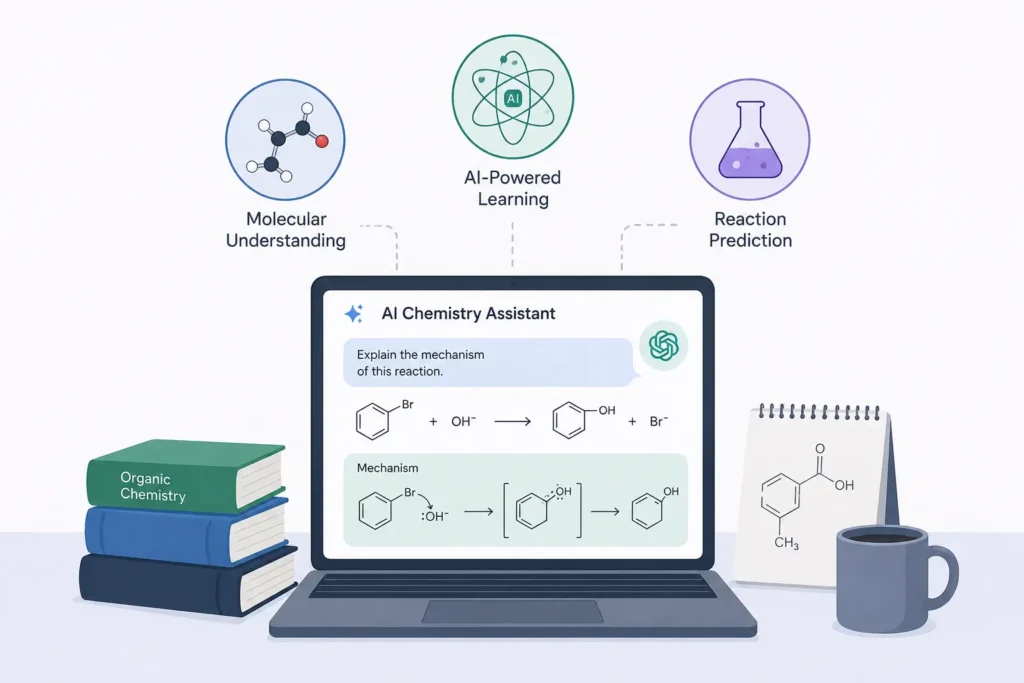
Purpose-Built Chemistry AI: Where Precision Actually Lives
This is the category most general “best AI” articles underweight, and it’s where the real value is for anyone doing serious organic chemistry work rather than just studying for an exam.
Retrosynthesis and Reaction Prediction Tools
Tools built specifically for synthetic chemistry reason over actual molecular graphs rather than text descriptions, which matters enormously for retrosynthesis. IBM RXN for Chemistry presents retrosynthesis pathways as a core capability, alongside reaction prediction and procedure derivation, and is one of the more established platforms in this space for researchers planning real synthetic routes rather than just checking homework.
What’s genuinely underrated about these tools is route diversity. A strong retrosynthesis tool should propose multiple disconnection strategies for the same target rather than a single narrow path — one optimized for fewer steps, another for more robust, well-precedented transformations. If a tool only gives you one route with no alternatives or buyable building blocks, treat that as a red flag rather than a feature.
Self-Driving Labs and Closed-Loop Optimization
One of the more interesting emerging trends is the shift from “AI suggests, human decides” to closed-loop experimentation. Modern research increasingly combines AI suggestions with human chemists making real-time judgment calls rather than fully automating decisions, and this hybrid approach is outperforming either pure automation or pure manual optimization. One reported example found a suitable ligand and solvent combination within just 15 experimental runs for an unreported Suzuki-Miyaura coupling, reaching 67 percent isolated yield, through this kind of human-AI collaboration loop — a result that would typically take far longer through traditional one-variable-at-a-time optimization.
Separately, the broader industry trend toward connecting chemistry AI directly to robotic automation is creating closed-loop systems that design, execute, and analyze experiments around the clock without human intervention, often described as “self-driving labs.” For most students and individual researchers this is more of an industry trend to be aware of than a tool you’ll personally use, but it explains why pharmaceutical and materials companies are investing heavily in this space.
Open-Source Options
Not every useful tool requires an enterprise contract. Open-source ecosystems like DeepChem keep advanced AI chemistry techniques accessible to researchers without enterprise budgets, which matters if you’re a grad student or independent researcher rather than someone with institutional licensing.
Student-Focused Chemistry AI Solvers
A separate category has emerged specifically for coursework: step-by-step mechanism solvers and tutoring tools that accept photos of handwritten problems, walk through reasoning rather than just outputting an answer, and include features like 3D molecular visualization and interactive retrosynthesis planning for learning purposes. Reviewers testing these tools have noted real value in seeing stereochemistry rendered in 3D rather than just described in text — spatial visualization of stereoisomers can shift a student’s understanding in a way reading alone doesn’t achieve.
The honest caveat here, and one that doesn’t get said often enough: these tools still show occasional inconsistencies when handling advanced organic chemistry reactions, particularly anything outside the standard undergraduate curriculum. They’re excellent training wheels, not a substitute for understanding the underlying logic yourself.
The Verification Problem: What Most Articles Don’t Tell You
This is the single biggest gap in existing content on this topic. Almost every “best AI for organic chemistry” article tells you what tools exist. Almost none tell you how to verify whether the output is actually correct before you act on it — and in organic chemistry, a confidently wrong mechanism or route is more dangerous than no answer at all, because it looks plausible.
A practical bench-test approach, drawn from how chemists actually stress-test these tools:
- Run a known reaction with a twist. Take a textbook reaction and add a competing functional group with known conflict risk — an aldehyde alongside an amine, an acid chloride near a free alcohol, or a nitro group under strongly reducing conditions. A tool that ignores the conflict and gives a clean, uncomplicated answer is telling you it isn’t reasoning about chemoselectivity.
- Ask for multiple routes, not one. For any retrosynthesis question, demand at least two disconnection strategies. A single proposed path with no alternatives and no discussion of trade-offs is a sign the tool is pattern-matching to a known reaction rather than genuinely reasoning.
- Check stereochemistry explicitly. Ask the tool to justify the stereochemical outcome, not just state it. If it can’t explain why a transition state favors one diastereomer, treat the stereochemical claim as unverified.
- Cross-check against a primary source. For anything you intend to actually run in a lab or submit for a grade, verify the proposed conditions or mechanism against a textbook, a literature reference, or an instructor — never against a second AI tool, since correlated training data means two AIs can confidently agree on the same wrong answer.
My Experience with What Is the Best AI for Organic Chemistry
I went into testing these tools assuming a general chatbot would be “good enough” for most organic chemistry needs, and came away with a more complicated picture. For conceptual questions — why an SN1 reaction favors a tertiary substrate, why a Hofmann elimination gives the less substituted alkene — a general LLM like Claude or ChatGPT was genuinely excellent, often better than the explanation in my own textbook because I could ask immediate follow-up questions until the logic actually clicked.
The frustration started when I pushed into anything involving multiple stereocenters or a non-obvious retrosynthesis. I tested a four-step synthesis route for a moderately complex target, and the general chatbot produced something that read confidently and looked correct on the surface, but quietly skipped a protecting-group step that would have caused a side reaction in real lab conditions. It wasn’t a hallucinated fact so much as a missing piece of chemical judgment — the kind of thing an experienced synthetic chemist catches instantly and a model trained mostly on text doesn’t reliably flag.
Switching to a purpose-built retrosynthesis tool for that same target produced a noticeably more cautious, more chemically grounded route, complete with multiple disconnection options and a clearer rationale for protecting group choices — but the interface was less conversational, and getting a plain-language explanation of why each step was chosen took more effort than just asking a chatbot. That trade-off, accuracy and chemical rigor versus conversational ease, came up repeatedly across every tool I tried.
The lesson I keep coming back to: the “best” tool changes depending on what stage of the work you’re in. For first-pass learning and concept-building, a general AI assistant is hard to beat for how patiently it explains things. For anything you’re going to actually submit, defend, or run in a lab, a purpose-built chemistry tool, cross-checked against a textbook or your instructor, is worth the extra friction. Treating any single AI as a final authority on organic chemistry is where I’ve seen people, myself included, get burned.
Frequently Asked Questions
Is ChatGPT good enough for organic chemistry homework?
For conceptual questions and mechanism explanations, generally yes — it tends to walk through electron-pushing logic clearly and patiently answers follow-up questions. For multi-step synthesis problems or anything involving complex stereochemistry, treat its output as a starting point that needs verification, not a final answer.
Can AI draw accurate molecular structures?
General chatbots reason about chemistry primarily through text and can describe structures in words, but they don’t always reliably generate or interpret structural diagrams the way purpose-built cheminformatics tools (which work directly with molecular graph representations) do. For structure-heavy work, a dedicated chemistry tool is more reliable.
What’s the best free AI for organic chemistry?
Open-source platforms like DeepChem offer real cheminformatics capability without licensing cost, though they require more technical setup than a chat interface. For casual studying, free tiers of general chatbots and several student-focused solver tools cover most undergraduate needs.
Can AI replace a chemistry textbook or professor?
No. Even the most capable tools available in 2026 still produce occasional reasoning errors on advanced reactions, and none of them can replace the judgment that comes from hands-on lab experience or an instructor who knows exactly what your course expects. Treat AI as a study accelerant, not a replacement for foundational learning.
Are AI chemistry tools reliable for retrosynthesis planning?
They’re useful for generating starting ideas and surfacing routes you might not have considered, but proposed routes still need verification against literature precedent before you commit lab time or resources to them. The strongest tools propose multiple routes rather than a single path, which gives you more to verify against.
Is Claude or ChatGPT better for organic chemistry mechanisms?
Testing across various reasoning-heavy tasks generally shows Claude performing well on complex, multi-step reasoning accuracy, while ChatGPT has historically been preferred by students for its thorough, anticipatory explanations that include underlying context. For organic chemistry specifically, the practical difference is often smaller than for other subjects — both are capable conceptual tutors, so personal preference and prompting style matter as much as model choice.
Do self-driving labs use AI for organic chemistry research?
Yes — closed-loop systems that combine AI experiment design with robotic execution are an active and growing area, particularly in pharmaceutical and materials research, though this is mostly relevant to industrial and academic labs rather than individual students.
Key Takeaways
There’s no single best AI for organic chemistry because the subject itself isn’t one task. For learning concepts and mechanisms, general-purpose assistants like ChatGPT and Claude are strong, patient tutors. For retrosynthesis planning and reaction prediction where structural precision actually matters, purpose-built cheminformatics tools like IBM RXN outperform general chatbots because they reason over real molecular structures rather than text descriptions. For coursework specifically, dedicated student solver tools add genuine value through step-by-step guidance and 3D visualization, with the caveat that they still make mistakes on advanced reactions.
The practical recommendation: use a general AI assistant as your first-pass conceptual tutor, use a purpose-built chemistry tool when structure and route accuracy genuinely matter, and verify anything consequential against a textbook, literature source, or instructor before you act on it. As these tools keep improving and self-driving lab research matures, the gap between “good for explaining chemistry” and “good enough to trust with real synthetic decisions” will likely keep narrowing — but it hasn’t closed yet, and treating it as already closed is the most common mistake people make with this technology today.
If you’re exploring AI tools more broadly beyond chemistry, our guides on choosing the right AI writing assistant and comparing AI productivity tools at AISofting break down similar trade-offs across other use cases.