There’s a moment every tech enthusiast remembers — the first time an AI actually surprised them. For me, it happened in late 2025, when I pasted a 300-page PDF into a chatbot and it read the whole thing without blinking. That chatbot was Kimi AI. If you haven’t heard of it yet, or only know it vaguely as “that Chinese AI,” this guide will change your understanding completely.
Kimi AI, developed by Beijing-based Moonshot AI, has gone from a scrappy long-context experiment in 2023 to a legitimate frontier model competing with OpenAI, Anthropic, and Google. And in March 2026, it quietly became the backbone of Cursor’s Composer 2.0 — one of the most popular AI coding tools in the world — before anyone even noticed.
This is the complete story of Kimi AI: what it is, how it works, why developers are choosing it over its Western rivals, and what you should know before using it yourself.
What Is Kimi AI? A Plain-English Overview
Kimi AI is a chatbot and series of large language models (LLMs) built by Moonshot AI, a company founded in March 2023 by Yang Zhilin, a Tsinghua University computer science graduate who previously did groundbreaking NLP research at Carnegie Mellon. The name “Kimi” comes from Yang’s own English nickname.
From day one, Moonshot AI had a single obsession: long context. While other AI companies were chasing benchmark scores on short, standardized tests, Yang’s team bet that the ability to process enormous amounts of text in a single conversation would be the capability that actually mattered in the real world — for lawyers reading contracts, researchers digesting literature, and developers understanding entire codebases at once.
That bet paid off spectacularly.
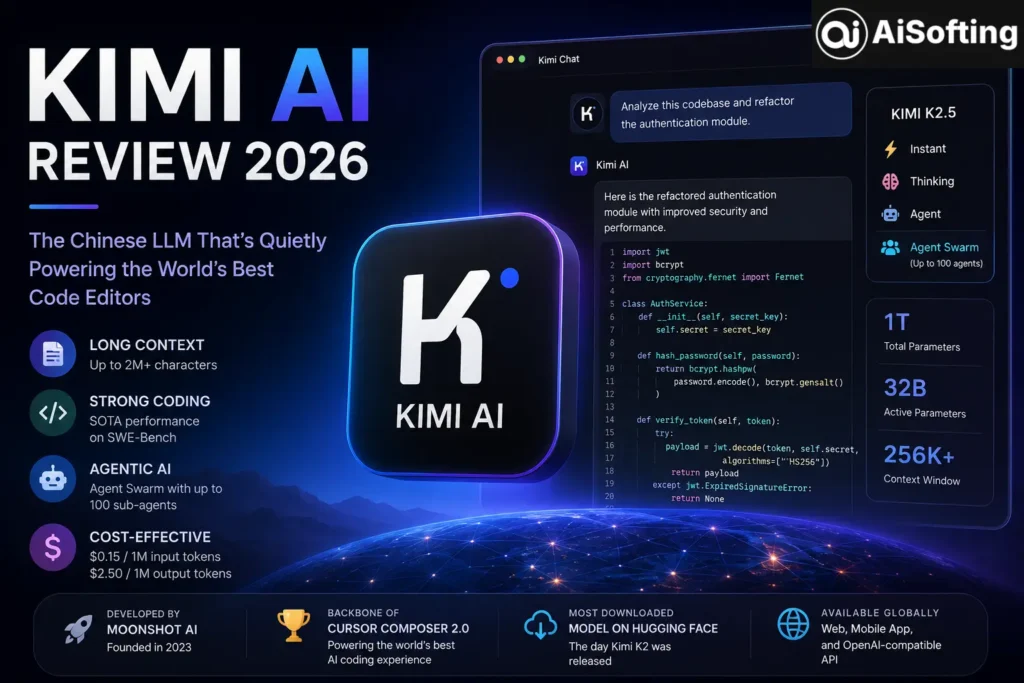
The Kimi chatbot launched publicly in November 2023 with support for 128,000 tokens of context — making it the first consumer AI model capable of handling inputs that large. By early 2024, that had grown to 2 million characters. By late 2025, Kimi’s agent features were processing up to 1 million rows of data in a single session. And in January 2026, Kimi K2.5 arrived as a multimodal, trillion-parameter model capable of orchestrating up to 100 AI sub-agents simultaneously.
This is not a niche tool anymore. Kimi AI is a serious contender.
The Evolution of Kimi AI: From Chatbot to Agentic Powerhouse
Kimi’s Breakthrough: Long Context Before Anyone Else
When Kimi launched in late 2023, the AI world was dominated by GPT-4, which had a context window of around 8,000 tokens in its standard version. Kimi’s 128,000-token context window felt almost absurd — why would anyone need that much? Researchers, lawyers, financial analysts, and students quickly showed why. Uploading an entire PhD thesis or a multi-file software project and asking coherent questions about the whole thing was suddenly possible in a way it hadn’t been before.
Moonshot doubled down. Within months, they claimed a 2 million character context window — a figure that seemed almost fictional. The company also suffered its first major growing pain: a two-day outage in March 2024 when the surge in users overwhelmed their infrastructure, forcing a public apology. It was the kind of problem you only have when something actually works.
Kimi K1.5: Taking on OpenAI’s Best Reasoning Model
In January 2025, Moonshot released Kimi K1.5 and made a bold claim: it matched OpenAI’s o1 model — then considered the gold standard for reasoning — in mathematics, coding, and multimodal tasks. The method was clever: rather than simply scaling up compute, the team married reinforcement learning with long-context memory. The model learned from its own self-generated experiences rather than relying entirely on human-labeled data.
This was a sign of things to come.
Kimi K2: The Open-Source Trillion-Parameter Model
In July 2025, Moonshot released what many consider their most significant achievement: Kimi K2. The numbers alone are staggering — a 1 trillion total parameter mixture-of-experts (MoE) model, trained on 15.5 trillion tokens of text, released openly under a modified MIT license.
But what makes K2 technically interesting isn’t just its size. It’s the efficiency. The MoE architecture means only 32 billion parameters are active during any given inference — delivering the performance of a much larger dense model at a fraction of the compute cost. Moonshot also developed a new training optimizer called MuonClip, which allowed K2 to train on the full 15.5 trillion tokens without a single loss spike — a remarkably clean training run by any standard.
K2 was immediately recognized for its coding ability, achieving state-of-the-art performance among open-source models on SWE-Bench Verified — a benchmark that tests real-world software engineering tasks. On Hugging Face, it became the most downloaded model the day it released.
Kimi K2.5: Multimodal, Agentic, and Built for the Real World
January 2026 brought Kimi K2.5, which Moonshot calls its most powerful model yet. Here’s what it added over K2:
- Native vision capabilities via a 400-million-parameter visual encoder called MoonViT
- Four operational modes: Instant, Thinking, Agent, and Agent Swarm
- Agent Swarm: a research-preview feature where Kimi can spin up and coordinate up to 100 sub-agents working in parallel on complex tasks
- Competitive benchmark performance: outperforming GPT-5.2 Pro on BrowseComp and Claude Opus 4.5 on WideSearch in research and retrieval tasks
The Cursor connection — where K2.5 quietly powered Composer 2.0 under the hood — only became public knowledge when a developer found the model string kimi-k2p5-rl-0317-s515-fast embedded in the system. Moonshot wasn’t even mentioned in Cursor’s announcement.
Who Is Behind Kimi AI? Understanding Moonshot AI
Moonshot AI is a remarkably lean organization for a company at its level. With roughly 80 employees, it has generated over $240 million in revenue and achieved a valuation reportedly reaching $18 billion — making it one of the fastest Chinese companies ever to reach decacorn status, beating ByteDance’s timeline by over two years.
The company has raised over $1.77 billion from investors including Tencent, Alibaba (which is simultaneously a competitor), and IDG Capital. Alibaba’s investment is particularly interesting — it’s a direct competitor through its own Qwen model series, yet backed Moonshot’s Series B. That kind of competitive investing is common in China’s tech ecosystem, but it reflects just how seriously the big players take Moonshot’s potential.
Founder Yang Zhilin graduated top of his class from Tsinghua in 2015, did his PhD at CMU, and co-authored influential NLP papers before starting Moonshot. He has stated publicly that his ultimate goal is AGI — and his three technical milestones are long context, multimodal world modeling, and a scalable architecture capable of continuous self-improvement.
Kimi AI’s Key Features: What Actually Makes It Useful
Massive Context Window
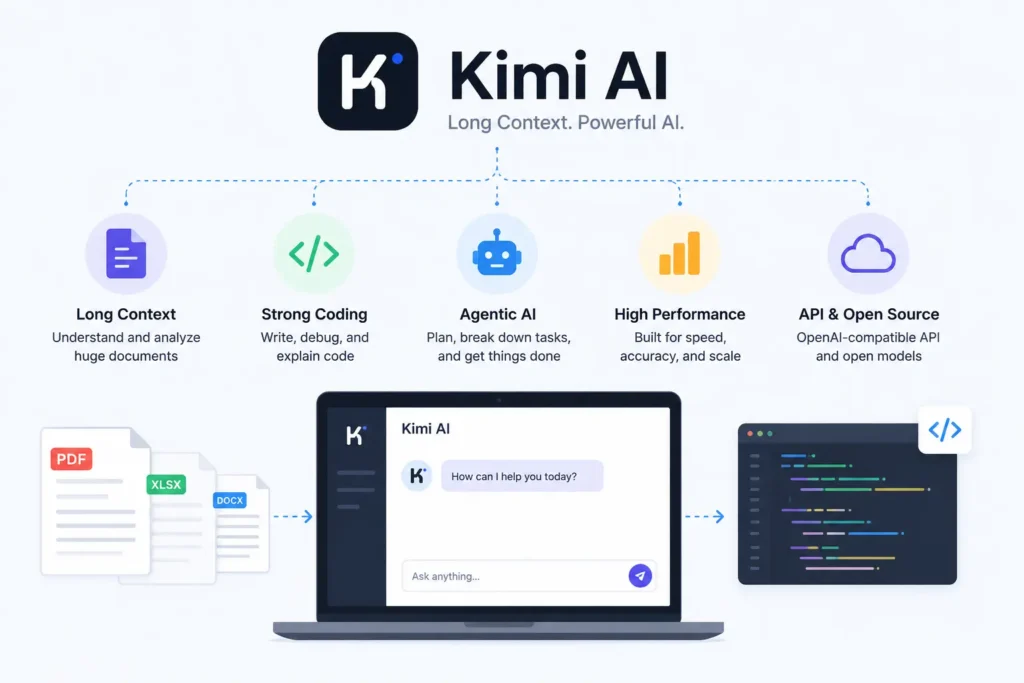
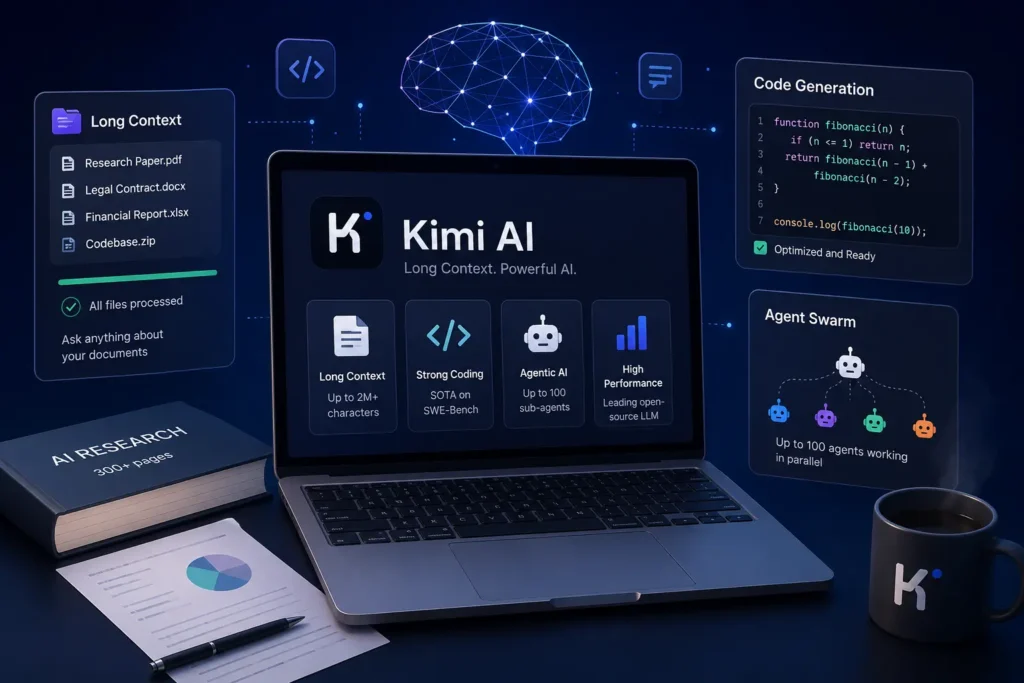
Kimi’s hallmark is still its context handling. You can upload lengthy documents, entire codebases, legal contracts, or research papers and ask questions that require synthesizing information spread across thousands of pages. Most AI tools force you to chunk documents manually; Kimi largely eliminates that friction.
Agentic Capabilities with “OK Computer”
In September 2025, Kimi added an agentic feature called “OK Computer” (yes, named after the Radiohead album). It can build multi-page websites, create editable slide presentations, process up to a million rows of input data, and output combinations of text, audio, images, and video — all from simple natural language prompts.
Strong Coding Performance
Kimi’s coding ability has become one of its strongest selling points. Kimi K2 and its successors consistently score near the top of open-source leaderboards for software engineering tasks. Tencent’s CodeBuddy product uses Kimi K2 Thinking as its underlying model. Companies like Genspark run their entire agent platform on it. Cursor adopted K2.5 as the core of Composer 2.0.
Developer-Friendly API
The Kimi platform at platform.moonshot.ai provides an OpenAI and Anthropic-compatible API, meaning developers can switch to Kimi with minimal changes to existing code. Pricing is competitive: $0.15 per million input tokens and $2.50 per million output tokens for K2 — significantly cheaper than many Western alternatives for comparable capability.
Open Source Models Available
Unlike OpenAI or Anthropic, Moonshot has open-sourced its flagship K2 model under a modified MIT license. The weights are available on Hugging Face and can be run locally with inference engines like vLLM, SGLang, or KTransformers. The license is permissive for most users, though organizations with more than 100 million users or $20 million in monthly revenue must display Kimi branding — a clever viral marketing mechanic.
Kimi AI vs. Competitors: How It Stacks Up
Kimi occupies an interesting competitive position. It sits alongside DeepSeek, ByteDance’s Doubao, and 01.AI in what observers call China’s “AI Tigers” — a cohort of LLM companies pushing the frontier from Beijing. In the global context, it competes with OpenAI’s GPT series, Anthropic’s Claude, and Google’s Gemini.
Where Kimi tends to win: long-context tasks, coding challenges, agentic workflows, and cost efficiency. Where it’s still catching up: broader multimodal understanding, consumer brand recognition outside of China, and the kind of trust that Western enterprise customers give established names.
The K2.5 benchmarks are genuinely impressive for an open-weight model. On several research and retrieval benchmarks, it outperforms frontier closed-source models that cost far more to use.
Personal Experience: Using Kimi AI for Real Work
I spent several weeks putting Kimi through its paces on actual work tasks, not synthetic benchmarks. Here’s what I found.
The long-context handling is as good as advertised. I uploaded a 250-page legal document and asked it to identify all clauses related to indemnification and flag any that were unusual compared to industry standard. It did this with a level of coherence that GPT-4 had historically struggled with when given the same document in chunks — the context window advantage is real and it shows.
The coding assistance was excellent on well-scoped tasks. Asking it to refactor a Python module, fix a specific bug, or explain a complex piece of open-source code all went smoothly. It felt more “senior developer” than “helpful autocomplete” in its responses.
Where I hit friction was in agentic tasks with ambiguous goals. When I gave it a vague research prompt, it occasionally over-generated — spending a lot of tokens on intermediate reasoning before arriving at a useful answer. The Moonshot team has acknowledged this in their own documentation, noting the model can sometimes produce excessive tokens on hard reasoning tasks. The fix is straightforward: be precise and specific with your prompts.
One thing that genuinely surprised me was the API pricing. Running extensive document analysis tasks that would have cost several dollars on GPT-4 cost a fraction of that on Kimi K2. For high-volume use cases, the economics are hard to ignore.
Lessons learned after weeks of use:
- Always specify output format explicitly — Kimi is powerful but benefits from constraints
- For coding, Kimi K2.5’s “Thinking” mode is worth the extra latency on complex problems
- For document analysis, break your questions into specific sub-questions rather than asking everything at once
- The API is genuinely easy to integrate if you’re already using OpenAI’s SDK
Common Mistakes to Avoid When Using Kimi AI
Sending vague prompts to agent mode. Kimi’s agent features are powerful, but they need clear objectives. “Research this topic for me” will produce a meandering result. “Find and summarize the five most-cited papers on transformer attention mechanisms published after 2022, with dates and author names” will produce something excellent.
Ignoring the different operation modes. Kimi K2.5 has Instant, Thinking, Agent, and Agent Swarm modes, each suited to different tasks. Using Thinking mode for a simple factual question is overkill; using Instant mode for multi-step reasoning is underselling what the model can do.
Assuming it handles all languages equally. Kimi was built primarily for Chinese and English. It performs well in both, but edge-case multilingual tasks may not get the same quality as its primary languages.
Not checking the API rate limits. If you’re building production applications, pay attention to Moonshot’s tiered rate limit system — usage scales with cumulative spend, so plan accordingly.
Frequently Asked Questions About Kimi AI
What is Kimi AI and who made it?
Kimi AI is a chatbot and family of large language models developed by Moonshot AI, a Chinese AI company founded in 2023 by Yang Zhilin. It’s known for long-context processing, strong coding ability, and agentic capabilities.
Is Kimi AI free to use?
Kimi’s consumer chatbot at kimi.com operates on a freemium model — basic access is free with premium tiers for heavier usage. The API at platform.moonshot.ai is pay-as-you-go, starting at $0.15 per million input tokens for K2.
How does Kimi AI compare to ChatGPT?
Kimi AI matches or exceeds ChatGPT on several benchmarks, particularly in coding, long-context tasks, and agentic workflows. GPT models have broader consumer brand recognition and potentially stronger general reasoning on some tasks, but Kimi offers significantly better cost efficiency and is open-source for the K2 line.
Is Kimi AI open source?
Kimi K2 and K2 Thinking are open-source under a modified MIT license. Weights are available on Hugging Face. The consumer chatbot and K2.5 are currently closed for the consumer product, though K2.5 weights were also released publicly.
What is Kimi K2’s context window?
The Kimi K2 Instruct model (updated September 2025) supports a 256,000-token context window — double the original 128K release. The consumer chatbot supports significantly larger contexts for document uploads.
Can Kimi AI be used for coding?
Yes — coding is one of Kimi’s strongest use cases. Kimi K2 achieved state-of-the-art performance on SWE-Bench Verified among open-source models. Cursor’s Composer 2.0 and Tencent’s CodeBuddy both use Kimi models as their underlying engine.
What is Kimi’s “Agent Swarm” feature?
Agent Swarm is a capability in Kimi K2.5 that allows the model to decompose a complex task into parallel subtasks and assign them to up to 100 AI sub-agents running simultaneously. It significantly reduces the time needed for complex research and multi-step workflows.
Is Kimi AI safe to use for sensitive documents?
Moonshot AI offers SLA-backed reliability and data compliance protections on the enterprise API. As with any cloud AI service, review the data handling terms before uploading sensitive business or personal documents.
Why did Cursor use Kimi K2.5 for Composer 2.0?
Kimi K2.5’s combination of coding ability, long-context handling, and vision capabilities made it an ideal fit for an agentic coding environment. The fact that it’s an open-weight model also gives Anysphere (Cursor’s parent company) more flexibility than relying on a fully closed API.
Where is Kimi AI available?
The Kimi chatbot is available globally at kimi.com via web and mobile apps. The Kimi API is accessible at platform.moonshot.ai. The K2 and K2.5 model weights can be downloaded from Hugging Face and run locally.
Conclusion: Why Kimi AI Deserves Your Attention in 2026
The story of Kimi AI is the story of what happens when a small, intensely focused team makes a genuine technical bet and executes on it relentlessly. Moonshot AI chose long context as its north star in 2023 when most of the industry thought it was a niche concern. Today, long context is table stakes for frontier models, and Kimi helped make that happen.
Whether you’re a developer looking for a cost-effective, highly capable coding assistant, a researcher who needs to synthesize vast amounts of literature, or a business building AI workflows at scale, Kimi AI is worth serious consideration in 2026. The open-source K2 line removes the vendor lock-in concern. The API pricing undercuts most Western competitors. And the benchmark numbers — especially on coding and agentic tasks — are no longer things you can dismiss as “Chinese hype.”
Actionable takeaways:
- Try the free Kimi chatbot at kimi.com for document-heavy tasks where other AI tools have let you down
- If you’re a developer, explore the Kimi API at platform.moonshot.ai — the OpenAI-compatible interface makes integration straightforward
- For local deployment, download Kimi K2 weights from Hugging Face and test with vLLM or SGLang
- Use “Thinking” mode for complex multi-step problems; use “Instant” mode for fast, conversational tasks
- Follow Moonshot AI’s GitHub (github.com/MoonshotAI) to track updates — this team ships fast
The AI race is genuinely global now. Kimi AI is proof of that — and it’s one of the most interesting players in it.
For more AI tools, AI assistants, software reviews, and the latest AI innovations, visit Aisofting
Disclaimer:
This article is intended for informational and educational purposes only. AI platforms such as Kimi AI evolve rapidly, and features, pricing, benchmarks, and availability may change over time. Readers should verify the latest information through Kimi AI’s official website and documentation before making business or technical decisions.