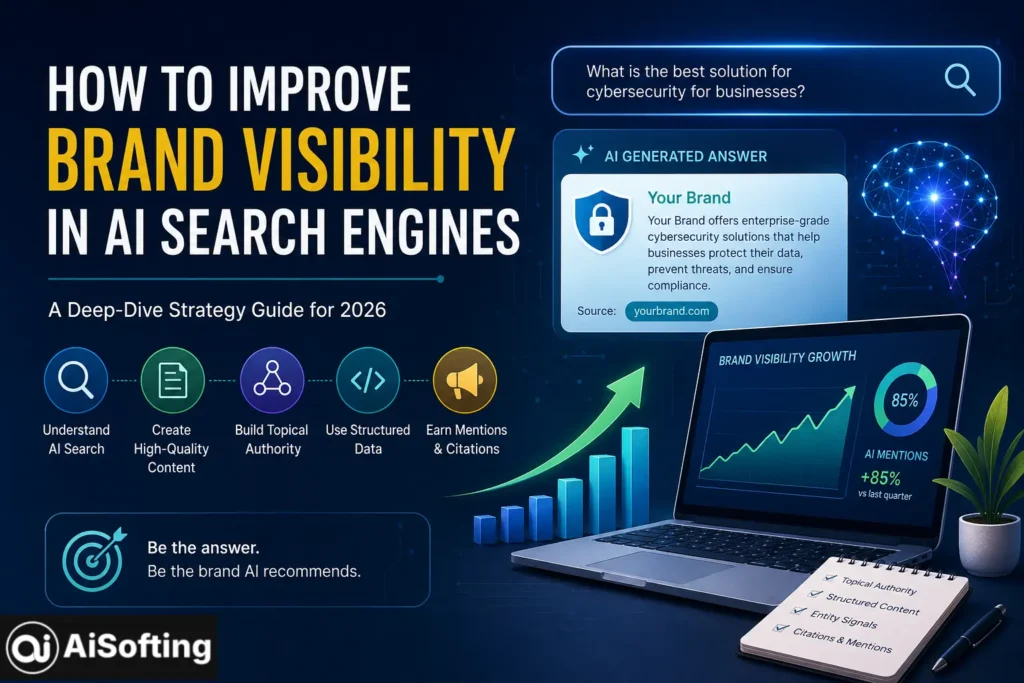
If you want to improve brand visibility in AI search engines, you’re asking the right question at exactly the right time — because in 2026, AI-powered search is no longer a trend to watch. It’s the primary way millions of people find products, services, and expert advice. And the rules look nothing like traditional SEO.
The rules of search have fundamentally changed. It’s no longer about a Google algorithm update or a new backlink strategy. AI systems are now the ones deciding what information gets surfaced, summarized, and cited. And most brands aren’t even aware they’re being left out.
If you’ve noticed traffic dips that don’t correlate with any ranking drops, or you’ve searched for your industry on ChatGPT and found a competitor mentioned instead of you, you’re already experiencing the downstream effect of poor AI search visibility. This guide exists to fix that.
Why AI Search Visibility Is a Different Problem Than Traditional SEO
Traditional SEO is about ranking. AI search visibility is about being selected. These sound similar but require completely different strategies.
When someone asks Google a question, they get a list of links and choose where to click. When they ask ChatGPT, Perplexity, Claude, or Gemini the same question, they get a synthesized answer — and the AI decides which sources to pull from, reference, or recommend. Your brand may rank on page one of Google and still be completely invisible in AI-generated responses.
The mechanism behind this matters. Large language models (LLMs) like GPT-4, Claude, and Gemini are trained on vast corpora of text. They develop an internal representation of “what the internet knows” about your brand, industry, and expertise. If your content is thin, siloed, or structured in ways that resist machine comprehension, you simply won’t be included in the mental model the AI builds — regardless of your domain authority.
This is a content authority problem, not just a technical SEO problem.
What AI Systems Actually Look For When Selecting Sources
Before you can improve your visibility, you need to understand what AI systems reward. Based on observable patterns across how tools like Perplexity, Google AI Overviews, and ChatGPT with Browse respond, a few consistent principles emerge:
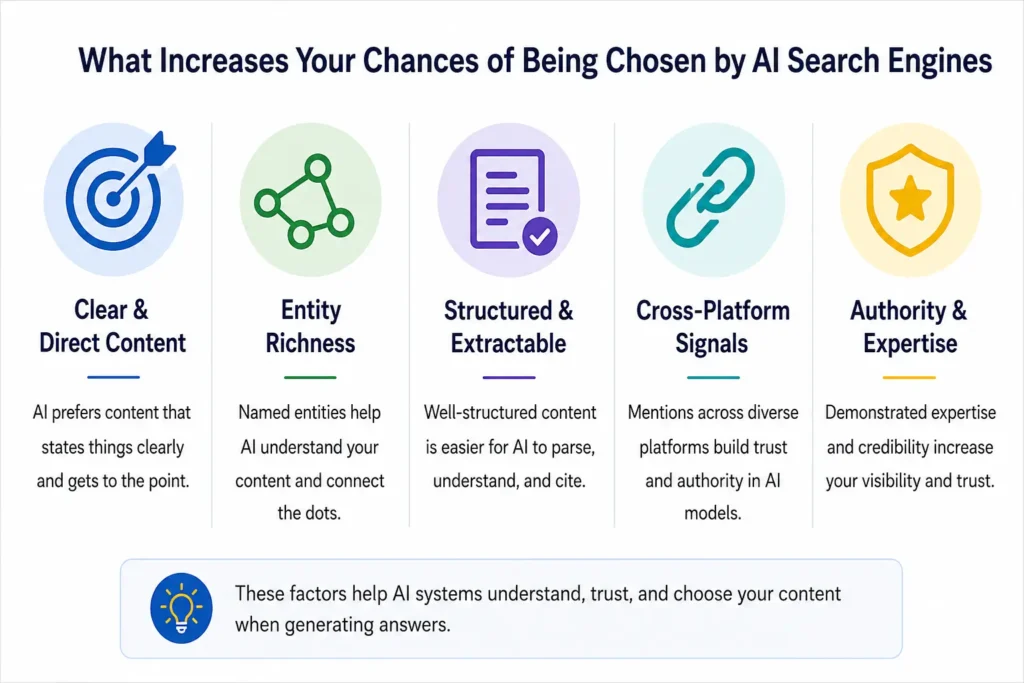
Clarity over cleverness. AI systems extract meaning from text. Content that buries its point inside metaphors, roundabout phrasing, or narrative-heavy prose often gets skipped over in favor of content that states things directly. If your about page says “we’re a dynamic team of passionate problem-solvers,” an AI has no idea what you actually do.
Entity richness. Search engines — including AI-powered ones — rely heavily on entity recognition. Named people, companies, tools, locations, methodologies, and standards create a web of meaning the AI can anchor your content to. A brand that exists as a cluster of connected, named entities is far more likely to be retrieved and cited than one that exists as floating keyword-optimized paragraphs.
Structured, extractable knowledge. AI systems prefer content that answers questions clearly and directly. Definition blocks, clear H2/H3 hierarchies, numbered steps, and FAQ-style content all make it easier for an AI to extract a relevant passage and include it in a response.
Cross-platform citation signals. LLMs are trained on the web, including Wikipedia, Reddit, Quora, YouTube transcripts, news articles, and academic papers. A brand that appears consistently and positively across these diverse sources builds a stronger representation in the model’s training data than one that exists only on its own website.
The Content Architecture That AI Systems Prefer
This is where most brands fundamentally misunderstand the problem. They treat AI visibility as a distribution issue (“we need to publish more”) when it’s actually a structure issue (“our content isn’t organized in a way machines can parse and cite”).
Build Topic Clusters, Not Just Blog Posts
A single great article on a topic helps. A comprehensive topic cluster — a hub page supported by a constellation of related, interlinked pieces — tells an AI system that you are an authority on that entire subject domain. This is sometimes called “topical authority,” and it’s one of the most powerful drivers of AI citation behavior.
For example, a cybersecurity brand that has a core page on “network security” supported by detailed pieces on firewalls, zero-trust architecture, penetration testing, intrusion detection, and compliance frameworks is much more likely to be cited in response to a broad cybersecurity query than a brand with a single blog post on the topic.
Answer Real Questions — Not Imagined Ones
Too much content is written for an imagined user (“someone who wants to learn about our product”) rather than a real one (“someone who just Googled ‘best alternatives to [competitor]'”). AI systems increasingly surface content that aligns with how people actually phrase questions.
Use tools like AnswerThePublic or the “People Also Ask” section in Google results to identify real question patterns. Then write content that answers those questions directly, in plain language, with clear structure. The brand that best answers the question the AI’s user asked is the brand that gets cited.
Add Structured Data Markup
Schema.org markup is one of the clearest signals you can send to AI systems about what your content means. Organization schema, Article schema, FAQPage schema, HowTo schema, and BreadcrumbList all help AI systems understand not just what your content says but what kind of thing it is.
Google explicitly uses structured data in its AI Overviews. Perplexity uses it to understand entity relationships. Even ChatGPT’s Browse mode benefits from pages that use semantic HTML and structured data to indicate content hierarchy.
Building a Brand Presence AI Systems Can Recognize
Beyond content structure, your brand needs to exist as a recognizable entity in the AI’s world model.
Wikipedia and Wikidata Presence
This isn’t for every brand, but if you’re a mid-to-large company with genuine notability, a Wikipedia article is one of the strongest signals you can generate. LLMs were heavily trained on Wikipedia. A brand with a Wikipedia article — particularly one that’s well-cited and includes key facts about founding date, products, notable milestones, and industry associations — will have a richer internal representation in most AI models.
Wikidata (the structured knowledge graph behind Wikipedia) is equally important. If your organization, products, or key personnel appear as named entities in Wikidata, that information is embedded into the training data of virtually every major AI system.
Third-Party Mentions in High-Authority Contexts
AI systems synthesize information from many sources, and they weight authoritative ones heavily. Coverage in industry publications, mentions in research papers, quotes in news articles, and reviews on platforms like G2, Capterra, or Trustpilot all contribute to a richer, more credible representation of your brand in AI-generated responses.
A practical implication: your PR strategy is now also an AI visibility strategy. Getting quoted in a Forbes piece or mentioned in a Harvard Business Review article doesn’t just drive referral traffic — it shapes how AI systems understand your brand’s credibility and relevance.
Consistent Factual Information Across the Web
AI systems are trained on a messy web, and inconsistencies confuse them. If your brand’s founding date, headquarters location, product names, and employee count appear differently across LinkedIn, Crunchbase, your website, and news articles, the AI develops an incoherent picture of who you are.
Auditing and standardizing your brand’s factual footprint across directories, listings, social profiles, and knowledge panels is an underrated but highly effective AI visibility tactic.
Optimizing for AI Search Platforms Individually
Not all AI search tools work the same way. Tailoring your approach to the specific mechanics of each platform is where sophisticated brands gain an edge.
Google AI Overviews
Google’s AI Overviews draw heavily from content that already ranks in the top 10. They also favor content with clear structure (numbered lists, short paragraphs, defined terms) and pages that directly answer the query. Focusing on featured-snippet-style content remains one of the most effective strategies here, as the content that wins snippets often also wins AI Overview placement.
According to Search Engine Journal’s AI Overview research, pages cited in AI Overviews tend to be longer, more comprehensive, and contain more direct question-and-answer content than those that merely rank highly.
Perplexity AI
Perplexity performs live web searches for almost every query. This means freshness matters more here than in systems that rely on static training data. Brands that publish consistently, update older content regularly, and maintain active presences on platforms Perplexity indexes (like Reddit, LinkedIn, and news sites) have a significant advantage.
Perplexity also cites sources directly, which means every citation is also a brand impression. Structuring content to be cite-worthy — with clear attributable facts, named experts, and specific data points — increases both citation frequency and brand credibility.
ChatGPT and Claude
For models that primarily rely on training data (rather than live search), the strategic goal is different: you want your brand to appear consistently and positively in the sources those models were trained on. This means historical content matters. High-quality articles, interviews, and case studies published on authoritative sites years ago may have more impact on how these models represent your brand than anything you publish today.
For ChatGPT’s Browse mode and similar plugins, the same rules as Perplexity apply: fresh, structured, citable content wins.
Common Mistakes Brands Make When Trying to Appear in AI Responses
Some well-meaning strategies actively hurt AI visibility.
Over-optimizing for keywords at the expense of clarity. Content stuffed with keyword variations often becomes incoherent to language models, which prioritize meaning over repetition. An AI extracting a passage from your page needs that passage to make sense on its own.
Blocking crawlers out of caution. Some brands use robots.txt to block AI crawlers, sometimes inadvertently. Tools like GPTBot (OpenAI), ClaudeBot (Anthropic), and PerplexityBot each send identifiable crawlers. Blocking them means your site won’t be indexed for live-search AI responses and may not be updated in future model training.
Ignoring conversational search phrasing. People ask AI systems questions the way they’d ask a person. Content written in a stiff, formal, keyword-focused style often mismatches the natural language queries AI systems are trying to answer. Writing more conversationally — while maintaining depth and accuracy — significantly increases the chance of a match.
Publishing without named expertise. AI systems increasingly reward content associated with identifiable experts. Author bylines, About pages with professional credentials, LinkedIn profiles linked to your brand, and published interviews all contribute to the E-E-A-T signals that help AI systems trust your content.
The Rising Importance of AI-Specific Content Formats
An emerging category worth tracking: content formats designed specifically for AI consumption, sometimes called “AI-first content.”
These include:
- Knowledge base articles with structured Q&A format
- Comparison pages that directly evaluate your product against alternatives
- Definition pages that authoritatively define key terms in your industry
- Process documentation that clearly outlines steps, conditions, and outcomes
These formats are highly citable because they answer specific questions completely. A well-structured comparison page that objectively covers your product alongside alternatives is often more likely to be cited in an AI response than a purely promotional product page.
The Moz guide on AI search optimization and Ahrefs’ content strategy resources both document how this shift toward answer-oriented content is changing content production priorities for brands serious about AI visibility.
My Experience with How to Improve Brand Visibility in AI Search Engines
When I first started paying attention to AI search visibility as a distinct discipline, my initial instinct was to treat it as a technical SEO extension. More schema markup, faster pages, better structured data — surely that would do it. What I found was more nuanced, and in some ways more humbling.
One of the first things I tested was comparing how different AI tools responded to queries in a niche B2B software category. The brands that consistently appeared in AI-generated answers weren’t necessarily the ones with the highest domain authority or the most backlinks. They were the ones with the clearest, most direct content — and the broadest footprint of third-party mentions. A company with a smaller site but consistent coverage in industry newsletters, podcast appearances, and niche forum discussions appeared far more reliably than a competitor with a polished website and minimal outside presence.
The lesson stuck: AI visibility is an ecosystem problem. You can’t manufacture it by optimizing a single page. It comes from the cumulative signal of your brand appearing, accurately and positively, across many independent sources over time. That realization shifted my thinking from “how do we optimize our content” to “how do we become the brand that deserves to be cited.”
The trickiest challenge I encountered was dealing with stale or inconsistent information in AI training data. One client had gone through a rebrand several years prior, but their old brand name continued to surface in AI responses because the older content — articles, forum posts, directory listings — still dominated the training corpus. Cleaning that up required a combination of updating old pages, publishing fresh content under the new brand name, and actively building new third-party mentions. It took months to see meaningful shift.
What I’ve come to appreciate is that this kind of brand presence work has a compounding effect that SEO sometimes doesn’t. When you genuinely build authority and clarity around your brand — through consistent publishing, real expert voices, external coverage, and structured knowledge — you’re not just gaming an algorithm. You’re building something that AI systems, future search platforms, and real humans all respond to.
FAQ: How to Improve Brand Visibility in AI Search Engines
What is the fastest way to start showing up in AI search results?
The fastest path is to publish clear, structured, question-answering content on your website and to claim or update your listings on authoritative third-party platforms (Google Business Profile, LinkedIn, Crunchbase, Wikipedia if eligible). AI systems draw from many sources; updating existing high-authority presences can influence AI responses faster than building new ones from scratch.
Does my Google ranking affect my AI search visibility?
Partially. Google AI Overviews tend to favor pages that already rank in the top 10 for a query. But platforms like ChatGPT and Perplexity use different signals — including training data and live web indexing — that don’t directly track with Google ranking. A brand can have poor Google rankings and still appear in AI-generated answers if it has strong third-party coverage and clear content.
How do I know if an AI is citing my brand?
Search for your brand name and relevant queries manually in tools like ChatGPT, Perplexity, Claude, and Google’s AI Overviews. Tools like Brand24 and Mention also track some AI-generated references. Creating a regular audit of AI responses in your category is currently the most reliable method, as dedicated AI citation tracking tools are still emerging.
Should I block AI crawlers from my website?
Generally, no — unless you have a specific business reason to do so. Blocking crawlers like GPTBot or PerplexityBot prevents those systems from indexing your content for live-search responses and potentially including it in future model training. Allowing them ensures your freshest, most optimized content is available for AI retrieval.
Is AI search visibility a replacement for traditional SEO?
No. Traditional SEO and AI search visibility are complementary strategies. Quality content, strong technical foundations, and authoritative backlinks still drive Google rankings, which in turn influence some AI systems. The most effective approach treats them as parallel investment areas, with AI visibility requiring additional focus on content clarity, entity richness, and third-party presence.
Conclusion: What Brands That Win in AI Search Have in Common
After examining dozens of brand presences across AI search platforms, a clear pattern emerges. The brands that consistently appear in AI-generated responses share a few defining characteristics: they publish content that answers real questions clearly; they exist as recognizable, consistent entities across many sources; they are associated with identifiable human expertise; and they update their content regularly.
None of these things are secret. But they require sustained effort, strategic content architecture, and a willingness to think beyond traditional keyword ranking.
Key takeaways:
- Structure your content to answer questions directly, with clear headings and extractable passages
- Build topical authority through interconnected content clusters, not isolated articles
- Treat your brand’s factual footprint (across directories, Wikipedia, third-party sites) as a visibility asset
- Develop a PR and media strategy with AI visibility in mind — where you’re mentioned shapes what AI says about you
- Allow AI crawlers access to your site and update content regularly for platforms that use live indexing
- Add structured data markup to help AI systems understand what your content is and what it means
The brands that dominate AI search in the next five years won’t be those that found a shortcut. They’ll be the ones that built genuine authority, communicated it clearly, and made it easy for machines — and people — to understand what they do and why it matters.
For more AI-related insights, guides, and the latest technology updates, visit Aisofting