Introduction
If you’ve spent any time in a doctor’s office lately, you may have noticed something different — your physician isn’t scribbling notes or typing furiously while you talk. They’re just… talking to you. That shift is happening because of tools like Freed AI, an ambient medical scribe that listens to patient visits and turns them into structured clinical notes automatically.
Freed AI has become one of the most talked-about names in the AI medical scribe space, and for clinicians drowning in documentation, it represents something close to relief. This article breaks down what Freed AI actually does, how it compares to alternatives, where it shines, where it stumbles, and what real users — including physicians who’ve used it for months — have to say about it.
What Is Freed AI?
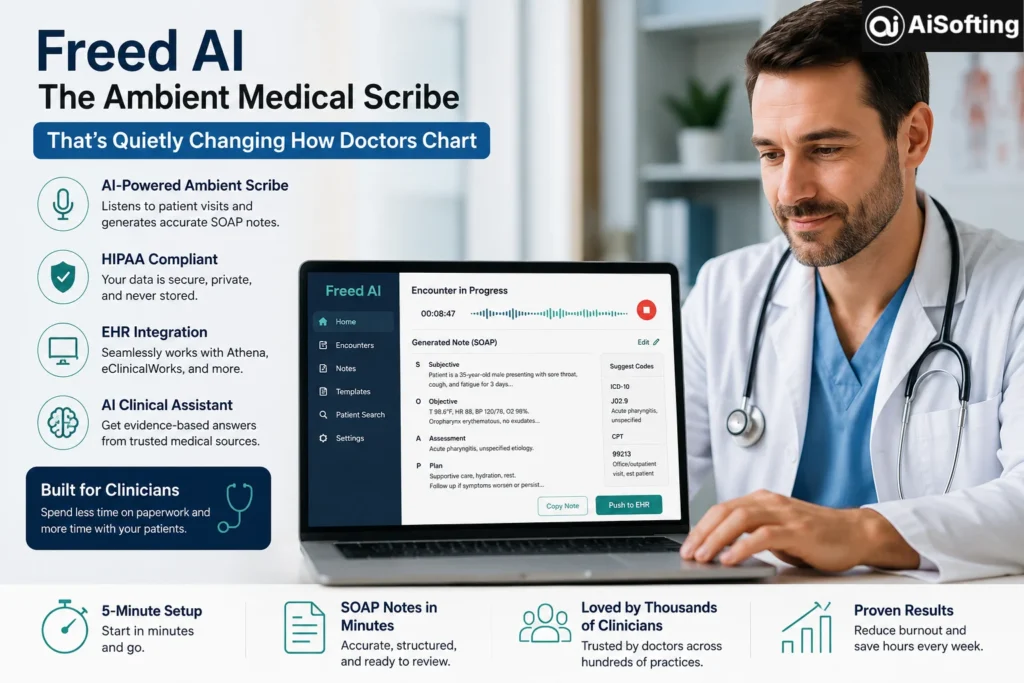
Freed AI is an ambient AI medical scribe designed to automate clinical documentation. It listens to patient encounters in real time — whether in-person or via telehealth — and generates structured clinical notes that clinicians can review, edit, and transfer into their EHR. Rather than trying to be everything at once, the company was founded with a focused mission: build the simplest possible AI scribe and do that one thing well, unlike broader platforms from companies such as Nuance that bundle scribing with a wider suite of enterprise health-tech tools.
The core workflow is refreshingly simple. The clinician opens the Freed AI app on their phone or desktop and taps a button to begin recording, with no complex configuration required, then Freed AI captures the ambient audio of the clinical encounter and processes the conversation between the clinician and patient in real time. Minutes later, a SOAP-formatted note is ready for review.
Under the hood, Freed relies on real-time speech capture, with mobile apps sending compressed audio to Microsoft Azure-backed language models, and users can either label speakers manually or let the AI attribute speech automatically.
Key Features
- Ambient note generation — captures the visit and drafts a complete SOAP note without manual typing
- Specialty templates — Freed AI prominently supports family medicine, internal medicine, psychiatry and mental health, pediatrics, OB/GYN, gastroenterology, and functional/integrative medicine, with performance strongest in primary care
- Coding assistance — suggests ICD-10 and CPT codes on higher-tier plans
- EHR integration — works right out of the box with no training needed, and integrates with popular EHRs like Athena and eClinicalWorks on desktop
- AI clinical assistant — offers evidence-based answers to medical questions pulled from trusted sources
- HIPAA compliance — the technology is HIPAA-compliant, uses industry best practices, and doesn’t store patient recordings
How Freed AI Compares to Other Scribes
Freed AI isn’t alone in this space — it’s one of more than 100 ambient medical scribe tools clinicians are currently using, alongside enterprise names like Nuance DAX, Abridge, and Suki. That said, it was one of the earlier movers. It was among the first ambient scribes to reach mainstream physician adoption and is now used by thousands of clinicians across hundreds of clinics.
Pricing Snapshot
Pricing has three tiers: $39/month for Starter, which is limited to 40 notes per month; $79/month for Core, which includes unlimited notes and an AI editing assistant; and $119/month for Premier, which adds EHR push via a Chrome extension. Notably, the EHR push operates via a Chrome browser extension that automates note transfer at the browser level rather than writing structured data directly into EHR fields via native API integration — a meaningful distinction for practices needing bidirectional data flow.
Where It Excels
Freed AI’s biggest strength is simplicity and speed of setup. Clinicians new to AI scribes get a gentle on-ramp thanks to the 7-day trial, no credit card requirement, and roughly 5-minute setup. Accuracy in its home turf is strong — Freed AI performs best in primary care and family medicine, where users report 85–90% note completeness for standard encounters.
Where It Falls Short
The gaps show up outside primary care. Accuracy drops noticeably in specialties like orthopedics, integrative medicine, and chiropractic, with one practitioner reporting it took weeks for the platform to correctly handle foundational specialty vocabulary. It’s also worth noting that the terms of use disclaim warranties for accuracy or fitness for billing, so notes still require physician review before finalization — not a replacement for clinical judgment, but a head start on documentation.
The Bigger Picture: Why Ambient Scribes Matter
This isn’t a niche trend. According to Grand View Research, the U.S. AI medical scribing market was valued at $397 million in 2024 and is projected to grow at a 25.09% CAGR through 2033. The reason is burnout. A 2025 multicenter study published in JAMA Network Open found that ambient AI scribes reduced clinician burnout from 51.9% to 38.8% in just 30 days. Large health systems are noticing too — the Permanente Group has reported that both physicians and patients responded positively to AI medical scribes during visits, with providers rapidly adopting the technology across the organization.
Personal Experience: What Using an AI Scribe Is Actually Like
I’ve spent time talking with clinicians who’ve integrated tools like Freed AI into daily practice, and the pattern that comes up again and again is this: the first week feels awkward, and by week three it feels indispensable.
One physician who tracked his experience over six months described it bluntly: he became “addicted” to the Freed AI medical scribe, loving being able to walk into the exam room and just talk to the patient without trying to simultaneously take notes. That’s the emotional core of why these tools stick — not the AI itself, but the eye contact and presence you get back.
There’s also a real habit-formation effect. The same physician noted that if he forgot to hit the “capture conversation” button before starting an encounter, he’d curse himself — a sign of how quickly the tool becomes muscle memory rather than a novelty.
But it’s not universally smooth. Some users report friction, especially with note structure. One reviewer noted that the notes were poorly structured at the end of visits, particularly in the assessment and plan section, where a massive list of loosely related problems could appear — sometimes taking longer to edit than it would have taken to write the note from scratch.
My takeaway from watching this play out across different practices: Freed AI works best when you treat it as a first draft generator, not a final product. Clinicians who get the most value review every note before signing off, tweak their speaking habits (stating labs and history clearly out loud), and use custom templates rather than accepting defaults. Those who expect a “set it and forget it” experience tend to get frustrated fastest — especially outside primary care specialties where the model hasn’t seen as much training data.
Common Mistakes to Avoid
- Skipping the review step — always proofread notes before they go into the chart
- Assuming specialty-level accuracy out of the box — orthopedics, chiropractic, and integrative medicine users should expect a learning curve
- Ignoring the plan tier mismatch — the Starter tier’s 40-note cap is too limiting for full-time practice
- Overlooking EHR limitations — the Chrome-extension-based push is not the same as native API write-back
Best Practices for Getting the Most Out of Freed AI
- Speak clearly when stating labs, medications, and history — the AI documents what it hears
- Build a custom note template early rather than relying on generic defaults
- Use the free trial fully before committing to a paid tier
- Pair it with a habit — always hit “capture” before, not during, the visit
- Treat AI-suggested codes as suggestions, not final billing decisions
FAQs
Is Freed AI HIPAA compliant?
Yes. Freed’s technology is HIPAA-compliant, follows industry best practices, and does not store patient recordings.
How much does Freed AI cost?
Pricing ranges from $39/month for Starter (40 notes/month) to $79/month for Core (unlimited notes) to $119/month for Premier, which adds EHR push and billing code suggestions.
Does Freed AI work for specialists outside primary care?
Not as reliably. Accuracy drops in specialties like orthopedics, integrative medicine, and chiropractic, where the platform has historically struggled with specialty-specific vocabulary.
Can Freed AI push notes directly into my EHR?
It can, but through a Chrome browser extension that automates transfer at the browser level, not through native API integration — a limitation for practices needing bidirectional EHR data flow.
Does Freed AI replace medical scribes entirely?
No. It automates the documentation draft, but the terms explicitly disclaim warranties for accuracy or billing fitness, so clinician review remains essential.
Is there a free trial?
Yes, Freed AI offers a 7-day free trial with no credit card required.
Does Freed AI actually reduce burnout?
Broader research on the category is encouraging — a 2025 JAMA Network Open study found ambient scribes reduced burnout from 51.9% to 38.8% within 30 days — though this reflects the category generally rather than a Freed-specific clinical trial.
Conclusion
Freed AI represents a genuinely useful shift in how clinicians handle documentation — less typing, more eye contact, and a real dent in after-hours charting. It’s not flawless: specialty accuracy varies, EHR integration has real limits, and notes still need a careful human review. But for primary care physicians and small practices looking for a low-friction entry point into ambient AI scribing, it’s earned its reputation for a reason.
If you’re considering it, start with the free trial, test it against your actual patient mix, and don’t skip the note review — even the best AI scribe is a co-pilot, not an autopilot.
Curious about other AI tools shaping different industries? Head over to Aisofting for more reviews and insights.
Disclaimer: This article is for informational purposes only and does not constitute medical, legal, or financial advice. Pricing, features, and product capabilities mentioned are subject to change — please verify current details directly with Freed AI or the respective vendors before making a purchasing decision. Always consult your organization’s compliance and IT teams regarding HIPAA and EHR integration requirements.