Introduction
Two years ago, “AI music” mostly meant robotic loops that sounded fine as background noise but fell apart the second real vocals or structure entered the picture. That’s no longer true. The best AI music generation tools in 2026 can produce full songs with coherent verses, choruses, and vocals that actually sit in the mix correctly not glued on top like an afterthought.
The catch is that this space is moving fast, almost too fast to keep up with. Tools update their models every few months, pricing shifts, and legal disputes over training data have already reshaped how some platforms operate. Picking the “best” AI music generator today isn’t really about finding one universal winner it’s about matching the right tool to the right job, whether that’s a full song with lyrics, quick background music for a video, or a professional score for a game.
This guide breaks down the AI music generation tools actually worth using in 2026, based on what they’re good at, where they fall short, and what I’ve personally run into testing them for real projects.
What Makes a Good AI Music Generator in 2026?
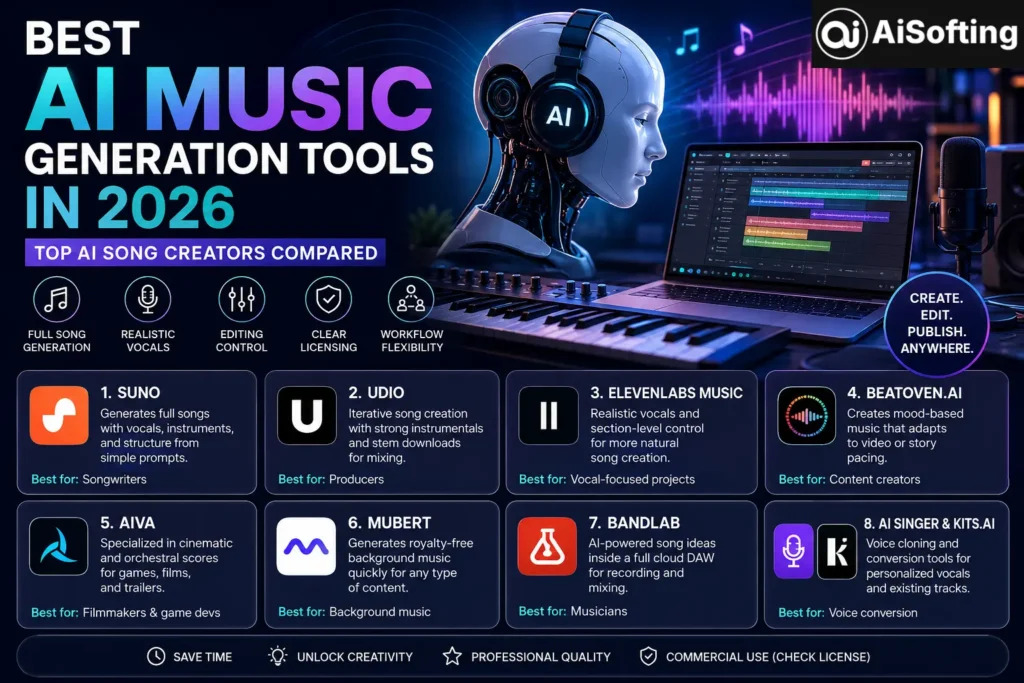
Before comparing tools, it helps to know what actually separates a strong AI music generator from a gimmicky one. The tools worth paying for in 2026 tend to do well on a few consistent factors:
- Audio fidelity does it sound like a real mix, or thin and over-compressed?
- Vocal coherence do lyrics land on the beat, or float awkwardly over the instrumental?
- Editing control can you fix a bad section without regenerating the whole track?
- Licensing clarity is commercial use clearly allowed, and under what terms?
- Workflow fit does it serve songwriters, content creators, or background-music use cases?
Keep these factors in mind, because the “best” tool changes depending on which one matters most for your project.
Best AI Music Generation Tools in 2026
1. Suno
Suno remains one of the most talked-about names in AI music, and for good reason. It generates full songs vocals, instrumentation, and structure from a short prompt or a handful of lyric lines. Its newer version has noticeably improved lyric timing and sound quality compared to earlier releases, and its Studio tool now allows section-level editing instead of forcing a full regeneration every time something’s slightly off.
Best for: Songwriters and creators who want a complete song fast, with room to refine afterward.
2. Udio
Udio takes a more iterative approach, encouraging users to reshape a track through multiple rounds of prompts rather than accepting the first output. It’s particularly strong on instrumental clarity and arrangement, and it offers stem downloads for paid users useful if you plan to bring the track into a traditional DAW for further mixing.
Best for: Producers who want to keep refining a track rather than settling for a single generation.
3. ElevenLabs Music
Best known for AI voice technology, ElevenLabs extended into music generation with strong vocal realism and section-level composition control. It’s a solid option for creators who care specifically about how natural the vocals sound, since that’s historically been the weak point for many competitors.
Best for: Projects where vocal quality matters more than instrumental complexity.
4. Beatoven.ai
Beatoven is built around mood and narrative rather than genre. You assign emotions to different sections of a video or story, and the tool builds music that shifts to match making it especially useful for YouTubers, podcasters, and video editors who need music that follows a story arc rather than playing on a loop.
Best for: Content creators syncing music to video or narrative pacing.
5. AIVA
AIVA focuses on cinematic and orchestral composition, aimed at film, games, and long-form media projects rather than pop songs. If you need something that behaves more like a traditional film score than a chart-ready track, AIVA is one of the few tools built specifically for that use case.
Best for: Game developers and filmmakers needing orchestral or cinematic scoring.
6. Mubert
Mubert focuses on fast, royalty-free background music generation, aimed at creators who need constant content intros, loops, and hooks without the complexity of full songwriting tools. It’s less about crafting a single perfect track and more about producing usable background audio quickly and repeatedly.
Best for: High-volume content creators needing quick, royalty-safe background tracks.
7. BandLab
BandLab combines a full cloud-based DAW with AI-assisted features like SongStarter for generating song ideas. Because it’s a complete production environment rather than just a generator, it appeals more to musicians who want AI as a creative jumpstart within a broader workflow, not a replacement for it.
Best for: Musicians who want AI assistance inside a full recording and mixing environment.
8. AI Singer and Kits.ai (Voice-Focused Tools)
These two serve a different niche entirely personalization and voice conversion rather than general song generation. AI Singer turns a short voice sample into a fully sung, personalized song, which has become popular for gifts and personal milestones. Kits.ai instead converts vocals on existing tracks into a different voice, which suits musicians who already have a recording and want to swap or clone the vocal performance.
Best for: Personalized songs or voice conversion on existing tracks, rather than generating new instrumentals from scratch.
Licensing and Copyright: What the Best AI Music Generation Tools in 2026 Won’t Always Tell You
This is arguably more important than sound quality. Several of the best AI music generation tools in 2026 have settled licensing disputes with record labels over the past year, which has directly affected commercial-use terms and, in some cases, temporarily paused downloads during licensing transitions. Before using any AI-generated track commercially, check the platform’s current terms of service “royalty-free” and “commercially cleared” don’t always mean the same thing across providers. The U.S. Copyright Office’s guidance on AI and copyrightability is a useful starting point for understanding how AI-generated works are currently treated under copyright law.
Common Mistakes When Using AI Music Generators
- Assuming every track is automatically safe for commercial use. Licensing terms vary widely and change frequently.
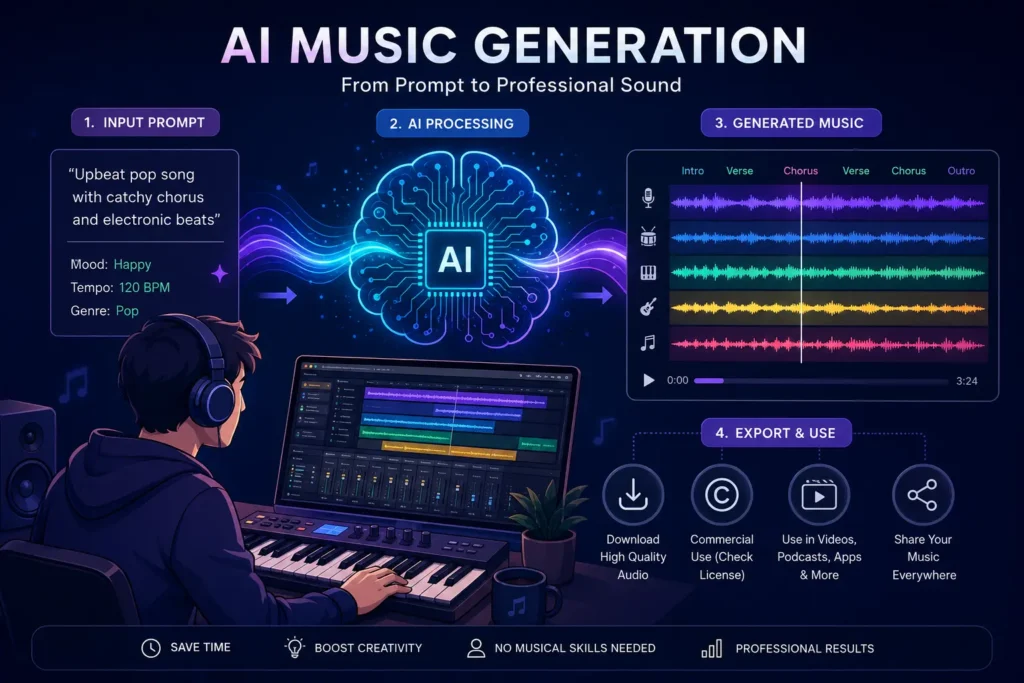
- Over-relying on vague prompts. Generic prompts produce generic music specifying mood, tempo, and reference style dramatically improves results.
- Ignoring editing tools. Many creators regenerate an entire track instead of using section-level editing features that already exist in most modern platforms.
- Choosing a tool based on hype alone. The “best” AI music generator changes depending on whether you need full songs, background loops, or orchestral scoring.
- Skipping platform terms during monetization. Publishing AI-generated music on platforms like YouTube or TikTok without checking licensing can lead to copyright strikes.
Best Practices for Getting Good Results
- Be specific in prompts: describe purpose, mood, tempo, and instrumentation rather than a single vague genre word
- Use section-based editing tools instead of regenerating full tracks from scratch
- Keep a small library of prompts that worked well for your channel or project, and adjust incrementally
- Always verify current commercial licensing terms before publishing or monetizing a track
- Match the tool to the job a background-music generator and a full songwriting tool aren’t interchangeable
Personal Experience: What I’ve Learned Testing These Tools
The first time I tested Suno for a client’s YouTube intro, I expected to generate one track and be done. Instead, it took about a dozen prompt variations before the energy actually matched the video’s pacing the first several attempts sounded technically fine but emotionally flat. That taught me early on that prompt specificity matters just as much in music generation as it does in text generation.
Working with Beatoven for a documentary-style project was a different experience entirely. Instead of one big prompt, we built the score section by section, assigning different moods to different scenes. It took longer than expected, but the final result felt far more intentional than anything a single-prompt tool could produce.
One mistake I made early on and see other people repeat constantly was publishing an AI-generated track commercially without double-checking the platform’s current licensing terms. At the time, the terms were fine, but a few months later that same platform updated its commercial-use policy. Since then, I always screenshot and save licensing terms at the time of publishing, just in case a dispute comes up later. Given how fast this space is moving, this feels less like paranoia and more like basic due diligence at this point.
The biggest shift in my own workflow: I stopped looking for a single “best” tool and started keeping two or three on rotation one for full songs, one for background music, and one for anything requiring a more cinematic feel. Trying to force one tool to do everything usually produces mediocre results across the board.
Frequently Asked Questions
What are the best AI music generation tools in 2026?
There isn’t a single universal answer Suno and Udio are among the best AI music generation tools in 2026 for full songs with vocals, Beatoven and Mubert excel at background and mood-based music, and AIVA is better suited for cinematic or orchestral scoring.
Are AI-generated songs free to use commercially?
Not always. Licensing terms vary by platform and have changed due to ongoing settlements between AI music companies and record labels, so it’s essential to check current terms before monetizing a track.
Can AI music generators create full songs with lyrics?
Yes, tools like Suno and Udio can generate complete songs with vocals, structure, and instrumentation from a text prompt or provided lyrics.
Which AI music tool is best for background music?
Beatoven.ai and Mubert are commonly used for background and mood-based music, especially for video content and podcasts.
Do I need musical experience to use these tools?
No. Most AI music generators are designed for non-musicians, using text prompts rather than requiring instrument or production skills.
Is AI-generated music safe from copyright strikes on YouTube or TikTok?
It depends on the platform’s licensing terms and how the track is used. Always verify commercial-use rights before publishing to avoid copyright issues.
How much do AI music generators typically cost?
Pricing varies widely, from free tiers with limited daily credits to paid plans in the range of a few dollars to around $25 per month for expanded commercial features.
What’s the difference between AI music generation and AI voice cloning tools?
Music generation tools create new instrumentals and vocals from prompts, while voice cloning tools like Kits.ai convert existing vocals into a different voice rather than generating new music from scratch.
Conclusion
The best AI music generation tools in 2026 aren’t defined by a single winner they’re defined by fit. Suno and Udio lead for full song creation, Beatoven and Mubert dominate background and mood-driven use cases, and specialized tools like AIVA and Kits.ai serve very specific creative needs. The real skill now isn’t just picking a tool; it’s learning to prompt effectively, verify licensing terms, and match the right platform to the right project.
If you’re just getting started, pick one full-song generator and one background-music tool, get comfortable with their editing features, and always double-check commercial licensing before publishing anything. For more insights on AI-driven tools and strategies for your business, visit Aisofting.
Disclaimer: AI music tool pricing, features, and licensing terms change frequently. The details in this article reflect information available at the time of writing and should be verified directly on each provider’s official website before making purchasing or commercial-use decisions.