
If you’ve been scrolling through your messages and stumbled upon “js” and had no clue what it means — you’re not alone. Texting slang evolves fast, and keeping up with what people actually mean when they fire off a quick “js” or “js saying” can feel like learning a second language. Whether you’re a parent trying to decode your teenager’s messages, a professional navigating a casual Slack channel, or just someone who got a new phone and suddenly feels behind, this guide has you covered.
Let’s break down exactly what “js” means in text, where it came from, how people use it, and everything else you need to know.
Quick Note: In this article, “JS” refers to its meaning in text messages and online conversations. In programming and technical discussions, “JS” usually stands for JavaScript, so the correct meaning always depends on the context.
What Does JS Mean in Text?
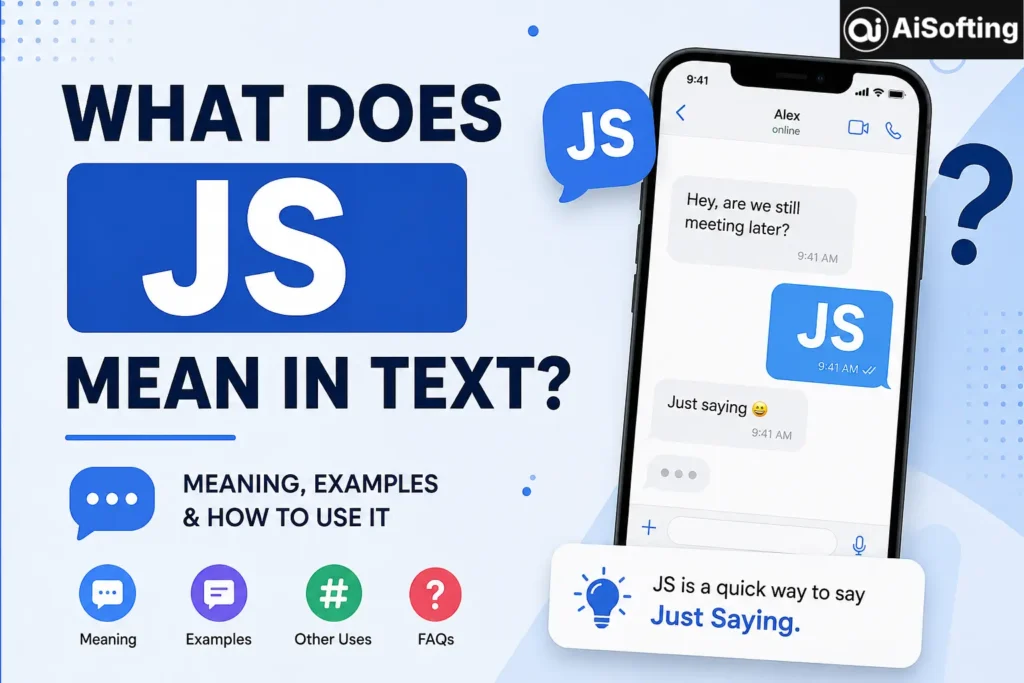
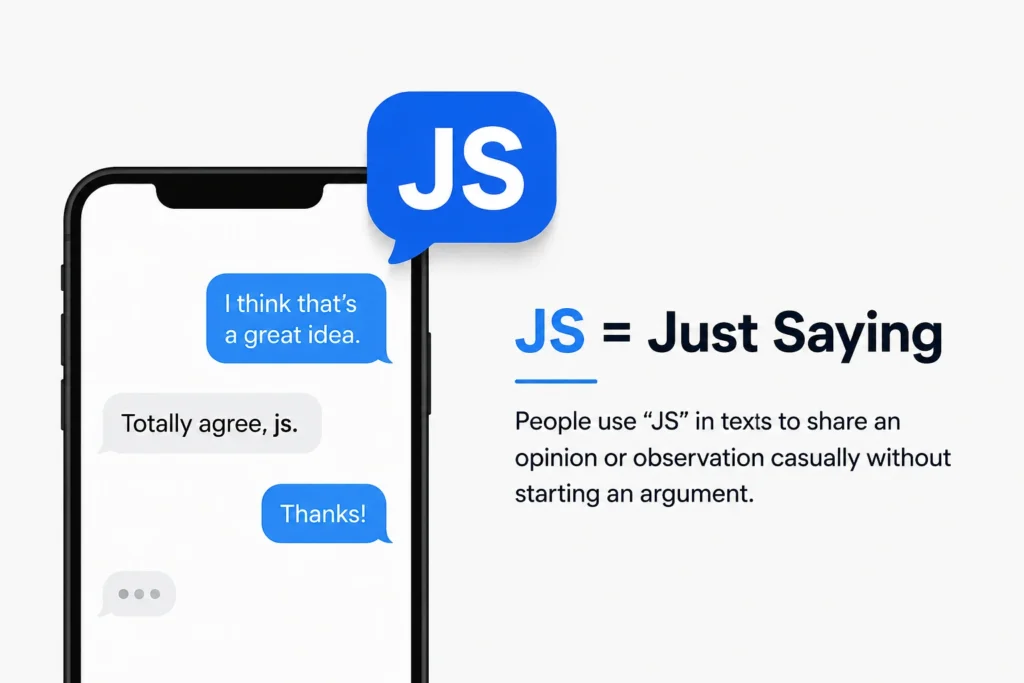
“JS” in text stands for “just saying.” It’s a shorthand phrase people use at the end of a statement to signal that they’re sharing an opinion or observation without wanting to start a fight about it. Think of it as a conversational cushion — a way to say something honest or blunt while softening the landing.
For example:
- “That outfit doesn’t match, js.”
- “You’ve been late three times this week, js.”
- “I think she likes you, js.”
The phrase “just saying” has been part of everyday spoken English for decades. The abbreviated “js” version emerged naturally as texting culture exploded in the 2000s and early 2010s, when character limits and typing on T9 keypads made every letter count.
How Is JS Used in Everyday Texting?
At the End of a Statement
The most common placement for “js” is at the tail end of a sentence. It acts almost like a disclaimer — the speaker is flagging that they’re not trying to argue, they’re just putting something out there.
“Your ex just posted a new photo with someone, js.”
The “js” here tells the recipient: I’m informing you, not stirring drama. It creates plausible deniability while still delivering the message.
As a Standalone Response
Sometimes “js” shows up all on its own after a previous statement:
Person A: “I can’t believe he said that.” Person B: “js”
Here it’s being used to validate without fully committing — it’s the textual equivalent of a shrug and a raised eyebrow.
Combined With Other Slang
You’ll also see “js” layered with other abbreviations, especially in Gen Z and millennial texting:
- “ngl js thought that was weird” (ngl = not gonna lie)
- “idk js seems off to me” (idk = I don’t know)
- “she’s ghosting you js lol”
These combos pack a lot of social nuance into just a few characters.
Other Meanings of JS in Different Contexts
While “just saying” is the dominant meaning in casual text conversations, “js” carries entirely different meanings in other contexts — and mixing them up can lead to real confusion.
JavaScript (Tech Context)
In programming and tech circles, JS almost always refers to JavaScript — the widely-used programming language that powers dynamic behavior on websites. If you’re in a developers’ Discord server or reading a tech forum on MDN Web Docs, “js” is almost certainly shorthand for JavaScript, not “just saying.”
“The bug is in the js file.” “We’re migrating from vanilla js to React.”
JetBlue Airways (Airline Code)
“JS” is also an IATA airline code. In aviation and travel contexts, it identifies North Korea’s Air Koryo. This is a pretty niche usage and unlikely to pop up in your regular text conversations, but worth knowing.
Other Possible Meanings
- Jesus — used in some religious or informal contexts
- Job Seeker — occasionally seen on career platforms or LinkedIn messages
- Junior Specialist — in certain professional or military contexts
Context is everything. If your friend texts “js this is wild,” they mean “just saying.” If your coworker sends “can you check the js file,” they’re talking about JavaScript.
The Tone Behind “JS” — Why Do People Use It?
Softening Bluntness
Human communication is full of what linguists call hedging — softening statements so they land less harshly. “Just saying” is a prime example of this. Saying “you’re being rude, js” still delivers the critique, but the “js” takes some of the edge off. It signals the speaker isn’t looking for a confrontation — they’re just sharing their honest read on the situation.
Maintaining Plausible Deniability
There’s also an element of social self-protection. Dropping “js” after a comment gives the speaker a way out if the other person reacts negatively. They can always follow up with “I’m just saying, don’t take it so seriously” — essentially using the phrase as both the original hedge and the defense for the hedge.
Signaling Casualness
In group chats or with close friends, “js” also functions as a marker of informality. It tells the other person: I’m being real with you right now, in a low-stakes, casual way. It builds conversational intimacy.
JS Across Different Platforms
Snapchat and Instagram DMs
On these platforms, “js” is most common among teenagers and young adults. It’s heavily used in reaction-style messages — someone shares a post, and the reply is “she’s acting weird js.”
Twitter and X
On short-form social platforms, “js” functions more publicly. People use it to voice opinions while maintaining a level of social distance: “this policy is going to fail js.” It’s become almost ironic at times — a way to say something controversial and then pretend it was just an offhand remark.
Discord and Gaming Chats
In gaming communities, “js” floats around both as “just saying” and as JavaScript, depending on the channel. Tech-focused servers lean toward the latter; casual gaming servers lean toward the former.
TikTok Comments
TikTok’s comment culture thrives on slang, and “js” shows up constantly — often piled onto a comment to lend it a breezy, non-aggressive tone while still making a pointed observation.
Personal Experience
I remember the first time I got a text that ended in “js” and completely misread the tone. A friend had sent me something like “you always cancel plans js” and for a solid five minutes I was stewing over it, reading it as passive-aggressive. When I asked what they meant, they laughed — they just wanted to gently mention something without making it a whole conversation.
That moment stuck with me. The same two letters can read completely differently depending on your relationship with the person, the platform you’re on, and your own communication style. I’ve since become much more attuned to how abbreviations like “js” carry emotional weight in digital communication. I’ve seen “js” used genuinely, sarcastically, lovingly, and sometimes as a social hand grenade — all depending on the surrounding context.
What I’ve also noticed is that younger texters tend to pile slang: “ngl js lowkey thought that was cringe lol” is a perfectly normal sentence in certain circles. For anyone new to this landscape, it can feel overwhelming. The key I’ve found is to pay attention to the relationship, not just the words. When you know someone well, you instinctively read the tone behind their “js.” With strangers or acquaintances, it’s always okay to just ask — most people are happy to clarify.
Common Mistakes and Misunderstandings
Mistake 1: Reading “js” as passive-aggressive when it isn’t. Sometimes people are genuinely just sharing a thought. Not every “js” carries hidden sting.
Mistake 2: Using “js” in professional settings. In a formal email or business message, “js” has no place. Save it for casual texts. If you’re writing to a manager or client, spell things out.
Mistake 3: Confusing it with JavaScript in mixed-context conversations. If you’re chatting with someone who works in tech and suddenly they say “js,” double-check the context before assuming it means “just saying.”
Mistake 4: Overusing “js” to soften every opinion. Dropping “js” after every statement makes you come across as non-committal or evasive. Use it sparingly so it retains its impact.
Tips for Using “JS” Effectively in Texts
- Know your audience. Use “js” with friends and family who’ll understand the tone. Avoid it with people you don’t know well.
- Match the platform. Casual social apps? Fine. Professional Slack channels? Skip it.
- Check the context. If you’re discussing a tech topic, clarify what you mean to avoid confusion.
- Don’t hide behind it. If you have something real to say, say it. “Js” works best as a soft nudge, not as a way to dodge accountability for hurtful comments.
Related Internet Slang You Should Know
While you’re brushing up on “js,” here are a few closely related terms that often pop up alongside it:
- NGL — Not gonna lie (similar softening function)
- TBH — To be honest
- IMHO — In my humble opinion
- IDK — I don’t know
- FYI — For your information
- JK — Just kidding (easy to confuse with JS!)
- IJS — I’m just saying (expanded version)
Resources like Merriam-Webster’s slang dictionary and Dictionary.com’s slang section are regularly updated and great for looking up terms you’re not sure about.
FAQs: What Does JS Mean in Text?
Q1: What does “js” mean in texting slang?
“JS” in texting stands for “just saying.” It’s used to share an opinion or observation casually, often to soften a blunt statement or add a light disclaimer.
Q2: Is “js” the same as “jk”?
No. “JK” means “just kidding,” implying something was said in jest. “JS” means “just saying,” implying the statement was sincere but casual. They’re opposite in meaning.
Q3: Can “js” mean something other than “just saying”?
Yes. In programming and tech contexts, “JS” almost universally refers to JavaScript. In certain niche contexts, it may stand for “Jesus” or other terms, but “just saying” is the dominant meaning in personal text conversations.
Q4: Is it rude to say “js” in a text?
Not inherently. The intention behind “js” matters. It can be gentle and friendly, or it can come across as passive-aggressive depending on tone and context. Reading the full message and the relationship is key.
Q5: What does “ijs” mean in texts?
“IJS” means “I’m just saying” — the full phrase abbreviated. It functions the same way as “js” but is slightly more emphatic, because the speaker includes themselves explicitly.
Q6: Do older generations use “js” in texts?
Increasingly, yes. While texting abbreviations like “js” started with younger generations, they’ve gradually entered broader use. Older texters may be less likely to use it, but they encounter it regularly.
Q7: How should I respond when someone texts me “js”?
It depends on the context. If the comment feels sincere and neutral, a simple acknowledgment works. If it feels critical, you might ask them to clarify. Don’t assume negativity unless the rest of the message signals it.
Q8: Is “js” used on social media too?
Absolutely. It appears frequently on Twitter/X, TikTok comments, Instagram DMs, and Discord servers — usually in its “just saying” form on lifestyle platforms and as “JavaScript” on tech-focused platforms.
Q9: What’s the difference between “js” and “tbh”?
“TBH” (to be honest) signals the speaker is about to be straightforwardly candid, sometimes after previously being vague. “JS” (just saying) is more of a soft disclaimer after making a comment. TBH leans into vulnerability; JS leans into casualness.
Q10: Where can I learn more about texting slang?
Sites like Merriam-Webster and Dictionary.com are reliable starting points. Social platforms like TikTok and Reddit are also good for real-time slang observation.
Conclusion: JS Is Simple Once You Know It
At the end of the day, “js” is one of those small but mighty pieces of digital communication shorthand that does a lot of heavy lifting in casual conversation. It tells your reader: I’m being honest with you, but I’m not trying to make a big deal out of it. That blend of candor and casualness is precisely why it’s stuck around.
Whether you’re just encountering “js” for the first time or trying to understand why your teenager keeps dropping it into every other text, the key takeaways are simple:
- In personal texting: JS = just saying
- In tech and programming: JS = JavaScript
- When in doubt: ask — language is always meant to connect, not confuse
Now that you’ve got “js” figured out, you’re one step closer to fluency in the ever-evolving language of digital conversation. And honestly? That’s worth knowing — js.
Visit: Aisofting