If you’ve been tracking keyword rankings diligently and still feel like something’s missing, you’re probably right. The search landscape in 2026 looks radically different from even two years ago. AI-generated answers from Google AI Overviews, ChatGPT, and Perplexity are now how millions of people get information — and your traditional rank tracker has no idea whether your brand appears inside those answers.
That’s the gap Ziptie AI Search Analytics was built to close.
This guide covers exactly what Ziptie AI Search Analytics is, how it works, who it’s for, and whether it’s the right tool for your team — without the marketing fluff that fills most reviews.
What Is Ziptie AI Search Analytics?
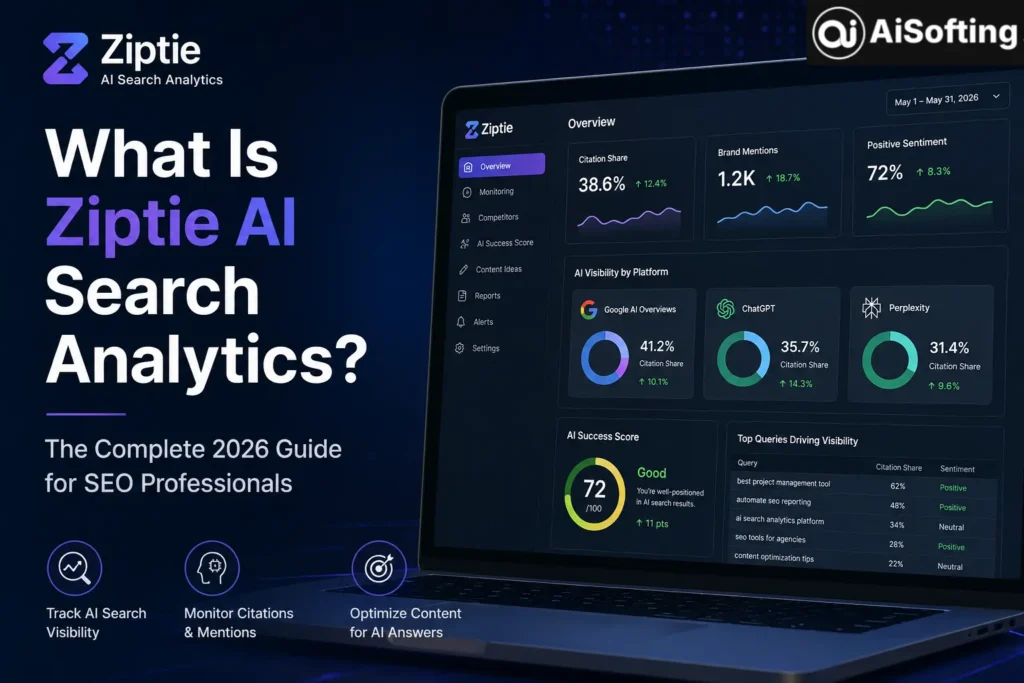
Ziptie AI Search Analytics (available at ziptie.dev) is a cloud-based AI search monitoring and optimization platform that tracks, measures, and helps improve how your brand appears inside AI-generated search results. Specifically, it monitors your brand’s presence across three major AI search engines: Google AI Overviews, ChatGPT, and Perplexity.
Unlike traditional SEO tools that measure keyword positions on a 1–100 scale, Ziptie operates in a fundamentally different paradigm. It tracks whether your brand is cited, mentioned, or recommended when AI systems answer questions in your category — and it quantifies that visibility over time.
The platform was launched by Tomasz Rudzki, Bartosz Góralewicz, and Sebastian Skowron — the team behind Onely, a respected technical SEO agency. That pedigree matters. This wasn’t built by a general SaaS team bolting AI monitoring onto an existing product; it was designed by people who understood search infrastructure deeply before AI answers existed.
Why This Category of Tool Now Exists
To understand what Ziptie does, you first need to understand why traditional analytics can’t do it.
Google Search Console tells you impressions, clicks, and average position for keywords. Google Analytics tells you sessions and conversions. Neither tells you what happens when a user types a question into Google and gets an AI Overview that answers it entirely — without ever clicking a result.
The numbers here are stark. According to Conductor’s analysis of 21.9 million queries, AI Overviews now appear in roughly 25% of all Google searches, up from about 13% in March 2025. BrightEdge puts the figure higher — as much as 48% in certain commercial verticals. Perhaps most sobering: research suggests that being ranked #1 in organic results only earns an AI citation a fraction of the time, with the overlap between Google’s top-10 results and AI citations dropping significantly through 2025 and early 2026.
You can win traditional SEO and still be completely invisible inside the AI answers your potential customers are actually reading.
That’s the problem Ziptie was built to solve.
How Ziptie AI Search Analytics Works
Browser-Accurate Query Simulation
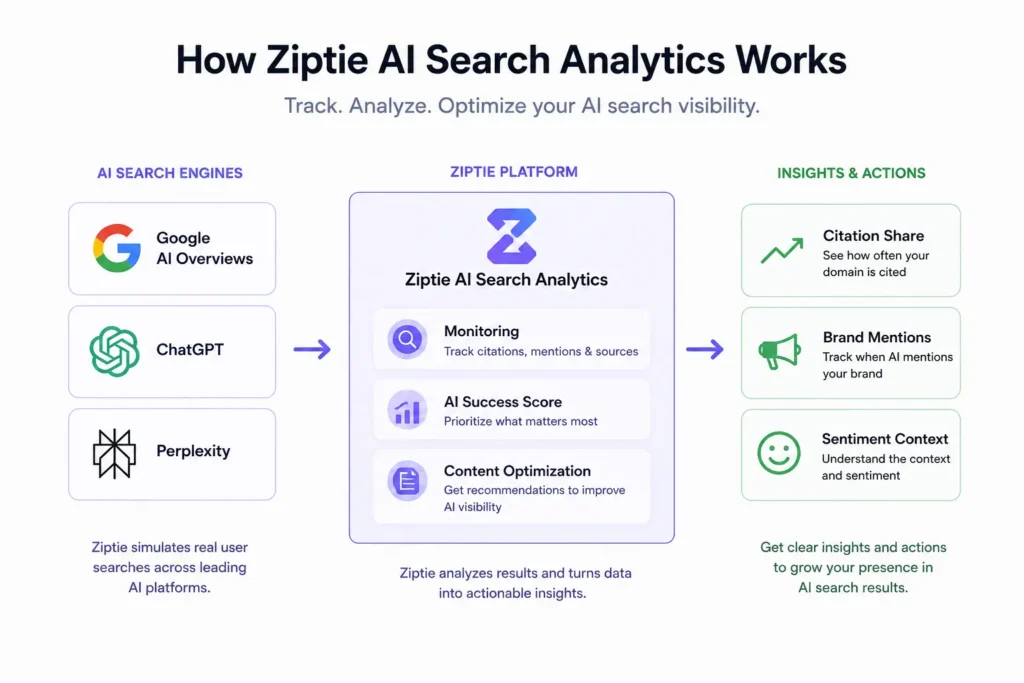
One of Ziptie’s most technically significant features is how it retrieves data. Rather than querying AI platforms through their APIs — which can return different results than what real users see — Ziptie simulates actual user behavior through browser-level interactions. This distinction matters more than it sounds.
API-based tracking tools query the underlying model directly, skipping the rendering and personalization layer where real-user results diverge. Independent testing has found that API-based tools can match manual verification only around 60% of the time. Ziptie’s browser-simulation approach captures what an actual searcher in a given location would see — which is the only visibility that actually matters for brand presence.
The Three Core Modules
Ziptie operates through three interconnected components:
Monitoring — The platform continuously queries AI engines with prompts relevant to your business, category, and competitive landscape. It captures whether your brand is mentioned, whether your domain is cited as a source, and the sentiment context around those mentions.
Prioritization (AI Success Score) — Rather than dumping raw data at you, Ziptie converts findings into a prioritized score that tells you which queries and content areas to focus on first. A Citation Share above 35% in your category is generally considered strong; below 15% signals competitive displacement risk.
Content Optimization — Ziptie doesn’t just report visibility gaps — it tells you what to do about them. The platform generates recommendations around which pages to update, which entities to clarify in your content, which FAQ structures to add, and which external sources to earn citations from.
What Ziptie Actually Measures
Three metrics anchor the platform’s reporting:
Citation Share — The percentage of relevant AI answers in which your domain is cited as a source. This is the metric no traditional SEO tool attempts.
Brand Mentions — When AI refers to your company by name without linking to you. This happens frequently in AI answers and represents real brand presence that analytics tools never capture.
Sentiment Context — Whether AI mentions of your brand are framed positively, neutrally, or negatively. An AI saying “Brand X is a good option but has limited integrations” is worth knowing about, even though it registers as a citation.
Who Actually Uses Ziptie
The platform targets a fairly specific audience, and being honest about that is important.
SEO agencies managing multiple clients find Ziptie useful for building AI visibility reporting into their deliverables — something clients are increasingly asking for. The ability to benchmark a brand against competitors in AI answers gives agencies a differentiated service offering.
In-house SEO and content teams at brands with established organic search programs use it to identify where AI is displacing their traffic and to prioritize content updates accordingly.
Digital marketing consultants who need to demonstrate AI visibility progress to stakeholders benefit from the platform’s dashboarding and export features.
Ziptie is less suited to early-stage businesses that haven’t yet built out their content base, or to teams that need full-spectrum visibility across AI engines beyond the three platforms it currently monitors. As of mid-2026, Ziptie does not track Gemini, Claude, Grok, DeepSeek, Microsoft Copilot, or Google AI Mode — platforms that collectively represent a meaningful and growing share of AI search traffic.
Pricing: What It Costs in 2026
Ziptie’s pricing is structured around accessibility — a deliberate choice given that many competitive tools in this space target enterprise budgets exclusively.
- Starter Plan: $69/month — suitable for small businesses and individual consultants
- Pro Plan: $159/month — for growing teams with broader tracking needs
- Enterprise: Custom pricing for agencies and larger organizations
A 14-day free trial is available, which is genuinely useful for testing whether the platform’s monitoring accurately captures your brand’s AI presence before committing. The platform also tracks AI Overviews across 10 countries, including the UK, Canada, Australia, India, Germany, Spain, and Poland, making it viable for international SEO programs.
What Ziptie Does Well — and Where It Falls Short
Strengths
The platform’s focus is its biggest strength. Unlike general SEO tools that bolted AI monitoring onto existing rank-tracking infrastructure, Ziptie was designed from scratch for this specific problem. That shows in the quality of its citation detection and the thoughtfulness of its prioritization layer.
The browser-accurate detection approach means the data reflects real user experiences, not API-sampled approximations. For an analytics tool where the whole point is knowing what users actually see, this is a meaningful advantage.
Setup is also genuinely straightforward — no code required, integration with existing workflows is clean, and the AI query generator helps teams identify the right prompts to monitor for their specific business.
Limitations Worth Knowing
Platform coverage is the most significant limitation. Three AI search engines — Google AI Overviews, ChatGPT, and Perplexity — cover a large portion of AI search traffic, but not all of it. Teams that need to understand their visibility in Gemini, Copilot, or other platforms will need supplementary tools.
Attribution complexity remains an industry-wide challenge that Ziptie hasn’t fully solved. Some brands with relatively low AI Success Scores see strong referral traffic from AI platforms; others with higher scores see minimal traffic because the AI citations don’t include links or clear calls to action. The relationship between citation metrics and business outcomes still requires correlation with your own analytics stack.
Sentiment nuance in scoring is an acknowledged area for improvement. A moderately critical AI mention — “good option but limited integrations” — can be counted as a citation in ways that slightly flatter overall visibility scores.
Ziptie vs. Traditional SEO Tools: The Fundamental Difference
It’s worth being explicit about what Ziptie is not, because the temptation to frame it as “SEO analytics plus AI stuff” misrepresents the platform.
Traditional rank trackers give you positions 1–100. Ziptie gives you binary citation status (mentioned or not), citation frequency across query variations, sentiment context, and competitive share of voice within AI responses. The data structure is different because the underlying question is different.
You’re not asking “where do I rank for this keyword?” You’re asking “when an AI answers a question in my category, does it recommend me?”
These questions require different data, different tracking infrastructure, and different optimization strategies. Ziptie is a complement to traditional SEO tools, not a replacement. Teams that understand this get more value from both.
My Experience with Ziptie AI Search Analytics
When I first started exploring AI visibility tracking tools in late 2025, my initial skepticism was reasonable — this felt like a category of tool that might be solving a problem before it was truly painful enough for most brands. That skepticism didn’t last long.
The first thing that struck me when working with Ziptie was how clearly it exposed the disconnect between traditional ranking data and AI citation reality. A client with strong rankings for several competitive informational keywords was appearing in AI answers for almost none of them. A competitor with weaker traditional rankings was getting cited in roughly 40% of the relevant AI queries we monitored. That gap would have been completely invisible without a tool like this.
The onboarding experience was better than I expected for a platform in a still-maturing category. The query generation feature — which suggests relevant questions for your business to monitor — saved significant setup time. Most teams I’ve talked to underestimate how many distinct query formulations an AI engine might use to discuss a topic; the tool’s suggestions caught several I wouldn’t have thought to include.
The limitation I kept running into was the platform coverage question. For clients in sectors where Gemini and Copilot are prominent — certain B2B software categories and financial services, in particular — the three-platform monitoring felt incomplete. Ziptie gave a useful partial picture but required supplementary research to fill the gaps. This isn’t a criticism unique to Ziptie; the entire category is still building out coverage, and Ziptie’s data quality within its covered platforms is genuinely strong.
What I came away with most is an appreciation for how much this category of analytics will matter in 18–24 months. The teams building AI visibility programs now — learning how AI engines perceive their content, which entities they associate with their brand, which content structures earn citations — are building a compounding advantage. Ziptie is one of the more credible tools for doing that work systematically rather than through guesswork.
Frequently Asked Questions
What exactly does Ziptie AI Search Analytics track?
Ziptie monitors whether your brand is mentioned or cited in AI-generated answers from Google AI Overviews, ChatGPT, and Perplexity. It tracks citation share (the percentage of relevant AI queries where your domain is cited), brand mentions, and the sentiment context around those mentions.
Is Ziptie a replacement for Google Search Console or traditional SEO tools?
No. Ziptie is a complementary layer that shows you something Google Search Console cannot: how AI search engines perceive and recommend your brand. Traditional SEO tools remain essential for organic traffic analysis; Ziptie fills the AI visibility gap those tools leave.
How does Ziptie’s data collection differ from API-based AI tracking tools?
Ziptie queries AI platforms the same way a real user would, through browser-level simulation rather than direct API calls. This captures the actual responses people see, including personalization and rendering layers that API queries skip. Independent testing suggests API-based tools match real-user results only about 60% of the time.
Which AI platforms does Ziptie monitor?
As of 2026, Ziptie monitors Google AI Overviews, ChatGPT, and Perplexity. It does not currently track Gemini, Microsoft Copilot, Claude, Grok, DeepSeek, or Google AI Mode.
What does a good AI Success Score look like in Ziptie?
A Citation Share above 35% in your niche is generally considered strong competitive positioning. Below 15% signals meaningful risk of competitor displacement in AI-generated answers for your category.
Who built Ziptie and why does that matter?
Ziptie was built by Tomasz Rudzki, Bartosz Góralewicz, and Sebastian Skowron — the founders of Onely, a respected technical SEO agency. Their background in search infrastructure means the platform was designed around how search actually works, rather than how it’s commonly perceived, which contributes to its data accuracy and methodological credibility.
Conclusion: Is Ziptie Worth It?
The answer depends less on Ziptie’s individual features and more on whether your business is ready to take AI search visibility seriously.
If your brand operates in a category where informational queries drive consideration — software, professional services, health, finance, education, B2B products — the shift to AI-generated answers is already affecting your traffic and customer acquisition, whether your analytics show it or not. Ziptie provides the visibility layer to understand and act on that shift.
Key takeaways:
- Ziptie solves a real problem that no traditional SEO tool addresses: understanding whether your brand appears in AI-generated answers
- Its browser-accurate detection approach is technically meaningful — it captures real user experiences, not API approximations
- The Citation Share, Brand Mention, and Sentiment tracking metrics are genuinely novel and actionable
- The platform coverage limitation (three AI engines, not the full landscape) is real and worth factoring into your tool selection
- At $69/month entry pricing with a 14-day trial, the barrier to testing it is low relative to the insight it offers
For teams ready to move beyond traditional rank tracking, Ziptie represents one of the more credible starting points in an emerging but increasingly essential category. For a broader perspective on how AI is changing search behavior, resources like Google Search Central and BrightEdge’s research on AI Overviews offer useful context alongside platform-specific tools. You can also explore Ziptie directly at ziptie.dev.
The brands building AI visibility programs today are not chasing a trend. They’re getting ahead of a structural shift that is already underway.
For more AI-related insights, guides, and the latest technology updates, visit Aisofting