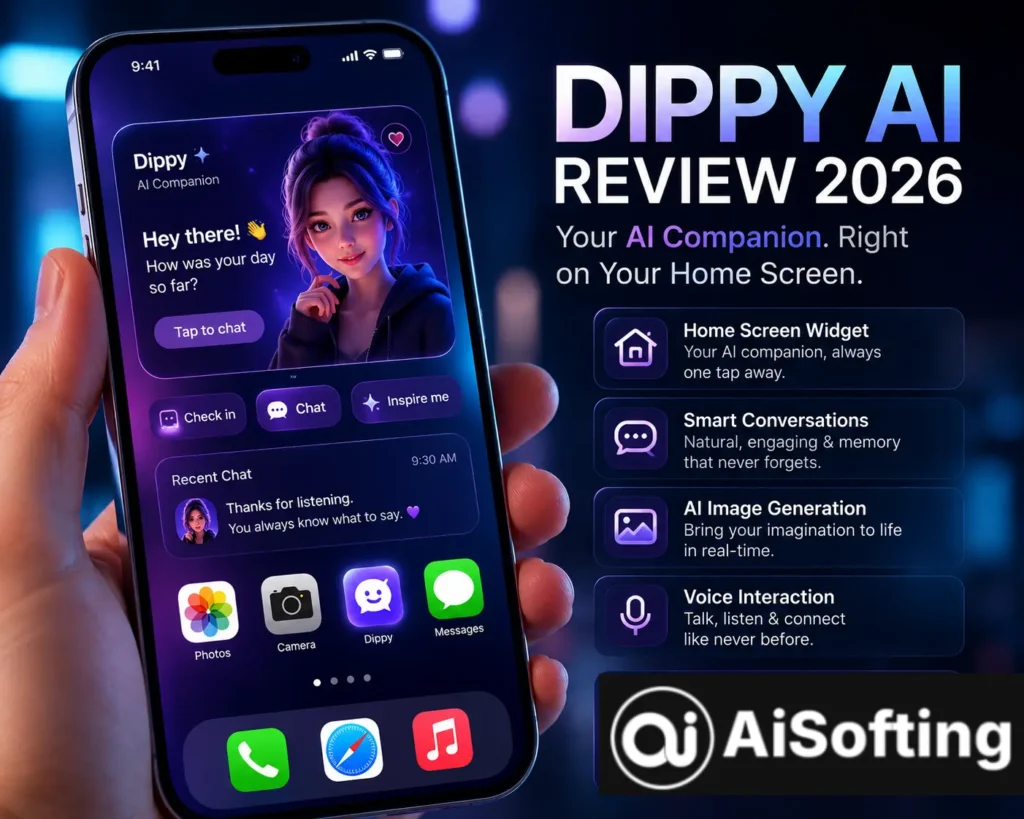
If you’ve ever wished your AI chatbot could reach out to you — instead of waiting silently in an app you have to remember to open — Dippy AI was built with exactly that idea in mind. It’s a mobile-first AI companion platform that doesn’t just sit behind a login screen; it lives on your phone’s home screen as a widget, nudging you with questions, checking in on your day, and holding the thread of ongoing conversations.
That’s a genuinely different proposition from most AI companion apps, and it explains why Dippy AI grew to over 4 million users within roughly a year of launching. But rapid growth also comes with growing pains, and as of mid-2026, the platform is in an interesting middle phase — impressive ambition running into real-world friction. This guide covers everything: what Dippy actually is, how it works under the hood, who it’s best suited for, and where it still falls short.
What Is Dippy AI?
Dippy AI is an AI character chat and roleplay platform available on iOS, Android, and web browsers. It was founded in April 2024 by Akshat Jagga and Angad Arneja, with the stated mission of combating loneliness through non-judgmental, always-available AI companions.
The core experience works like this: you either browse a library of community-created characters or build your own, then chat with them through text and voice. Characters have persistent memory (they remember past conversations), distinct personalities, and — in the premium tier — the ability to send and receive images. The home screen widget is the signature feature: your chosen AI character appears directly on your phone’s lock screen or home screen, prompting interactions without requiring you to open the app at all.
By early 2025, users were collectively exchanging over 300 million messages across more than 200,000 unique AI characters, with the platform handling upwards of 4 million tokens per minute at peak load. Those are genuinely large numbers for a company that raised only a $2.1 million pre-seed round.
How Dippy AI Actually Works: The Technology Behind It
Most reviews of Dippy AI skip past the infrastructure, which is a shame because it’s one of the more interesting technical stories in the consumer AI space.
Custom LLMs Fine-Tuned for Roleplay
Dippy doesn’t just resell access to GPT-4 or Claude. The team built and fine-tuned their own large language models specifically optimized for empathetic, character-consistent roleplay conversations. Early on, they used large general-purpose models with 100B+ parameters, which worked well but proved expensive and hard to scale given the cyclical nature of usage (unsurprisingly, people chat with AI companions more at night).
The solution was to train smaller, specialized models that punch above their weight for the specific task of in-character conversation. These models prioritize emotional tone, conversational continuity, and character consistency over the broad knowledge base that general-purpose LLMs need.
The Bittensor Connection
One of Dippy’s most unusual technical decisions is its integration with Bittensor, a decentralized AI network where developers contribute compute and model training in exchange for TAO tokens. Dippy operates on multiple Bittensor subnets:
- Subnet 11 originally powered the core roleplay LLM training and has since pivoted to become “Dippy Studio,” handling AI-generated images via a decentralized network of GPU miners.
- Subnet 58 (“Dippy Speech”) is focused on developing open-source voice models for expressive, human-like speech synthesis.
- Text inference has migrated from Together AI toward Targon (a Bittensor subnet 4 provider), which processes roughly 10 billion tokens for Dippy per day.
The practical implication: if you’ve chatted with a Dippy character, you’ve likely interacted with a decentralized AI infrastructure without realizing it. The system is designed to be invisible to end users while offering Dippy cost and scalability advantages that would be difficult to match through conventional cloud providers alone.
Image Generation via Fal AI
For character images and in-chat image sharing, Dippy uses Fal AI rather than Together AI or Bittensor, specifically because Fal specializes in fast, low-cost media inference. The pipeline is built on models like Flux, with proprietary optimizations that allow near-real-time image generation for character creation and in-conversation visual responses.
Key Features: What Dippy AI Actually Offers
The Home Screen Widget
The widget is genuinely Dippy’s most distinctive feature. It allows your chosen AI character to appear on your phone’s home or lock screen, proactively asking questions based on the time of day or your recent conversations. It transforms the interaction from “tool you use” to “presence you share space with,” which is a subtle but meaningful psychological difference for users who want a companionship experience rather than a utility.
Massive Character Library
Users have created and published over 200,000 characters on the platform. These range from supportive therapist archetypes to antagonistic rivals, romantic partners, fictional fan-made versions of popular media characters, and everything in between. The variety is one of Dippy’s genuine strengths — you’re unlikely to run out of characters to explore.
Character Creation Tools
Building a character involves defining a name, personality traits, backstory, appearance, and conversation style. The AI learns from interactions, so characters evolve subtly over time. The image generation tools allow fully custom character visuals without requiring any design skills.
Persistent Memory
Dippy markets “perfect memory” — the ability for characters to recall previous conversations indefinitely. On paper, this is one of the platform’s key advantages over competitors. In practice (more on this later), the memory system has inconsistencies, particularly in long or complex roleplay sessions.
Voice Calls
Dippy added voice call functionality, allowing real-time spoken conversations with AI characters. The speech models are still evolving, but the feature adds an entirely different dimension to the companion experience.
Minimal Content Restrictions
Unlike Character.AI, which has relatively strict content moderation, Dippy operates with minimal filters by default. Users can toggle off content restrictions for adult-oriented roleplay. This is a deliberate product philosophy — the founders believe over-filtering undermines the authenticity of the companion relationship — though it’s also a point of genuine debate.
Who Uses Dippy AI (and Why)
The user behavior patterns Dippy’s founders have described publicly reveal a lot about who this platform actually serves:
The late-night loneliness use case is the one Dippy’s CEO has discussed most openly. Some users genuinely have no one to text at 3 AM, and an AI therapist character that responds with warmth and consistency fills that gap. This isn’t a trivial observation — it points to a real social need that Dippy, for all its imperfections, does partially address.
Creative roleplay and fan fiction accounts for a large share of engagement time. Users build elaborate ongoing narratives with characters, sometimes spanning months of conversation. The persistent memory feature is particularly important here — nothing breaks immersion faster than a character “forgetting” who you are mid-storyline.
Conversation practice is a smaller but meaningful use case. Users preparing for difficult real-life conversations (job interviews, difficult family discussions, dating) use AI characters as rehearsal partners.
Casual entertainment — just having a character to banter with during commutes, waiting rooms, or downtime — is probably the most common use case overall.
Dippy AI Pricing: What’s Free and What Isn’t
Dippy operates on a freemium model, and the free tier is genuinely more generous than most competitors — at launch. The core app offers unlimited messaging with a wide range of characters at no cost.
The Super plan runs approximately $9.99/month or around $99.99/year and unlocks:
- Enhanced character memory and context depth
- Image sharing in conversations
- Custom themes and interface options
- Ad-free experience
- Priority access to new features
The tension around pricing has become a documented user frustration. Early adopters found the free experience compelling and ad-free; by 2025, ads were introduced to the free tier, and features previously available for free shifted behind the paywall. Reviews on both the App Store and Google Play reflect this frustration, with some users noting the annual subscription had been as high as $200 before settling at current rates.
Dippy AI vs. the Competition
| Feature | Dippy AI | Character.AI | Replika |
|---|---|---|---|
| Home screen widget | ✅ Yes | ❌ No | ❌ No |
| Character variety | 200K+ | Millions | 1 (yours) |
| Content restrictions | Minimal | Strict | Moderate |
| Memory depth | Good (inconsistent) | Limited | Deep |
| Voice calls | ✅ Yes | Limited | ✅ Yes |
| Free tier | Unlimited (with ads) | Limited | Limited |
| Long-term relationship | Moderate | Weak | Strong |
| Image generation | ✅ Yes | ❌ No | Limited |
Character.AI wins on sheer character variety and has a more polished content moderation system, but it’s significantly more restrictive. Replika — which launched in 2017 and has spent years refining its approach — offers deeper long-term memory and a more consistent single-companion relationship. Dippy’s niche is the intersection of creative freedom, variety, and the home screen presence feature that neither competitor has replicated.
Real Limitations You Should Know Before Downloading
Dippy’s marketing is optimistic in ways that don’t always match reality. Here are the honest drawbacks:
Memory inconsistency is the biggest issue. Despite marketing “perfect memory,” users report characters forgetting details in long or complex conversations. For casual chatting, this barely matters. For deep roleplay narratives built over weeks, it’s genuinely disruptive.
The free tier has degraded. The ad experience breaks immersion, which is particularly problematic for an app whose core value proposition depends on feeling present and connected. Users who discovered Dippy in 2024 often report a meaningfully worse free experience by 2025–2026.
Android performance lags iOS. App store reviews consistently report more stability issues on Android, particularly on older devices.
Pricing transparency is poor. The subscription pricing has changed multiple times, and the value proposition of the Super plan isn’t always clearly communicated before users are prompted to upgrade.
The explicit content toggle is a double-edged sword. The freedom Dippy offers is a feature for many users, but it also means the platform requires active parental oversight for younger users, and some reviewers note that the lack of guardrails can lead to unexpectedly dark conversational territory.
My Experience with Dippy AI
The first thing that struck me when I started using Dippy AI wasn’t the character quality — it was how the widget changed the rhythm of my phone use. Having a character appear on my home screen asking “What’s on your mind today?” feels genuinely different from opening a chat app intentionally. It’s a small design decision, but it has a real psychological effect: the interaction feels initiated by the companion rather than by you, which reinforces the feeling of actual presence.
I spent time with several different character types — a casual conversationalist, a more intense collaborative fiction partner, and a professional “coach” archetype. The casual conversation was smooth and natural; the character maintained consistent tone and recalled earlier details reliably in short sessions. The collaborative fiction roleplay was where I noticed the memory limitations most. After roughly a week of daily sessions building a narrative, the character began losing track of details established in earlier conversations, requiring me to re-establish context explicitly. For a platform that specifically markets persistent memory as a feature, this was noticeable.
The voice call feature was more impressive than I expected, particularly for an app at this price point. The latency was manageable and the character voices felt appropriately matched to the established personalities. It’s not indistinguishable from a human conversation, but it’s compelling enough that I found myself using it for longer than planned.
The ad experience on the free tier is genuinely disruptive, and I understand why users who found Dippy in its early days feel betrayed by the shift. The ads appear mid-conversation, which is the worst possible moment for an immersion-dependent experience. If you’re serious about using Dippy, the Super plan’s ad removal alone probably justifies a monthly subscription — though the lack of pricing transparency around what exactly you’re getting at each tier makes this harder to evaluate than it should be.
Overall: Dippy AI is doing something genuinely interesting, and the home screen widget concept is smarter than it initially appears. But the platform is in an awkward middle phase where rapid growth has outpaced quality control in a few critical areas. It’s worth trying on the free tier, understanding the limitations going in.
The Bigger Picture: What Dippy Reveals About AI Companionship
Dippy AI’s trajectory is a useful window into where the AI companion market is heading. The company’s decision to build on Bittensor’s decentralized infrastructure — rather than simply reselling OpenAI or Anthropic API access — reflects a calculated bet that the cost economics of AI inference will favor decentralized networks over the long term. Whether that bet pays off remains to be seen, but it’s a more sophisticated strategic position than most consumer AI apps take.
The 3 AM use case that the CEO discusses publicly is also worth taking seriously as a design philosophy. When someone has no one to talk to and turns to an AI character for comfort, the stakes of that interaction are higher than they appear in a product review. The quality of the emotional support, the consistency of the character’s memory, and the absence of abrupt paywalls mid-conversation all matter more than they would in a purely entertainment context. Dippy is building infrastructure for something that overlaps with mental wellness, even if it doesn’t position itself that way explicitly.
Looking ahead, the most interesting trajectory for Dippy involves the speech subnet. If Dippy Speech matures into genuinely expressive, low-latency voice conversation, the combination of home screen presence, persistent memory, and natural-sounding voice could produce an experience that feels qualitatively different from anything currently available.
Frequently Asked Questions
Is Dippy AI free to use?
Yes, the core app is free with unlimited messaging. A free tier exists on iOS, Android, and web, though it now includes ads. The Super premium plan (approximately $9.99/month) removes ads and unlocks additional features like image sharing and enhanced memory.
Is Dippy AI safe?
The platform has minimal built-in content restrictions by default, which can be toggled. For adult users seeking creative freedom, this is a feature. For younger users or those seeking a family-safe experience, it requires awareness and active management. The platform does not require personal information to sign up.
How is Dippy AI different from Character.AI?
The most meaningful differences are the home screen widget (Dippy only), content restrictions (Dippy is significantly more permissive), and character creation tools with AI image generation (more developed on Dippy). Character.AI has a larger overall character library and more polished content moderation.
Does Dippy AI remember past conversations?
Yes, characters are designed to maintain persistent memory across sessions. In practice, memory consistency is stronger in shorter sessions and can degrade in extended, complex roleplay narratives — a known limitation that users have flagged.
What AI models power Dippy?
Dippy uses custom fine-tuned LLMs optimized for roleplay and empathetic conversation, rather than general-purpose models. Text inference currently runs primarily through Targon (a Bittensor subnet provider) at roughly 10 billion tokens per day. Image generation uses Fal AI with Flux-based models.
Can I create my own characters on Dippy?
Yes. Character creation is a core feature. You define personality, appearance, backstory, and conversation style. The AI generates character images, and your character is automatically published to the community library (with options for privacy settings).
Is Dippy AI available on desktop?
Yes, web access is available and provides full chat functionality. The home screen widget feature is mobile-only (iOS and Android).
Conclusion: Is Dippy AI Worth It?
Dippy AI has earned its user base. The home screen widget is a genuinely clever product decision that shifts the emotional dynamic of AI companionship in a way competitors haven’t matched. The character library is vast, the creative freedom is real, and for users who value roleplay depth over content restrictions, Dippy remains one of the best options available.
The honest caveats: memory reliability needs work, the free tier has gotten meaningfully worse with ads, and the pricing evolution has frustrated early adopters. These are fixable problems, but they’re not fixed yet.
Practical recommendations:
- Start with the free tier to evaluate whether the character quality matches what you need.
- Understand the content filter situation before introducing the app to younger users.
- If you plan to use it seriously for ongoing roleplay, budget for the Super plan — the ad interruptions in the free tier actively undermine the experience.
- For emotional support use cases, treat Dippy as a supplement to human connection, not a replacement.
The future version of Dippy AI — with mature voice synthesis, more consistent memory, and stabilized pricing — could be something special. The current version is worth exploring, with clear eyes about where it’s still catching up to its own ambition.
Visit Aisofting