Introduction
A few months ago, a client asked me why their organic traffic had dropped almost 30% even though their rankings, according to their tracking tool, hadn’t moved. Same position 3 for their main keyword. Same backlinks. Same content. Just… fewer visitors.
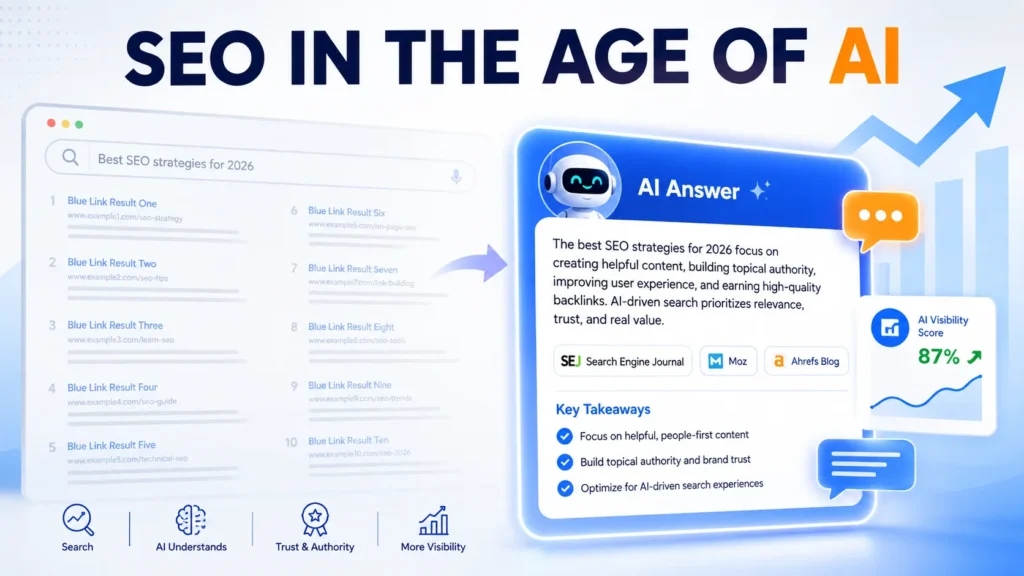
The answer wasn’t a penalty. It was Google answering the question directly on the results page before anyone reached their site. That’s the quiet, unglamorous reality of SEO in 2026: you can win the ranking and still lose the click, because the “search engine” isn’t really a search engine anymore in the way it was five years ago. It’s an answer engine, and increasingly, it’s talking to other AI systems as much as it’s talking to people.
This isn’t the “AI is coming for SEO” article you’ve read a dozen times. I want to walk through what’s concretely different this year — the traffic mechanics behind zero-click search, the rise of a completely new crawler ecosystem that most businesses have never looked at in their server logs, and the practical changes worth making before the next core update catches you off guard.
The Biggest Shift: Search Has Split Into Two Audiences
For twenty years, SEO had one audience: a human typing a query and scanning ten blue links. In 2026, every page you publish effectively has two audiences reading it — the person, and the AI system deciding whether to summarize, cite, or ignore you before that person ever arrives.
Zero-Click Search Is Now the Default, Not the Exception
The numbers here are stark. Roughly 60% of Google searches in 2026 end without a single click to any website, and when an AI Overview appears on the results page, that number climbs as high as 83%. This isn’t a temporary side effect of a new feature — it’s the baseline behavior of search now. Google has been steadily shifting from a system that lists sources to a system that answers questions directly, and AI Overviews are the clearest expression of that shift.
The important nuance most businesses miss: this doesn’t mean visibility stopped mattering. It means visibility and clicks have decoupled. Being cited inside an AI Overview functions more like a trust signal than a traffic source. Data from search visibility studies suggests that sites cited as sources in AI Overviews see roughly 34% higher direct traffic and 28% higher branded search volume within 30 days, even without a corresponding click-through spike — people see the citation, remember the brand, and come back directly later.
Your Site Now Has Non-Human Visitors Worth Optimizing For
Here’s the part almost nobody outside technical SEO circles has internalized yet: bots may already outnumber humans on your website. Web infrastructure data reported publicly in 2026 estimated that automated requests had overtaken human traffic on the open web, with bots generating around 57.5% of HTML traffic. A meaningful share of that isn’t spam — it’s crawlers like GPTBot, ClaudeBot, PerplexityBot, and OAI-SearchBot actively deciding whether and how to represent your business in an AI-generated answer.
That changes what “optimizing a page” even means. You’re no longer just formatting for a person skimming on their phone — you’re formatting for a language model trying to extract a clean, quotable fact from your HTML.
What’s Actually New in 2026 (Not Just Rebranded SEO Advice)
1. Entity SEO Has Overtaken Keyword-First Thinking
AI systems don’t just match strings of text anymore — they map your business as an entity inside a knowledge graph: who you are, what you’re an authority on, and how consistently that identity shows up across the web. This matters because AI models need enough confidence in “who is speaking” before they’ll cite you at all.
Practical entity-SEO moves worth prioritizing:
- Treat your About page as a ranking asset, not boilerplate — AI models increasingly weigh it when assessing authority
- Keep your business name, description, and details identical across your website, Google Business Profile, directories, and social profiles
- Reference your own brand, products, and services with enough context that a model reading the page in isolation still understands who you are
2. llms.txt: A New File Type Businesses Are Quietly Adding
In September 2024, Jeremy Howard of Answer.AI proposed a new convention called llms.txt — a lightweight Markdown file placed at your site’s root, similar in spirit to robots.txt or sitemap.xml, but written specifically for language models instead of search crawlers. It typically includes an H1 with your brand name, a short blockquote describing what the site covers, and a curated list of your most important pages.
Adoption is still genuinely early — by mid-2026, llms.txt implementation had crossed only about 2% of websites, and a large share of existing files were low-effort auto-generated stubs rather than curated documents. No major AI company has officially committed to consuming it as a ranking input. So should you bother? Realistically:
- If you run a documentation-heavy, technical, or content-dense site, it’s worth the hour it takes to build one properly
- For most businesses, treat it as inexpensive hygiene — not a replacement for schema markup, domain authority, or content quality, which still move the needle far more
- The forcing function is valuable on its own: if you can’t summarize your site in 10–30 curated links, your information architecture probably needs a rethink anyway
3. AEO and GEO Are Becoming Their Own Disciplines
Answer Engine Optimization (AEO) and Generative Engine Optimization (GEO) are the terms now used for optimizing specifically for how AI systems summarize and cite content, as distinct from how Google’s traditional algorithm ranks it. In practice the two overlap heavily with good technical SEO, but the emphasis shifts toward:
- Modular content — clear headers, direct answers near the top, and self-contained sections a model can extract without needing the whole page for context
- Structured data — schema markup that gives AI systems machine-readable facts instead of forcing them to infer meaning from prose
- Quotable clarity — short, factual, well-sourced statements that a model can lift cleanly into a summary without distorting the meaning
Common Mistakes Businesses Are Making Right Now
- Optimizing only for rankings, not citations. Ranking #1 no longer guarantees visibility if an AI Overview answers the query before anyone scrolls down.
- Ignoring bot traffic in analytics. Most standard analytics setups undercount or misclassify AI crawler visits entirely, so businesses have no idea how often they’re actually being read by the systems that could cite them.
- Publishing thin AI-generated content at scale. Volume without original data, expertise, or a clear point of view rarely earns a citation — it just adds noise Google’s own quality systems are actively working to suppress.
- Treating AEO/GEO as a separate department from SEO. The overlap is too large to run these as competing strategies; they should share the same content and technical foundation.
- Abandoning long-form or in-depth content entirely. AI Overviews still pull from top-ranking, well-structured pages — thin, overly summarized content performs worse in both traditional and AI-driven search.
Best Practices for Updating Your SEO Strategy in 2026
- Audit for citation-worthiness, not just rank position. Ask whether each page contains something quotable, original, or specific enough that a model would choose to name you as the source.
- Diversify away from search-dependent traffic. Direct traffic channels — email lists, communities, branded apps — are the practical hedge against a search landscape where fewer clicks reach you at all.
- Keep entity signals consistent everywhere, not just on your website.
- Add structured data deliberately, not just because a plugin suggests it — schema is now doing double duty for traditional rich results and AI extraction.
- Monitor AI referral traffic separately from organic search in your analytics, since it behaves differently and often converts differently too.
- Keep testing. The AI search landscape changes fast enough that a tactic validated three months ago may already need revisiting.
Personal Experience: What I’ve Actually Seen Change
I’ll be honest — going into 2026, I assumed AI Overviews would mostly hurt low-authority sites and leave established brands alone. That assumption turned out to be wrong in an interesting way. What I’ve actually observed across a handful of client accounts is that content depth mattered less than content clarity for getting cited. A dense, well-researched 2,500-word article sometimes got skipped entirely in favor of a shorter competitor page that simply stated its key facts in a clean, extractable format near the top.
The other surprise was server-log data. When we started actually segmenting bot traffic instead of ignoring it as noise, one client’s logs showed AI crawler visits had quietly become a meaningful share of total requests — arriving in patterns totally different from human sessions, often hitting the same handful of “explainer” pages repeatedly. That page turned out to be exactly the kind of content getting quoted in AI Overviews for a competitive query, even though it never ranked higher than position five in traditional results. That was the moment “ranking” and “visibility” stopped meaning the same thing to me in practice, not just in theory.
The mistake I made early on was treating this as a technical checklist — add schema, write an llms.txt file, move on. The accounts that actually saw citation gains were the ones where we changed how the content was written: shorter, more declarative sentences near the top of sections, one clear fact per paragraph, and a genuine effort to say something a competitor’s page hadn’t already said. The technical layer opened the door; the writing is still what walked through it.
Frequently Asked Questions
Is traditional SEO still relevant in 2026? Yes. AI Overviews and AI search tools still pull heavily from top-ranking pages, so strong technical SEO, quality content, and authoritative backlinks remain the foundation everything else is built on.
What is Answer Engine Optimization (AEO)? AEO is the practice of optimizing content specifically to be summarized, quoted, or cited by AI systems like Google AI Overviews, ChatGPT, Perplexity, and Claude, rather than optimizing purely for traditional ranking position.
Does my business need an llms.txt file? It depends on your site type. Documentation-heavy or content-dense businesses benefit most. For most businesses it’s a low-cost, low-priority addition — useful but far less impactful than domain authority, structured data, and content quality.
Why is my traffic dropping even though my rankings haven’t changed? This is often caused by zero-click search — your page may still rank well, but an AI Overview or featured answer is satisfying the searcher’s question directly on the results page before they click through.
What is entity SEO? Entity SEO is the practice of helping AI systems and search engines confidently identify your business as a distinct, authoritative “entity” — through consistent branding, detailed About pages, and contextual mentions across the web — rather than relying purely on keyword matching.
Do AI crawlers like GPTBot and ClaudeBot count as real traffic? Not in the traditional sense of visitors who convert, but they’re increasingly important — these crawlers determine whether and how your content gets surfaced in AI-generated answers, which can drive indirect brand visibility and later direct traffic.
How can a small business compete for AI citations against bigger brands? By offering something a larger, more generic competitor page doesn’t: specific data, a clear point of view, or firsthand expertise. AI systems tend to reward citation-worthy specificity over sheer domain size alone.
Should businesses stop investing in long-form content? No — but long-form content now needs a modular structure so AI systems can extract clean, self-contained answers from within it, rather than needing to read the entire piece for context.
Conclusion: Adapt the Strategy, Not Just the Tactics
The core work of SEO — building trust, demonstrating expertise, and genuinely answering what people are asking — hasn’t changed. What’s changed is the audience reading your content first, and the format that earns a citation instead of a scroll-past. Businesses that treat AI Overviews, AEO, and AI crawler traffic as an extension of their existing SEO strategy, rather than a separate fire to put out, are the ones adapting fastest.
Actionable takeaways:
- Audit your top pages for citation-worthiness, not just keyword rank
- Strengthen entity signals: About page depth, cross-platform consistency, structured data
- Segment AI crawler traffic in your analytics instead of ignoring it
- Treat llms.txt as optional hygiene, not a substitute for content quality
- Build direct traffic channels as a hedge against zero-click erosion
- Write in shorter, more declarative, more extractable sections without losing depth
For more on building visibility inside AI-driven search results, see our guide on improving brand visibility in AI search engines, our breakdown of AI search analytics with Ziptie, and our piece on refining AI business context for teams building this into their internal workflow.