If you’ve been researching custom software development, you’ve likely come across the term “software house” used almost interchangeably with “IT company,” “development agency,” or “tech partner.” The terms overlap, but they’re not the same — and the distinction matters enormously when you’re deciding who to trust with your digital product.
This guide breaks down what a software house actually is, how it operates, what separates a great one from a mediocre one, and what you should genuinely know before signing any contract.
What Is a Software House, Really?
A software house is a company whose core business is designing, developing, and delivering software products and solutions for clients — typically on a project or retainer basis. Unlike a freelancer or a generalist IT support firm, a software house maintains an in-house team of engineers, designers, QA specialists, and project managers who collaborate on building digital products from scratch or extending existing systems.
The term is widely used in Europe, South Asia, and the Middle East. In North America, the same entities are often called “software development agencies” or “product studios.” But the model is the same: a structured team building software for businesses that don’t want to — or can’t — build it themselves.
What makes a software house distinct from a simple “coding shop” is the breadth of services it typically covers. A genuine software house handles the full lifecycle: discovery and requirement analysis, UI/UX design, frontend and backend engineering, quality assurance, deployment, and post-launch support. The output isn’t just code — it’s a functioning, tested, maintainable product.
The Services a Modern Software House Actually Provides
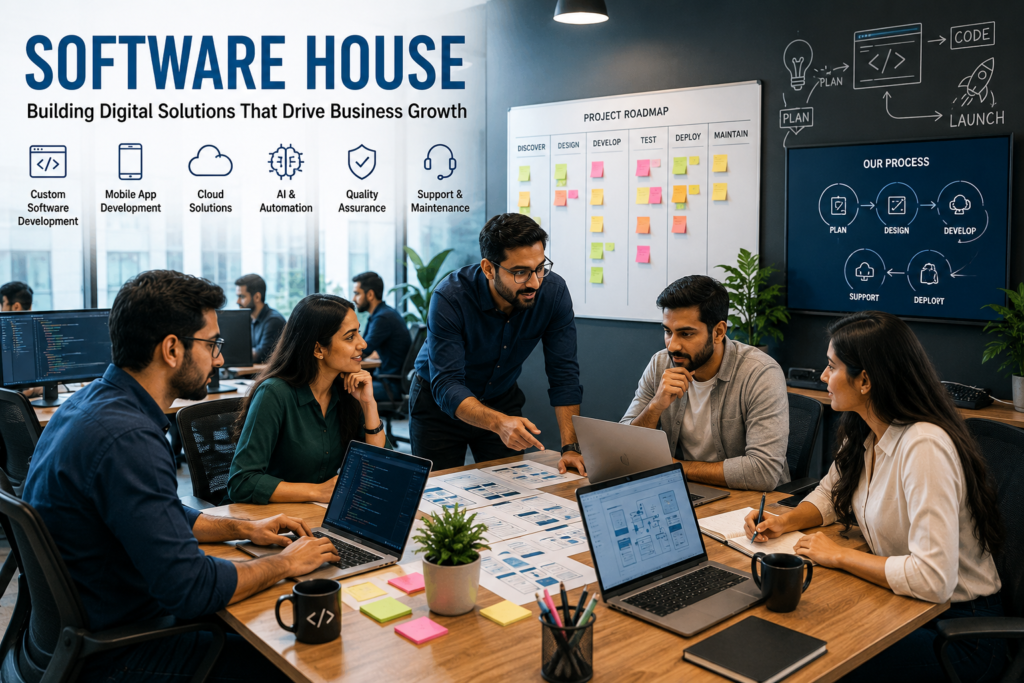
Here’s how a modern software house team collaborates across design, development, and project management:

Not every software house is built the same way. Some specialize vertically (healthtech, fintech, logistics). Others go horizontal, serving any industry but focusing on specific technologies like mobile development, cloud engineering, or AI integration.
The core service categories you’ll typically find include:
Custom Software Development — Building applications tailored to your exact business processes. This is the bread and butter of any software house, and the quality here reflects the firm’s overall maturity.
Web Application Development — Full-stack web apps, SaaS platforms, portals, and dashboards. Frameworks like React, Next.js, Django, Laravel, and Node.js come up most frequently in modern stacks.
Mobile App Development — Native iOS and Android development, or cross-platform builds using Flutter or React Native. The right choice depends on your audience and performance requirements.
AI and Automation Solutions — This is where things have shifted dramatically in recent years. Software houses are increasingly embedding machine learning models, large language model integrations, and intelligent process automation into client products. It’s no longer a specialty niche — it’s becoming a baseline expectation. Firms like AISofting have made this a core offering rather than an add-on, which is increasingly the right approach for any business serious about building intelligent software.
UI/UX Design — A competent software house doesn’t just write code; it thinks about the person using the product. UX research, wireframing, prototyping, and usability testing are part of the professional standard.
Quality Assurance and Testing — Manual and automated testing to ensure the product works correctly before it touches real users. Often underestimated by clients, and often where corners get cut at weaker firms.
DevOps and Cloud Infrastructure — Deployment pipelines, CI/CD, containerization with Docker and Kubernetes, and cloud setup on AWS, Google Cloud, or Azure.
Why Businesses Hire a Software House Instead of Building In-House
The build vs. buy vs. outsource decision is one of the most consequential choices a business makes. For most small to mid-sized companies, building a full internal engineering team is expensive, slow, and distracting from the core business. Hiring ten engineers in-house might take 12–18 months and require HR, management overhead, and a dedicated technical leader to keep the team functioning.
A software house compresses that timeline dramatically. You get access to a pre-formed team that already knows how to work together, has established processes, and has likely solved similar problems before.
There’s also the flexibility argument. When your product needs more backend work one quarter and more mobile development the next, an internal team is structurally rigid. A software house can scale the right skills up or down based on your actual roadmap.
That said, outsourcing isn’t always the answer. If software is your core product and your competitive moat is in how you build it, an internal team with deep institutional knowledge often wins in the long run. The best software houses are honest about this tradeoff rather than overselling outsourcing as universally superior.
How to Evaluate a Software House (Without Getting Burned)

The market is saturated. There are thousands of software houses globally, ranging from world-class to outright fraudulent. The signals that actually matter:
Portfolio Depth vs. Breadth
Look beyond the case study landing pages. Ask to speak with a previous client directly. Ask what went wrong on a project, not just what went right. A firm that can articulate past failures and what they learned from them is a firm that actually reflects on its work.
Technical Communication Quality
How a software house communicates before you hire them tells you everything about how they’ll communicate after. Are their project managers technically literate? Can they explain architectural decisions in plain language? Do they push back when your requirements are vague or contradictory — or do they just say yes to everything?
Team Stability and Structure
High developer turnover is a risk that almost never shows up in sales conversations. Ask about average team tenure. Ask whether your project will be handed off mid-build. Ask if the senior developer in the proposal is actually the person who’ll work on your project, or just someone there to close the deal.
Engagement Model Fit
Fixed-price contracts feel safe but create misaligned incentives — the software house optimizes for minimum viable delivery to protect margin. Time-and-materials (T&M) or dedicated team models give you more flexibility and transparency, but require more active client involvement. Neither is inherently better; the right model depends on how clearly you can define requirements upfront.
The AI Shift: What It Means for Software Houses Right Now
The software development industry is in the middle of a structural shift that’s bigger than any previous technology cycle. AI coding assistants, automated testing tools, and generative design platforms are changing what it means to build software — and changing it fast.
For software houses, this creates both pressure and opportunity. Firms that integrate AI into their development workflow can deliver faster, catch more bugs, and reduce repetitive work. Those that don’t are already starting to look slow by comparison.
For clients, this shift means two things. First, you should ask any software house you’re evaluating how they’re using AI internally. A firm that has no answer, or gives a vague one, may already be falling behind. Second, AI-assisted development is increasingly accessible — which raises the bar for what a professional software house needs to offer beyond raw code generation.
The firms that will lead in the next five years are those that combine AI fluency with genuine domain expertise, strong communication practices, and the ability to manage complex, long-running product relationships. Speed is no longer the differentiator it once was. Judgment is.
Teams like AISofting are already building this model — combining traditional software engineering with AI-native development capabilities to deliver products that are smarter from the ground up, not just faster to ship.
Common Misconceptions About Software Houses
“A bigger firm is a safer bet.” Not necessarily. Large software companies often assign junior teams to mid-sized client projects while the senior talent works on flagship accounts. A focused, mid-sized software house with the right specialization can outperform a 500-person agency.
“Cheap offshore development is always a risk.” Location isn’t the variable that matters most. Process maturity, communication norms, and technical leadership matter far more. Some of the highest-quality software development teams in the world operate out of Pakistan, Poland, Ukraine, India, and Vietnam. The rate difference compared to US or UK firms can be 3–5x, and the quality gap — when the firm is well-selected — is often minimal.
“I need to have a full spec before I approach a software house.” A good software house will help you define your requirements through a discovery phase. Coming in with a rough problem statement and business goals is completely legitimate. In fact, firms that want a complete spec before they’ll engage often lack the product thinking skills to be genuinely useful.
My Experience with Software Houses
Working closely with software development companies over the years, a few truths become clear that you won’t often read in polished marketing copy.
The first is that the proposal phase and the delivery phase are almost always run by different people. Sales teams are skilled at presenting the company’s best work and most experienced engineers. But once the contract is signed, the day-to-day work is handled by a project team that may have had no involvement in the sale. I’ve seen this disconnect cause serious friction — not because the delivery team was incompetent, but because expectations set during the proposal didn’t translate cleanly into the project brief.
The second insight is about communication cadence. Software houses that run weekly video check-ins, share live staging environments, and make their project boards visible to clients consistently deliver better outcomes — not because transparency magically fixes technical problems, but because it surfaces misalignment early, before it compounds into expensive rework. The firms that send monthly email updates and “just trust the process” are almost always the ones where the final product diverges most from the original vision.
The third thing I’d flag is the discovery phase question. A software house that skips a formal discovery engagement — even a short one — and jumps straight into development is telling you something about how they work. Discovery isn’t just about gathering requirements. It’s where a capable team challenges your assumptions, identifies risks you hadn’t considered, and builds a shared mental model of what success looks like. Teams that skip it usually end up building the wrong thing well.
Finally, and perhaps most importantly: the best software houses operate more like product partners than service vendors. They hire people who are curious about your business, not just your technical requirements. That distinction is subtle but it compounds over time into dramatically better products.
Frequently Asked Questions
What is the difference between a software house and a software company?
A software company typically builds and sells its own products (like Microsoft or Salesforce). A software house builds custom software for client businesses. The software house owns the development process; the client owns the resulting product.
How much does it cost to hire a software house?
Costs vary widely based on team location, project complexity, and engagement model. A basic web application might run from $15,000 to $50,000. Enterprise-grade platforms or AI-integrated systems can reach $200,000 or more. Rates in South Asia and Eastern Europe are typically 40–70% lower than US or UK rates for comparable quality.
How long does it take a software house to build an app?
A minimum viable product (MVP) typically takes 3–6 months, depending on feature scope. A production-ready, fully tested application with multiple integrations may take 9–18 months. Be cautious of firms that promise unusually short timelines without a clear explanation of how they’ll achieve them.
Can a software house help with AI features in my product?
Yes, many modern software houses offer AI integration services — including LLM integration, recommendation engines, intelligent automation, and computer vision. Ask specifically about their AI experience and request examples of deployed AI features in live products.
What should I look for in a software house portfolio?
Look for industry relevance, technical complexity comparable to your project, and evidence of long-term client relationships. Case studies that show challenges and solutions — not just glossy screenshots — are a better indicator of real capability.
Is it better to hire a local software house or an offshore one?
There’s no universal answer. Local firms offer easier communication and timezone alignment. Offshore firms often provide cost advantages without sacrificing quality, provided you manage communication and expectations carefully. Hybrid models — where a local project manager oversees an offshore delivery team — are increasingly common.
What questions should I ask a software house before hiring them?
Ask about their discovery process, typical team structure for projects like yours, how they handle scope changes, what happens if a key developer leaves mid-project, and whether you can speak with a reference client. Also ask how they’re incorporating AI into their development workflow — the answer reveals a lot about their current maturity.
Conclusion: Choosing a Software House That’s Actually a Partner
The software house industry has matured enormously over the past decade. The era of sending requirements to a distant team and hoping for the best is giving way to collaborative, iterative, AI-augmented development practices that keep clients close to the process at every stage.
If you’re evaluating a software house, prioritize communication transparency and project methodology over price. Look for a team that challenges your assumptions, has a credible portfolio in your domain, and can articulate how they work — not just what they’ve built.
The right software house isn’t just a vendor executing your vision. It’s a team that helps you refine that vision, builds it intelligently, and supports it long after launch. That kind of partner is worth taking your time to find.
For businesses looking to explore AI-powered software development with a team that treats your project as a genuine long-term investment, AISofting offers end-to-end development services across web, mobile, and AI integration — with a focus on building products that scale.
For further reading on software project delivery standards and best practices, the Project Management Institute is one of the most respected independent resources available.